
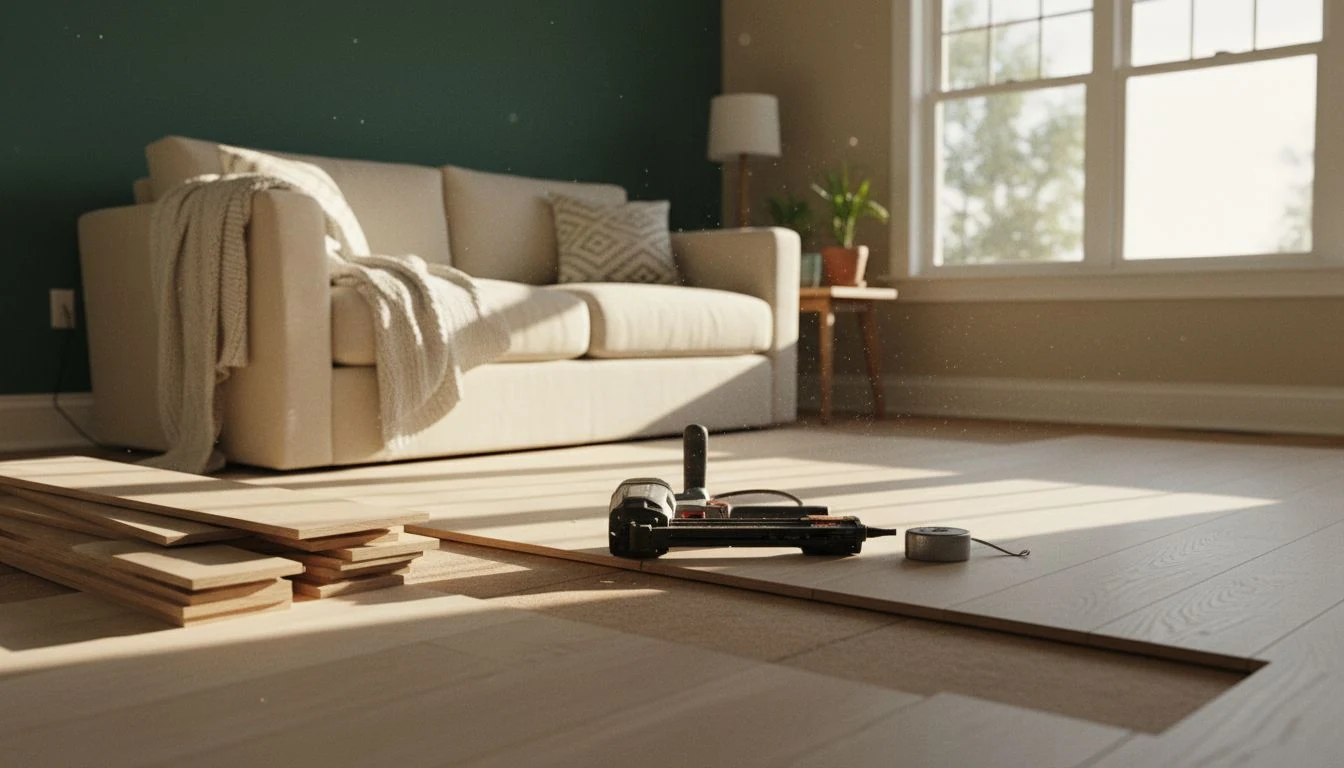
I got three quotes to put oak down on the main floor of my fixer-upper, about 600 square feet, and they came back at $5,400, $7,800, and $9,900. Same rooms. Same wood, more or less. I almost signed the $5,400 one on the spot, because that is what you do when a number looks like a gift. Then I read the fine print and found out it didn’t include leveling my very un-level subfloor, and the “real” price was closer to $6,800. That gap is exactly why I write these guides.
Here is the honest version before the tables. The hardwood floor installation cost in 2026 runs about $6 to $25 per square foot installed, materials and labor together, with most normal homes landing between $10 and $16 per square foot. A 1,000-square-foot floor usually costs $10,000 to $16,000. Budget jobs in plain oak come in around $6 to $10 a foot. Wide-plank, exotic, or fancy-pattern floors push past $20. Below I break it down per square foot, by wood type, by room size, and by the line items that never make it onto the cheap quote, so you can build your own number before anyone hands you a “gift.”
What does hardwood floor installation cost in 2026?
As of mid-2026, the national average to install hardwood lands around $13 to $17 per square foot installed. That is the all-in number: the wood, the labor, the basic prep, the finishing. On a typical job, the wood itself is only 30 to 50 percent of what you pay. The other 50 to 70 percent is labor and everything around the labor, which is the part people forget when they price a floor by looking at a box of planks at the store.
Here is the fastest way to think about it by quality tier.
| Install level | What you get | 2026 cost per sq ft installed |
|---|---|---|
| Budget | Basic red oak, simple rectangular rooms, minimal subfloor prep | $6 to $10 |
| Mid-range (most homes) | White oak or maple, standard prep, trims and transitions | $10 to $16 |
| Premium | Wide planks, exotic species, patterns, heavy prep, stairs | $16 to $25+ |
My 600-foot floor was a mid-range job that one guy tried to price like a budget one. The tell was the subfloor line. A real quote tells you what they’re doing about your subfloor before they lay a single board. A hopeful quote leaves it blank and hits you with a change order on day two.
Hardwood floor installation cost per square foot
Per square foot is the only way to compare quotes that makes any sense, because a 200-square-foot bedroom and a 1,400-square-foot main level are not the same job even when they’re the same wood. Break the per-foot price into its two real halves and you can sanity-check anyone’s number.
Materials run $3 to $15 per square foot depending on the species and the plank. Labor runs $3 to $8 per square foot for a standard nail-down or glue-down install. A normal installed price of $10 to $16 is roughly half wood, half hands. When a quote is way under that, someone is either using a cheaper board than you think or skipping prep you’ll pay for later. When it’s way over, ask what the wide planks, the patterns, or the stairs are adding, because something specific is driving it.
One thing I wish I’d known: prefinished planks (sanded and sealed at the factory) install faster and cost less in labor than site-finished floors that get sanded and coated in your house. Site-finished hides the board seams better and lets you pick the exact stain, but you’re paying for extra days, and you’re living somewhere else while the fumes clear. I went site-finished in one room to match an old floor and underestimated the four days of dust by a country mile.
Solid vs engineered hardwood: what each one costs
This is the choice that quietly decides a third of your bill, so don’t let an installer rush you past it. Solid hardwood is one piece of wood all the way through. Engineered is a real-wood top layer bonded over plywood-style core layers. Both are real wood underfoot. They behave very differently with moisture and they price differently.
| Type | 2026 installed cost per sq ft | Best for |
|---|---|---|
| Solid hardwood | $11 to $25 | Main and upper floors; refinish many times; lasts decades |
| Engineered hardwood | $9 to $20 | Basements, concrete, below grade, humid rooms; faster floating install |
Here is the mistake I watched a friend make so you don’t have to. She put solid oak in a walk-out basement family room because it was a few dollars cheaper than the engineered she’d been quoted. First humid summer, the boards cupped along every seam. She paid twice. Below grade or over concrete, engineered wins almost every time, and the slightly lower price is a bonus, not the reason. If you want the full picture of where flooring sits against a whole project, I mapped that in my guide to real home renovation costs.
Hardwood floor installation cost by wood species
The species you pick sets the material half of your bill. These are 2026 material prices per square foot, before labor. Add roughly $3 to $8 a foot for installation on top of any of them.
| Species | Material per sq ft | The look |
|---|---|---|
| Red oak | $3 to $6 | The classic budget pick; warm, forgiving grain that hides dings |
| White oak | $4 to $7 | Neutral, tighter grain; the one every designer wants right now |
| Maple | $6 to $9 | Hard, fine grain, clean and contemporary; shows scratches more |
| Hickory | $5 to $9 | The hardest common domestic wood; busy, rustic character |
| Walnut | $8 to $14 | Rich chocolate tones; soft underfoot and unmistakably premium |
I went red oak for the main floor and I’d do it again. White oak is beautiful and I get why it’s everywhere, but on a real budget the $1 to $2 a foot difference times a thousand feet is a whole appliance. If your heart is set on a pricier species, put it in the one room people actually see and use a cheaper match in the bedrooms. Nobody is grading the floor under your bed.
Hardwood floor installation cost by room size
Once you know your per-foot price, total cost is just math. Here is what a mid-grade installed floor (think white oak, standard prep) costs at common sizes in 2026.
| Space | Square feet | Typical 2026 installed cost |
|---|---|---|
| Single bedroom | 200 sq ft | $2,000 to $3,200 |
| Average living room | 350 sq ft | $3,500 to $5,600 |
| Whole main floor | 1,000 sq ft | $10,000 to $16,000 |
| Larger open layout | 1,500 sq ft | $15,000 to $24,000 |
Measure your actual square footage and add about 7 to 10 percent for waste and cuts. Pros build that into their estimate, but if you’re buying the wood yourself, the box that runs short on the last afternoon is the most expensive box you’ll ever buy. Ask me how I know.
The hidden costs nobody puts on the quote
This is where my $5,400 “deal” turned into $6,800, and it’s where most floor budgets blow up. None of this is shady on its own. It only becomes a problem when an installer leaves it off to win the bid and bills it later. Read every quote looking for these:
- Old flooring removal and disposal: $1 to $4 per square foot. Tearing out tile or glued-down vinyl costs more than pulling up carpet.
- Subfloor leveling or repair: $2 to $8 per square foot where it’s needed. This was my surprise. Wood floors telegraph every dip, so a wavy subfloor has to be fixed or your new floor squeaks and gaps.
- Moisture barrier and underlayment: $0.30 to $1.50 per square foot, and non-negotiable over concrete.
- Stairs: $40 to $100+ per step, finished. Stairs are slow, fussy work and they add up fast.
- Trim, transitions, and door-jamb cuts: small line items individually, real money across a whole house.
- Moving furniture and pulling baseboards: sometimes included, sometimes not. Ask.
The fix is simple. Before you compare prices, make every installer quote the same scope in writing, including subfloor prep and removal. The cheapest bid that skips leveling isn’t cheaper. It’s just quoting a different, smaller job. That same instinct runs through my whole checklist on whether a contractor quote is fair.
Grab my free Project Cost Estimator
I put every line on this page, with its 2026 price range and a DIY-or-pay-for-it tag, onto one printable sheet. Print it, fill in your square footage, species, and prep, and you’ll have a real flooring number before you call a single installer. No fluff, no upsell.
Where you can lower your hardwood floor installation cost (and where you shouldn’t)
You can shave real money off a floor without buying a worse one. Smart places to save: pick red or white oak over an exotic species, choose prefinished over site-finished to cut labor days, do your own demo and furniture moving if you’re able, and floor the high-traffic rooms in nicer wood while using a budget match in bedrooms. Buying your own material from a flooring outlet and paying a pro labor-only can cut a chunk too, as long as you order enough.
Where you should not cheap out: subfloor prep, moisture barrier over concrete, and the installer’s experience. A botched nail-down floor that squeaks and gaps is a daily reminder you have to walk on, and fixing it means pulling up the floor you just paid for. The National Wood Flooring Association keeps a directory of certified pros, and on a five-figure floor it’s worth using a vetted installer rather than the cheapest truck that answered. You can find certified installers through the National Wood Flooring Association. If you’re choosing engineered, check the formaldehyde emissions label, because compliant products are regulated for a reason, per the U.S. Environmental Protection Agency.
Is hardwood flooring worth the cost?
Money-wise, hardwood is one of the better dollar-for-dollar upgrades in a house. It recoups roughly 70 to 80 percent of its cost at resale and, more to the point, buyers look for it, which carpet and most vinyl can’t claim. A solid floor also lasts decades and can be sanded and refinished several times, so the cost spreads out over a very long life.
My take? If you’re staying put and you’ll feel it underfoot every day, real wood is worth the stretch in the rooms you live in. If you’re flooring a basement, a rental, or anything below grade, go engineered and don’t lose sleep over it. The fanciest solid oak in the wrong room is just expensive regret, and I’ve watched that movie. For how flooring stacks up against every other line in the house, I keep a running tally in my home improvement cost statistics roundup.
The long-term cost of owning each hardwood floor type
The install quote is only the start of your hardwood floor installation cost — what you pay over the years to keep it looking good matters just as much. Here’s how the common floor types compare on upkeep and lifespan.
| Floor type | Refinish cycle | Refinishes possible | Realistic lifespan |
|---|---|---|---|
| Solid hardwood (3/4″) | Every 7–10 yrs | 5–8 times | 50–100 yrs |
| Engineered (thick wear layer) | Every 10–15 yrs | 2–4 times | 30–40 yrs |
| Engineered (thin wear layer) | Sand-and-screen only | 0–1 time | 15–25 yrs |
| Prefinished solid | Every 10–12 yrs | 4–6 times | 40–80 yrs |
The mistakes that cost you twice
- Buying a thin-wear-layer engineered floor to save upfront. If it can’t be sanded, the first deep scratch means full replacement, not a cheap refinish.
- Skipping felt pads and rugs. Surface wear you could’ve prevented forces an early refinish — a few hundred dollars in protection saves a sanding cycle.
- Refinishing too aggressively. Sanding deeper than needed eats your board thickness and steals future refinishes you paid for.
Plenty of people price hardwood and then land on something softer for the bedrooms. If that’s you, here’s what carpet installation costs in 2026.
Hardwood over a basement slab needs a moisture strategy, and sometimes the slab itself is the finished floor. Either way, see what a concrete floor costs to install and level.
FAQ
How much does hardwood floor installation cost in 2026?
The hardwood floor installation cost in 2026 runs about $6 to $25 per square foot installed, materials and labor together, with most homes landing between $10 and $16 per square foot. A 1,000-square-foot floor typically costs $10,000 to $16,000. Budget oak jobs come in near $6 to $10 a foot, while wide-plank or exotic floors push past $20.
Is engineered hardwood cheaper than solid hardwood?
Usually, yes. Engineered hardwood runs about $9 to $20 per square foot installed versus $11 to $25 for solid. Beyond price, engineered handles moisture far better, so it’s the right call for basements, concrete slabs, and below-grade rooms where solid wood can cup and warp.
What is the labor cost to install hardwood floors?
Labor alone runs about $3 to $8 per square foot for a standard nail-down or glue-down install, which is roughly half of a typical installed price. Stairs, intricate patterns, site-finishing, and heavy subfloor prep push labor toward the high end.
What hidden costs should I watch for in a flooring quote?
The big ones are old-flooring removal ($1 to $4 per sq ft), subfloor leveling ($2 to $8 per sq ft where needed), moisture barrier and underlayment ($0.30 to $1.50 per sq ft), stairs ($40 to $100+ per step), and trim and transitions. Make every installer quote the same scope in writing so a low bid isn’t just skipping prep.
Does hardwood flooring add value to a home?
Yes. Hardwood recoups roughly 70 to 80 percent of its cost at resale and is something buyers specifically look for. A solid floor can also be refinished multiple times over decades, so the upfront cost spreads across a very long lifespan.
Prices in this guide are 2026 national estimates and vary a lot by region, wood species, room size, subfloor condition, and how busy installers are in your area. Treat them as a starting point for building and comparing your own numbers, not exact figures.
Free DIY Project Cost Estimator
The spreadsheet I use to price out a project before I start, so a weekend job never blows the budget. Join the newsletter and I’ll send it over.
No spam, ever. Unsubscribe anytime. — Tessa
Keep reading — more on Flooring & Tile Costs
How Much Does Epoxy Floor Installation Cost in 2026? (I Paid Twice)
The kit came in a box with a picture of a showroom floor on it. I…
Read article →
How Much Does Concrete Floor Installation Cost in 2026?
We pulled up the ruined carpet in the basement and there it was: a bare gray…
Read article →
How Much Does Carpet Installation Cost in 2026? (By Room, Fiber + DIY vs. Pro)
Three installers walked my upstairs hallway with the same laser measure, wrote down the same 620…
Read article →
How Much Does Laminate Flooring Installation Cost in 2026?
The first quote I got for laminate in my hallway and two bedrooms was $4,900, and…
Read article →