
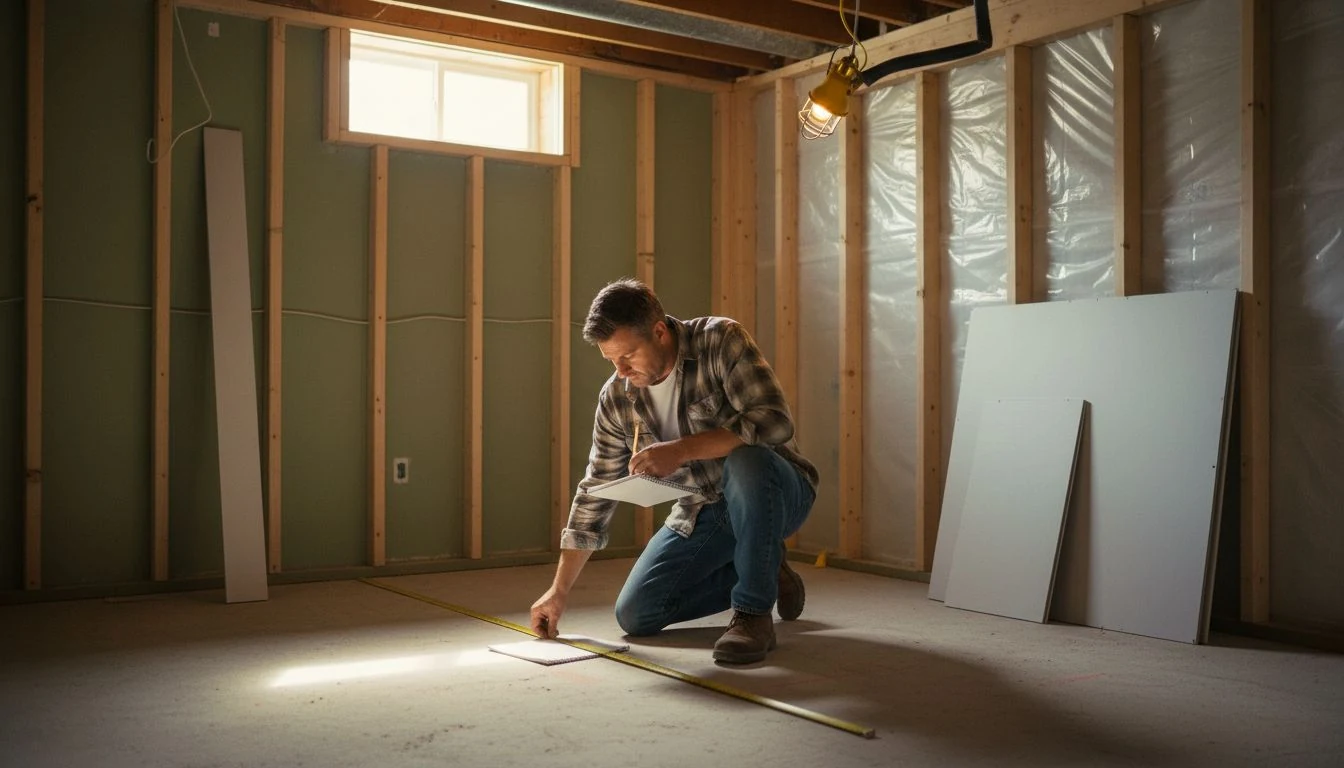
The first contractor who walked my basement quoted $58,000 to finish about 900 square feet. No bathroom. No fancy wet bar. Just walls, a ceiling, some lights, and floor. I stood there nodding like I understood the number, then spent the next two weeks figuring out whether he was fair or just hoping I wouldn’t check. He wasn’t fair. Not even close.
So here’s the honest version before the tables start. The cost to finish a basement in 2026 runs about $30 to $50 per square foot for a standard build, which lands most projects between $15,000 and $75,000, with the national average sitting near $32,000. A bare-bones, mostly-DIY finish can come in around $7 to $23 per square foot. A high-end basement with a full bathroom and built-ins can sail past $75,000. Below I break it down per square foot, line by line, and by the stuff nobody puts on the quote, so you can build your own number at the kitchen table before anyone hands you a $58,000 surprise.
What does it cost to finish a basement in 2026?
Headline first. The average cost to finish a basement in 2026 is roughly $30 to $50 per square foot, finished, with labor and materials included. Most homeowners land somewhere around $32,000 for a full job, but the spread is enormous because “finished” means wildly different things to different people.
For a gut check, common basement sizes shake out like this at that mid-range rate:
| Basement size | Square feet | Typical 2026 finished cost |
|---|---|---|
| Small | 500 sq ft | $15,000 to $25,000 |
| Average | 800 to 1,000 sq ft | $24,000 to $50,000 |
| Large | 1,200 sq ft | $36,000 to $60,000 |
| Large + full bath | 1,200+ sq ft | $50,000 to $75,000+ |
Most people overestimate how finished they need the space to be. I wanted a playroom, a guest corner, and somewhere to hide the treadmill. That’s a mid-range job, not a $58,000 one. If you want to see how a basement fits into a bigger picture of whole-house spending, I mapped that out in my guide to real home renovation costs.
Cost to finish a basement per square foot
Per square foot is the only way to compare quotes that actually makes sense, because a 600-square-foot basement and a 1,400-square-foot basement are not the same project even if both contractors say “twenty grand.” The per-square-foot cost to finish a basement breaks down by finish level like this in 2026:
| Finish level | Cost per sq ft | What you get |
|---|---|---|
| Basic / mostly DIY | $7 to $23 | Framing, drywall, basic flooring, paint, simple lighting |
| Standard | $30 to $50 | The above, done by pros, plus better flooring, trim, and more outlets |
| High-end | $50 to $90+ | Full bath, wet bar, custom built-ins, premium finishes |
Here’s the part that surprised me. The jump from basic to standard isn’t mostly materials. It’s labor. When I priced doing the demo, insulation, and painting myself and hiring out only the framing, electrical, and drywall, my per-square-foot number dropped by almost half. More on where that’s smart and where it’s dangerous further down.
The line-by-line breakdown of where your money goes
This is the table I wish someone had handed me before that first quote. These are 2026 ranges for the pieces that make up almost every basement finish. Print this part, honestly.
| Line item | 2026 cost range | DIY-able? |
|---|---|---|
| Framing | $18 to $24 per linear foot | Doable if you’re handy |
| Insulation | $1 to $3 per sq ft | Yes |
| Electrical (wiring, outlets, lights) | $4 to $9 per sq ft, or $2,000 to $13,500 total | Hire a pro |
| Drywall (hang, tape, finish) | $3.50 to $6.50 per sq ft of wall | Hang yes, finish is an art |
| Flooring | $3 to $12 per sq ft | Yes, for vinyl plank |
| Paint and trim | $2 to $5 per sq ft | Yes |
| Permits | $200 to $1,000, or 1% to 2% of total | Pull it, don’t skip it |
Framing my space ran right at the top of that range because of a weird furnace bump-out we had to box around. The electrical came in at $6,400, which felt high until I learned an inspector has to sign off on every junction box down there. That’s not a number you negotiate. That’s a number you respect.
What a basement bathroom really adds
If there’s one decision that moves your total more than anything, it’s the bathroom. A basement bathroom addition runs $10,000 to $25,000 in 2026, and the reason is plumbing. Your basement floor sits below your home’s main sewer line in a lot of houses, which means you may need an up-flush system or a sewage ejector pump to move water uphill. That’s not cheap, and it’s not optional if you want a working toilet down there.
I went back and forth on this for a month. We ended up adding a half bath instead of a full one, which kept us closer to the $11,000 end. If you’re weighing a basement bath against an upstairs remodel, the math rhymes with what I found pricing a regular bathroom remodel cost upstairs, just with that pump tax bolted on.
The basement costs nobody puts on the quote
This is where the $58,000 guy and the fair $34,000 guy actually differed. It wasn’t the drywall. It was the stuff that hides until you’re already committed.
- Moisture control. Basements are damp by nature. Waterproofing, a sump pump, or a vapor barrier can add 15% to 30% on top of the base finish cost. Skipping it is how a beautiful basement grows mold in two years. ENERGY STAR has solid, free guidance on insulating and sealing basements the right way.
- Egress window. If you’re adding a bedroom, code almost always requires an escape window. A code-compliant egress window with the well dug out runs $2,500 to $5,000. The window itself is $200 to $950; the excavation is the expensive part.
- Radon. Before you seal anything up, test for radon. It’s a real basement health issue and the fix is far cheaper before the walls go up. The EPA’s radon guidance walks you through testing, and a mitigation system runs about $800 to $1,500 if you need one.
- Ceiling height and obstructions. Low ducts, beams, and pipes cost real money to box around or reroute. Nobody quotes the furnace bump-out until they’re standing in front of it.
A quote that doesn’t mention moisture or egress isn’t a cheaper quote. It’s an incomplete one. I learned to ask every contractor flat out: what’s your plan for water, and is egress in this number? If they got cagey, I crossed them off. That same instinct is the whole point of my checklist on whether a contractor quote is fair.
Grab my free Project Cost Estimator
I put every line on this page, with its 2026 price range and a DIY-or-pay-for-it tag, onto one printable sheet. Print it, fill in your square footage and finish level, and you’ll have a real basement number before you call a single contractor. No fluff, no upsell.
Where you can finish a basement for less (and where you shouldn’t)
Because labor is the biggest line, the cost to finish a basement drops fast when you take on the right pieces yourself. My honest split after doing it:
Save here. Demo, insulation, painting, trim, and vinyl plank flooring are all genuinely DIY-friendly. I did all of those over six weekends and saved somewhere around $8,000. Painting a basement is slow and a little miserable, but it’s not skilled work, and it’s the single biggest “pay myself instead” win in the whole job.
Pay a pro here. Electrical, plumbing, framing that bears load, and anything that needs an inspection. I cannot say this loudly enough. The ledger that ties new framing to your foundation, the wiring buried in those walls, the pump moving sewage uphill, that is not where you save $1,200. A failed inspection means tearing open finished walls, and a bad electrical job in a below-grade room is a fire you don’t see coming.
For a sense of how basement spending compares to every other project in the house, I keep a running tally of real numbers in my home improvement cost statistics roundup.
Is the cost to finish a basement worth it?
Money-wise, a basement finish recoups roughly 70 cents on the dollar at resale, which is solid but not a windfall. You don’t do it to flip it. You do it because you just added a whole floor of usable house for a fraction of what an addition costs, and an above-grade addition runs two to three times the per-square-foot price of going down into space you already own.
My take? If your basement is dry, has decent ceiling height, and you’ll actually live in the space, finishing it is one of the best dollar-for-square-foot moves in the whole house. If it floods every spring or you’re doing it purely to sell, spend the moisture-control money first and keep the finishes simple. The fanciest basement in a damp foundation is just expensive regret.
The permit and inspection costs in your cost to finish a basement
Almost every basement budget I see forgets the paperwork side, and that’s exactly where projects get red-tagged. Here are the permit and inspection line items that quietly add to your cost to finish a basement in 2026.
| Line item | Typical cost | Usually required when |
|---|---|---|
| Building/finish permit | $200–$1,500 | Almost always for finished space |
| Electrical permit & inspection | $50–$350 | Any new circuits or outlets |
| Plumbing permit (bathroom/wet bar) | $75–$500 | Adding a bath, sink, or rough-in |
| Egress window + permit | $2,500–$6,000 | Adding a bedroom below grade |
| Re-inspection fee | $50–$150 | If you fail the first inspection |
What gets a basement red-tagged
- Finishing without a permit. An unpermitted basement can fail a home sale and force you to tear out drywall so an inspector can see behind it — far costlier than the permit.
- Adding a “bedroom” with no egress. Without a code-compliant egress window it legally isn’t a bedroom, which kills the appraisal value you were chasing.
- Burying junction boxes or rough-ins. Drywalling over work before inspection means cutting it back open — schedule the inspection first, always.
The floor is one of the bigger line items down there, and a bare slab is often the cheapest good option, so it’s worth seeing what concrete floor installation costs in 2026.
Framing, electrical, plumbing, and drywall all stacking in order is textbook GC work, so weigh the cost of a general contractor against running it yourself.
Before any drywall or carpet goes down there, test the pump with a bucket of water. Mine failed in a storm, and replacing the sump pump cost less than I feared.
Drywall is one of the bigger lines in a basement budget. For the per-sheet and per-foot numbers, and what finish level to ask for, see my drywall installation cost guide.
FAQ
How much does it cost to finish a basement in 2026?
The cost to finish a basement in 2026 runs about $30 to $50 per square foot for a standard build, which puts most projects between $15,000 and $75,000, with a national average near $32,000. A mostly-DIY basic finish can come in around $7 to $23 per square foot, while a high-end basement with a full bathroom and built-ins can pass $75,000.
Is it cheaper to finish a basement yourself?
Yes, often by thousands, because labor is the largest cost. Doing your own demo, insulation, painting, trim, and vinyl plank flooring can cut close to half off a standard quote. But electrical, plumbing, load-bearing framing, and anything that needs an inspection should go to a licensed pro. That’s a safety and resale issue, not a place to save money.
Do I need a permit to finish a basement?
In almost every area, yes, especially when you add electrical, plumbing, or a bedroom. A basement finishing permit typically costs $200 to $1,000, or about 1% to 2% of the total project. Skipping it causes problems when you sell and can make insurance claims harder if something goes wrong. Contact your city or county building department before you start.
What adds the most to the cost of finishing a basement?
A bathroom and moisture control move the number the most. A basement bathroom adds $10,000 to $25,000 because of the plumbing and often a sewage ejector pump. Waterproofing, sump pumps, and vapor barriers can add another 15% to 30%. An egress window for a bedroom runs $2,500 to $5,000 installed.
Is finishing a basement a good investment?
It recoups roughly 70% of its cost at resale, which is strong for a home project, and it adds usable square footage at a fraction of what an addition costs. The catch is moisture. A finish over a dry, healthy foundation is a great investment; a finish over a basement that floods is throwing good money after a wet problem.
Prices in this guide are 2026 national estimates and vary a lot by region, basement size, finish level, moisture conditions, and how busy contractors are in your area. Treat them as a starting point for building and comparing your own numbers, not exact figures.
Free DIY Project Cost Estimator
The spreadsheet I use to price out a project before I start, so a weekend job never blows the budget. Join the newsletter and I’ll send it over.
No spam, ever. Unsubscribe anytime. — Tessa
Keep reading — more on Flooring & Tile Costs
How Much Does Epoxy Floor Installation Cost in 2026? (I Paid Twice)
The kit came in a box with a picture of a showroom floor on it. I…
Read article →
How Much Does Concrete Floor Installation Cost in 2026?
We pulled up the ruined carpet in the basement and there it was: a bare gray…
Read article →
How Much Does Carpet Installation Cost in 2026? (By Room, Fiber + DIY vs. Pro)
Three installers walked my upstairs hallway with the same laser measure, wrote down the same 620…
Read article →
How Much Does Laminate Flooring Installation Cost in 2026?
The first quote I got for laminate in my hallway and two bedrooms was $4,900, and…
Read article →