
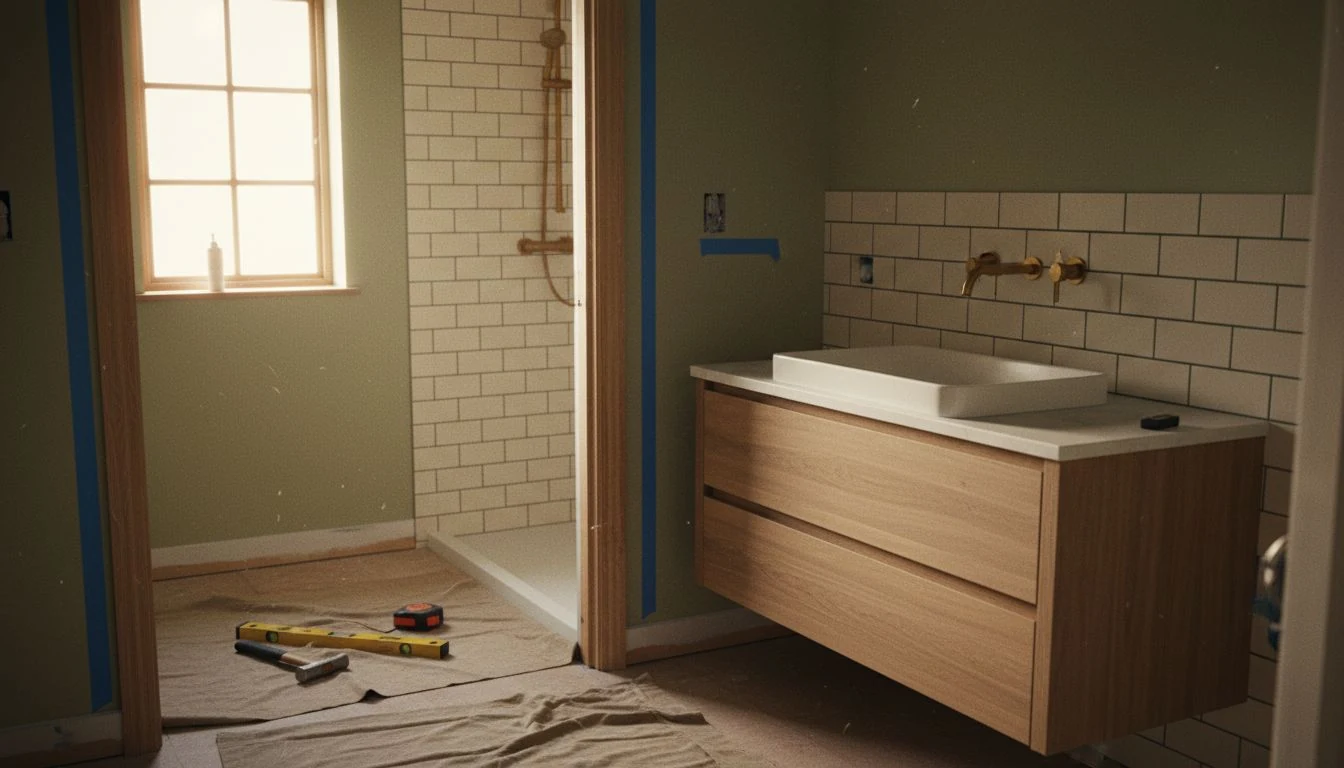
My contractor friend has a saying about bathrooms: small room, big bill. I didn’t believe him until I gutted my own. It’s the size of a parking space, and somehow it cost more per square foot than any other room in the house.
Here’s the short version before we get into the tables. A bathroom remodel cost in 2026 usually lands between $6,000 and $18,000 for a standard midrange job, with a quick cosmetic refresh starting around $500 and a primary-bath gut climbing past $25,000. That’s a huge spread, and where you fall in it depends almost entirely on three things: whether you move the plumbing, what you put on the floor and walls, and how much of the work you’re willing to do yourself. Below I’ve broken the whole thing down line by line, with real 2026 ranges, so you can build your own number before anyone hands you a quote that makes your stomach drop.
What does a bathroom remodel cost in 2026?
Let me give you the headline number first, because that’s the one you came for. A bathroom renovation cost in 2026 runs roughly $120 to $350 per square foot, which is wild when you remember a kitchen averages less per foot. Bathrooms cost more per square inch than almost anything because every one of those feet has plumbing, waterproofing, tile, and ventilation crammed into it.
For a standard 5-by-8-foot bathroom, here’s how the levels shake out:
| Remodel level | Typical 2026 cost | What you get |
|---|---|---|
| Cosmetic refresh | $500 to $2,500 | Paint, new fixtures, mirror, hardware, maybe a vanity top |
| Midrange remodel | $6,000 to $18,000 | New vanity, toilet, tub or shower, tile, lighting, fan |
| Tub-to-shower conversion | $3,000 to $12,000 | Remove tub, build tiled or panel shower, new glass |
| Primary bath, high-end | $25,000 to $50,000+ | Custom tile, double vanity, freestanding tub, heated floor |
Most people don’t need the high-end number, and honestly, most people shouldn’t chase it. The midrange band is where you get a bathroom that looks new, works for a decade, and doesn’t require a second mortgage. If you want to see how the bathroom fits into a bigger project, I mapped out whole-house numbers in my guide to real home renovation costs.
Bathroom remodel cost by project (line by line)
The level tables above are useful for a gut check, but you build a real budget by adding up the pieces. Here’s what each part of a bathroom remodel runs in 2026, installed:
| Project | Typical 2026 cost (installed) |
|---|---|
| New toilet | $250 to $700 |
| New vanity + sink | $1,200 to $3,500 |
| New bathtub | $1,000 to $4,500 |
| Tile shower surround | $2,500 to $6,000 |
| Floor tile (small bath) | $700 to $2,000 |
| Exhaust fan | $250 to $550 |
| New lighting + fixtures | $200 to $1,200 |
| Plumbing relocation | $1,500 to $5,000+ |
| Labor (often 40 to 65% of the total) | $3,000 to $10,000 |
Notice that last line. Labor is the silent giant of any bathroom remodel cost, usually eating 40 to 65 percent of the whole bill. That’s not a contractor gouging you, that’s the reality of cramming a plumber, a tile setter, and an electrician into a closet-sized room one at a time. It’s also the exact reason doing some of the work yourself moves the needle so hard, which I’ll get to.
What drives your bathroom remodel cost up or down
Two people can remodel the identical 5-by-8 bathroom and one pays $7,000 while the other pays $20,000. The difference isn’t luck. It’s a handful of decisions, and you control most of them.
- Moving the plumbing. This is the big one. Relocating a toilet, tub, or sink even a couple of feet means rerouting drain lines under the floor, and that’s $1,500 to $5,000 of work you’d never see. Keep the fixtures where they are and you save the most money of any single choice.
- Tile, and how much of it. Tile is priced by the square foot and the labor to set it is real. A full floor-to-ceiling tiled shower costs multiples of a simple acrylic surround. Beautiful, but know what you’re signing up for.
- Fixture tier. A $250 toilet flushes the same as an $800 one. The jump from builder-grade to designer fixtures can add thousands without changing how the room functions.
- Surprises behind the wall. Old homes hide rot, mold, and ancient plumbing. On a pre-1978 house there’s also lead paint to deal with safely, and the EPA’s Renovate Right rules mean a contractor has to be certified to disturb it, which costs more. Budget a cushion.
- Your zip code. Labor in a major metro can run double what it does in a small town for the exact same job.
My rule after doing mine: spend your money on the stuff you touch and see every day, and refuse to spend it on moving pipes around for a layout that was fine.
Where I’d spend, and where I’d save
I learned this the expensive way, so let me save you the tuition. When I did my bathroom, I blew $900 on a fancy faucet because it was pretty in the showroom. Six months later I couldn’t have told you which faucet I had. That money should have gone toward the one upgrade I still notice every single morning: a good exhaust fan that actually clears the steam.
So here’s my honest split. Spend on waterproofing (never cheap out here, water damage is the one mistake that costs you the whole remodel twice), a quiet powerful fan, and the vanity, because it’s the workhorse you use daily. Save on the toilet, the showerhead, and trim, where mid-tier performs just as well. A water-efficient model labeled by the EPA’s WaterSense program actually trims your water bill for years, so the “cheap” choice there is also the smart one.
The fastest way to blow a bathroom budget is to fall in love with a finish in a showroom. Decide your numbers at the kitchen table first, then go shopping with a cap.
DIY vs hiring it out (what you can actually do yourself)
This is where you reclaim a big chunk of that labor line. You don’t have to be a tradesperson to knock real money off a bathroom remodel cost, you just have to be honest about which jobs are yours and which ones aren’t.
Do it yourself: demo (pulling out the old vanity, mirror, and toilet is genuinely satisfying and saves a few hundred dollars), painting, installing the new vanity and mirror, swapping the toilet, and hanging hardware and a fan if you’re comfortable with basic wiring. Painting alone is the cheapest high-impact change in the room, and if you’ve never done it well, my notes on the cost to paint kitchen cabinets covers the same prep-and-finish logic that makes bathroom paint last.
Hire it out: anything that moves water or gas, tile work in a wet area (the waterproofing has to be perfect or you’ll be redoing it), and any electrical beyond a simple swap. I did my own demo and vanity and paid pros for the shower tile and plumbing. That split cut my total by about a third without risking the parts that flood your house if they’re done wrong.
How to tell if your bathroom remodel quote is fair
Once you’ve got the line-item ranges above, you can read a quote like a pro instead of just hoping the number is honest. Get three quotes on a job this size. Not two. Three. The spread between the highest and lowest bid on the same bathroom is routinely 40 percent or more, and the middle one is usually the realistic one.
Watch for a few red flags: a quote that’s one lump sum with no breakdown (a real contractor itemizes labor and materials), pressure to sign today for a “this week only” discount, and anyone who quotes a full gut before they’ve looked behind the wall. I wrote a whole field guide to this in is your contractor quote fair, because reading an estimate is its own skill and it’s the one that protects your wallet most. For broad national averages to sanity-check any number you’re handed, I also keep a running set of home improvement cost statistics pulled from real surveys.
How to build your own bathroom remodel budget
Putting it all together is just addition plus a few hard rules I wish someone had told me on day one:
- Start from the line-item table, not the headline number. Add up only the pieces you’re actually changing. A vanity-and-paint refresh is a different planet from a full gut.
- Add a 15 to 20 percent contingency. Bathrooms hide more surprises per square foot than any other room. Budget for the surprise now or panic about it mid-demo.
- Subtract your DIY jobs. Move demo, paint, and fixture installs to your column and watch the total drop. That’s the money that funds the pro work.
- Keep the plumbing where it is unless the layout is genuinely broken. This single rule saves more than any coupon ever will.
- Phase it if you have to. A refresh you can pay for beats a gut that buries you in debt. The bathroom doesn’t care if it took you two years.
Grab my free Project Cost Estimator
I put every line item on this page, with its 2026 price range and a DIY-or-pay-for-it tag, onto one printable sheet. Print it, fill in your bathroom, and you’ll have a real number before you call a single contractor. No fluff, no upsell.
Where the money actually goes in a bathroom remodel
People fixate on the tile or the vanity, but those aren’t where most of the budget lives. Here’s roughly how a typical mid-range remodel splits up, so you know which line to negotiate and which to leave alone.
| Category | Share of budget | Why it lands there |
|---|---|---|
| Labor (plumber, tiler, electrician, GC) | 40% – 60% | The single biggest line; skilled trades and time |
| Fixtures (tub, toilet, sink, faucets) | 15% – 20% | Where finish level swings the price the most |
| Tile, flooring & surfaces | 10% – 15% | Material + the labor to set it adds up fast |
| Cabinetry & vanity | 10% – 15% | Stock vs. semi-custom is a big swing |
| Permits, design & the surprise fund | 5% – 15% | Permits, plus hidden rot/old plumbing behind walls |
What blows the budget
- Moving the plumbing. Relocating the toilet, tub, or shower drain is the most expensive decision in the room—keep the layout and you keep the labor line down.
- No contingency for what’s behind the wall. Old pipes, hidden rot, and surprise wiring are common; a 10–20% cushion keeps them from derailing you.
- Splurging on labor-heavy finishes. Intricate tile patterns and niches cost as much in labor as material—the install time is the part people forget to price.
FAQ
How much does a bathroom remodel cost in 2026?
A standard midrange bathroom remodel cost in 2026 runs $6,000 to $18,000, or roughly $120 to $350 per square foot. A simple cosmetic refresh with paint, fixtures, and a new mirror can start around $500, while a high-end primary bath with custom tile, a double vanity, and a heated floor can climb past $25,000. The biggest single factor is whether you move the plumbing.
What is the most expensive part of a bathroom remodel?
Labor is almost always the largest line, eating 40 to 65 percent of the total, because a plumber, tile setter, and electrician each have to work one at a time in a tiny space. After labor, tile work and relocating plumbing are the priciest individual items. Doing your own demo, painting, and fixture installs is the fastest way to cut the labor share.
Can I remodel a bathroom for under $5,000?
Yes, if you keep the layout and do the cosmetic work yourself. A refresh that includes paint, a new vanity, toilet, mirror, lighting, and hardware can land between $1,500 and $4,500 when you handle the installs and only pay a pro for anything involving water or wiring. You hit five figures the moment you retile a shower or move plumbing.
Does a bathroom remodel add value to your home?
A midrange bathroom remodel typically returns 60 to 70 percent of its cost at resale, and a fresh, clean bathroom is one of the first things buyers notice. The smart money is a midrange refresh, not a high-end gut, because you rarely recoup the cost of premium finishes. Fixing anything broken or water-damaged returns the most, since buyers discount hard for problems they can see.
Prices in this guide are 2026 estimates and vary a lot by region, the age and size of your home, the finishes you choose, and how busy contractors are in your area. Treat them as a starting point for building and comparing your own numbers, not exact figures.
Coordinating a plumber, tiler, and electrician is exactly the job a GC is paid for, and what that general contractor fee actually costs.
If the only thing you actually want to change is the tub, pricing that alone is cheaper than pricing the room, so start with what a tub to shower conversion costs on its own.
Free DIY Project Cost Estimator
The spreadsheet I use to price out a project before I start, so a weekend job never blows the budget. Join the newsletter and I’ll send it over.
No spam, ever. Unsubscribe anytime. — Tessa
Keep reading — more on Remodel & Renovation Costs
Whole House Humidifier Installation Cost (and Whether You Need One)
Last January the little hygrometer on my bookshelf read 21 percent. I’d bought it for $14…
Read article →
Gas Fireplace Installation Cost: Inserts, Built-Ins, and Venting
My sister Jen has a brick fireplace in her 1962 ranch that she has used exactly…
Read article →
Shower Remodel Cost: Refresh, Walk-In, and Full Tear-Out
My mom called me in August because the floor of her shower had started to flex.…
Read article →
Gas Line Installation Cost: For a Stove, Dryer, Fireplace, or Generator
For nine days last winter, a brand new gas range sat in the middle of our…
Read article →