
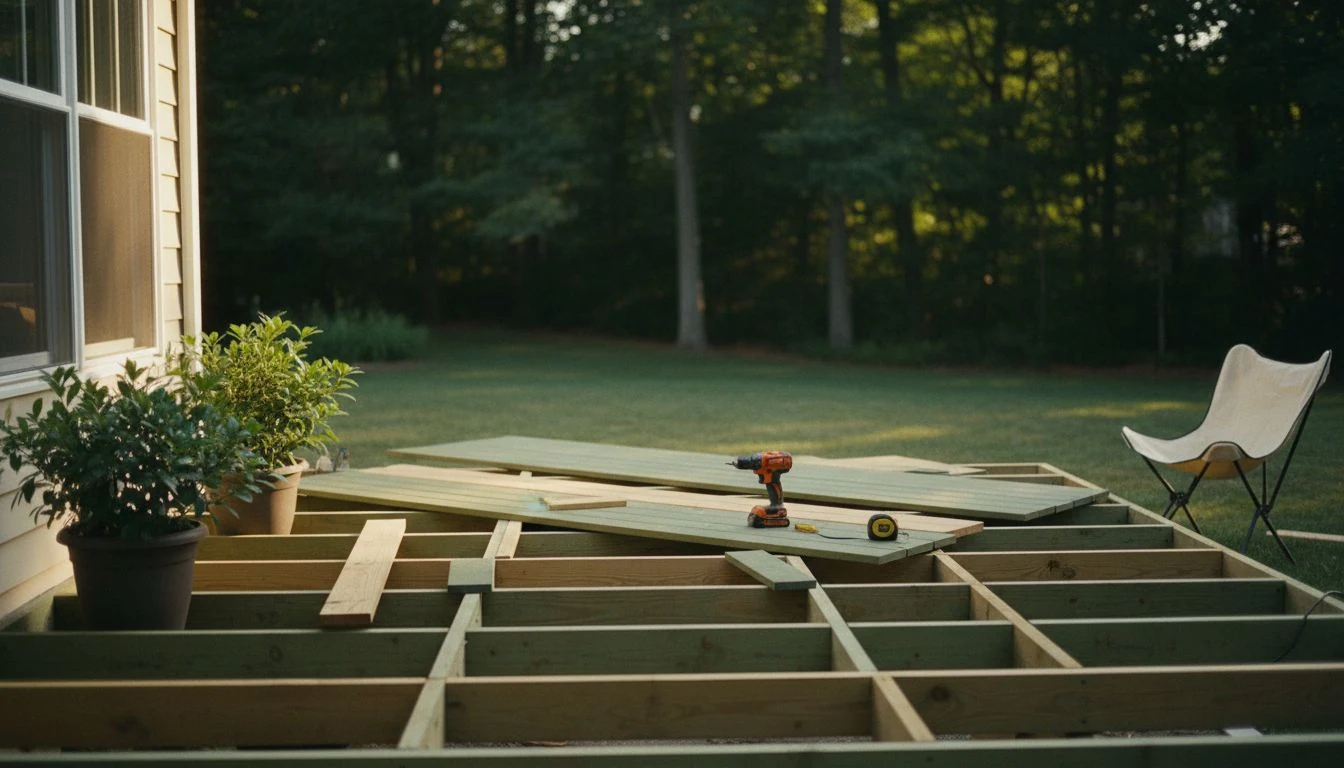
I got three quotes for a 12-by-16 deck off the back of my house. They came back at $6,800, $11,400, and $19,000. Same deck. Same yard. Same week. That spread is exactly why I started writing these guides, because somebody hands you a number like $19,000 and you have no idea if it’s fair or a fantasy.
So here’s the honest version before the tables start. The cost to build a deck in 2026 runs about $30 to $60 per square foot installed, which puts a typical project somewhere between $5,000 and $25,000 depending on size, material, and how much of the work you take on yourself. A small pressure-treated platform can come in under $4,000. A big composite deck with railings and stairs can sail past $40,000. Below I break the whole thing down per square foot, by material, and by size, so you can build your own number at the kitchen table before anyone gets you to sign anything.
What does it cost to build a deck in 2026?
Let me give you the headline first. The average cost to build a deck in 2026 lands around $30 to $60 per square foot, fully installed, with labor and materials included. That number swings hard based on what you build it out of and who builds it.
For a quick gut check, here’s where the common project sizes shake out at that mid-range rate:
| Deck size | Square feet | Typical 2026 installed cost |
|---|---|---|
| Small (10×12) | 120 sq ft | $3,600 to $7,200 |
| Medium (12×16) | 192 sq ft | $5,800 to $11,500 |
| Large (16×20) | 320 sq ft | $9,600 to $19,200 |
| Oversized (20×20+) | 400+ sq ft | $12,000 to $40,000+ |
Most people don’t need the oversized number, and most people overestimate how big a deck they actually use. My 12-by-16 felt enormous on paper and is just right in real life: a table, a grill, and room to walk around both. If you want to see how a deck fits into a bigger picture of outdoor and whole-house spending, I mapped that out in my guide to real home renovation costs.
Cost to build a deck by material (per square foot)
The single biggest lever on your cost to build a deck is what the boards are made of. This is where a “cheap deck” and an “expensive deck” split apart, and it’s the one decision you’ll look at every day for the next twenty years.
| Decking material | Material cost per sq ft | What you’re getting |
|---|---|---|
| Pressure-treated pine | $3 to $6 | The budget standard. Strong, cheap, needs staining every few years. |
| Cedar | $4 to $8 | Naturally rot-resistant, smells incredible, still needs upkeep. |
| Composite (Trex and similar) | $5 to $14 | No staining, no splinters, costs more up front, lasts decades. |
| Exotic hardwood (Ipe) | $10 to $20 | Gorgeous and tough as iron, but heavy, pricey, and hard to work with. |
| Aluminum | $15 to $20 | Lightweight, fireproof, niche. You won’t see it often. |
Here’s my take after living with a pressure-treated deck: it’s the right call if you’ll actually maintain it, and a slow regret if you won’t. I told myself I’d re-stain mine every two years. I have re-stained it exactly once in four years. If that sounds like you, the math on composite changes, because you pay more on day one and basically nothing after. One thing worth knowing before you buy treated lumber: it’s pressure-treated with preservative chemicals, and the EPA’s overview of wood preservative chemicals is worth a two-minute read so you handle and cut it safely.
What you’ll actually pay by deck size and add-ons
The per-square-foot rate gets you a flat deck surface. Real decks have stairs, railings, and sometimes a roof, and those extras are where the quote quietly climbs. Here’s what the common add-ons run in 2026, installed:
| Add-on | Typical 2026 cost |
|---|---|
| Railing (per linear foot) | $20 to $60 |
| Stairs (per step) | $100 to $300 |
| Built-in bench seating | $400 to $1,200 |
| Pergola or roof cover | $3,000 to $10,000+ |
| Permit + inspection | $150 to $800 |
| Footings / foundation | $1,000 to $3,000 |
That railing line is the one that got me. My 12-by-16 deck has roughly 44 linear feet of railing, and at the composite rate I priced, that alone was almost $2,000 before a single board hit the frame. Don’t skip the permit either. It runs a couple hundred bucks and it protects you, and a deck that flunks inspection or wasn’t permitted can sink a home sale later.
Why labor is the part of a deck quote that surprises everyone
If you only remember one thing, make it this. Labor usually eats 50 to 60 percent of the total cost to build a deck. On a $12,000 job, that’s six or seven thousand dollars of skilled work, not lumber. That’s not a contractor gouging you. Framing a deck level, setting footings that won’t heave, and flashing the ledger board so water doesn’t rot your house wall is real, get-it-wrong-and-it’s-dangerous work.
It’s also exactly why doing some of it yourself moves the number so much, and why DIY decking content is everywhere. You’re not saving on wood. You’re saving on those labor hours. Just be honest about which hours are safely yours.
The fastest way to blow a deck budget is to fall for the showroom material and forget the railing, the stairs, and the permit. Price the whole thing, not just the floor.
What drives the cost to build a deck up or down
Two neighbors can build the same-size deck and pay thousands apart. It’s almost never luck. It’s a handful of choices, and you control most of them.
- Material, first and always. Pressure-treated versus composite versus hardwood can double or triple your per-foot cost before labor. This is the lever, period.
- Height off the ground. A ground-level platform is cheap. A second-story deck on tall posts needs bigger footings, more bracing, and railings everywhere, and the price climbs fast.
- Stairs and shape. A simple rectangle is cheap to frame. Curves, multiple levels, and long staircases add labor hours, which is the expensive part.
- Site conditions. Sloped yards, rocky soil, or poor drainage mean more foundation work before a board ever goes down.
- Your zip code. Labor in a big metro can run nearly double a small town for the identical build.
My rule after pricing mine three ways: spend on the surface you touch and the structure that keeps you safe, and refuse to spend on a fancy shape that just adds labor.
DIY vs hiring it out (what you can really do yourself)
This is where you claw back a chunk of that labor line. You do not have to be a carpenter to knock real money off a deck. You just have to be ruthless about which jobs are yours.
Reasonable to DIY: a low, ground-level deck under a couple feet high, the demolition of an old deck, the staining and sealing, and the simple finish work like trim boards. A basic floating platform is genuinely a strong-weekend project for a confident DIYer, and it can cut your cost to build a deck close to just the price of materials.
Hire it out: anything attached to the house (the ledger connection is the single most common point of deadly deck failures), anything tall, footings that have to pass inspection, and stairs over a few steps. I did my own staining and demo and paid a pro to frame and attach. That split saved me real money on the parts I could handle without risking the parts that hold people up. For the why-it-matters side of that, NADRA’s deck safety resources spell out exactly what fails on a deck and why the structural pieces aren’t the place to save fifty bucks.
How to tell if your deck quote is fair
Once you have the per-square-foot and add-on ranges above, you can read a quote like you know what you’re doing, because now you do. Get three quotes on a deck. Not two. Three. As my own $6,800-to-$19,000 spread shows, the gap between the high and low bid on the identical job is routinely huge, and the middle one is usually the realistic number.
Watch for the same red flags I watch for on any job: a single lump-sum price with no breakdown (a real contractor itemizes lumber, footings, railing, and labor), pressure to sign today for a “this week only” deal, and a quote that doesn’t mention a permit at all. I wrote a full field guide to reading estimates in is your contractor quote fair, and to sanity-check any number against national averages I keep a running set of home improvement cost statistics pulled from real surveys.
How to build your own deck budget
Putting it together is just addition plus a few hard rules I wish I’d had on day one:
- Start from square footage, not the headline. Multiply your size by a realistic per-foot rate for your chosen material, then add the extras separately.
- Add the railing, stairs, and permit as their own lines. They’re not optional and they’re not small. This is where most DIY budgets come up short.
- Build in a 10 to 15 percent contingency. Soil surprises and lumber price swings are real. Budget for them now or panic mid-build.
- Subtract the jobs you’ll truly do. Move staining, demo, and simple trim to your column and watch the total drop. That’s the money that funds the framing pro.
- Keep the shape simple unless you have a real reason not to. A clean rectangle is the cheapest beautiful deck there is.
And if a full deck is out of reach this year, a deck isn’t the only way to make a backyard usable. I turned a bare slab into a real hangout for almost nothing in my budget patio makeover, which buys you time to save for the deck you actually want.
Grab my free Project Cost Estimator
I put every line on this page, with its 2026 price range and a DIY-or-pay-for-it tag, onto one printable sheet. Print it, fill in your deck size and material, and you’ll have a real number before you call a single contractor. No fluff, no upsell.
What a deck actually costs you every year after it’s built
The build price is only half the story. Every deck has an annual upkeep cost, and it swings hard by material—the cheaper-to-build option is usually the pricier one to keep. Here’s the yearly reality so you can budget past day one.
| Decking material | Typical yearly upkeep | What that buys |
|---|---|---|
| Pressure-treated pine | $150 – $400 | Annual cleaning; seal/stain every 2–3 yrs, board swaps |
| Cedar / redwood | $150 – $350 | Yearly wash; stain every 2–3 yrs to fight graying |
| Composite | $30 – $100 | Soap-and-water wash; no sealing, occasional fastener fix |
| PVC / capped polymer | $20 – $80 | Just cleaning; essentially no refinishing |
| Hardwood (ipe, etc.) | $200 – $500 | Oil 1–2x/yr to hold color, or let it silver |
What blows the budget
- Pricing only the build. A cheap pressure-treated deck can cost more over ten years than composite once you add stain, sealer, and replacement boards.
- Letting wood go gray, then “fixing” it. Restoring a neglected deck (sanding, stripping, restaining) costs far more than the yearly maintenance you skipped.
- Ignoring climate. Full sun, snow, and damp shade all accelerate wear; the same board needs more upkeep in a harsh climate than a mild one.
FAQ
How much does it cost to build a deck in 2026?
The cost to build a deck in 2026 runs about $30 to $60 per square foot installed, which puts a typical project between $5,000 and $25,000. A small pressure-treated platform can come in under $4,000, while a large composite deck with railings and stairs can pass $40,000. Material choice and labor are the two biggest factors.
Is it cheaper to build your own deck?
Yes, often by thousands, because labor is 50 to 60 percent of the total. Doing your own staining, demo, and finish work, or building a simple low platform yourself, cuts the cost close to just materials. But anything tall, attached to the house, or requiring footings that pass inspection should go to a pro. The ledger connection and structural framing are not the place to save money.
What is the cheapest material to build a deck?
Pressure-treated pine is the cheapest decking material at roughly $3 to $6 per square foot. It’s strong and budget-friendly, but it needs staining and sealing every few years to last. If you won’t keep up with that maintenance, composite costs more up front but saves you the ongoing upkeep, which can make it cheaper over the deck’s full life.
Do I need a permit to build a deck?
In most areas, yes, especially for any deck attached to the house or raised off the ground. A permit and inspection typically cost $150 to $800 and protect you as the homeowner. Skipping it can cause problems when you sell, and an uninspected deck that fails can be dangerous. Contact your city or county building department before you start.
Prices in this guide are 2026 estimates and vary a lot by region, material, deck size and height, site conditions, and how busy contractors are in your area. Treat them as a starting point for building and comparing your own numbers, not exact figures.
Free DIY Project Cost Estimator
The spreadsheet I use to price out a project before I start, so a weekend job never blows the budget. Join the newsletter and I’ll send it over.
No spam, ever. Unsubscribe anytime. — Tessa
Keep reading — more on Exterior & Structural Costs

Gutter Cleaning Cost: What I Paid, and the Month It Stops Being Optional
Gutter cleaning cost in 2026 runs $120 to $425 for most houses. Real quote numbers, what…
Read article →
Foundation Repair Cost in 2026: The Crack That Matters and the One That Does Not
A man in a branded polo put a level against my basement wall, made a face…
Read article →
Roof Repair Cost in 2026: What It Costs by What Actually Broke
The stain showed up on the upstairs hallway ceiling the morning after a March storm, about…
Read article →
Garage Door Spring Replacement Cost in 2026 (and Why I Do Not DIY This One)
It sounded like a rifle going off in the garage at 6:40 on a Tuesday morning.…
Read article →