
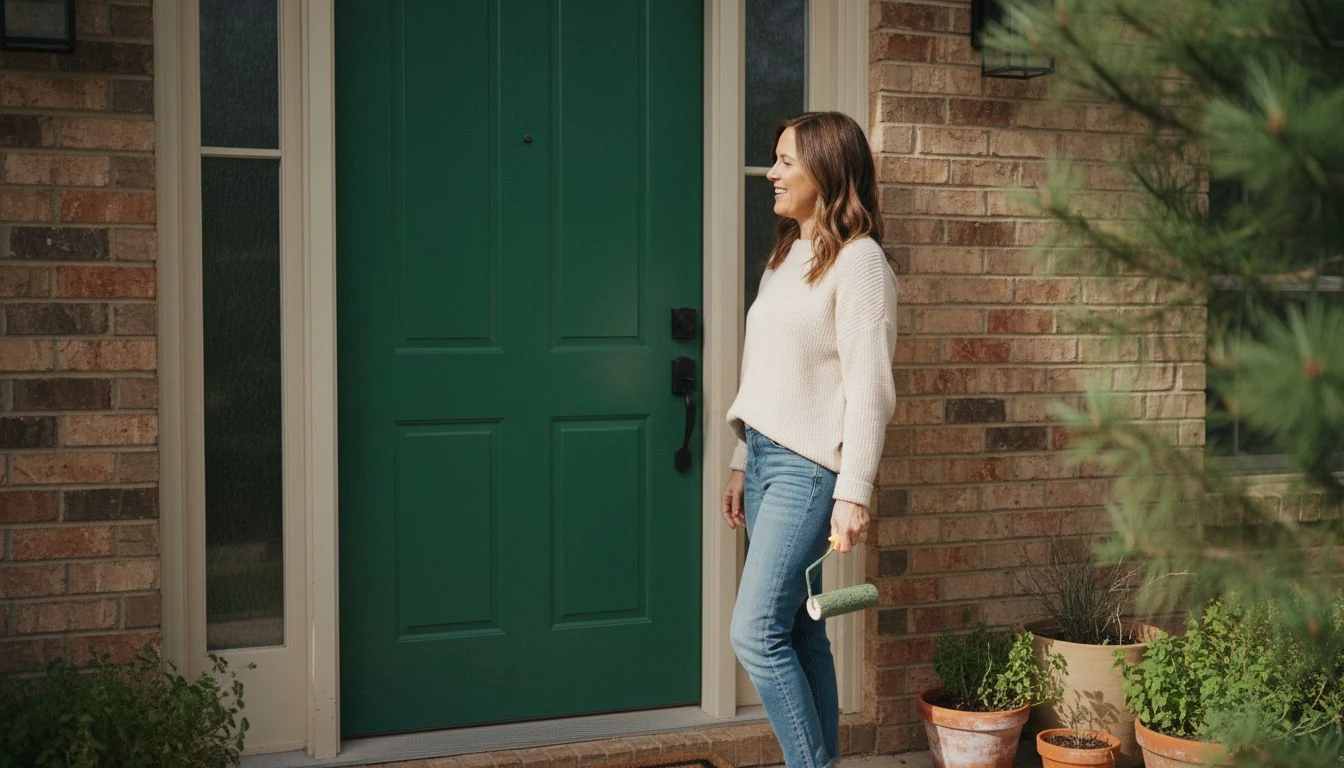
My front door used to be the saddest thing about my house. Faded builder-beige, a scuffed brass knob from some decade I wasn’t alive for, and house numbers so small the delivery guy called me twice. One Saturday I gave myself a $100 cap and fixed all of it. This is the exact front door refresh I did, what every piece cost, and the one thing I overspent on so you don’t have to.
I’m not a contractor and I didn’t hire one. A front door refresh is the highest-payback weekend project I know of, because it’s the first thing anyone sees and almost nobody looks at it closely enough to notice it’s cheap. Paint, hardware, numbers, a clean mat. That’s the whole list. You can do all of it for under a hundred bucks and an afternoon.
What my front door refresh actually cost
Here’s the full receipt, because I hate when a post says “budget makeover” and then quietly assumes you already own $300 of supplies. I didn’t own most of this. A pro would have charged me somewhere between $177 and $362 just to paint the door, according to Angi’s 2026 door-painting data. I spent a lot less because I did the labor myself on a Saturday.
- Quart of exterior enamel (forest green): $16
- Small foam roller, angled brush, painter’s tape: $14
- Matte-black lever handle + deadbolt set: $42
- Four oversized 6-inch floating house numbers: $28
- Plain dark doormat: already owned ($0, or about $15 new)
That came to $100 on the nose, and I already had the mat, so my out-of-pocket was closer to $85. If you reuse your existing lockset and just paint and swap the numbers, you’re under $60. The big variable is hardware, and I’ll get to why I think it’s worth the splurge in a minute.
Start with the layer that costs nothing
Before you buy a single thing, clean the door. I know. Everyone skips this and then wonders why the new paint looks blotchy. A front door collects a film of pollen, bug spray, and hand grime you stop seeing because you walk past it daily. I wiped mine down with a sponge and a bucket of warm water with a squirt of dish soap, rinsed it, and let it dry fully in the sun.
Then look at it in good light. Stand on the sidewalk at the time of day people actually arrive and be honest about what’s dragging it down. For me it was three things: the color, the dated knob, and those tiny numbers. Yours might be a dead wreath or a porch light full of dead bugs. Fixing the free stuff first means you spend your $100 only on what’s left, instead of throwing money at a door that just needed a wash.
The 2026 front door colors worth copying
The colors trending hard right now are the moody, nature-pulled ones: forest or pine green, an inky navy that reads almost black, and a warm charcoal. I went forest green because it plays nice with brick and it hides road dust better than a pale color would. These shades look expensive precisely because they’re restrained. No fire-engine red, no glossy teal.
One tip that saved me a second trip: buy a quart, not a gallon. A standard exterior door takes well under a quart for two coats, and door paint runs $15 to $60 a gallon depending on grade, so a quart of solid mid-range enamel is plenty and cheaper. Get an exterior-rated enamel in a satin or semi-gloss finish. Flat paint on a door that gets touched and rained on is a regret waiting to happen. I learned that on a different door, years ago, and the fingerprints never fully wiped off.
How to paint a front door refresh without streaks
This is the part people are scared of, and it’s the easiest part. Here’s the order that gives a smooth finish with zero brush marks.
- Tape off the hinges, the glass, and the weatherstripping. Five minutes now saves an hour of scraping later.
- Lightly scuff the old finish with a fine sanding sponge so the new coat grips. Wipe the dust.
- Cut in the panels and edges with the angled brush first, then immediately roll the flat areas with the foam roller while the brushed paint is still wet. This blends the two and kills streaks.
- Let it dry the full time on the can before the second coat. Rushing coat two is the number-one cause of a tacky, streaky door.
- Two thin coats always beat one thick one. Thick paint sags and drips on a vertical door.
If your home was built before 1978, the old paint may contain lead, and scraping or sanding it kicks up dust you do not want around kids or pets. Read the EPA’s guidance on lead in the home before you sand anything on an older door, and use a wet-sanding sponge to keep dust down. It’s a two-minute read and worth it. I rolled my whole door in about 40 minutes of actual work, then let it cure between coats while I did other things.
Grab my free Project Cost Estimator
Want to keep your front door refresh under your number instead of blowing past it at the register? I built a simple spreadsheet that tallies every item as you add it, so you see the running total before you check out. Download the free Project Cost Estimator here and plan your own door makeover.
Hardware is the upgrade nobody notices but everybody feels
If I could only change one thing, it’d be the hardware. A tired old knob makes the whole door look tired, and a clean matte-black or brushed-brass handle set makes a $16 paint job look like you hired someone. I swapped my builder-brass knob for a matte-black lever-and-deadbolt set for $42, and it’s the change my neighbor actually commented on.
Take a photo of your existing lockset before you shop so you buy the right backset and bore size. Most residential doors use a standard 2-3/8 or 2-3/4 inch backset, and the new set tells you on the box. The install is four screws and a screwdriver. If you can hang a picture, you can swap a handle set. While the old hardware is off, this is also the moment to check your weatherstripping. A door that seals badly wastes money all year, and the Department of Energy’s weatherstripping guide walks through the cheap fixes. New foam stripping is a few dollars and it’s the least glamorous, most useful thing you’ll do that day.
Oversized house numbers are the cheapest wow
This is the upgrade that punches way above its price. Big, modern, floating house numbers instantly read as “someone who cares lives here.” I bought four 6-inch brushed numbers for $28. The standing trend leans even bigger, 8 to 12 inches, floated off the wall with a little standoff so they throw a shadow. If your house has room for it, go large.
Mount them with a paper template first. Most number sets come with one, or you can make your own with painter’s tape: stick the tape on, level it, mark your holes, drill, then peel. Eyeball it from the street before you commit to the holes. I mounted mine slightly too low the first time and had to patch and redo two of them, which brings me to the part where I tell you what not to do. For more cheap-but-not-cheap-looking touches in this same vein, my dollar-store DIY decor post has a pile of them.
What I’d skip on a budget front door refresh
The money I regret: a fancy seasonal wreath. I almost dropped $45 on a faux-eucalyptus number that would’ve lived in a closet most of the year and faded in the sun by August. A clean door with good hardware doesn’t need a wreath to look finished. Spend that money on the handle set instead, which actually changes how the door feels every single time you use it.
I’d also skip the temptation to repaint the trim and the frame the same day. It feels efficient and it is a trap. The frame and trim are exterior surfaces that take prep, and trying to do everything in one afternoon is how you end up with a half-finished door and a sore back. Do the door slab and hardware this weekend, live with it, and tackle the trim another day if it still bugs you. Mine still has the original trim and honestly nobody’s noticed. The same logic carried over from when I learned to paint kitchen cabinets without sanding: do the high-impact surface well, skip the parts that double the work for half the payoff.
One more: don’t buy a brand-new “welcome” mat with a slogan on it. It dates fast and screams seasonal-aisle. A plain dark mat reads cleaner and lasts years. If you want the bigger-picture version of stretching a small budget across a whole outdoor space, my budget patio makeover runs the same playbook on the back of the house.
Front door refresh: time and difficulty by task
A door refresh isn’t one job, it’s a stack of small ones, and they’re not equally hard. Here’s how I’d rank them so you can knock out the high-impact, low-effort wins first and decide what’s actually worth a weekend.
| Task | Time | Difficulty | Visual payoff |
|---|---|---|---|
| Swap the welcome mat & add a plant | 10 min | Easy | High |
| Replace the house numbers | 20–30 min | Easy | High |
| Clean & polish or replace hardware | 30–60 min | Easy–Medium | High |
| Add a wreath or seasonal door decor | 15 min | Easy | Medium |
| Repaint the door (prep + 2 coats) | 4–6 hrs over 2 days | Medium | Very high |
| Replace weatherstripping / threshold | 1–2 hrs | Medium | Low (but you feel it) |
Common mistakes
- Painting in the wrong weather. Direct sun or high humidity makes the finish tacky and streaky; aim for mild, dry, shaded conditions.
- Reusing tired hardware. A fresh coat of paint behind a scratched, mismatched handle just highlights the old part. Refresh both or neither.
- Skipping the prep. No cleaning, sanding, or taping means peeling paint and ragged edges within a season—the slowest step is the one that lasts.
FAQ
How much does a front door refresh cost to do yourself?
You can do a full front door refresh for $60 to $100 if you paint the door yourself, swap the hardware, and update the house numbers. Mine came to about $85 out of pocket. Hiring a painter to do just the door painting runs $177 to $362, so the DIY savings come almost entirely from the labor.
What’s the best paint finish for a front door?
Use an exterior-rated enamel in satin or semi-gloss. Those finishes wipe clean, shed rain, and hide fingerprints far better than flat paint, which holds onto every smudge on a surface people touch daily. A single quart covers two coats on a standard door.
Can I refresh my front door if I rent?
Often yes, but ask first. Many landlords are fine with a freshly painted door in a neutral or classic color since it improves the property, and new house numbers or a doormat are completely reversible. Get permission in writing before painting, and keep the original hardware to reinstall when you leave.
How long does a front door refresh take?
Plan on one afternoon of actual work, plus drying time between coats. The painting is about 40 minutes of hands-on effort spread across a few hours, the hardware swap is 15 minutes, and the house numbers take another 15. Most of the “time” is just waiting for paint to dry.
These are real costs from my own front door in 2026; prices vary by region, store, brand, and the finish you pick, so treat them as a starting point, not a guarantee. I’m a DIYer sharing what worked for me, not a licensed contractor. For older homes with possible lead paint, follow the EPA guidance linked above or call a certified pro.
If paint and new hardware won’t save your door because the frame is soft or water gets under it, it’s time to price a replacement. Here are real exterior door installation costs and quotes.
Free DIY Project Cost Estimator
The spreadsheet I use to price out a project before I start, so a weekend job never blows the budget. Join the newsletter and I’ll send it over.
No spam, ever. Unsubscribe anytime. — Tessa
Keep reading — more on Budget Decor
Budget Backyard Makeover: How I Did Mine for Under $200 (Renter-Friendly)
My budget backyard makeover cost $186, not $5,000. Here's the renter-friendly weekend playbook for cozy outdoor…
Read article →
DIY Back-to-School Drop Zone: A Backpack & Homework Command Station
Build a DIY back-to-school drop zone in a weekend: hooks, cubbies, and a homework command station…
Read article →
Kids' Room Makeover on a Budget (A Back-to-School Refresh)
Three weeks before school started, my daughter announced that her room was “a baby room” and…
Read article →
Back-to-School Homework Station: A DIY Study Nook on a Budget
The DIY homework station I built for about $79: where to put it, what to buy,…
Read article →