
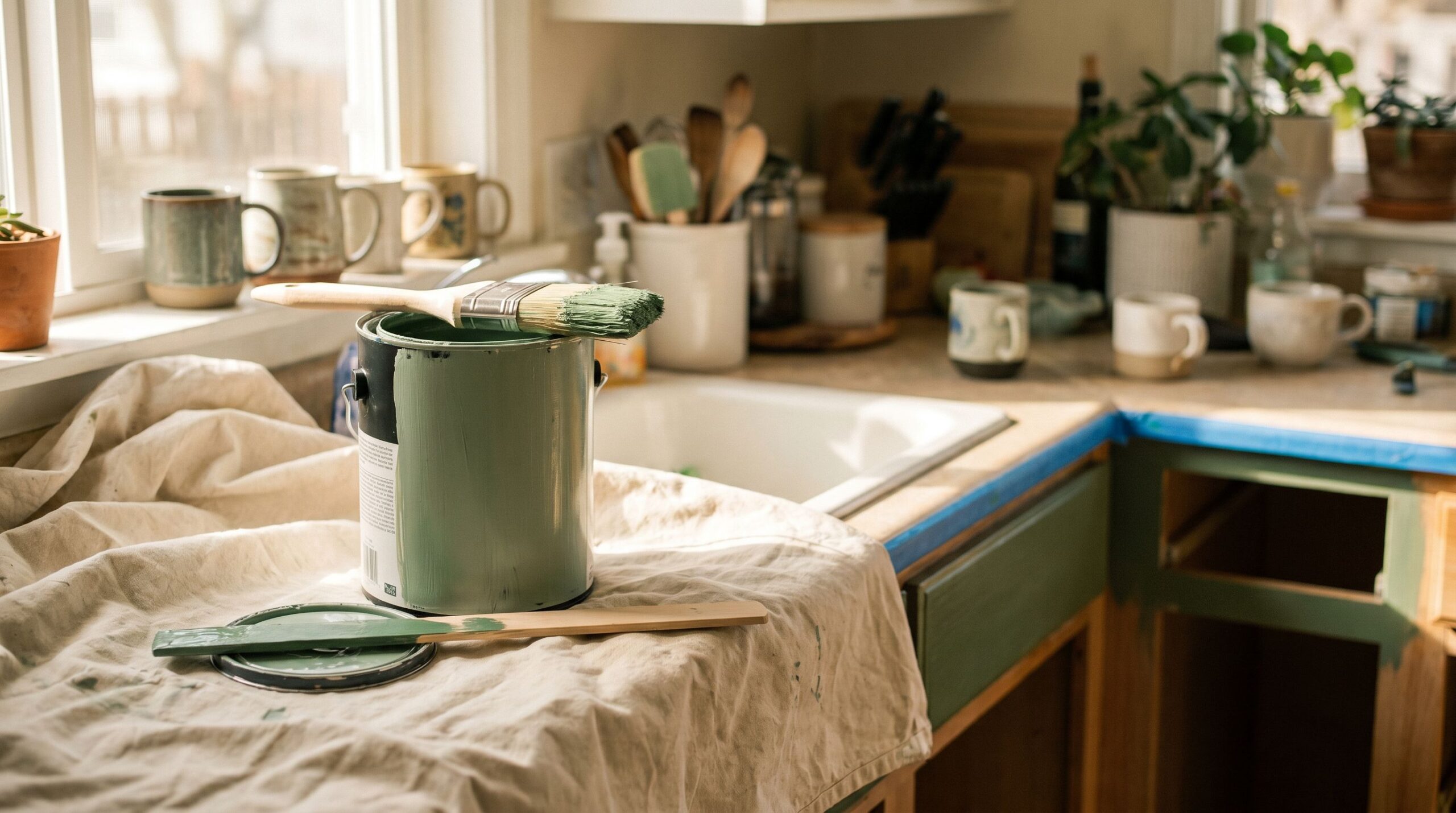
The first quote I got to paint my kitchen cabinets was $4,200. The second was $2,800. The third guy quoted me $6,500 and acted like he was doing me a favor. Three pros, same 30 doors, and a spread wide enough to drive a truck through.
That spread is exactly why I’m writing this. The cost to paint kitchen cabinets in 2026 runs anywhere from about $200 if you do it yourself to north of $7,000 for a full pro spray job, and most of the difference has nothing to do with how nice your kitchen turns out. It has to do with your cabinet count, your finish, your zip code, and whether the person quoting you thinks you’ll shop around. I painted mine in the end, learned a lot the hard way, and I’m going to lay out every real number so nobody charges you for fear instead of work.
The short answer: what painting kitchen cabinets costs in 2026
Here’s the range before we get into the weeds. If you hire a professional, you’re usually looking at $30 to $60 per door and drawer front, or roughly $3 to $10 per square foot of cabinet surface. For an average mid-size kitchen of about 30 doors and drawers, that lands most quotes between $2,500 and $5,000. Do it yourself and the same kitchen costs you $150 to $400 in materials, plus a couple of weekends you won’t get back.
So the real decision isn’t “paint or don’t.” It’s “pay $3,000 for a flawless sprayed finish, or pay $300 and a sore back for a finish that’s 90% as good.” I’ll help you figure out which one is right for your kitchen and your patience level.
Cost to paint kitchen cabinets: DIY vs pro side by side
This is the comparison I wish someone had handed me before I started calling contractors. Same kitchen, two totally different price tags, and the gap is mostly labor.
| What you’re paying for | DIY (do it yourself) | Professional |
|---|---|---|
| Total cost (30-door kitchen) | $150 – $400 | $2,500 – $5,000 |
| Cost per door/drawer | $5 – $13 in materials | $30 – $60 installed |
| Time it takes | 3 – 5 days (2 weekends) | 3 – 5 days, hands-off for you |
| Finish quality | Good to very good (brush/roller or rented sprayer) | Excellent, factory-smooth sprayed finish |
| Durability | Solid if you prep right and use cabinet enamel | High, with pro-grade catalyzed coatings |
| Risk if it goes wrong | You repaint a door. Cheap lesson. | You’re out thousands and still unhappy |
Look at the labor line and you can see where the money goes. A pro charges $2,500 to $5,000 and maybe $300 of that is paint. The rest is skill, equipment, and time, which is completely fair. The question is whether your kitchen needs that level of finish, or whether you’d rather keep the difference.
Cost to paint kitchen cabinets by kitchen size
Cabinet count is the single biggest driver of a pro quote, more than your finish or your color. Painters mostly price by the door and drawer front, so a galley kitchen and a big U-shaped kitchen can be double each other for the exact same work per piece. Here’s roughly how it breaks down at typical 2026 pro rates.
| Kitchen size | Doors + drawers | DIY material cost | Typical pro quote |
|---|---|---|---|
| Small / galley | 10 – 18 | $120 – $220 | $900 – $2,200 |
| Average / mid-size | 20 – 32 | $180 – $350 | $2,200 – $4,500 |
| Large / U-shape + island | 34 – 50 | $300 – $500 | $4,500 – $7,500 |
When a pro comes to quote, count your doors and drawers yourself before they arrive. If their number works out to way more than $60 a door, ask them to walk you through why. Sometimes there’s a real reason. Sometimes there isn’t, and just asking the question changes the price.
What actually moves the price up or down
Two kitchens with the same door count can still get quotes hundreds of dollars apart. These are the factors doing it, ranked roughly by how much they swing the total.
Spray vs brush and roll
This is the big one for a pro job. A sprayed finish looks factory-smooth with no brush marks, but it means masking off your entire kitchen or hauling doors to a shop, which is labor and overhead. Spraying can add $500 to $1,500 over a brush-and-roll job. For DIY, renting a sprayer runs $40 to $70 a day and gets you most of that smoothness if you practice on a scrap door first.
Cabinet material and current finish
Smooth painted or laminate cabinets are the easiest. Heavily grained oak needs grain filler or extra primer coats to hide those open pores, and that’s real time. Slick thermofoil or melamine sometimes needs a bonding primer and can be genuinely tricky. If a painter sees oak grain or thermofoil, expect the quote to climb $300 to $800.
Color change and number of coats
Going from dark cabinets to white is the expensive direction. White over dark wood can need an extra coat or two of primer to stop the old color and any tannins from bleeding through. A dramatic color change can add a coat across the whole kitchen, which is more labor and more product.
Prep and repairs
Loose hinges, gouges, water damage near the sink, or cabinets caked in years of cooking grease all add prep time. Degreasing alone can eat an afternoon. Honest painters bake this into the quote. Less honest ones leave it out, then hit you with a change order halfway through.
Hardware and new doors
Swapping knobs and pulls for new ones, or replacing a few warped doors, isn’t painting but often rides along on the same invoice. New shaker doors alone can run $40 to $100 each, so if “painting” suddenly costs $9,000, check whether they quietly added door replacement.
Regional differences: your zip code matters
The same cabinet job swings a lot depending on where you live, and it tracks with local labor costs more than anything. I’ve compared notes with readers all over the country, and here’s the rough lay of the land for a standard 30-door pro job in 2026.
| Region | Typical pro cost (30 doors) | Per-door range |
|---|---|---|
| Midwest / South (lower cost of living) | $2,000 – $3,500 | $28 – $45 |
| National average | $2,800 – $4,200 | $35 – $55 |
| Northeast / West Coast metros | $4,000 – $7,000 | $50 – $90 |
If you’re in a high-cost metro, a sky-high quote might genuinely be normal for your area, not a rip-off. The fix is the same everywhere though: get three quotes, all for the same scope, and compare them against each other instead of against a number you read online. Want a deeper checklist on spotting a fair number? I wrote a whole guide on whether your contractor quote is fair that walks through the red flags.
The hidden cost almost nobody warns you about: lead paint
This one surprised me, and it’s worth real money if your house is older. If your home was built before 1978, your cabinets and walls may have layers of lead-based paint underneath. Sanding or scraping that releases lead dust, which is a genuine health hazard, especially around kids.
The EPA Lead Renovation, Repair and Painting Program requires that contractors who disturb paint in pre-1978 homes be certified and follow lead-safe work practices. A certified painter will cost a bit more, and that’s not a scam, it’s the law and it protects your family. If a contractor working on your 1960s kitchen waves off lead entirely, that’s a red flag, not a discount. For DIY in an old house, this is also the strongest argument for a no-sanding method that doesn’t kick up dust, which I cover in my guide on how to paint kitchen cabinets without sanding.
What it really costs to DIY: my actual receipt
Let me get specific, because “it depends” helps no one. Here’s what I actually spent painting my 28-door kitchen myself over two weekends. I went brush-and-roll, no rented sprayer, sage green over honey oak.
| Item | What I bought | Cost |
|---|---|---|
| Cabinet primer (bonding) | 1 gallon | $48 |
| Cabinet enamel paint | 2 gallons, tinted | $96 |
| Deglosser / degreaser | 1 quart | $14 |
| Foam rollers, brushes, trays | Good-quality set | $38 |
| Painter’s tape + drop cloths | Plus sanding sponges | $26 |
| New cabinet hardware | 28 pulls (optional splurge) | $84 |
| Total | $306 |
Strip out the optional hardware and I was at $222. Against my lowest pro quote of $2,800, I saved roughly $2,500 and lost about 16 hours of my life spread across two weekends. For me, with a kitchen I just needed to look fresh and not flawless, that math was a no-brainer. Your math might land differently, and that’s fine.
When it’s actually worth hiring a pro
I’m the DIY-it lady, but I’m not going to pretend hiring out is always a waste. Sometimes paying the $3,000 is the smart move, and I’d tell my own sister to do it in these cases.
- You want a true factory finish. If you’re selling the house or you genuinely can’t live with the faintest brush texture, a pro spray booth gets a result that’s very hard to match at home.
- Your cabinets are tricky. Thermofoil that’s peeling, heavy grain, or a lot of damage repair can turn a DIY weekend into a frustrating month. Pros have the products and the practice.
- Pre-1978 home and you’re not set up for lead-safe work. This is a health-and-safety case, not a vanity case. Hire someone EPA-certified.
- You physically can’t, or your time is worth more. No shame in this. If your weekend is worth more than $150 an hour to you, the pro is the rational choice.
If none of those describe you, and you’re mostly just nervous, that nervousness is the cheapest thing to fix. A test door costs you $10 and an evening.
Is your cabinet painting quote fair?
Here’s how I’d sanity-check any quote you get, fast. Take the total, divide by your door-and-drawer count, and see where it lands.
- Under $30 a door: Suspiciously cheap. Ask what prep and how many coats are included before you celebrate. Cheap often means thin.
- $30 to $60 a door: The fair fairway for most of the country. This is where a solid pro job should sit.
- $60 to $90 a door: Normal for high-cost metros or spray finishes with heavy prep. Fine if they can explain it.
- Over $90 a door: Either you’re in Manhattan, there’s serious repair work bundled in, or they’re hoping you won’t ask. Get another quote.
And always, always get the scope in writing: number of coats, primer yes or no, spray or brush, hardware included or not, and who moves the doors. A vague quote is where the “surprise” charges live.
Grab the free renovation budget tracker. Before you call a single painter, jot down your real numbers: door count, the finish you want, and the three quotes as they come in. My one-page renovation budget tracker has a cabinet-painting section with the per-door math built in, so you can compare quotes apples to apples in about two minutes. Print it, fill in your kitchen, and walk into those conversations knowing what fair looks like.
For the bigger picture beyond cabinets, I pulled together the latest home improvement cost statistics.
Cost to paint kitchen cabinets: DIY vs. pro at a glance
Cabinet painting prices swing a lot with kitchen size and who swings the brush. Use these tiers as a planning starting point, then get real quotes for your zip code.
| Kitchen size | DIY supplies only | Pro (labor + materials) |
|---|---|---|
| Small (around 10–15 doors) | $120–$250 | $900–$2,500 |
| Average (around 20–30 doors) | $200–$400 | $2,000–$5,000 |
| Large / many doors & drawers | $350–$600 | $4,000–$8,000+ |
| Add-on: spray vs. brush finish | Sprayer rental $40–$80/day | Often $500–$1,500 upcharge |
| Add-on: new hardware | $2–$8 per knob/pull | Usually billed at cost + labor |
What blows the cabinet-painting budget
- Underestimating the door count. Pros often price per door/drawer front, not per kitchen. Count every door, drawer, and side panel before you trust any number.
- Heavy prep you didn’t plan for. Filling grain, fixing water damage, or stripping old finishes adds hours of labor—the single biggest reason a quote climbs.
- Chasing a flawless sprayed look on a budget. Spraying means masking the whole kitchen and extra labor. Beautiful, but it’s where DIY-cheap turns into pro-priced fast.
Frequently Asked Questions
How much does it cost to paint kitchen cabinets professionally?
In 2026, a professional cabinet painting job runs about $30 to $60 per door and drawer front, which lands most average kitchens between $2,500 and $5,000. High-cost metros and sprayed finishes can push that to $7,000 or more. The number is driven mostly by your cabinet count, the finish you choose, and your local labor rates.
Is it cheaper to paint or replace kitchen cabinets?
Painting is dramatically cheaper. Painting an average kitchen costs $200 to $5,000 depending on DIY or pro, while replacing cabinets typically runs $8,000 to $25,000 or more. As long as your cabinet boxes are structurally solid, painting gets you a fresh look for a fraction of replacement, which is why it’s such a popular budget makeover.
How much does it cost to paint kitchen cabinets yourself?
Doing it yourself, expect to spend $150 to $400 in materials for a standard kitchen: primer, cabinet enamel, a deglosser, brushes or a rented sprayer, tape, and drop cloths. I spent $306 on my 28-door kitchen, and that included optional new hardware. The trade-off is your time, usually two weekends of prep, paint, and dry time.
Why are some cabinet painting quotes so much higher than others?
The biggest swings come from spray versus brush, cabinet material like grained oak or thermofoil, color changes that need extra coats, prep and repair work, and your region. A quote can also be high because the painter assumes you won’t compare. Getting three quotes for the same written scope is the fastest way to see who’s fair.
Once you’ve decided to DIY, here’s exactly how to do it the easy way in my step-by-step guide to painting kitchen cabinets without sanding. And if you’re weighing this against bigger projects, read whether your contractor quote is fair before you sign anything.
Cabinets are just one line on a much bigger renovation budget. If you’re pricing out the whole house, I put every room and project into one place in my full home renovation cost guide, so you can see where the cabinet number fits.
Prices in this guide are 2026 estimates and vary a lot by region, cabinet count, and finish. Treat them as a starting point for comparing your own quotes, not exact figures.
Free DIY Project Cost Estimator
The spreadsheet I use to price out a project before I start, so a weekend job never blows the budget. Join the newsletter and I’ll send it over.
No spam, ever. Unsubscribe anytime. — Tessa
Keep reading — more on Painting & Finishing Costs
How Much Does Exterior House Painting Cost in 2026? (By Siding + DIY vs. Pro)
Last June I paid a crew $4,800 to paint the front and both sides of my…
Read article →
How Much Does Drywall Repair Cost in 2026? (By Damage Type + DIY vs. Hire)
The first hole I ever patched was a doorknob-sized crater my dog put in the hallway…
Read article →
How Much Does Interior Painting Cost in 2026? (Per Room + DIY vs. Hire)
A painter walked my house last spring, nodded at every room, and handed me a number…
Read article →