
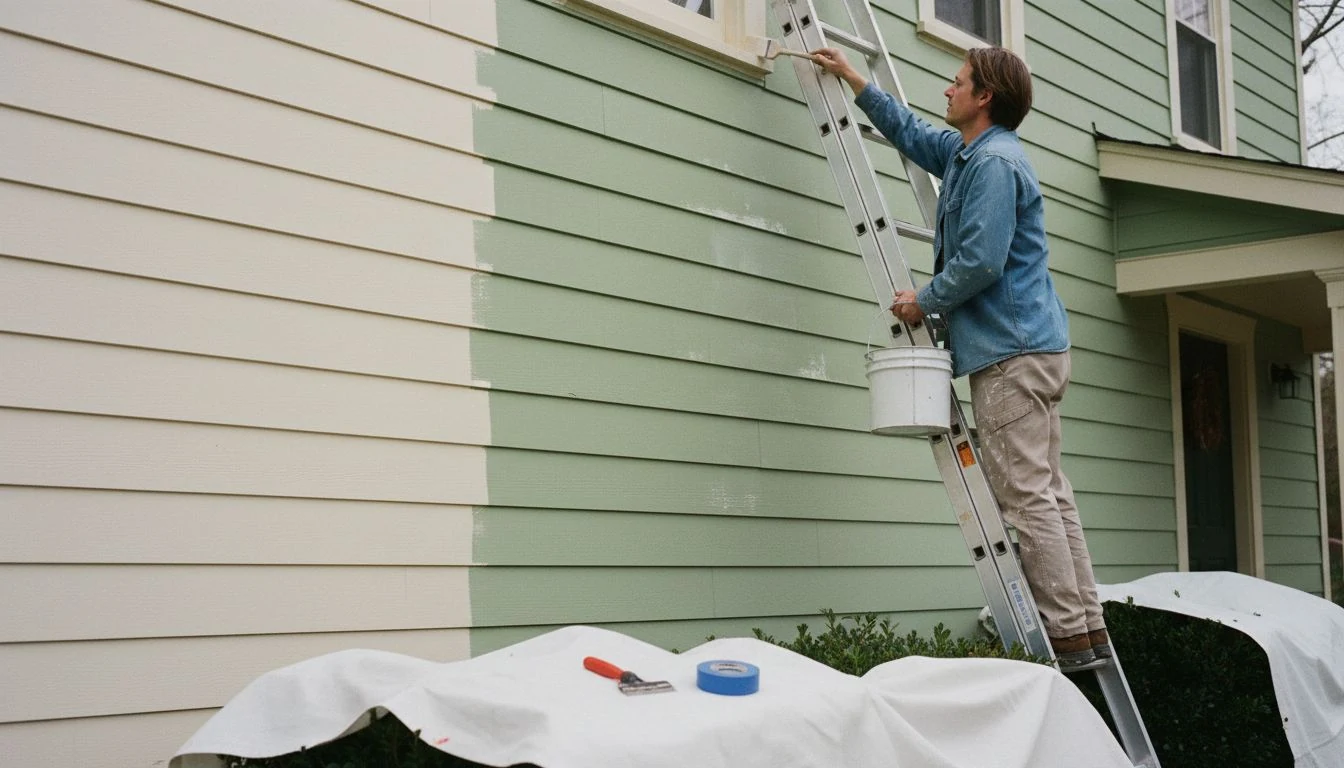
Last June I paid a crew $4,800 to paint the front and both sides of my house, and then I painted the back of it myself for $310 and one very long weekend. Same house. Same paint, same color, same month. That gap is not a story about me being cheap. It is the entire story of where exterior painting money actually goes, and once I watched it happen on my own driveway I could not unsee it.
The numbers, before I get into why they move so much. The average exterior house painting cost in 2026 runs about $1.50 to $4.50 per square foot of paintable surface, and most homeowners land somewhere between $3,000 and $7,500 for a professional repaint. A typical 2,000-square-foot home comes in around $3,200 to $8,000. But the paint itself is the cheapest thing on that invoice. Labor eats 65% to 75% of your exterior house painting cost. What moves your number is how far off the ground your walls go, and how much scraping the previous owner left behind for you.
How much does exterior house painting cost in 2026?
The national average exterior house painting cost sits near $3,177. That figure is close to useless on its own, though, because it averages a one-story ranch in a dry climate with a three-story Victorian that needs scaffolding. Ranges are more honest.
Most homeowners land in one of these three spreads for a professional job with mid-grade paint and light prep:
- One-story home: $1,500 to $4,000
- Two-story home: $3,000 to $6,500
- Three-story or hillside home: $4,500 to $10,000 and up
My two-story portion landed at $4,800, which sits right in the fat middle of that second row. When I got the bid I assumed the number was mostly product. It was not. Two painters worked five days on my house. A 2,000-square-foot two-story repaint typically takes two to three painters four to six working days, and that crew time is what you are buying. The paint on my walls cost roughly $600 of that $4,800.
Exterior house painting cost by siding type
What your walls are made of changes the price more than most people expect, and it changes it through prep, not paint. Stucco and brick drink coating and demand more surface work, so they run 25% to 40% above vinyl.
| Siding type | 2026 cost per sq ft | What makes it cheap or expensive |
|---|---|---|
| Vinyl | $1.25 to $3.00 | The cheapest surface to paint. It is smooth, it is uniform, and there is almost nothing to scrape. Sprays fast. |
| Brick | $1.40 to $4.20 | Porous, so it swallows more coating than the square footage suggests. Also a one-way door: painted brick has to stay painted. |
| Stucco | $2.00 to $5.00 | Texture is the problem. All those pits and ridges mean more paint per square foot and slower work with a brush at the edges. |
| Wood | $2.00 to $5.00+ | Priced by condition, not material. Sound wood is easy. Peeling wood is a scraping bill wearing a siding costume. |
Wood is the row that surprises people, because it has no fixed price. My back addition is wood lap siding and it was in good shape, which is the only reason a single weekend was enough. If it had been flaking, that same wall would have been three weekends and I would have paid someone.
What a second story does to your quote
This is the part I got wrong for years. I assumed painting was priced by area, like carpet. It is priced by area and reach.
A second story adds roughly 25% to labor. Not because the wall is different, but because a painter on an extension ladder moves slowly, climbs down to reposition constantly, and cannot safely rush. Three stories adds around 50% and often brings scaffolding, which is another $200 to $500, sometimes far more on a steep lot.
Run that against my driveway. The back addition is single story. I could reach the whole thing from a six-foot ladder standing on flat grass, which is why a homeowner with a free Saturday could do it at all. The front is two stories over a sloped bed of hydrangeas. Confidence has nothing to do with it. Ladder footing does, and that is exactly what $4,800 buys.
Prep is the line item that decides everything
Ask three painters why their bids differ by thousands and you will get three answers about paint quality. Ignore that. Compare their prep instead.
Power washing runs $150 to $650 and is usually folded into the base quote. The real variable is scraping and sanding, which costs $0.50 to $2.50 per square foot on weathered surfaces. On a 2,000-square-foot house that single line swings by four thousand dollars depending on how honest the estimator was about your peeling.
A bid that lands way under the others usually means a crew planning to wash your house and shoot fresh color straight over failing old color. That paint job looks great in September and starts flaking by spring. You did not save $2,000. You financed the same job twice.
A cheap quote is almost never cheaper paint. It is less scraping. Prep is the product you are buying, and paint is just what makes it visible.
The lead paint rule that can change your bid overnight
If your house was built before 1978, this paragraph is worth more than the rest of the post.
Federal rules require that anyone paid to disturb painted surfaces in a pre-1978 home be certified in lead-safe practices under the EPA’s Renovation, Repair and Painting program. Exterior repaints are scraping and sanding by definition, so this lands on real quotes for real houses. Certified crews cost more. They also contain the mess instead of grinding it into the dirt where your kids play.
And this is not paperwork theater. The EPA is blunt that lead dust forms when old paint is scraped, sanded, or heated, even in a well-kept home where the paint looked fine. Intact old paint is generally not the hazard. Old paint you attacked with a power sander on a breezy afternoon is.
If your home predates 1978 and a bidder shrugs at the question, that is your answer about the rest of their work. I asked all three of mine. Two had the certification ready. One told me not to worry about it, and that is the one who did not get my $4,800.
Can you paint your own house exterior?
Sometimes. The savings are real: doing it yourself cuts 60% to 75% off the line item. But look at what you are actually signing up for before you feel clever.
A DIY budget for a 1,500-square-foot single-story ranch runs $1,000 to $1,800 in paint, primer, caulk, and masking, plus $150 to $400 in rentals if you do not own a sprayer or a tall ladder. Figure one gallon per 350 square feet, so a 2,000-square-foot house needs 8 to 12 gallons plus 3 to 5 gallons of primer. Paint runs $20 to $40 a gallon for builder grade and $70 to $100+ for the premium stuff. An airless sprayer rents for $70 to $110 a day. A power washer is $100 to $200.
Then the number nobody puts on a blog graphic: 50 to 90 hours. Call it most of a summer of evenings, each one ending with you scrubbing your hands at the kitchen sink.
My honest line is the one my driveway drew. Paint what you can reach standing on the ground or a short ladder on level footing. Pay for everything above that. Falls are the risk that does not care how careful you are, and no siding is worth a hospital bill. If your whole house is single story with sound siding, DIY is a good deal. At two stories, what you are really paying a crew for is their insurance.
The mistake I paid for twice
On my back wall I scraped four bare patches down to raw wood, and I skipped priming them because it was 94 degrees and I wanted to be finished. Those four patches were flaking again by the following April. Everything I had primed held perfectly. So my $310 weekend became a $310 weekend plus a second afternoon, and the wall now has a faint ghost of a repair I can find from the yard. Prime bare wood. Always. The primer cost $28.
What drives exterior house painting cost up the fastest
Two houses with identical square footage can sit $4,000 apart, and the color has nothing to do with it. The tier you pick decides what you get, and it decides how soon you do this again. For a typical 2,000-square-foot home:
| Tier | Typical 2026 total | What you actually get | Realistic lifespan |
|---|---|---|---|
| Budget repaint | $3,000 to $4,500 | Wash, spot-scrape, one coat of builder-grade paint at $20 to $40 a gallon. Minimal caulking. Body color only, trim extra. | 3 to 5 years |
| Mid-range repaint | $4,500 to $7,500 | Wash, full scrape and sand of failing areas, primer on bare spots, two coats of $40 to $70 paint, caulk at joints. Body plus trim. | 7 to 10 years |
| Premium repaint | $7,500 to $12,000+ | Full prep, carpentry on rotted boards, primer everywhere, two coats of $70 to $100+ paint, multi-color scheme, written warranty. | 10 to 15 years |
Read that lifespan column as a cost-per-year column, because that is what it is. The budget job at $3,750 over four years is about $940 a year. The mid-range job at $6,000 over nine years is about $670 a year. The cheap one is the expensive one. It just bills you later, and it bills you in scraping.
What blows the exterior painting budget
- Rotted wood the estimator did not find. Every bid assumes your siding is paintable. When a crew starts scraping and hits soft boards around a window, that becomes carpentry at carpentry prices, mid-project, with your house half-finished and your leverage gone. Walk the walls with the estimator and push on the trim yourself before you sign.
- A second color you mentioned casually. Trim, shutters, and doors in a contrasting color mean masking, a separate setup, and a slower crew. It is one sentence in a conversation and hundreds of dollars on the invoice. Get it priced as a line item, not a nod.
- Paying for prep you could have done. This one runs the other way, and it is the cheapest money on the whole job. Scraping and sanding is $0.50 to $2.50 per square foot of pure labor with no skill floor. Clearing the beds, moving furniture, and knocking down the loose stuff yourself on the reachable walls shaves real money off a bid without touching quality.
How to save without buying a worse paint job
The biggest lever on your exterior house painting cost is making three bids describe the same house. Force them to quote the same scope, because a bid is only comparable if the prep matches. Ask each one, in writing, how many coats, whether primer is included, and what happens if they find rot. The bid that gets vague is the bid that will find surprises later. My own habit now is to walk every estimator to the same three problem spots on the house, so all three price the same reality. If a number still looks off after that, my guide on whether a contractor quote is fair walks through what to compare line by line.
Book in the shoulder season if you can. Crews are slammed in mid-summer and quote accordingly, and paint has temperature rules anyway, so late spring and early fall often buy you a better price and a better cure.
Then the honest one: if your siding is failing badly, price replacement before you price paint. Painting rotted wood is a $5,000 delay tactic. Run the math against what siding replacement costs first, because paint on bad siding is the most expensive product in this entire post. And if the repaint is one piece of a larger plan, it helps to see it beside what a full home renovation costs and against what interior painting costs before you decide which one gets this year’s budget.
Grab my free Project Cost Estimator. Before a single painter walks your property line, plug your square footage, siding type, and story count into my printable estimator so you meet all three bids already knowing your own fair range. It is the same one-page sheet that caught the $1,400 of scraping one bidder had quietly left out of his scope.
Frequently Asked Questions
How much does it cost to paint a 2,000-square-foot house exterior?
Roughly $3,200 to $8,000 in 2026 for a professional job, with most homeowners landing between $4,500 and $7,500 for mid-grade paint and real prep. A single story sits at the low end of that spread, two stories at the high end. Stucco or brick pushes it up another 25% to 40% over vinyl.
How often do you need to repaint a house exterior?
Every 7 to 10 years for a decent job, and every 3 to 5 for a cheap one. Your siding and climate move it too: vinyl and fiber cement hold color longer than wood, and coastal salt or desert sun shortens every estimate. Your walls will tell you before the calendar does. Chalky color that leaves dust on your palm means the surface is spent, and caulk lines gaping at the joints say the same thing.
Is it cheaper to paint your house yourself?
Yes on paper, by 60% to 75% of the line item. A single-story ranch runs $1,000 to $1,800 in materials plus $150 to $400 in rentals. But it costs 50 to 90 hours, and the savings shrink fast above the first story, where ladders and fall risk enter the math. Paint what you can reach from the ground safely, hire the height, and you keep most of the savings without the trip to the emergency room.
All prices here are 2026 estimates and vary by region, home condition, and contractor. Tessa is a hands-on homeowner, not a licensed contractor; use these ranges to ask sharper questions and always confirm figures with local pros.
Free DIY Project Cost Estimator
The spreadsheet I use to price out a project before I start, so a weekend job never blows the budget. Join the newsletter and I’ll send it over.
No spam, ever. Unsubscribe anytime. — Tessa
Keep reading — more on Painting & Finishing Costs
How Much Does Drywall Repair Cost in 2026? (By Damage Type + DIY vs. Hire)
The first hole I ever patched was a doorknob-sized crater my dog put in the hallway…
Read article →
How Much Does Interior Painting Cost in 2026? (Per Room + DIY vs. Hire)
A painter walked my house last spring, nodded at every room, and handed me a number…
Read article →
How Much Does It Cost to Paint Kitchen Cabinets in 2026?
The real cost to paint kitchen cabinets in 2026: DIY vs pro tables, per-door pricing, kitchen-size…
Read article →