
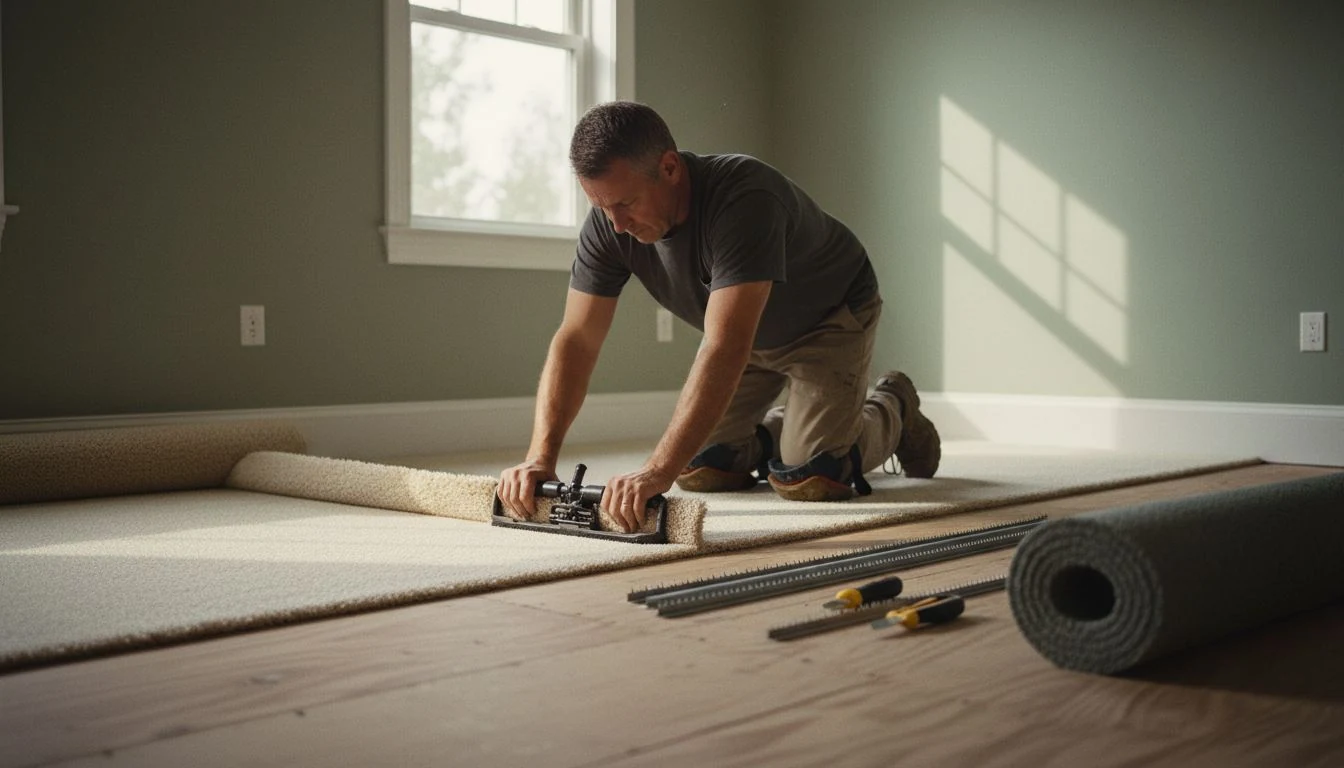
Three installers walked my upstairs hallway with the same laser measure, wrote down the same 620 square feet, and handed me quotes of $2,100, $3,400, and $5,900. Same house. Same week. I stood in my kitchen holding three pieces of paper that disagreed by almost four thousand dollars, thinking, one of you is lying to me. Turns out none of them were.
The short version, before the tables: the average carpet installation cost in 2026 runs about $3 to $8 per square foot installed, and most homeowners land near $5.60 once you add up carpet, padding, and labor. A standard 12×12 bedroom comes in around $500 to $1,600. A 400-square-foot living room runs $1,800 to $4,400. But the number on your quote has less to do with the carpet than you’d think. What moves your carpet installation cost is the fiber, the padding under it, and the four line items hiding behind the words “and install.”
How much does carpet installation cost in 2026?
Installed, all in, most residential carpet jobs land between $3 and $8 per square foot in 2026. The national average sits around $5.60 per square foot once carpet, padding, and labor are stacked together. You’ll see quotes as low as $2.50 and as high as $15, and both can be honest numbers. They’re just different tiers of the same product.
The clearest way to think about it is by grade, because that’s how the showroom is secretly organized whether they tell you or not.
| Grade | Typical fiber | 2026 installed cost |
|---|---|---|
| Budget | Polyester, olefin | $2.50 to $4.50 per sq ft |
| Mid-range | Nylon, triexta | $4.50 to $8.00 per sq ft |
| Premium | Premium nylon, wool | $8.00 to $15.00+ per sq ft |
Those are estimates and they swing hard by region. My $2,100 quote was budget polyester with a thin pad. The $5,900 was wool. The $3,400 in the middle was mid-grade nylon with a decent pad, and that’s the one I took, because that hallway sees a dog and two kids every single day. The cheap quote wasn’t a scam. It was just a carpet that would have looked tired in four years.
Carpet installation cost by room
Per square foot is how installers think. Per room is how the rest of us think. Here’s what the common jobs actually run in 2026, and I’ve put my own hallway numbers in here because round national averages never quite match a real house.
| Space | Typical size | 2026 installed cost |
|---|---|---|
| Small bedroom | 12×12 (144 sq ft) | $500 to $1,600 |
| Standard bedroom | 200 sq ft | $900 to $2,200 |
| Living room | 400 sq ft | $1,800 to $4,400 |
| Staircase | 13 to 16 steps | $400 to $650 |
| Whole upstairs | 600 to 900 sq ft | $2,000 to $6,500 |
Notice how wide those ranges are. A 200-square-foot bedroom swinging from $900 to $2,200 isn’t a measuring problem, it’s a fiber-and-pad problem. Same room, same labor, three times the material budget. Which is exactly why the next table matters more than this one.
Carpet installation cost by fiber type
This is the lever. Nobody in my three quotes led with fiber, and fiber was the entire difference between them. Here’s what each type runs for materials alone in 2026, before pad and labor, plus how long it realistically lasts.
| Fiber | 2026 material cost | Realistic lifespan |
|---|---|---|
| Olefin (polypropylene) | $0.70 to $5 per sq ft | 3 to 10 years |
| Polyester | $0.50 to $6 per sq ft | 5 to 15 years |
| Berber (loop pile) | $1 to $5 per sq ft | 10 to 15 years |
| Triexta | $2 to $5 per sq ft | 12 to 18 years |
| Nylon | $3 to $8 per sq ft | 12 to 20 years |
| Wool | $3 to $21 per sq ft | 20+ years |
My honest opinion, and installers rarely say this out loud: polyester is a fine carpet in a guest room nobody walks in, and a bad carpet in a hallway. It’s soft and it shrugs off spills. But it crushes. Walk the same path for two years and you’ll see your own footpath permanently pressed into it, and no amount of cleaning brings it back. Nylon bounces back. That’s the whole difference, and it’s why I paid the extra $1,300.
Triexta is the one worth asking about if you have kids. It’s the newer polyester cousin, resists stains almost aggressively, and holds up far better than standard polyester for about the same money. If a salesperson steers you straight from polyester to wool without mentioning triexta or nylon, that’s a small tell about whose budget they’re optimizing for.
What your quote actually includes
My four-thousand-dollar mystery got solved right here. “Carpet and install” is four or five separate things bundled behind a single number, and installers bundle differently. When I lined my three quotes up item by item at the kitchen table, the spread stopped looking like dishonesty and started looking like different scopes.
- Labor. Usually $0.50 to $1.50 per square foot on its own. This is the smallest piece of the puzzle, which surprises everyone.
- Padding. $0.30 to $1.80 per square foot. Basic rebond foam runs $0.30 to $0.60. Memory foam or rubber runs $0.90 to $1.80. The pad is the single most under-discussed line on the whole quote.
- Tearing out the old carpet. $0.50 to $1.50 per square foot for standard staple-down. Glued-down carpet jumps to $3 to $5 because it fights back.
- Hauling it away. $0.45 to $0.60 per square foot, or a flat $50 to $100 depending on how far the dump is.
My cheapest quote had excluded tear-out and disposal entirely. It was there in tiny type, and I’d have discovered it on install day when three guys stood in my hallway waiting for me to rip up 620 square feet of old carpet myself. That’s not a scam either, technically. But it’s the kind of thing you only catch if you know to look, which is the whole reason I write these guides.
Ask for every quote broken into those four lines. Any installer who won’t itemize is telling you something. The same line-item logic applies to every trade in your house, and it’s the backbone of how I decide whether a contractor quote is fair.
Why stairs cost so much more
Stairs are where carpet math stops making sense to normal people. Expect $14 to $36 per step for a straight staircase, and $25 to $50 per step for curved or pie-shaped ones. A typical run of 13 to 16 steps lands at $400 to $650.
Do the math and you’ll notice stairs cost several times more per square foot than a flat bedroom. The reason is that each step is a separate small installation, cut and wrapped and tucked by hand, on a surface where a quarter-inch of sloppiness shows forever and doubles as a tripping hazard. Nobody rolls out one big piece on a staircase. It’s sixteen tiny jobs stacked on top of each other.
If your stairs are curved, get that quoted separately and specifically. Pie-shaped treads are the single most skill-dependent carpet work in a house, and it’s the one place I’d pay the premium installer without blinking.
Can you install carpet yourself?
I’ll be straight with you, because I’m not a licensed contractor and I’m not going to pretend this one’s a casual weekend win. Carpet is the DIY flooring job I actively talk people out of, and I say that as someone who has personally installed vinyl plank, laid tile, and refinished a deck.
Here’s why. Carpet has to be stretched. Not laid, stretched, with a power stretcher that runs $40 a day to rent and takes real technique to use without either ripping the carpet or leaving it loose. Loose carpet ripples within a year, and ripples are both ugly and a trip hazard. You’re also working with tack strips, which are exactly what they sound like, and seams that will announce themselves forever if your cuts drift. Add the fact that a single roll weighs a couple hundred pounds and doesn’t fit up most staircases without a friend and some cursing.
The DIY math doesn’t help either. Labor is only $0.50 to $1.50 per square foot of a job that runs $3 to $8. So you’d take on the hardest part of the project to save the smallest slice of the bill. That’s a bad trade. Where you can genuinely save is on the demo: tearing out old carpet and pad yourself is unskilled, mildly gross, and knocks real money off the quote. If you want a floor you can actually install yourself, vinyl plank flooring is the honest answer, and the vinyl plank installation cost often lands close to mid-grade carpet anyway.
The hidden costs that ride along with carpet installation
Beyond the carpet itself, these are the extras that quietly show up on real quotes. Here’s what each runs in 2026 and whether it’s worth paying for. Treat every one as a line item you’re allowed to question.
| Add-on | Typical 2026 cost | Tessa’s take |
|---|---|---|
| Upgraded padding | $0.90 to $1.80 per sq ft | Worth it. The pad decides how the carpet feels and how long it survives. Cheapest place to buy real comfort. |
| Moving furniture | $50 to $200 per room | Skip it. Empty the room yourself the night before and keep the cash. |
| Subfloor repair | $200 to $1,200 | Only if they find soft spots or squeaks. Fix it now; it’s never cheaper with carpet on top. |
| Old carpet tear-out and haul | $0.95 to $2.10 per sq ft combined | The one job worth doing yourself. Pure labor, no skill, real savings. |
| Transition strips and thresholds | $3 to $12 per doorway | Small money, and quotes that omit them leave you with raw edges at every door. |
| Stair surcharge | $14 to $50 per step | Non-negotiable and fair. Confirm whether your quote counts a landing as a step. |
What blows the carpet budget
- Cheaping out on the pad to afford nicer carpet. This is backwards and it’s the most common mistake I see. A good carpet on a thin pad wears out fast and feels like a rug over plywood. Most warranties quietly require a minimum pad spec, so the cheap pad can also void the coverage you just paid for.
- Not asking whether tear-out and disposal are included. That’s $0.95 to $2.10 per square foot hiding in the fine print, which on 620 square feet is over a thousand dollars appearing on install day.
- Measuring the room instead of the roll. Carpet comes in 12-foot widths, so a 13-foot room means a seam plus real waste you pay for. Expect to buy 5% to 20% more than your room math suggests, and ask where the seam will land before you sign.
How to save on carpet installation without cutting corners
You don’t lower a carpet installation cost by buying worse carpet. You lower it by being an organized customer. Get three quotes, always, and make every one itemize labor, pad, tear-out, and haul separately, because that’s the only way to compare them honestly. Do the demo yourself. Empty the rooms yourself. Ask for the pad spec in writing, and check it against the carpet warranty before you sign anything.
Two things worth knowing that have nothing to do with money. New carpet off-gasses, and the EPA recommends running ventilation for the first 72 hours after installation to cut those emissions, which is free and takes one open window and a box fan. Their guidance on carpet and indoor air quality also suggests asking for low-emitting adhesives if any are used in your job. And if you’re carpeting anywhere that’s ever been damp, read the EPA’s guidance on mold and health first, because carpet is absorbent, and the official line is that carpet that grows mold usually has to be replaced rather than cleaned. Carpet over a moisture problem is money set on fire.
One more that saved me real money: I scheduled my install for late January. Flooring is seasonal, and the crews that are booked solid in September will negotiate in the dead of winter. If carpet is one line in a bigger project, it helps to see it against what a full home renovation costs, and if you’re still deciding between materials, compare it honestly against hardwood floor installation cost and laminate flooring installation cost before you commit a single room.
Grab my free Project Cost Estimator. Before you let a single installer measure your hallway, plug your square footage and fiber choice into my printable estimator so you walk into all three quotes already knowing your own fair range. It’s the same one-page sheet I used to catch the $1,200 of tear-out that one installer left out of the fine print.
Frequently Asked Questions
How much does it cost to carpet a 12×12 room?
In 2026, a 12×12 bedroom (about 144 square feet) runs roughly $500 to $1,600 installed, including carpet, padding, and labor. Budget polyester lands at the low end, mid-grade nylon in the middle, and wool at the top. Add $100 to $300 if the old carpet needs tearing out and hauling away.
Is carpet cheaper than laminate or vinyl plank?
Usually, yes, at the budget end. Basic carpet installs for $2.50 to $4.50 per square foot, which typically undercuts laminate and vinyl plank. But the comparison flips over time. Budget carpet lasts 5 to 10 years while vinyl plank commonly runs 20, so the cheaper floor today can be the pricier floor per year of use.
Do I really need new padding, or can I reuse the old pad?
Replace it. Pad compresses permanently under years of foot traffic, and installing new carpet on a flattened pad wastes most of what you just paid for. Padding is only $0.30 to $1.80 per square foot, and most carpet warranties require a minimum pad spec, so reusing an old one can void your coverage.
All prices here are 2026 estimates and vary by region, home condition, and installer. Tessa is a hands-on homeowner, not a licensed contractor; use these ranges to ask smarter questions and always confirm figures with local pros.
Free DIY Project Cost Estimator
The spreadsheet I use to price out a project before I start, so a weekend job never blows the budget. Join the newsletter and I’ll send it over.
No spam, ever. Unsubscribe anytime. — Tessa
Keep reading — more on Flooring & Tile Costs
How Much Does Epoxy Floor Installation Cost in 2026? (I Paid Twice)
The kit came in a box with a picture of a showroom floor on it. I…
Read article →
How Much Does Concrete Floor Installation Cost in 2026?
We pulled up the ruined carpet in the basement and there it was: a bare gray…
Read article →
How Much Does Laminate Flooring Installation Cost in 2026?
The first quote I got for laminate in my hallway and two bedrooms was $4,900, and…
Read article →
How Much Does Vinyl Plank Flooring Installation Cost in 2026? (Real Prices)
Vinyl plank flooring installation cost in 2026 runs $3 to $7 per sq ft installed. See…
Read article →