
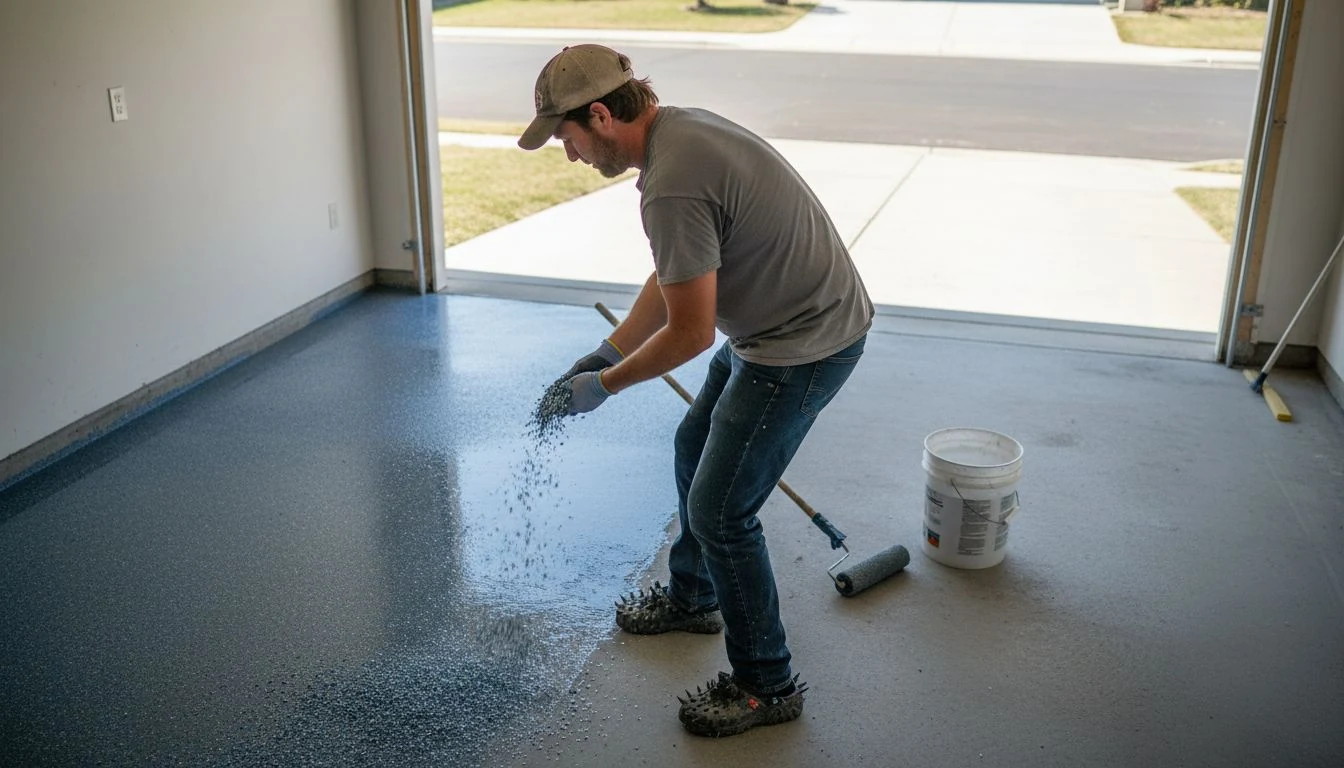
The kit came in a box with a picture of a showroom floor on it. I paid $189 for it on a Saturday in March, spent a weekend on my knees with an acid etch bottle and a roller, and for about a year and a half I was smug about it. Then I backed the car out one August afternoon and there were two gray patches on the concrete, shaped exactly like my front tires.
The epoxy floor installation cost in 2026 runs about $3 to $12 per square foot installed by a pro, which puts a normal two-car garage somewhere between $1,500 and $5,500. A DIY kit is $175 to $620 for the same floor. I have now paid for both, in that order, which is the expensive order.
Two quotes that both say “epoxy” can be four thousand dollars apart, and the difference is almost never the part you can see.
Jump to what you need:
- What it costs in 2026
- Cost by coating system
- Why prep is half the bill
- Hot tire pickup
- Flake, topcoat, and upgrades
- How long you lose the garage
- Kit or installer
- Where my money went
- FAQ
What is the epoxy floor installation cost in 2026?
Most homeowners pay $3 to $12 per square foot for a professionally installed garage coating in 2026. On a 400 to 500 square foot two-car garage, that is roughly $1,500 on the low end and $5,500 at the top, with a lot of real jobs landing near $3,500.
A single-car garage of about 240 square feet runs $900 to $2,900. A three-car bay at 700 square feet or so runs $2,400 to $8,000.
That spread is not regional pricing noise. It is three different products being sold under one word. The $3 quote and the $12 quote are not the same floor, they do not last the same number of years, and only one of them survives a hot tire in August.
One thing to get straight before you compare anything: this post is about a coating going onto a slab you already have. If your question is about pouring or finishing the concrete underneath, that is a separate job with separate numbers, and I broke it out in my guide to what concrete floor installation costs. Nothing here covers new slabs, leveling, or polishing.
Epoxy floor installation cost by coating system
This is the sheet I rebuilt after my floor failed, using three written quotes on my own garage plus what I paid for the kit that did not last.
| System | Installed, per sq ft (2026 est.) | 440 sq ft garage | Realistic life |
|---|---|---|---|
| DIY 1-part water-based kit | $0.40 to $1.40 (materials) | $175 to $620 | 1 to 5 yrs |
| Pro 1-part or thin-build epoxy | $3 to $5 | $1,320 to $2,200 | 3 to 6 yrs |
| 100% solids epoxy, no flake | $4 to $7 | $1,760 to $3,080 | 5 to 10 yrs |
| 100% solids epoxy + full flake + clear topcoat | $6 to $10 | $2,640 to $4,400 | 10 to 15 yrs |
| Polyaspartic or polyurea full system | $7 to $12 | $3,080 to $5,280 | 15 to 20 yrs |
| Metallic or designer epoxy | $9 to $16 | $3,960 to $7,040 | 10 to 15 yrs |
Read the first row against the last one. My kit worked out to $0.62 a square foot and gave me eighteen months. A polyaspartic system runs about $9 and gives you fifteen years or better. Per year of floor you actually get, the cheap one costs more, and the box it comes in does not mention that anywhere.
My honest read after living with both: 100% solids epoxy with a full flake broadcast and a clear topcoat is the sweet spot for a garage. Polyaspartic beats it on every measure that matters and charges you accordingly, and there are two situations where I think that trade is worth making. Straight 1-part epoxy from any source, pro or kit, is a coat of paint with a chemistry degree.
Why prep is half your epoxy floor installation cost
When a bid comes in cheap, prep is what got cut. Every time. This is the single most useful thing I learned and it took a failed floor to learn it.
Concrete is sealed at the surface by the troweling that finished it. A coating cannot bite into that. So the surface has to be opened up first, and there are two ways to do it that are not remotely equal.
Acid etching is the DIY route. You pour a diluted acid, it fizzes, you scrub and rinse and neutralize and wait for the slab to dry. Materials run $30 to $70. It roughens the very top of the surface and it does almost nothing on a hard-troweled or previously sealed floor. It is what came in my box. It is why my floor came up.
Diamond grinding is a walk-behind machine with segments that physically cut a profile into the concrete. Pros charge $1 to $3 per square foot for it, often folded into the quote instead of listed. Rental is $90 to $180 a day plus a vacuum. Shot blasting does the same job on bigger floors at $1.50 to $3.50.
Ask any bidder one question: are you grinding or etching. If the answer is etching, or the answer is vague, you are being quoted a floor with a countdown on it.
Two more prep lines that show up as change orders when nobody looked first:
- Crack and spall repair, $100 to $450 on a typical garage, more if the slab has settled or a corner has crumbled at the door.
- Moisture testing, $50 to $150. Concrete on grade wicks water up from the ground, and vapor pushing through will lift a coating no matter how well it was applied. A calcium chloride or relative humidity test is cheap and almost nobody volunteers to do one. This gets worse below grade, so if the basement is on your list too, price the coating as one line inside what finishing a basement costs.
Safety note that I did not take seriously enough the first time. Grinding concrete throws respirable crystalline silica, and it is not the kind of dust you shrug off. OSHA’s guidance on crystalline silica covers dust controls for exactly this work, and the practical version for a homeowner is a grinder with a dust shroud connected to a HEPA vacuum, not a shop broom and an open door. If you rent the machine, rent the shroud with it.
The coating itself off-gasses too, particularly solvent-based products in a closed garage. The EPA’s overview of volatile organic compounds indoors is worth two minutes before you seal yourself into a bay with a bucket. Cross-ventilate, and if the garage shares a wall with the house, keep that door shut.
Hot tire pickup, or why my first floor peeled
Tires get hot. On a summer highway run they get very hot, and hot rubber goes soft and slightly tacky. Park on a coating that never bonded properly and the tire grabs harder than the coating holds, and when you pull out the next morning you leave a patch of your floor stuck to the rubber.
That is hot tire pickup, and it is the number one killer of DIY garage floors. Mine went at eighteen months, both front tires, gray patches the size of dinner plates.
It is not really a product failure. It is a bond failure, and the bond was decided during prep, back when I chose fizzing over grinding. A 100% solids epoxy on a ground profile is far more resistant, and a polyaspartic topcoat is more resistant still.
The part that stung came later. Removing my failed coating was its own line item on all three quotes, $1.50 to $2 per square foot, because a partially bonded floor has to be ground off completely before anything new goes down. My $189 experiment added $660 to the real job. I paid a surcharge for the privilege of having tried.
Flake, topcoat, and the upgrades that move the number
Once you are pricing real systems, these are the choices that swing the quote.
Flake broadcast is the color chip you see in showroom garages. Partial coverage adds about $1 per square foot. Full broadcast, where chips are thrown until the floor rejects more, adds $1.50 to $3. Full is not a looks decision. It hides slab imperfections, it hides tire marks and drips, and it adds real texture so a wet floor is not a skating rink. If I could only add one upgrade, this is it.
Clear topcoat runs $1.50 to $3 per square foot. On a flake floor it is not optional, since it is what locks the chips down and gives you the flat surface. A polyaspartic topcoat over an epoxy base is the standard build for good reason.
And this is the argument for polyaspartic that nobody at the big box store makes: epoxy ambers under UV light. If your garage has a window, a glass door, or you leave the overhead door open on nice afternoons, a plain epoxy floor turns faintly yellow over a few years and it does not turn back. Polyaspartic is UV stable. My garage faces west and the door is open most of the summer, which is exactly why I paid for the topcoat.
An anti-slip additive runs $40 to $150 for a garage. Skip it if you are getting full flake, since the chips already give you texture. Add it on a smooth or metallic floor, especially if you live where cars come in wet with snow packed in the wheel wells.
Cove base, where the coating turns up the wall a few inches, is $4 to $9 a linear foot. It belongs in a workshop you hose down. In a garage that parks cars it is money you can keep.
How many days you actually lose the garage
No quote I got mentioned downtime anywhere, and downtime is what decided which system I bought.
A 1-part water-based kit takes foot traffic in about 24 hours and should not see a car for 5 to 7 days. Most people cheat this. Most people also get hot tire pickup.
A 100% solids epoxy system with topcoat takes foot traffic overnight and vehicles in 3 to 5 days, with full chemical cure closer to a week.
Polyaspartic is the fast one, and speed is half of what you are paying for. Foot traffic in 4 to 8 hours, cars back in 24. Crews often do the whole install in one day. The tradeoff is on their side, not yours: polyaspartic sets up in twenty to forty minutes in the bucket, which is why it is a terrible DIY product and a great professional one.
Plan for the garage being unusable, not inconvenient. Everything comes out, including the shelving if it is not on wheels, and the car parks on the street for most of a week. In January in Ohio that is a real cost. We did ours in May.
Should you buy a kit or hire an installer?
Buy the kit if: the slab is newer than about ten years, has never been coated or sealed, is dry, has no cracking worth mentioning, and you are honestly okay with a floor that looks great for a few years and then needs redoing. Rent the grinder anyway. The kit costs $175 to $620 in materials, the grinder rental adds $90 to $180, and a weekend gets you there.
Hire it out if: the slab has ever been coated or sealed, the slab is on grade in a wet climate, there is any cracking or spalling, you want it to last past five years, or you want a flake floor. Also hire it out for polyaspartic, always, because the working time is shorter than the time it takes to do one bay carefully.
My opinion, and I have earned it the dumb way: the DIY kit only makes sense on a garage you plan to redo again. As a permanent floor it is not competing with a professional system, it is postponing one. If I had gotten quotes first and skipped my $273 weekend, I would have spent $3,190 instead of $3,850, and I would have had three extra years of a floor I liked.
If this is one line in a bigger garage project, or if a concrete guy and a coating crew both have to show up, it is worth reading what a general contractor costs before you decide to schedule the trades yourself. And if the driveway leading up to it is also on the list, my driveway replacement cost breakdown has those numbers.
Where the epoxy floor installation cost actually went in my garage
My garage is 22 by 20, so 440 square feet. What I paid sits in the middle column, with the other two quotes I collected on the same floor in the same week on either side of it.
| Line item (440 sq ft garage) | Budget tier | What I paid (mid tier) | High tier |
|---|---|---|---|
| Surface prep | $46 (acid etch, DIY) | $0 (folded into grind below) | $880 (grind, itemized) |
| Removing my failed kit | n/a | $660 | $880 |
| Crack and spall repair | $0 (ignored it) | $180 | $340 |
| Moisture test | $0 (skipped) | $0 (included) | $120 |
| Base coat | $189 (1-part kit) | $1,940 (100% solids + full flake) | $2,510 (polyaspartic) |
| Clear topcoat | $0 (none) | $1,070 (polyaspartic) | $1,150 |
| Tools and supplies | $38 | $0 | $0 |
| Total | $273 | $3,850 | $4,980 |
| Per square foot | $0.62 | $8.75 | $11.32 |
What blows up the epoxy floor installation cost
- An old coating nobody priced. This was my $660 line, and it exists only because I coated the floor myself first. Any previous kit, sealer, or paint has to be ground off completely before a real system goes down, at $1.50 to $2 per square foot. Tell every bidder what is already on that slab, and if you do not know, let them scrape a test patch before they hand you a fixed number.
- Comparing a $3 quote to a $9 quote as if they are the same floor. They are different products with different prep and a decade of difference in service life. Make every bid write down three things in words: the prep method, the solids content or product name of the base, and whether there is a separate topcoat. The cheapest bid is usually the one that left prep out.
- Moisture coming up through the slab. A garage on grade in a wet climate can push vapor through concrete for years, and it will lift a perfectly applied coating from underneath while everyone blames the installer. A calcium chloride or RH test is $50 to $150 and it is the cheapest insurance in this entire project. Ask for it in writing on any below-grade or damp slab.
Grab my free Project Cost Estimator. Before you call anybody, measure the bay, note whether the slab has ever been coated, and write down which prep method each quote promises. It is the one-page sheet that would have stopped me from buying a $189 box and turning it into a $660 surcharge.
Frequently Asked Questions
How much does it cost to epoxy a two-car garage floor?
Budget $1,500 to $5,500 in 2026 for a professionally installed coating on a 400 to 500 square foot two-car garage, with many real jobs near $3,500. A 100% solids epoxy with full flake and a clear topcoat typically lands at $6 to $10 per square foot. A DIY kit for the same floor is $175 to $620 in materials, plus grinder rental if you do the prep properly.
Is a DIY epoxy garage floor kit worth it?
Only on a newer slab that has never been coated or sealed, and only if you rent a diamond grinder instead of acid etching. Kits applied over etched concrete are the most common cause of hot tire pickup, usually within one to three years. Mine failed at eighteen months and the removal added $660 to the professional job that replaced it.
Is polyaspartic better than epoxy for a garage floor?
It is more durable, UV stable so it will not yellow, and it returns the garage to you in about a day instead of most of a week. It also costs $7 to $12 per square foot against $4 to $7 for epoxy. The common build gets you both: a 100% solids epoxy base with a polyaspartic clear topcoat over it.
How long does an epoxy garage floor last?
A DIY kit lasts one to five years. A professional 100% solids epoxy lasts five to ten. Add full flake and a polyaspartic topcoat and ten to fifteen years is realistic, with a full polyaspartic system reaching fifteen to twenty. Surface prep predicts lifespan more reliably than the product does.
Can you epoxy over a cracked garage floor?
Cracks get repaired first, at roughly $100 to $450 on a typical garage. A coating is about two to three times the thickness of a business card and it does not bridge anything, so an unrepaired crack telegraphs straight through and reopens. Active or widening cracks mean something is moving in the slab, and that gets diagnosed before any coating goes down.
All prices here are 2026 estimates and vary by region, garage size, slab condition, moisture, whether an existing coating has to be removed, and local labor rates. Tessa is a hands-on homeowner, not a licensed contractor or concrete professional; use these ranges to ask sharper questions, and confirm slab moisture, crack repair, and product specifications with local installers before you sign anything.
Free DIY Project Cost Estimator
The spreadsheet I use to price out a project before I start, so a weekend job never blows the budget. Join the newsletter and I’ll send it over.
No spam, ever. Unsubscribe anytime. — Tessa
Keep reading — more on Flooring & Tile Costs
How Much Does Concrete Floor Installation Cost in 2026?
We pulled up the ruined carpet in the basement and there it was: a bare gray…
Read article →
How Much Does Carpet Installation Cost in 2026? (By Room, Fiber + DIY vs. Pro)
Three installers walked my upstairs hallway with the same laser measure, wrote down the same 620…
Read article →
How Much Does Laminate Flooring Installation Cost in 2026?
The first quote I got for laminate in my hallway and two bedrooms was $4,900, and…
Read article →
How Much Does Vinyl Plank Flooring Installation Cost in 2026? (Real Prices)
Vinyl plank flooring installation cost in 2026 runs $3 to $7 per sq ft installed. See…
Read article →