
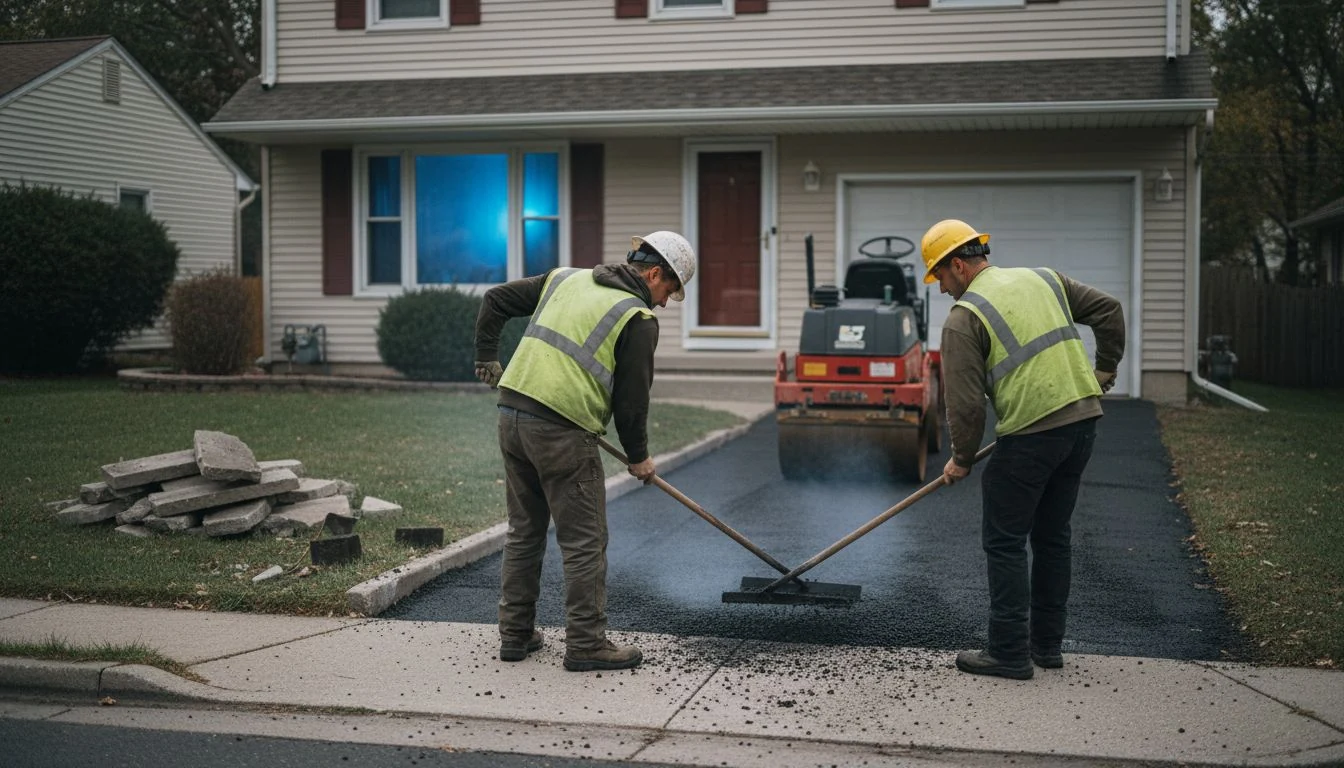
The crack in my driveway went from a hairline to something I could fit two fingers into over one winter. I kept telling myself it was cosmetic. Then a chunk the size of a dinner plate came loose under the mail truck, and the guy had to swerve around it, and I stood in the window feeling like the neighbor everyone talks about.
So I got three quotes. The cost to replace a driveway in 2026 runs roughly $4,500 to $11,000 for a standard two-car driveway, which works out to about $7 to $18 per square foot installed depending on what you put down. Gravel drops under that. Pavers blow straight through the top of it. My asphalt came in at $6,840 on 600 square feet, and about $1,400 of that was a line I had not budgeted for at all.
Jump to what you need:
- What it costs to replace a driveway in 2026
- Cost to replace a driveway by material
- How much is it to replace a driveway by size?
- The teardown nobody puts in the quote
- Repair, resurface, or replace?
- How to bring the cost down
- FAQ
What does it cost to replace a driveway in 2026?
Most homeowners land somewhere between $4,500 and $11,000. That band is wide because a driveway is priced by the square foot, and driveways vary in size more than almost anything else you will ever hire out. A short city drive might be 400 square feet. A rural one that runs to a detached garage can be 1,500.
The honest per-square-foot cost to replace a driveway breaks down like this in 2026: gravel $2 to $6, asphalt $7 to $13, plain concrete $8 to $18, and pavers $15 to $40. Those numbers include tearing out what is already there, prepping the base, and laying the new surface. They are installed prices, not material prices, and the difference between those two things is where a lot of budgets go sideways.
Here is what surprised me. The spread between the cheapest and most expensive quote I got for the exact same asphalt job was $2,310. Same square footage, same material, same street. The low bid skipped the base work. I only caught it because one of the other guys walked me around the edges and showed me where the old drive had sunk, which meant the gravel underneath had washed out and needed rebuilding. The cheap quote was cheap because it was going to fail.
Cost to replace a driveway by material
Material is the single biggest lever on the price, and it is the one decision that is genuinely yours. Everything else on the quote is dictated by your dirt and your square footage. This is the table I built while I was comparing bids.
| Material | Installed cost per sq ft | Typical 600 sq ft driveway | Lifespan | The catch |
|---|---|---|---|---|
| Gravel | $2 to $6 | $1,200 to $3,600 | 10 to 15 yrs | Needs topping up every 1 to 3 yrs |
| Asphalt | $7 to $13 | $4,200 to $7,800 | 15 to 20 yrs | Sealcoat every 3 to 5 yrs or it goes fast |
| Concrete (plain) | $8 to $18 | $4,800 to $10,800 | 25 to 40 yrs | Cracks are hard to fix invisibly |
| Stamped concrete | $14 to $28 | $8,400 to $16,800 | 25 to 30 yrs | Resealing every 2 to 3 yrs |
| Pavers | $15 to $40 | $9,000 to $24,000 | 30 to 50 yrs | Highest upfront by a mile |
| Permeable pavers | $18 to $45 | $10,800 to $27,000 | 30 to 50 yrs | May solve a drainage problem you have |
My opinion, and the contractors I talked to mostly agreed: in a cold climate, asphalt is the sensible default and concrete is the upgrade. Asphalt flexes with freeze and thaw instead of cracking, and when it does fail you can overlay it. In a hot dry climate the logic flips, because concrete stays cooler and asphalt softens.
That heat difference is bigger than people expect. The EPA notes that a pilot study in Arizona measured conventional paving like asphalt reaching surface temperatures up to 152 degrees at midday, with cooler reflective pavements running 10 to 16 degrees below that. If your driveway is the path your dog walks to the car in July, that is not a small detail.
Permeable pavers are the one option worth a second look even though they top the price list. They let rain soak through instead of sheeting into the street. The EPA’s guidance on permeable pavement points out these systems can cut the need for conventional drainage features, which in some jobs claws back part of the extra cost. If you already have a water problem at the bottom of your drive, price it before you dismiss it.
How much is it to replace a driveway by size?
Per-square-foot pricing is useless until you measure. Go out with a tape, get length times width, and then find your row. Most two-car driveways are 16 to 20 feet wide and 20 to 30 feet deep, which is where that 600 square foot number keeps coming from.
| Driveway size | Square feet | Asphalt | Concrete | Pavers |
|---|---|---|---|---|
| Single car, short | ~300 | $2,100 to $3,900 | $2,400 to $5,400 | $4,500 to $12,000 |
| Single car, standard | ~450 | $3,150 to $5,850 | $3,600 to $8,100 | $6,750 to $18,000 |
| Two car, standard | ~600 | $4,200 to $7,800 | $4,800 to $10,800 | $9,000 to $24,000 |
| Two car, long | ~900 | $6,300 to $11,700 | $7,200 to $16,200 | $13,500 to $36,000 |
| Long rural drive | ~1,500 | $10,500 to $19,500 | $12,000 to $27,000 | $22,500 to $60,000 |
One thing worth knowing before you measure: bigger is cheaper per foot. Crews have a fixed cost just showing up, so a 300 square foot job carries all that mobilization on very few feet. When I priced adding a small parking pad beside my drive, the extra 120 square feet only cost $780, well under my per-foot average. If you have been thinking about widening, doing it at the same time is the cheapest it will ever be.
The teardown nobody puts in the quote
This is the $1,400 line I mentioned. Getting rid of the old driveway is real work, and it is not always inside the number you are shown.
Demolition and haul-away runs about $1 to $3 per square foot, so $600 to $1,800 on a typical two-car drive. Concrete costs more to remove than asphalt because it is heavier and has to be broken up. If there is rebar in it, more again. Dump fees vary wildly by county, and some crews charge by the load rather than the foot.
My mistake was assuming “replace” meant the old one was going away as part of the deal. It did on two of my three quotes. On the third, the cheapest one, removal was a separate line further down that I skimmed past. When I put the three bids side by side properly, the cheap one was actually the middle one. I nearly picked it for the wrong reason.
Ask the question flat out: does this price include breaking out and hauling away the existing driveway, and are dump fees included. Get the answer in writing. This is the same discipline that applies to any big bid, and it is worth walking your quotes through how to tell if a contractor quote is fair before you sign anything. If your driveway is part of a bigger project, know what a general contractor costs to coordinate it too.
Repair, resurface, or replace?
Not every ugly driveway needs replacing, and this is where I see people waste the most money in both directions. Some pay $8,000 for a teardown they did not need. Others spend $2,000 on a resurface that fails in two years because the problem was never the surface.
The test is the base. Surface cracks, faded color, and small potholes are surface problems, and a repair or an overlay handles them. But if the driveway has sunk in spots, if there are areas of interlocking cracks that look like alligator skin, or if water pools in low points after rain, the gravel base underneath has failed. Nothing you put on top of a failed base survives.
Rough thresholds I would use. Under about 25 percent damage with a solid base, repair. More than that, or any sinking, replace. An asphalt overlay costs roughly $3 to $7 per square foot and buys 8 to 12 years, but only over a base that is genuinely sound. Concrete has its own middle path, and if it is the surface rather than the structure that has gone, the same logic behind pool deck resurfacing applies to a driveway slab.
Mine was 22 years old with sinking at the apron and alligator cracking across a third of it. Every contractor said the same thing without being prompted, which is usually how you know the answer is real.
How to bring the cost to replace a driveway down
Timing is the free lever. Asphalt and concrete both want warm dry weather, so crews are slammed from late spring through early fall and their prices reflect it. I booked in late September for early October and the same contractor came down $400 from his July number. Ask directly whether there is a shoulder-season rate. Plenty of crews would rather fill a slow week than sit idle.
Check permits before you assume. Many towns require one for a driveway replacement, especially where it meets the street, and a few regulate how much of your lot can be impervious surface. A permit is usually $50 to $200, but doing the work without one can mean tearing it out. Call your building department. It is a ten minute phone call.
And get three bids, genuinely three, from local crews who will walk the site. Not one, not two. The $2,310 spread I found was on a job small enough that I almost did not bother. If you are budgeting a bigger season of work, seeing the driveway beside your other numbers in a broad home renovation cost breakdown keeps the whole year honest, the same way it does when you are pricing siding replacement.
| Material | Mid-range cost (600 sq ft) | Expected life | Cost per year owned | Upkeep you will actually do |
|---|---|---|---|---|
| Gravel | $2,400 | 12 yrs | ~$200 | Regrade and top up, $150 to $400 a year |
| Asphalt | $6,000 | 18 yrs | ~$333 | Sealcoat every 3 to 5 yrs, $250 to $600 |
| Concrete (plain) | $7,800 | 30 yrs | ~$260 | Seal every 5 yrs, crack fill as needed |
| Stamped concrete | $13,500 | 25 yrs | ~$540 | Reseal every 2 to 3 yrs, $400 to $900 |
| Pavers | $16,500 | 40 yrs | ~$412 | Re-sand joints, reset the odd sunken paver |
Look at that fourth column, because it reorders everything. Asphalt is the cheaper driveway to buy and the more expensive one to own. Plain concrete costs about $1,800 more upfront on a 600 square foot drive and comes out cheaper per year because it lasts nearly twice as long. Gravel wins outright on paper, and then you spend every spring pushing stone back where it belongs.
What blows the driveway budget
- Demolition hiding on a separate line. The single most common reason a cheap bid stops being cheap. Removal and disposal is $600 to $1,800 on a standard drive, and if one contractor bundled it and another did not, you are not comparing the same job. Make every bidder quote it the same way before you look at a total.
- A base that failed and nobody priced. If the old drive sank, the gravel under it washed out, and rebuilding that base adds $2 to $4 per square foot. A bid that skips it buys you a driveway that cracks again in two or three years. Ask each contractor what they found at the edges and low spots.
- Drainage and slope you inherited. Water that runs toward your garage instead of away from it has to be solved during the pour, not after. Regrading, a trench drain, or a swale can add $800 to $3,000. Walk the drive in hard rain before you sign, and point out every puddle.
Grab my free Project Cost Estimator. Put your square footage in once and it fills in the range for each material, with separate boxes for demolition, base repair, and permits so nothing hides at the bottom of a bid. It is the sheet that caught the $1,400 haul-away line I had skimmed right past.
Frequently Asked Questions
How much is it to replace a driveway?
For a standard two-car driveway of about 600 square feet, expect $4,500 to $11,000 in 2026. Asphalt typically runs $4,200 to $7,800, plain concrete $4,800 to $10,800, and pavers $9,000 to $24,000. Your final number depends on square footage first, then material, then whether the base underneath needs rebuilding and who is hauling the old surface away.
Is it cheaper to resurface or replace a driveway?
Resurfacing is far cheaper, around $3 to $7 per square foot against $7 to $18 for full replacement, but it only works when the base is sound. If your driveway has sunk anywhere, holds puddles after rain, or shows interlocking alligator cracking, an overlay will crack through within a couple of years. In that case replacement is the cheaper option measured over a decade.
How long does a driveway replacement take?
The work itself is usually two to four days for a standard driveway, including demolition, base prep, and laying the new surface. The waiting is the longer part. Asphalt needs about three days before you park on it and roughly a month before sealcoating. Concrete needs about seven days before vehicles and closer to 28 days to fully cure.
All prices here are 2026 estimates and vary by region, driveway size, site access, soil conditions, and local labor markets. Tessa is a hands-on homeowner, not a licensed contractor; use these ranges to ask sharper questions and always confirm figures, permits, and contract terms with local pros before you sign.
Free DIY Project Cost Estimator
The spreadsheet I use to price out a project before I start, so a weekend job never blows the budget. Join the newsletter and I’ll send it over.
No spam, ever. Unsubscribe anytime. — Tessa
Keep reading — more on Exterior & Structural Costs
Gutter Cleaning Cost: What I Paid, and the Month It Stops Being Optional
Gutter cleaning cost in 2026 runs $120 to $425 for most houses. Real quote numbers, what…
Read article →
Foundation Repair Cost in 2026: The Crack That Matters and the One That Does Not
A man in a branded polo put a level against my basement wall, made a face…
Read article →
Roof Repair Cost in 2026: What It Costs by What Actually Broke
The stain showed up on the upstairs hallway ceiling the morning after a March storm, about…
Read article →
Garage Door Spring Replacement Cost in 2026 (and Why I Do Not DIY This One)
It sounded like a rifle going off in the garage at 6:40 on a Tuesday morning.…
Read article →