
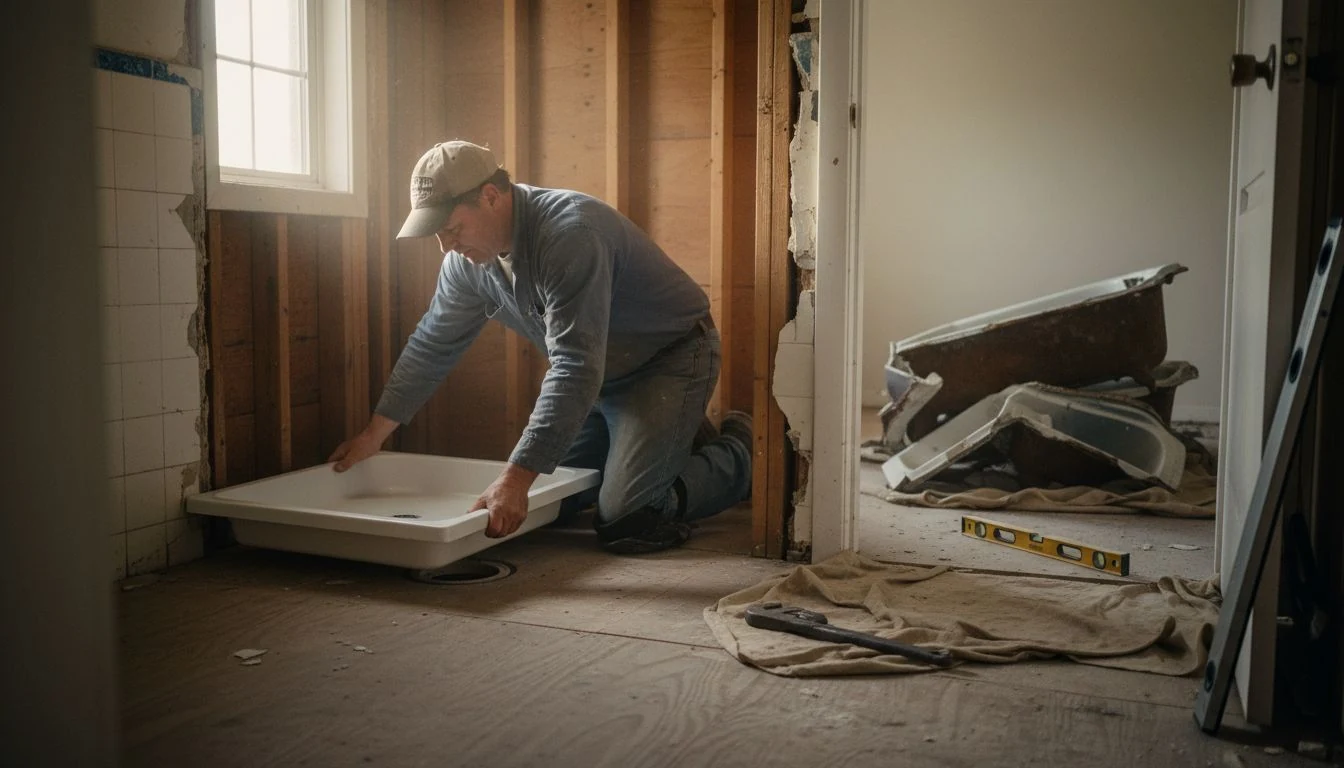
My dad had his knee replaced in March, and the first night he stayed with us he stood in the hall bathroom looking at our cast iron tub. Sixteen inches of wall to swing a new knee over. He didn’t say anything. He went down the hall to the half bath and washed up at the sink, and I stood in the kitchen feeling like the worst host in Ohio.
A tub to shower conversion cost in 2026 runs about $3,000 to $12,000 installed, and most people land between $4,500 and $8,000. An acrylic kit dropped into the same footprint is the cheap end. A tiled shower with a new drain location and a curbless entry is the expensive end. The biggest swing is not the tile you pick. It is whether the plumbing has to move.
We had not filled that tub in four years. It was a step stool for reaching the window.
Jump to what you need:
- What a tub to shower conversion costs in 2026
- Cost by the kind of shower you build
- The drain line that decides your budget
- What the quote leaves out
- Curbless, grab bars, and what accessibility adds
- Should you keep one tub in the house?
- What you can DIY and what you should pay for
- Where the money actually goes
- FAQ
What does a tub to shower conversion cost in 2026?
Most homeowners spend $4,500 to $8,000. That is the honest middle for a standard 60 by 32 inch alcove, which is what the majority of American hall baths have, and it assumes the new shower stays where the tub was.
The wider band underneath it is $3,000 to $12,000. It is that wide because “tub to shower conversion” describes two different jobs wearing the same name. One is a swap. The other is a small remodel with demolition, a plumber, a tile setter, and an inspection.
I got three written quotes over eleven days last spring. A one-day acrylic system, quoted in my living room at $9,400 with a discount that expired at midnight. A local plumber and a tile guy working together, $5,900. And a general contractor at $11,200, because he had priced the whole bathroom, which I had not asked for. Same 60 inch alcove. Same week.
We went with the $5,900. It took nine days from tear-out to first shower, not one, and I would make that trade again.
Tub to shower conversion cost by the kind of shower you build
This is the table I kept on my phone while the quotes came in, corrected afterward against what we paid and what two neighbors paid the same season.
| Shower type | Installed cost (2026 est.) | Typical timeline | Best for |
|---|---|---|---|
| Acrylic or fiberglass kit, same footprint | $3,000 to $6,000 | 1 to 3 days | Rentals, secondary baths, tight budgets |
| Branded one-day system (in-home sales) | $6,000 to $14,000 | 1 to 2 days | Buyers paying for speed and a warranty |
| Tiled shower, pan kit, existing drain | $5,000 to $9,500 | 7 to 12 days | Most homeowners, best value per year |
| Tiled shower, drain relocated | $7,000 to $13,000 | 10 to 15 days | Changing the layout or going wider |
| Curbless or roll-in, tiled | $9,000 to $20,000 | 2 to 4 weeks | Aging in place, wheelchair access |
The gap between rows three and four is worth staring at. Same shower, same tile. The only difference is a pipe moving about eighteen inches, and it costs thousands.
One thing the table cannot show you: the acrylic kits have gotten good. The seam-free ones with a solid surface base do not look like a camper anymore. I talked myself out of one because I wanted tile, and if I am honest about the value, tile was a want.
The drain line that decides your whole budget
A tub drain sits at one end of the tub, roughly six inches from the wall, and it is usually a 1.5 inch line. A shower drain sits in the middle of the pan, and modern code generally wants 2 inches so it can handle the flow without pooling around your ankles.
That gives you three versions of this job at three very different prices:
- Drain stays, line stays. You use a shower base designed for an end drain. Cheapest path, adds nothing.
- Drain stays, line upsized to 2 inches. The plumber opens the floor at the existing hole. Usually $400 to $900.
- Drain moves to the center. Now the floor comes up, and if your joists run the wrong way the plumber works around them instead of through them. We were quoted $600 for this. The final bill was $1,450, because the joists ran perpendicular and there was old galvanized pipe under there nobody had mentioned.
Ask the plumber to look under the bathroom before quoting, from the basement or the crawlspace, with a flashlight, while you stand there. Ninety seconds of looking separates a real number from a hopeful one. I skipped it, and that is the $850 I paid for the lesson.
What the quote leaves out
Every conversion quote I have seen prices the shower. Very few price the room the shower lives in.
The wall was mine. When the old tile surround came off, it took the drywall with it in sheets, because in 1974 they set tile on whatever was handy. Behind it was gray board that crumbled. New cement backer, waterproofing membrane, and drywall repair up to the ceiling ran $780 that I had budgeted zero dollars for.
The other lines that show up late:
- Flooring. The old tub sat on the subfloor and the tile stopped at its apron, so pulling the tub leaves a bare rectangle. Patching it invisibly is close to impossible. Plan on a new floor or a threshold you can live with.
- The valve. A tub filler valve and a shower valve are different parts, and swapping means opening the wall. If your house has a two-handle setup from before pressure-balancing valves were required, you are replacing it regardless. Figure $350 to $900 with labor.
- Glass. A curtain is $40. Frameless glass on a 60 inch opening was $1,600 for us and took three weeks to arrive after templating, which happens after the tile is done. The glass is a separate project with its own timeline and it rarely gets mentioned that way.
- The permit. Moving plumbing usually requires one, roughly $75 to $400 depending on your town, plus an inspection before the walls close. The FTC’s guidance on avoiding home improvement scams is blunt about contractors who suggest skipping it. So am I.
None of this is exotic. It is just not on the one-page proposal, and it is how a $5,900 quote became a $7,130 job for us. For the wider picture of how these line items stack up across a whole room, I broke down what a full bathroom remodel costs in 2026 separately.
Curbless, grab bars, and what accessibility actually adds
This was the whole reason we started, so I went deep on it.
A standard conversion still has a curb, usually four to six inches. That is a lot better than a sixteen inch tub wall. A truly curbless shower means the floor is sloped and recessed, which on a wood-framed floor means sistering or notching joists, and that is a structural job. It is why curbless starts around $9,000 and climbs from there.
The middle ground almost nobody offers unprompted: a low-profile base with a two inch curb and a folding seat. We spent $340 on a wall-mounted teak seat and the blocking behind it, and it is the most used thing in that bathroom.
On grab bars, get the blocking in while the walls are open. Adding solid wood behind the tile costs almost nothing during framing and turns into a real wall repair afterward. Bars mount into blocking or studs and hold 250 pounds. Suction cup bars are not grab bars, and I would not let my dad near one. The US Access Board’s guidance on bathing rooms lays out the actual dimensions and mounting heights, and even if your house is not held to ADA standards, it is the best free spec sheet you will find for building this right.
While the valve is out, this is also the cheapest moment you will get to change the showerhead. EPA WaterSense lists heads that use 2.0 gallons per minute or less without feeling weak, and a handheld on a slide bar is worth more to someone with a bad knee than any tile upgrade in this article.
Should you keep one tub in the house?
My take, and agents will argue with me on half of it.
Keep one tub somewhere in the house if you can. Not because a shower hurts your appraised value, it usually does not, but because families with small kids screen listings for a tub and cross houses off before they ever walk in. That is a buyer-pool problem rather than a valuation one.
If your primary bath has a tub and the hall bath has one nobody has filled since the Obama administration, convert the hall bath. Easy call. It is the one we made.
If you have exactly one bathroom, think harder. In a one-bath house the tub is doing real work for resale, and a full conversion is worth pricing against a tub replacement with a good handheld and grab bars, which lands closer to $1,200 to $3,000. Not every accessibility problem needs a demolition to solve it. My rundown of what home renovations cost in 2026 has the comparison across other rooms if you are deciding where the money does the most good.
What you can DIY and what you should pay for
I am a capable DIYer and I paid for most of this one, which is not something I say often.
Do it yourself: the demolition. Pulling an old tub is satisfying and saves $300 to $700 in labor. A steel tub cuts into pieces with a reciprocating saw and a metal blade in about forty minutes. A cast iron one gets broken with a sledge, in a respirator and safety glasses, with the tub covered in a moving blanket to catch shards. Ours weighed enough that leaving in six pieces was the only way it was getting out of that room. Also yours: hauling debris, painting, the curtain rod, the seat, and the final fixtures.
Pay for it: the pan and the waterproofing. A shower pan that fails does not announce itself. It rots the subfloor for two years, then the ceiling below gets a stain, and the repair is five figures. Pay someone who does this weekly, get the pre-slope right, and ask them to water-test the pan for 24 hours before any tile goes down. A tile setter who refuses that test has told you something useful.
Also pay for the valve, any pipe work, and the glass. For a sense of what tile labor runs on its own, my tile installation cost breakdown has the per-square-foot numbers, and if you are weighing whether to hire one person to run the whole thing, I wrote about what a general contractor costs and when their markup earns itself.
Where the money actually goes in a tub to shower conversion
This is our real invoice, reorganized, next to the low and high ends I collected from the other quotes. It is the sheet I wish someone had handed me in March.
| Line item | Budget tier | What we paid (mid tier) | High tier |
|---|---|---|---|
| Tub removal and haul-off | $0 (DIY) | $0 (DIY) | $700 |
| Plumbing: drain and valve | $450 | $1,450 | $2,600 |
| Wall prep, backer, waterproofing | $400 | $780 | $1,900 |
| Base or pan | $350 | $620 | $2,200 |
| Tile and setting labor | $0 (kit walls) | $2,180 | $6,500 |
| Fixtures and trim | $200 | $500 | $1,400 |
| Door or glass | $40 (curtain) | $1,600 | $3,500 |
| Permit and inspection | $75 | $0 (in labor) | $400 |
| Total | $1,515 | $7,130 | $19,200 |
What blows up the tub to shower conversion cost
- Moving the drain without looking underneath first. This is the one that got me. A center drain sounds like a detail and it is a floor-opening, joist-dodging plumbing job. Have the plumber inspect from below before you accept a number, and ask which direction the joists run and whether any galvanized or cast iron is left in that run. A quote written without that look is a guess with a signature on it.
- The wall you inherit when the surround comes off. Estimators do not price substrate they cannot see. On any house built before about 1990, assume the tile came off with the wall and budget $500 to $1,500 for backer board, waterproofing, and drywall repair. If it turns out fine, you got a rebate. Skip it and you get a change order at the worst possible moment.
- Signing at the in-home sales appointment. The $9,400 living room quote with the midnight deadline was $3,500 more than the same job from two local trades, and the pressure is the product. Get three written quotes over at least a week, and do not sign the day someone is standing in your bathroom with a tablet. For a checklist on reading those bids, here is how to tell if a contractor quote is fair.
Grab my free Project Cost Estimator. Before you take a single conversion quote, fill in your alcove measurements, whether the drain is moving, and what you plan to demo yourself. It is the same one-page sheet that showed me the $9,400 living room pitch and the $5,900 local bid were the identical shower.
Frequently Asked Questions
How much does a tub to shower conversion cost?
Budget $3,000 to $12,000 in 2026, with most homeowners landing between $4,500 and $8,000 for a standard 60 by 32 inch alcove. An acrylic kit in the existing footprint runs $3,000 to $6,000. A tiled shower with the drain relocated runs $7,000 to $13,000. Curbless entry starts around $9,000 because it involves the floor structure rather than the walls alone.
Is it cheaper to convert a tub to a shower or replace the tub?
Replacing a tub with a new tub is cheaper, usually $1,200 to $3,000, because the drain, the valve, and the footprint all stay put. Conversion costs more because it changes the plumbing and the waterproofed area. If your goal is easier entry rather than a shower specifically, a new tub with a handheld and properly blocked grab bars solves much of the problem for a third of the money.
How long does a tub to shower conversion take?
An acrylic kit is one to three days. A tiled shower is seven to twelve working days including cure time for the pan and the grout, and closer to fifteen if the drain moves and an inspection has to be scheduled between the plumbing and closing the walls. Frameless glass adds two to four weeks after that, since it is templated only once the tile is finished.
Do I need a permit to convert a tub to a shower?
Usually yes if any plumbing moves or the valve is replaced, which is nearly always. Fees typically run $75 to $400 and the inspection has to happen before the walls are closed up. A like-for-like insert with no plumbing changes sometimes does not require one. Call your local building department and ask directly, because the answer varies by city and an unpermitted bathroom becomes your problem at closing.
Does removing a bathtub hurt resale value?
Converting a secondary or hall bathroom is generally fine and often preferred by buyers. Leaving a house with no tub at all is the risk, mainly because families with young children screen listings for one. If you have a single bathroom, keep a tub in it or price the conversion knowing it narrows your buyer pool.
All prices here are 2026 estimates and vary by region, bathroom size, shower type and materials, floor construction, plumbing condition, and local permit and labor rates. Tessa is a hands-on homeowner, not a licensed contractor, plumber, or occupational therapist; use these ranges to ask sharper questions and always confirm figures, code requirements, and accessibility needs with local pros and your building department.
Free DIY Project Cost Estimator
The spreadsheet I use to price out a project before I start, so a weekend job never blows the budget. Join the newsletter and I’ll send it over.
No spam, ever. Unsubscribe anytime. — Tessa
Keep reading — more on Remodel & Renovation Costs
Boiler Replacement Cost: Gas, Oil, and Combi Boilers Compared
My friend Marisol called me on a Sunday in October with her coat on inside the…
Read article →
HVAC System Replacement Cost: Furnace, AC, or Both at Once
The tech who told me my air conditioner was done also handed me a second price…
Read article →
Furnace Tune Up Cost: What a Fall Service Includes (and What to Skip)
Three companies left door hangers on my porch the same week in September. One said $79.…
Read article →
Furnace Blower Motor Replacement Cost in 2026: PSC vs ECM
My dad called on a Sunday in January and opened with “the furnace is running but…
Read article →