
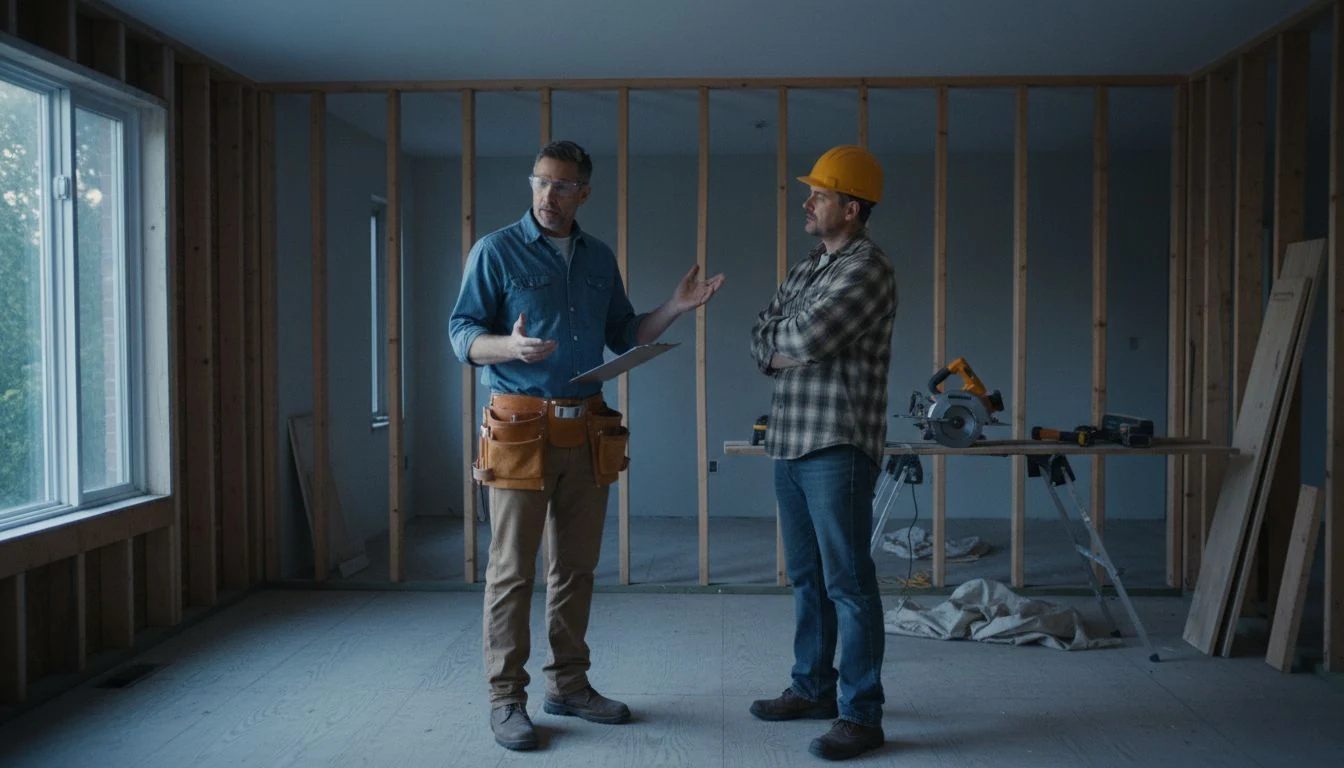
The first time I hired a general contractor, I nearly walked out over a number I did not understand. His bid was $4,200 higher than the sum of the quotes I had collected myself from a plumber, a tiler, and an electrician. I thought he was padding it. He was not. That gap was his fee, and once I understood what it bought, I stopped seeing it as a markup and started seeing it as the cheapest line on the whole job.
So how much does a general contractor cost? In 2026 the general contractor cost on a residential job runs 10 to 20 percent of the total project on straightforward work, and 20 to 25 percent on complex or high-end jobs. On a $40,000 kitchen that is $4,000 to $8,000 of GC fee sitting inside the total. It feels like a lot until you price out what happens when nobody is running the job.
Jump to what you need:
- What a general contractor costs in 2026
- General contractor cost by pricing model
- What the markup actually pays for
- When a GC is worth it, and when to run it yourself
- General contractor cost by project size
- FAQ
What does a general contractor cost in 2026?
The honest answer is that the general contractor cost is almost never a separate invoice. It is baked into the total bid as a percentage of the job, which is exactly why homeowners miss it and then feel ambushed when they add up the trades themselves. The standard band is 10 to 20 percent for a normal remodel, climbing to 20 to 25 percent when the work is complicated, custom, or on a tight timeline.
Some GCs quote it as a flat management fee instead, often $300 to $500 a day on a small job, or a fixed number written into the contract. Others bill hourly, and a working general contractor cost by the hour lands around $50 to $150 depending on your market and whether they are swinging a hammer or only managing. There is no single right structure. There is only the one your contract actually spells out, and the fight you avoid by reading it before you sign.
Here is the part nobody tells you. On my kitchen, the GC’s 15 percent did not sit on top of my three quotes. His trade prices were lower than mine, because his plumber does forty jobs a year with him and gave him a number I would never get as a one-time customer. The fee was real, but so was the discount underneath it. Net, the managed job cost me about $1,900 more than herding the trades myself, and it took eleven weeks off my life that I got back.
General contractor cost by pricing model
Before you compare two bids, find out how each contractor is charging, because a 15 percent number and a $12,000 number can be the exact same job or wildly different ones. This is the table I keep on my phone now.
| Pricing model | Typical 2026 cost | Best for | The catch |
|---|---|---|---|
| Percentage markup | 10 to 20% of project (20 to 25% if complex) | Most standard remodels | Fee grows if the job grows |
| Cost-plus | Trade costs + 10 to 20% fee, itemized | Unknowns, gut jobs | Open-ended; needs a cap |
| Fixed / flat fee | $5,000 to $30,000+ by scope | Well-defined projects | Change orders cost extra |
| Hourly (managing) | $50 to $150 per hour | Small jobs, consults | No ceiling without one written in |
| Daily supervision | $300 to $500 per day | Short, fast projects | Delays add days you pay for |
| Per square foot (new build) | $50 to $200+ per sq ft, GC inside | Additions, new construction | Finish level swings it hard |
Cost-plus is the one that scares people, and it should not, as long as you put a not-to-exceed number in the contract. It is the most transparent model there is, because you see every trade invoice and the fee sits on top in plain sight. The general contractor cost is the honest thing on the page instead of the hidden thing. I would take a capped cost-plus over a suspiciously round fixed bid any day.
What the general contractor markup actually pays for
When I thought the fee was padding, it was because I could not see the work it covered. A GC is not a middleman taking a cut. They are the person whose phone rings at 6 a.m. when the tile that was supposed to arrive Monday is sitting in a warehouse in another state.
That fee pays for scheduling the trades in the right order so the electrician is not standing in a room the drywaller has not closed up yet. It pays for pulling permits and standing in front of the inspector, which matters more than it sounds, because unpermitted work can wreck a home sale years later. The Federal Trade Commission’s guidance on avoiding home improvement scams spells out what to check before you hand that risk off, from licensing and insurance to who pulls the permits.
It also pays for their crew existing at all. Construction management is a real trade with real training. The Bureau of Labor Statistics tracks construction managers as their own occupation, with a median wage well into six figures, because coordinating a build without blowing the budget or the schedule is a genuine skill and not a phone-call-forwarding service. You are renting that skill for the length of your project.
And it pays for the relationships. The lower trade prices a good GC gets are half the reason the math works. My GC’s number for the plumbing was $900 under my own quote. Multiply that across five trades and the fee starts paying for itself before you even count the eleven weeks.
When a general contractor is worth it, and when to run it yourself
Not every job needs one, and pretending otherwise is how you overpay. The rule I use is simple: how many trades have to talk to each other, and how much does a mistake cost.
A single-trade job almost never needs a GC. Getting a bathroom fan replaced or a room painted, you call the painter directly and skip the fee entirely. Same with a job where the sequence does not matter much. But the moment three or more trades have to hand off to each other in a set order, or the moment a permit and an inspection are involved, the general contractor cost usually earns itself back in avoided mistakes and time. A full kitchen remodel or a bathroom remodel is squarely in GC territory. So is finishing a basement, where framing, electrical, plumbing, insulation, and drywall all stack in a fixed order.
Being your own GC is legal in most places and can save you that 10 to 20 percent. I did it once, on a $9,000 laundry-room job, and I will be straight with you: I saved about $1,400 and I earned every dollar of it. I made the mistake of scheduling the flooring before the plumber finished, and the rough-in tore up two boards I had already paid to install. That single sequencing error ate a third of what I saved. Owner-GC works when your job is small, your trades are reliable, and you can be on site to make decisions. On a big job with a real deadline, the fee is cheaper than your own learning curve.
Whichever way you go, the skill that protects you is reading a bid. Before you sign anything, walk it through how to tell if a contractor quote is fair, because a fair general contractor cost hides inside a total that only makes sense when you know how the fee is built.
General contractor cost by project size
A percentage is abstract until you put a real project total under it. This is what the fee actually looks like in dollars at each tier, so you can spot when a bid’s markup is inside the normal band and when it has quietly wandered out of it.
| Project total | GC fee at 10% | GC fee at 15% | GC fee at 20% | Typical job at this size |
|---|---|---|---|---|
| $10,000 | $1,000 | $1,500 | $2,000 | Small bath refresh, flooring |
| $25,000 | $2,500 | $3,750 | $5,000 | Mid bathroom, basement start |
| $40,000 | $4,000 | $6,000 | $8,000 | Full kitchen remodel |
| $75,000 | $7,500 | $11,250 | $15,000 | Whole-floor gut, small addition |
| $150,000 | $15,000 | $22,500 | $30,000 | Large addition, major renovation |
Read that $40,000 row against your own quotes. If your kitchen came in at $40,000 managed and the trades alone would have run you $35,000 to $37,000, the general contractor cost inside that bid is normal. If the managed total is $50,000 against $36,000 of trades, that is a 39 percent markup wearing a nice suit, and it is worth a hard conversation. Seeing it beside a broad home renovation cost breakdown keeps the whole season’s budget honest.
What blows the general contractor budget
- Change orders you asked for without asking the price. “Can we also move the outlet” sounds free and never is. Every change during the build gets the full fee applied on top, often at a worse rate than the original bid, because now the GC has the upper hand and a crew already on site. Decide the scope before demolition, and put every change in writing with its own number attached.
- Cost-plus with no ceiling. The most transparent model becomes the most dangerous one the second you skip the not-to-exceed clause. Without a cap, a job that hits surprises just keeps spending your money with the fee riding along on every dollar. Never sign cost-plus without a written maximum you both agree to.
- Comparing bids that use different pricing models. A fixed $45,000 and a “15 percent” bid are not comparable numbers until you know what the percentage is riding on. Homeowners pick the lower-looking one and get surprised at the end. Make all three bidders quote the same way, or translate them yourself before you choose.
Grab my free Project Cost Estimator. Before a single GC walks your house, fill in each trade’s rough cost and the markup band, and the sheet shows you what a fair managed total should land at. It is the same one-page tool that showed me a bid I almost rejected was actually $1,900 well spent, not $4,200 wasted.
A conversion is the classic job people cannot decide whether to hand to a GC, and the numbers are in my tub to shower conversion cost breakdown.
Frequently Asked Questions
How much does a general contractor cost on average?
Most residential general contractor cost lands at 10 to 20 percent of the total project, rising to 20 to 25 percent for complex or high-end work. On a $40,000 kitchen that is roughly $4,000 to $8,000 of fee built into the total. Some GCs charge a flat fee or bill hourly at $50 to $150 instead. The percentage is the most common structure, but the one in your contract is the only one that counts.
Is it cheaper to be my own general contractor?
Yes, on paper you save the 10 to 20 percent fee, and on a small, well-defined job with reliable trades that can be real money. But you take on the scheduling, permits, inspections, and every mistake. The lower trade prices a GC gets, plus the errors they prevent, close much of the gap on a large job. Owner-GC pays off best when the project is small and you can be on site to make decisions fast.
What is the difference between cost-plus and a fixed-fee contractor?
Cost-plus means you pay the actual trade and material costs plus a set fee, usually 10 to 20 percent, with everything itemized so you see each invoice. Fixed fee means one agreed number for the whole scope, regardless of what it actually costs the GC. Cost-plus is more transparent but needs a not-to-exceed cap. Fixed fee gives you certainty but makes change orders expensive.
All prices here are 2026 estimates and vary by region, project size, complexity, and local labor markets. Tessa is a hands-on homeowner, not a licensed contractor; use these ranges to ask sharper questions and always confirm figures, licensing, and contract terms with local pros before you sign.
Free DIY Project Cost Estimator
The spreadsheet I use to price out a project before I start, so a weekend job never blows the budget. Join the newsletter and I’ll send it over.
No spam, ever. Unsubscribe anytime. — Tessa
Keep reading — more on HVAC & Hiring a Contractor

Furnace Replacement Cost in 2026: My Three Quotes and the Signs It Was Time
Last April the furnace in our basement started to howl. The little motor that pulls exhaust…
Read article →
Chimney Inspection Cost: What I Paid Before Lighting the First Fire
The first cold night in my fixer-upper, I had a stack of firewood on the porch,…
Read article →
Heat Pump Maintenance: What It Costs and Why It Beats the Repair
The tech pulled the top grille off my outdoor unit, tipped it toward me, and let…
Read article →
Interior House Painting Service: How to Hire One Without Getting Burned
The first interior house painting service to quote this house described the entire job in five…
Read article →