
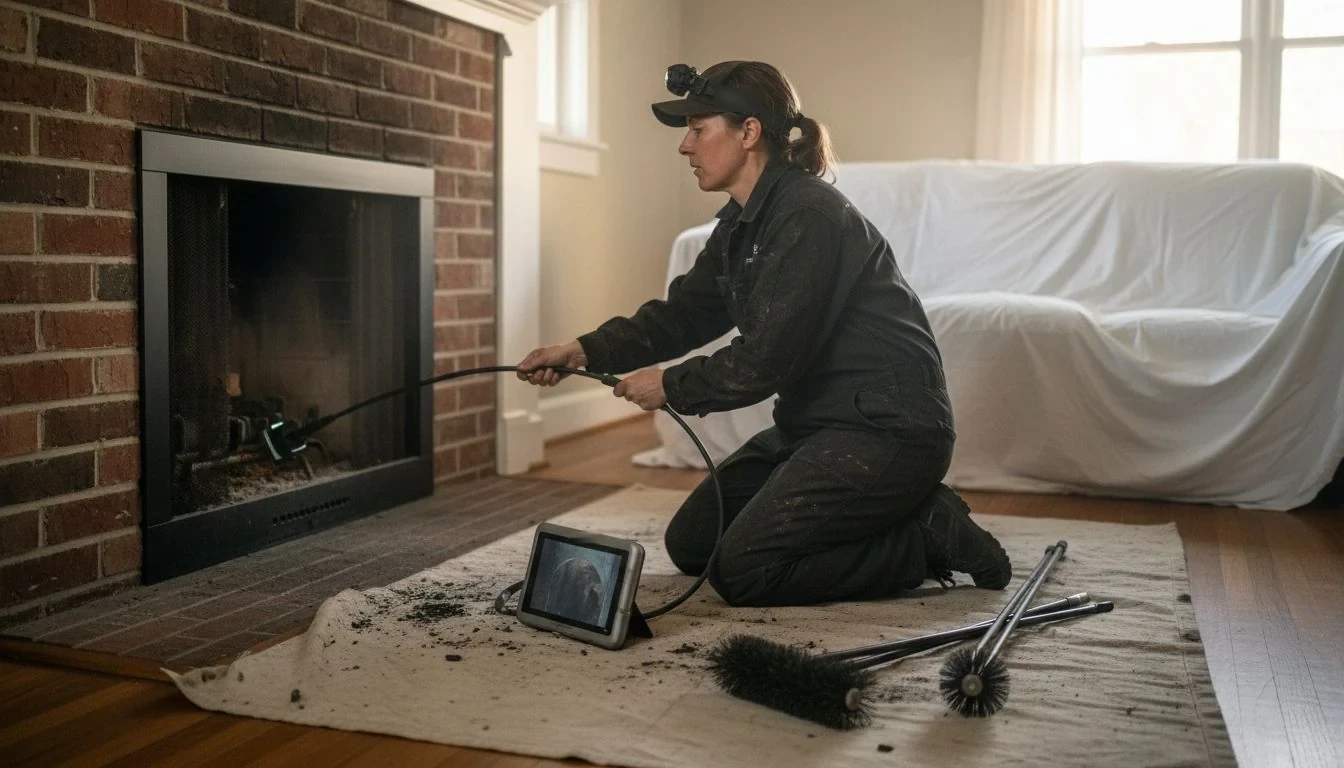
The first cold night in my fixer-upper, I had a stack of firewood on the porch, a box of matches on the mantel, and a line in my home inspection report I had skipped right past for five months. “Recommend evaluation by a qualified chimney professional before use.”
I did not light the fire. I opened my laptop instead, and then I made a phone call I regret.
A chimney inspection cost in 2026 runs about $100 to $250 for a basic Level 1 inspection and about $250 to $600 for a Level 2 with a camera run up the flue. A standard sweep of one flue adds $150 to $400, and plenty of sweeps bundle a Level 1 inspection into the sweep for no extra charge. My whole bill came to $1,030: a Level 2 inspection with a sweep, a new chimney cap, and a seal on the crown. The first company I called wanted $4,800.
I came within one ATM trip of paying the $4,800. That same week I also bought a porch full of wet firewood, so I have made both of the expensive chimney mistakes, and you can skip them.
Jump to what you need:
- Chimney inspection cost in 2026, level by level
- What a chimney sweep costs on top of the inspection
- Level 1, 2 or 3: which chimney inspection you need
- The $89 chimney sweep special
- What the camera found, and what I paid to fix it
- The chimney work that is yours to do
- When to book, and why it is not November
- Chimney inspection price by fireplace type
- Frequently Asked Questions
Chimney inspection cost in 2026, level by level
Nobody official publishes a national price for this, so the table below is built from the quotes I collected, the price sheets three local sweeps emailed me, and what friends in two other states paid last fall. Use it to check the number someone hands you.
| What you are paying for | Typical 2026 range | Notes |
|---|---|---|
| Level 1 inspection, alone | $100 – $250 | Often free when you book a sweep |
| Level 2 inspection with video | $250 – $600 | More for tall chimneys or several flues |
| Level 3 inspection | $1,000 – $5,000+ | Opens up walls or chimney parts. Rare |
| Standard sweep, one flue | $150 – $400 | Masonry fireplace or wood stove |
| Sweep plus Level 1, bundled | $200 – $450 | The most common fall appointment |
| Each additional flue | add $75 – $200 | A furnace flue in the same chimney counts |
| Heavy glaze creosote removal | $300 – $1,500+ | Chemical or rotary work, sometimes two visits |
The single biggest thing moving your number is the inspection level. A Level 1 is a look at what can be seen and reached. A Level 2 is the same look plus a camera through the whole flue, and that camera is where most of the extra money goes.
What a chimney sweep costs on top of the inspection
Inspection and sweep sound like the same job. They are two different line items, and a fair quote lists both.
The sweep is the cleaning: brushes and rods run through the flue, the smoke chamber scraped, the soot vacuumed out of the firebox without covering your living room in black dust. The inspection is the checkup: is the liner intact, is the damper working, is anything stuck in the flue, are the clearances to the wood framing right. You can have an inspection with no sweep if the flue is clean, and a sweep with no real inspection if you hire the wrong company.
The Chimney Safety Institute of America, the group that certifies sweeps, has a clear rule on its homeowner resources page: masonry fireplaces should be swept at 1/8 inch of sooty buildup, and sooner if there is any glaze in the system. That is why a good sweep looks first and cleans second. If there is barely anything in there, you should not be paying for a full sweep.
Three things raised the sweep quotes I got. A steep or three-story roof means more setup and a second person. A wood stove or insert that has to be pulled out adds labor, often $100 to $300. And a chimney that has not been touched in years usually means heavier deposits and a longer visit. Mine had not been swept in at least six years, going by the soot and the date written in marker inside the cleanout door.
Level 1, 2 or 3: which chimney inspection you need
The three levels come from NFPA 211, the national fire code standard for chimneys, fireplaces and vents. The same standard says chimneys should be inspected at least once a year “for soundness, freedom from deposits, and correct clearances,” which is the line the CSIA quotes on that page.
Level 1 is the annual checkup for a chimney you have been using and plan to keep using the same way. The sweep checks the parts that are easy to reach and see: the firebox, the damper, the visible flue, the exterior. No camera is required. For most people, most years, this is the right one.
Level 2 covers everything in a Level 1, then adds a video scan of the inside of the flue and a look at the chimney from the attic, crawl space or basement where it passes through. NFPA 211 calls for a Level 2 when you buy or sell a house, after a chimney fire, or when something changes: a new stove or insert, a switch from wood to gas, or a relined flue.
Level 3 is for when a sweep suspects a hidden hazard that a camera cannot confirm. It can mean removing part of a wall or the chimney to get eyes on the problem. You will almost never start here, and if someone opens with a Level 3 on a first visit, get a second opinion before anyone touches drywall.
My house had changed hands five months earlier, so Level 2 was the one I needed. The seller’s disclosure said the fireplace “works fine,” which it probably had for the seller, who told me she lit it about twice a year.
Before you call a sweep, write down these four things. What the fireplace burns: wood, gas logs, or a pellet or wood stove insert. When it was last swept, if you know, plus any date you can find inside the cleanout door. Whether you bought the house in the last year, since that alone points to a Level 2. And how many flues your chimney has, which you can count from the ground by the openings at the top. A sweep who never asks about any of this is pricing a job without knowing what the job is.
The $89 chimney sweep special
This is the part I am least proud of.
A flyer on my door that week promised a chimney sweep and “safety inspection” for $89. I called the number because it was the cheapest thing I had seen and it was a Sunday. A man showed up on Tuesday, swept for about twenty-five minutes, and then showed me three blurry photos on his phone. He said my clay liner was cracked the whole way up, that I could not light a fire, and that a stainless steel liner would run $4,800. He could start Thursday if I put down half today, in cash.
I did not have $2,400 in cash, which is the only reason I did not pay it.
Later I read the FTC’s page on how to avoid a home improvement scam, and it described my Tuesday almost line by line. Scammers knock on your door looking for business, it says, they pressure you for an immediate decision, and they ask you to pay for everything up front or only accept cash. The same page tells you to get several written estimates and to ask for an explanation when they differ by a lot. I did that next.
I am not saying every cheap sweep is running this play. Some run a low sweep price to fill the calendar in slow weeks. But a $89 sweep that ends in a $4,800 emergency, with photos you cannot make out, is a pattern worth knowing about before your doorbell rings. How I lay quotes side by side is in how to tell if a contractor quote is fair, and it applies here word for word.
What the camera found, and what I paid to fix it
I got two more quotes. One was $300 for a sweep and a Level 1, with no camera. Honest and fairly priced, but the wrong level for a house I had just bought. The other was $425 for a sweep plus a Level 2 with a video scan, from a sweep whose CSIA certification I looked up on the institute’s site before she arrived.
She put the camera up the flue and turned the screen toward me. The clay liner tiles were intact all the way up, without a crack anywhere. The soot was the light, brushable kind, not the shiny tar-like glaze that means real trouble. What she did find was at the top: no chimney cap at all, a mess of old twigs from a nest sitting on the smoke shelf, and a hairline crack running across the concrete crown, the slab that caps the masonry around the flue.
She swept it, pulled the nest debris out, and wrote up the two repairs with a price on each. I paid $265 to have a stainless steel cap installed and $340 to have the crown cleaned and sealed. With the $425 visit, that is $1,030. The Tuesday guy’s number was $4,800, plus the $89.
The cap turned out to matter more than I expected. Without one, rain was running straight down the flue, and that water is what eats mortar joints and rusts dampers over time. A cap also keeps birds and squirrels out. If the chimney is coming up during a bigger roof conversation, keep it separate in your head: flashing leaks where the chimney meets the shingles belong in roof repair costs, not in the sweep’s quote.
Relining is a real repair, and sometimes it is the right call. A cracked liner, or a switch to a new stove or insert, can put you in the $2,500 to $7,000 range for a stainless steel liner. Before you pay for one, see the crack on a video, shown to you by someone who is not holding a cash receipt book.
The chimney work that is yours to do
Sweeping is not on this list. I own a ladder and I still hired it out, and I would tell you to do the same. The US Fire Administration’s heating fire safety page says to have heating equipment and chimneys cleaned and inspected each year by a professional, and I am not going to argue with that one from a roof.
What you can do is make the sweep’s job smaller and the next bill cheaper.
Burn dry wood. This is where I made my second mistake that fall. The wood stacked on my porch came from a guy on a local marketplace who called it “seasoned.” I bought a $22 moisture meter after the sweep mentioned it, split a log, and got 31 percent. The EPA’s Burn Wise page on best wood-burning practices says wood burns best under 20 percent moisture and should season for at least six months, stored off the ground with only the top covered. Wet wood smolders, and a smoky fire leaves more deposits in the flue. My porch pile sat until spring.
Burn only wood. The same EPA page lists what stays out of the fireplace: household trash, cardboard, painted or pressure-treated wood, plywood and anything with glue in it. The CSIA says the same thing more bluntly, that well-seasoned wood is the only thing that belongs in there.
Look at your chimney from the ground. Once a season, with binoculars, check whether the cap is still there, whether bricks near the top look loose or stained white, and whether the crown looks cracked. I spotted my missing cap this way a week before the sweep confirmed it. I did not know what I was looking at yet.
Keep ashes in a covered metal can, stored outside on something that cannot burn, like the concrete pad by the garage and not the wooden deck. That one is also straight from the EPA page, and the can costs about $30.
When to book, and why it is not November
I remembered the chimney on the first cold night, and from what the sweeps told me, so does nearly everyone else. All three said some version of the same thing: their phones light up in October and November, the calendar fills three or four weeks out, and there is no reason to discount anything.
September is the gap. The weather is still fine for roof work, the schedules are open, and if the camera finds something, you have time to get it fixed before you want a fire. Two of the three sweeps I talked to this year offered a small early-season discount, around $25 to $50, for booking before October.
If you heat with gas and think this skips you, it does not. The CSIA’s answer to that exact question is that gas flues get blocked by nests and debris too, and that modern furnaces can have problems venting through flues built for older ones. If your furnace vents through a chimney flue, ask the sweep to look at that flue on the same visit. I booked mine the same week as my furnace tune-up, and what furnace repairs cost has the numbers for that side of it. If you are switching some of your heat to a heat pump this year, heat pump maintenance covers what that visit should include, and my checklist for winterizing a house puts the chimney on the same September list as the gutters and the outdoor faucets.
Chimney inspection price by fireplace type
What your fireplace burns changes what gets checked, how long it takes, and what the most common repair turns out to be.
| Fireplace type | Inspection plus sweep, 2026 | What gets checked | Common add-on |
|---|---|---|---|
| Open masonry wood fireplace | $200 – $450 | Firebox, damper, smoke chamber, flue, crown | Chimney cap $150 – $600 |
| Wood stove or insert | $250 – $550 | Stove, connector pipe, liner, flue | Pulling the insert $100 – $300 |
| Gas fireplace or gas logs | $100 – $300 | Burner, vent, flue for blockages | Nest or debris removal $100 – $500 |
| Prefab, factory-built fireplace | $150 – $400 | Metal flue sections, cap, firebox panels | Replacement panels or cap $200 – $800 |
| Just bought the house, any type | $350 – $700 | Level 2 with a full video scan | Crown seal $200 – $1,000 |
What blows the chimney budget
- Waiting for the first cold night. Booking in October or November means weeks on a waitlist, no early-season discount, and less room to get a second opinion if the camera finds something.
- Saying yes on the spot. A cheap sweep that ends in an urgent four-figure repair, a cash deposit and photos you cannot read is the setup the FTC warns about. Ask for the video and a written estimate, then get one more.
- Skipping the cap and the crown. A $265 cap and a $340 crown seal kept rain out of my flue. Water left alone for a few winters is how you end up paying for a liner or a rebuild at the top of the chimney.
The cleaning itself is priced separately from the inspection, and it changes a lot with the appliance at the bottom of the flue, which I broke down appliance by appliance in what a chimney sweep costs.
Frequently Asked Questions
How much does a chimney inspection cost?
A Level 1 inspection runs about $100 to $250 in 2026 and is often included free with a sweep. A Level 2 inspection with a video scan of the flue runs about $250 to $600, more for tall chimneys or several flues. A Level 3, which can involve opening walls, can pass $1,000. These are estimates that shift with region, roof access and local labor rates.
How much does it cost to have a chimney swept?
A standard sweep of one flue costs about $150 to $400, and a sweep with a Level 1 inspection bundled in usually lands between $200 and $450. Wood stove inserts that have to be pulled out, steep roofs and heavy glaze creosote all push the price up. The CSIA recommends sweeping masonry fireplaces at 1/8 inch of buildup, or sooner if glaze is present.
How often should a chimney be inspected?
At least once a year. That is the standard in NFPA 211, and the US Fire Administration also recommends having chimneys cleaned and inspected each year by a professional. It applies to gas fireplaces and furnace flues too, because nests and debris can block any flue. Book a Level 2 when you buy a house, after a chimney fire, or when you change your stove or fuel.
If the chimney is one line on a longer list this fall, what gutter cleaning costs is the other roof-level job worth booking the same month, and my home renovation cost guide has the bigger picture.
All prices here are 2026 estimates and vary by region, chimney height, roof access, number of flues, fuel type, the season you book in, and local labor rates. Tessa is a hands-on homeowner who has hired this work and read the quotes, not a certified chimney sweep or inspector. Nothing here is an inspection of your chimney. Only a qualified professional who has examined your system can tell you whether it is safe to use, and the CSIA keeps a lookup of certified sweeps. Use these ranges to ask sharper questions of the people quoting your house, not as a quote.
Free DIY Project Cost Estimator
The spreadsheet I use to price out a project before I start, so a weekend job never blows the budget. Join the newsletter and I’ll send it over.
No spam, ever. Unsubscribe anytime. — Tessa
Keep reading — more on HVAC & Hiring a Contractor
Furnace Replacement Cost in 2026: My Three Quotes and the Signs It Was Time
Last April the furnace in our basement started to howl. The little motor that pulls exhaust…
Read article →
Heat Pump Maintenance: What It Costs and Why It Beats the Repair
The tech pulled the top grille off my outdoor unit, tipped it toward me, and let…
Read article →
Interior House Painting Service: How to Hire One Without Getting Burned
The first interior house painting service to quote this house described the entire job in five…
Read article →
Furnace Repair Cost in 2026: What Each Part Runs, and When to Replace
The furnace in this house is a 2009 builder-grade gas unit that lives in the basement…
Read article →