
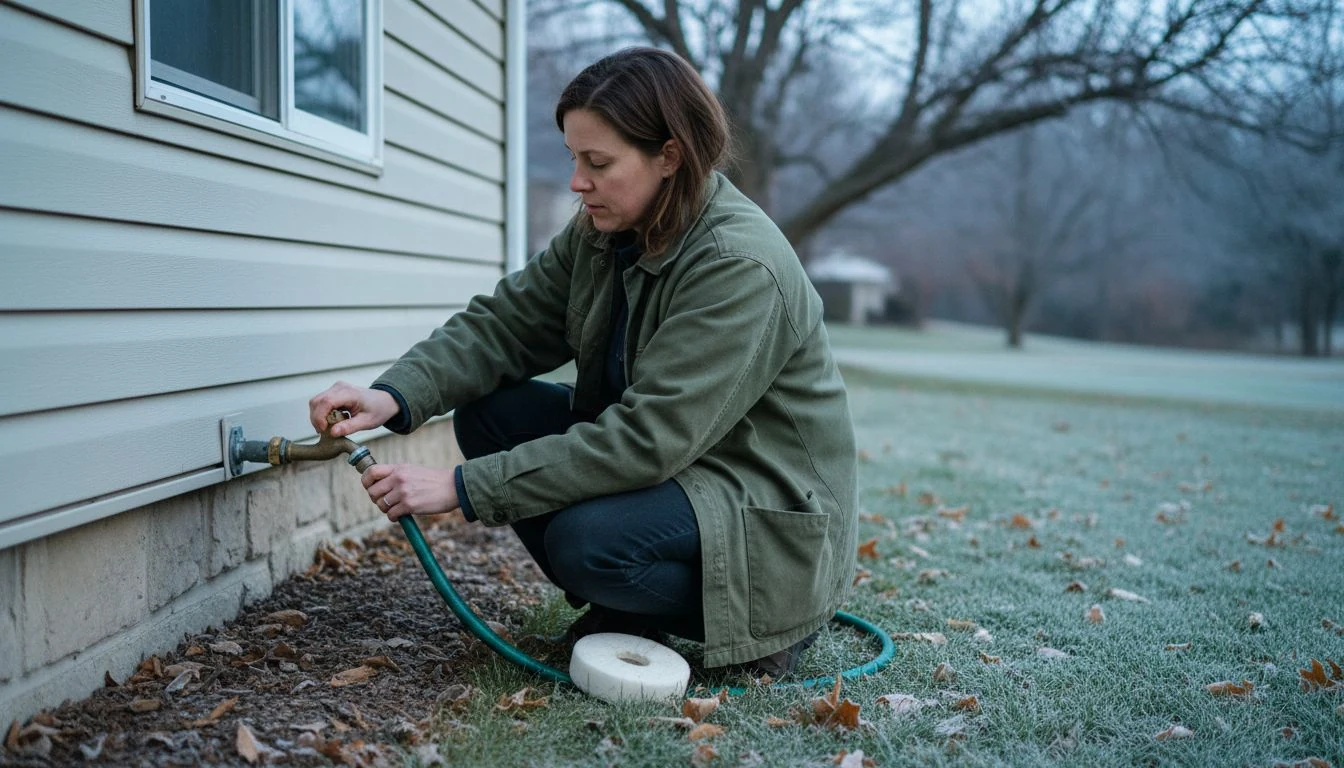
The first house I owned taught me this lesson for $1,900. I left a garden hose screwed onto the spigot through a November cold snap, the way I had every year in the apartment where somebody else owned the pipes. The hose held the water. The water froze, backed up into the wall, and split a copper line I never knew ran behind the guest room closet.
I did not find out in November. I found out in March, when the thaw came and a stain the shape of Ohio bloomed across the drywall.
To winterize house systems properly costs most homeowners about $150 to $600 a year if you do the hands-on parts yourself and hire out the two or three that need a pro, and roughly $600 to $1,800 if you hire the whole list. Almost none of that is the exciting stuff. It is a hose, a bag of foam covers, a tube of caulk, and one phone call to a heating company in September instead of December.
This is the order I work in now, what each piece runs in 2026, and which jobs I have decided are worth paying for after doing them badly myself. I am a homeowner who has owned two cold-climate houses and made most of these mistakes on my own dime. I am not a licensed contractor, and a few items on this list belong to one.
Jump to what you need:
- What it costs to winterize a house in 2026
- The one job that bursts pipes if you skip it
- Air sealing is the cheapest real money on this list
- Book the heating service in September, not December
- Gutters, roof, and where winter water actually gets in
- The outage items most checklists leave out
- What I have stopped bothering with
- The winterize house checklist, in the order I do it
- Frequently Asked Questions
What it costs to winterize a house in 2026
The reason this list feels overwhelming is that people present it as one project. It is not. It is about eleven small ones, and four of them are free.
Here is the honest split. The DIY column is materials only, assuming you own a caulk gun and a ladder. The hired column is what a single trade charges to show up and do that one thing, which is almost always more per visit than the work is worth, so bundle them.
| Job | DIY materials, estimated 2026 | Hired out, estimated 2026 |
|---|---|---|
| Disconnect hoses, drain and cover spigots | $3 to $12 per faucet cover | Usually bundled, $75 to $150 minimum trip |
| Shut off and drain irrigation lines | Free if you have the valves | $70 to $180 for a sprinkler blowout |
| Weatherstrip doors, caulk window trim | $30 to $90 in materials | $350 to $1,200 for whole-house air sealing |
| Insulate exposed pipes in crawl or garage | $10 to $35 in foam sleeves | $150 to $400 |
| Furnace or heat pump annual service | Filter only, $15 to $40 | $80 to $200 for a tune-up visit |
| Chimney sweep and inspection | Not a DIY job | $130 to $380 |
| Clean gutters and downspouts | Free, plus a ladder you trust | $120 to $350 |
| Roof and flashing look-over | Free from the ground with binoculars | $120 to $350 for an inspection |
| Reverse ceiling fans, swap filters | Free | Not worth hiring |
| Test sump pump and backup | Free to test | $400 to $1,100 to replace |
| Programmable or smart thermostat | $25 to $250 for the unit | $100 to $200 to install |
The one job that bursts pipes if you skip it
If you do nothing else on this page, go outside and take the hoses off.
A connected hose keeps a column of water sitting in the spigot and the pipe behind it. Water expands when it freezes, the pipe splits, and you do not know until something thaws and the split starts spraying inside a wall cavity. My $1,900 was drywall, insulation, a plumber, and paint. The prevention was walking outside in October.
The full version takes fifteen minutes per faucet. Unscrew the hose and drain it. Find the interior shutoff for that line, usually in the basement or crawl space, and close it. Then open the outdoor spigot and let it drain, and leave it open through winter so nothing collects. Snap a foam cover over the outside. If your spigots are frost-free sillcocks they are more forgiving, but the hose still has to come off, because the hose defeats the frost-free part entirely.
While you are down there with the shutoff valve, notice whether it drips. A valve that weeps in October is a valve that will be worse in April, and a dripping outdoor faucet is one of the more approachable repairs in the house. I wrote up the fix in my guide to how to fix a leaky outdoor faucet, and it is a washer and an afternoon far more often than it is a plumber.
Do these four before the first hard freeze, in this order. Hoses off and spigots drained. Irrigation blown out or drained. Foam sleeves on any pipe you can see in an unheated space. Furnace or heat pump service booked. Everything else on this page can wait for a free Saturday. These four cannot, and three of them are free.
Air sealing is the cheapest real money on this list
This is the item people skip because it is boring and nobody sees it. It is also the one with a number attached.
ENERGY STAR puts it plainly in their guidance on sealing and insulating a home: sealing air leaks and adding insulation can make a house more comfortable and more efficient and provide up to a 10 percent savings on annual energy bills. Ten percent of a winter heating bill, for thirty dollars of caulk and weatherstripping, is the best return on this entire page.
You find the leaks by feel on a windy day. Run the back of your hand around door frames, window trim, the gap where the dryer vent punches through, the sill plate in the basement, and every outlet on an exterior wall. Cold spots are money leaving. Weatherstripping goes on the moving parts, caulk goes on the stationary joints, and foam gaskets behind outlet covers cost about a dollar each and take a screwdriver.
The part I do pay for is the attic, because attic work is miserable and getting the depth right matters more than getting it done fast. That is a real quote, not a caulk tube, and it belongs in the same conversation as the rest of the year’s projects, which is what my home renovation cost guide is for.
One more thing worth knowing, because almost nobody mentions it: if your household income qualifies, this work may be free. The Department of Energy runs a Weatherization Assistance Program that reduces energy costs for low-income households by improving the energy efficiency of their homes while protecting health and safety. It is administered through state and local agencies, there is a waiting list in most places, and September is a much better month to get on it than January.
Book the heating service in September, not December
An annual tune-up runs about $80 to $200 and it is the single easiest thing to procrastinate on, because the heat worked fine last spring and it is seventy degrees outside.
Two reasons not to wait. The first is scheduling: every heating company in your zip code is booked solid the week of the first cold snap, and the same visit that costs $120 in September becomes an emergency call in December. The second is that a tune-up is diagnostic. The tech finds the cracked igniter or the failing capacitor while it is a part, not while your house is at fifty-two degrees and you are agreeing to anything.
What I have learned to do is ask for the findings in writing, with a price, and then decide indoors instead of in the hallway. If they come back with a real repair, the ranges in my furnace repair cost guide will tell you fast whether the number is in the normal band or whether you want a second quote. And if the quote is big enough to make your stomach drop, that is exactly what my post on judging whether a contractor quote is fair was written for.
Change the filter while you are thinking about it. A clogged filter makes the system work harder all winter for no reason, it costs about twenty dollars, and it is the maintenance task with the highest ratio of benefit to effort in the entire house.
Gutters, roof, and where winter water actually gets in
Winter damage is almost always water damage wearing a coat.
Clogged gutters are the mechanism behind ice dams. Water backs up at the eave, freezes, and the ridge of ice forces meltwater up under the shingles and into the ceiling below. Clearing them is free if you are steady on a ladder and $120 to $350 if you are not, and if yours pull away from the fascia or dump straight against the foundation, the sizing and pricing side lives in my gutter installation cost guide.
The roof itself you can mostly assess from the ground with a pair of binoculars. Look for lifted or missing shingles, granules piling up at the downspout, and the rubber boots around vent stacks, which crack and are a very common leak point. A small repair in October is a repair. The same spot in February, with ice on it, is a tarp and a much larger number, and my roof repair cost guide covers what those look like.
Then walk the perimeter and look down. Downspouts should carry water at least four feet from the house. Grade should fall away from the foundation, not toward it. This is a ten-minute walk that prevents the most expensive category of problem there is.
The outage items most checklists leave out
Winter is when the power goes out, and a house with no heat becomes a plumbing problem within about a day.
Test the sump pump now by pouring a bucket of water into the pit and confirming it kicks on and empties. If it does not, you want to know in September. Know where your main water shutoff is and make sure the valve actually turns, because the moment you need it is not the moment to discover it is seized. Check that smoke and carbon monoxide alarms work, since this is the season everything combusts indoors at once.
If your service panel is the original one from the seventies and it already trips when the space heater and the microwave run together, adding winter load will not improve its mood. That is a conversation to have before the cold, and the numbers are in my guide to upgrading an electrical panel.
What I have stopped bothering with
Plastic window film works. I used it for two winters and it genuinely cut the draft in a drafty rental. I stopped because it takes an evening, it looks like what it is, and it peels the paint off the trim when it comes down in April. In a house you own, put the same money toward weatherstripping and caulk, which are permanent.
I also stopped closing vents in unused rooms. It feels efficient and it is not, because a forced-air system is balanced for the whole house, and closing registers raises duct pressure and can push conditioned air into leaks instead of into rooms.
And I no longer buy a new snow shovel every year in a panic in December. That one is not a cost guide insight, just a thing I did four times.
The winterize house checklist, in the order I do it
Order matters here, because the free outdoor items are time-sensitive and the paid indoor ones are schedule-sensitive. This is roughly a Saturday plus two phone calls.
| Order | Task | Who | When |
|---|---|---|---|
| 1 | Hoses off, spigots drained and covered | You | Before the first freeze, no exceptions |
| 2 | Irrigation drained or blown out | You or a pro | Before the first freeze |
| 3 | Book heating service and chimney sweep | Pro | September, while they answer the phone |
| 4 | Foam sleeves on exposed pipes | You | Any dry afternoon |
| 5 | Gutters cleared, downspouts extended | You or a pro | After most leaves are down |
| 6 | Roof and flashing scan from the ground | You | Same day as the gutters |
| 7 | Weatherstrip, caulk, outlet gaskets | You | First genuinely cold windy day |
| 8 | Filter, reversed fans, thermostat set | You | Fifteen minutes, any time |
| 9 | Sump pump, main shutoff, CO alarms tested | You | Before the first storm |
What blows the winterizing budget
- Waiting for the first cold snap to call anyone. The same furnace visit is a $120 appointment in September and a $250 emergency call in December, and the December version comes with whatever they find while your house is cold and your judgment is bad.
- Treating the hose as a small thing. It is the cheapest item on the list and the most expensive omission. A split line behind drywall runs well past $1,000 once you count the plumber, the wall, and the paint, and it is prevented by a two-minute walk outside.
- Buying gadgets instead of sealing gaps. Space heaters, heated mats and smart vents all cost real money and none of them fix the reason the room is cold. Thirty dollars of caulk and weatherstripping outperforms most of that aisle, and it keeps working next winter.
The fireplace belongs on the same September list as the gutters, and the price of a chimney cleaning.
If the attic is the item on this list you keep putting off, I priced mine out in what attic insulation costs, blown-in versus batts.
The same gaps that let cold air in let mice in, and October is when they move indoors. I sealed mine with steel wool and a door sweep after comparing the mouse exterminator cost with doing it myself.
Frequently Asked Questions
How much does it cost to winterize a house?
Budget about $150 to $600 a year if you handle the hands-on jobs yourself and hire out the heating service and the chimney, and roughly $600 to $1,800 if you hire the entire list. Those are 2026 estimates for a single-family home in a climate that freezes. The spread depends mostly on how many outdoor spigots and irrigation zones you have, your roof pitch, and whether attic insulation is on the list this year.
When should you winterize a house?
Start about four to six weeks before your area’s average first hard freeze, which for much of the United States means late September into October. The freeze-sensitive tasks, meaning hoses, spigots, irrigation and exposed pipes, have a real deadline. The comfort and efficiency tasks do not, but booking heating and chimney appointments early is the difference between a scheduled visit and an emergency rate.
What happens if you do not winterize outdoor faucets?
Water trapped in the spigot and the pipe behind it can freeze and split the line, usually inside a wall where you cannot see it. The failure often does not show up until the thaw, which is why the damage is typically discovered as a stain or a soft spot rather than as a leak. Disconnecting hoses, draining the line and covering the faucet is the fix, it takes about fifteen minutes per spigot, and the covers cost a few dollars each.
If you are stacking this against the rest of the year, the whole-house view is in my home renovation cost guide, and once the cold actually arrives my cozy winter home ideas cover the part of winter that is about comfort rather than plumbing.
All prices here are 2026 estimates and vary by region, climate zone, house size and age, roof pitch and access, number of spigots and irrigation zones, and local trade rates. Tessa is a hands-on homeowner, not a licensed plumber, HVAC technician, roofer, or electrician. Nothing here is an inspection of your house. Gas appliances, chimneys and flues, electrical panels, and any pipe you cannot reach safely belong to a licensed professional. If you suspect a frozen or burst pipe, shut off the water at the main and call a plumber rather than thawing a wall cavity yourself. Use these ranges to ask sharper questions and to compare two written quotes against one written scope.
Free DIY Project Cost Estimator
The spreadsheet I use to price out a project before I start, so a weekend job never blows the budget. Join the newsletter and I’ll send it over.
No spam, ever. Unsubscribe anytime. — Tessa