
The microwave and the space heater could not run at the same time. That was the whole symptom for about a year, and my fix was to remember which one I had turned on.
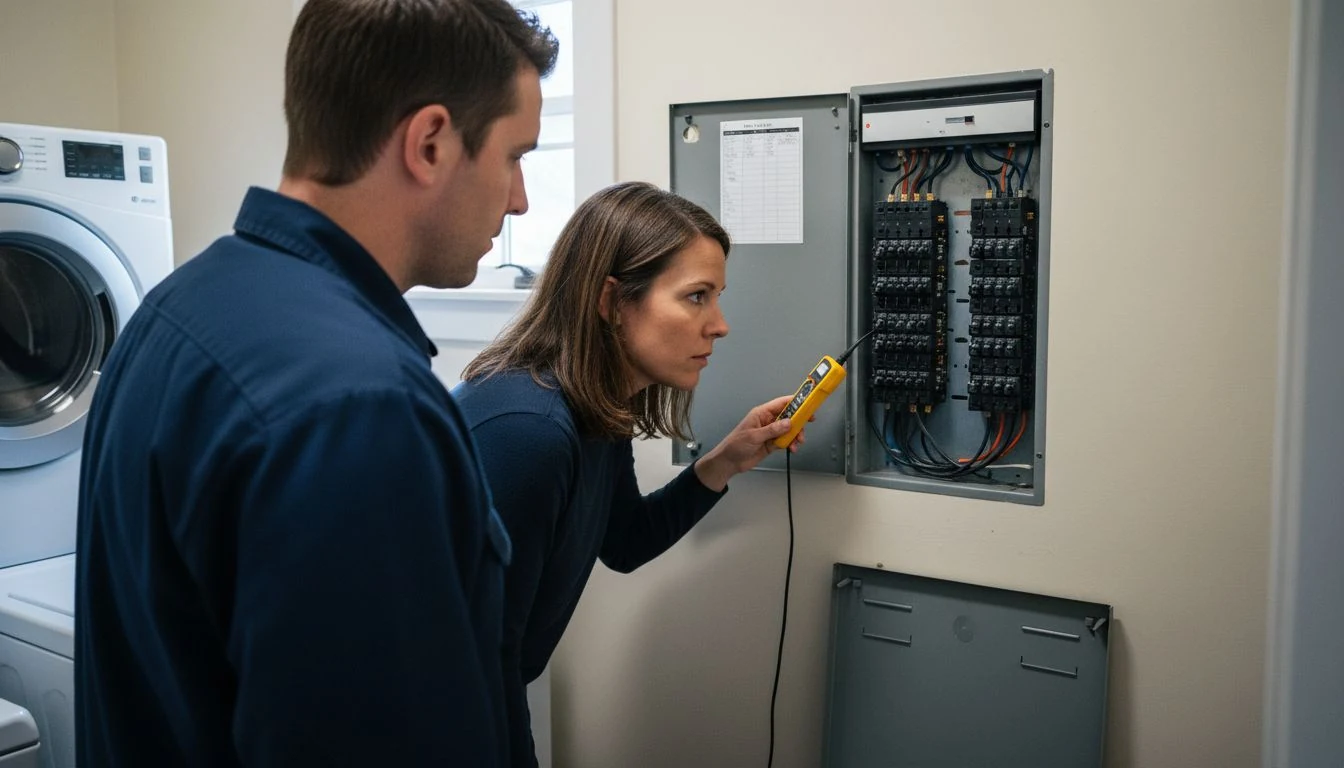
Then the electrician who came to add a basement circuit pulled the cover off the box in my laundry room. “Who did this?” Two circuits doubled onto one breaker, a ground wire wrapped around a screw that held nothing, and 100 amps feeding a house that had gained a dryer, a dishwasher and a window unit since 1974.
Upgrading electrical panel service in 2026 runs about $1,800 to $3,500 for a straight swap where the panel stays where it is, and $3,000 to $6,500 once the meter, the mast and the wire coming in from the street have to be replaced too. The gap between those two numbers is not the panel. It is everything around it.
I got three quotes. They came in at $2,400, $4,150 and $9,800, for what I thought was the same job. Below is what each line costs, how to tell whether you need this at all or only need a sub-panel, the tax credit that quietly died on December 31 last year, and the one word in the $9,800 quote that almost got me. I am not a licensed electrician. I am the homeowner who read three quotes at the kitchen table and made one of the salesmen explain himself.
Jump to what you need:
- Upgrading electrical panel costs in 2026
- Do you actually need this, or do you need a sub-panel?
- Going from 100 to 200 amps
- The line items that move the price
- The recall that never happened
- The $600 credit is gone in 2026
- My three quotes, side by side
- Cost by scenario, and a fair quote
- FAQ
Upgrading electrical panel costs in 2026, in plain numbers
Three different jobs hide under that one phrase, and they cost wildly different amounts.
$1,800 to $3,500 is a like-for-like replacement. The new panel goes on the same wall, in the same spot, fed by the same service wire, with the same amperage or a bump to 200 amps if the incoming service already supports it. A day of work for two people, plus the permit and the inspection.
$3,000 to $6,500 is a real service upgrade. That means a new meter socket, usually a new mast and weatherhead, new service entrance cable, grounding and bonding brought up to current code, and a scheduled disconnect and reconnect with the utility. More parts, more coordination, and a day where your power is off.
$6,500 to $12,000 and up is when the panel moves to a different wall, the service comes in underground and has to be trenched, or you are going to 400 amps because somebody in the house is charging two cars and running a heat pump.
Those are 2026 estimates and they move hard by region. Labor is most of the bill, and licensed electrician labor is priced by your local market, not by the panel.
Do you actually need this, or do you just need a sub-panel?
This is the question the sales-heavy companies skip, so ask it out loud on every visit.
Plenty of houses with a 100 amp panel are not out of power. They are out of spaces. The service coming from the street is fine, the main breaker never trips, but every slot in the box is full and there is nowhere to land a new circuit. That is a $900 to $2,000 sub-panel, not a $5,000 service upgrade. My electrician priced both for me before I asked, which is most of why he got the job.
The signs that point to a genuine upgrade are more specific than “the lights flicker”:
- The main breaker itself trips, not the branch circuits. A branch breaker tripping is that circuit doing its job. The main letting go means the whole house is asking for more than the service can deliver.
- You are adding a large fixed load: an EV charger, a heat pump, a hot tub, an electric range replacing gas, central air where there was none. Any of those can be the thing that tips a 100 amp service over on a design-day calculation.
- The panel is a fuse box, or a split-bus panel with no single main disconnect. Both are legal to keep using, both are a headache to add to, and some insurers will ask about them.
- Scorching, rust, a warm cover, or a burnt smell anywhere near the box. Call an electrician today. That one is not a budgeting conversation and it does not wait for three quotes.
- You are finishing a space and the plans need a dozen new circuits. That was my basement, and it is a common trigger. I laid out the rest of that budget in my guide to what it costs to finish a basement.
The honest test is a load calculation, not a vibe. An electrician can run one on your actual square footage, appliances and planned additions, and it takes maybe twenty minutes. If somebody tells you that you need 200 amps without asking what appliances you have, they have not calculated anything. They have priced a panel.
Upgrading electrical panel capacity from 100 to 200 amps
This is the upgrade most people mean when they ask, and the price swings on one question: does the wire coming in from the street get replaced?
If your service entrance conductors, meter socket and mast are already rated for 200 amps, and some 1990s and later houses are, then a 200 amp panel is close to a straight swap. You are in the $1,800 to $3,500 band. If the incoming service is the original 1970s aluminum sized for 100 amps, all of it changes, and the utility has to come out to pull the meter and put it back. That is the $3,000 to $6,500 band, and it is not padding.
My house was the second one. The mast on the side wall was original, the meter socket was rated for 100 amps, and the electrician showed me the stamp on it with a flashlight before he wrote anything down. That thirty seconds is the difference between a quote and a guess, and it is the same thing I look for when I score any contractor bid, which I broke down in how to tell a fair contractor quote from a padded one.
One thing to know before you spend the extra money. 200 amps is the common answer, not the automatic one. A 125 or 150 amp service is a real option in a small house, and going to 400 amps costs roughly double a 200 amp job because it usually means two panels and heavier everything. Buy the capacity your load calculation asks for plus honest headroom, not the biggest number on the truck.
The line items that move the price
When I lined my three quotes up next to each other, the panel itself was between $250 and $600 on all of them. Everything else is where they diverged.
| Line item | Estimated 2026 range | When it shows up on the quote |
|---|---|---|
| Panel and breakers (200A load center) | $250 to $600 | Every job. Arc-fault and ground-fault breakers cost 4 to 8 times a standard one, and current code wants a lot of them. |
| Electrician labor, 1 to 2 days | $1,200 to $3,000 | Every job. Usually two people. This is most of your bill. |
| Permit and inspection | $100 to $500 | Every job, legally. Some cities run higher. Never optional. |
| New meter socket or base | $250 to $600 | Only when the existing one is undersized or damaged. |
| Mast, weatherhead and service entrance cable | $400 to $1,200 | Overhead service upgrades. Skipped on a like-for-like swap. |
| Utility disconnect and reconnect coordination | $0 to $800 | Often free from the utility, but it has to be scheduled, and that schedule sets your date. |
| Grounding and bonding to current code | $200 to $500 | Almost always on older homes. New ground rods, water pipe bonding. |
| Trenching for underground service | $1,200 to $4,000 | Only underground services. Length and what is on top of it decide the number. |
| Drywall patch and paint after | $150 to $600 | Panel relocation, or any time the wall gets opened. Ask who owns this. |
| Whole-home surge protector at the panel | $250 to $500 | Optional add-on. Cheap while the cover is already off. |
Read that table next to your own quotes and the arguing gets easy. If one company is $2,000 higher than another, it is usually the mast and meter, and the honest answer to “why” is a physical part they can point at on your wall.
Grab my free Project Cost Estimator. Put in your current service size, whether the meter and mast get replaced, and your metro, and you walk into the second visit already holding your own range. When three quotes on one job land almost $7,500 apart, the only thing that keeps you steady is having done the math before anybody rings the doorbell.
The recall that never happened, and the word that almost got me
My most expensive quote had a line in it, printed, that said my panel had been “recalled.” My panel is a Federal Pacific Stab-Lok, which is the brand you find in a lot of houses built between the 1950s and the late 1970s, and it has a bad reputation among inspectors.
Here is the part that made me put the pen down. It was never recalled. The Consumer Product Safety Commission investigated those breakers for two years and closed the investigation in March 1983, stating that the data available did not establish that the breakers posed a serious risk of injury, and that it would cost several million dollars to gather the data needed to settle it. The CPSC added a note in 2011 telling electricians, home inspectors and real estate agents to read that release carefully, because the Commission closed the matter without making a determination as to the safety of the breakers either way.
So what is true is uncomfortable and specific: testing confirmed those breakers failed certain UL calibration requirements, the question was never resolved, and no federal recall exists. That is a real reason to have an electrician look at an old Stab-Lok panel and a real reason many people replace them. It is not a reason to accept a $9,800 number because a salesman used a legal-sounding word on a printed page.
I asked him to show me the recall. He said he would email it. He never did.
The $600 federal tax credit is gone in 2026
If you have been reading about this for a while, you have probably seen the number $600 attached to a panel upgrade. Check the date on whatever you read.
Under the Energy Efficient Home Improvement Credit, panelboards, sub-panelboards, branch circuits and feeders qualified for a credit if they met the National Electrical Code and had a capacity of 200 amps or more, capped at $600 per item. The IRS states the credit is allowed for qualifying property placed in service on or after January 1, 2023, and before December 31, 2025. Placed in service is the test, not signed, not paid, not permitted. If your panel was energized in 2026, there is no credit to claim.
A lot of electrician websites still have the $600 sitting in their copy, and I do not think most of them are lying on purpose. They wrote the page in 2024 and never came back to it. But if a quote leans on that credit to make the number feel smaller, that quote is doing math with money that no longer exists.
What is left in 2026 is the state route. The Department of Energy runs the Home Energy Rebates programs, which offer up to $14,000 for efficiency and electrification upgrades, and the eligible list explicitly covers electric wiring and load service center upgrades, which is the formal name for your panel. It is income-qualified, it runs through your state or territory energy office, and it is live in some states and not others. Call your state energy office before you assume either way, because this is the one place left where a panel upgrade gets meaningfully cheaper.
My three quotes, side by side, and the one I took
Same house, same panel, same week.
The $2,400 quote was a like-for-like 200 amp swap, panel stays on the laundry room wall, no meter or mast work. It was also the one where the guy asked me to pull the permit myself as a homeowner. That is the tell I now watch for on every trade, because a licensed contractor pulls the permit in their own name, since their license is what carries the risk if the inspection fails. Once I am holding the permit, the inspection is my problem.
The $9,800 quote was the recall one. It included a panel relocation to the garage that nobody had asked for, and a whole-home surge protector listed at $1,150.
I took the $4,150. It replaced the meter socket and the mast, because both were stamped for 100 amps and he showed me, added new ground rods, pulled the permit in his own name, and left me a labeled directory taped inside the door with every circuit written out in pencil. The power was off for about five hours on a Tuesday. The inspector came Thursday and was in the house for eleven minutes.
What I got wrong: I did not ask a single one of them about drywall. The cheapest quote would have opened the wall for the relocation and left the patching to me, and I would not have noticed until there was a hole. Ask who closes the wall, in writing, before anyone starts.
Upgrading electrical panel costs by scenario, and what a fair quote looks like
| Your situation | What the job usually is | Estimated 2026 range |
|---|---|---|
| Panel is full, main never trips | Add a sub-panel, keep existing service | $900 to $2,000 |
| Service is already 200A, panel is old or obsolete | Like-for-like panel replacement | $1,800 to $3,500 |
| 100A service, adding EV charger or heat pump | Full service upgrade to 200A, new meter and mast | $3,000 to $6,500 |
| Fuse box or split-bus panel, 1960s house | Service upgrade plus grounding and bonding to code | $3,500 to $7,000 |
| Panel has to move to another wall | Service upgrade plus rerouting, plus drywall | $6,500 to $10,000 |
| Underground service, needs trenching | Service upgrade plus excavation and restoration | $5,000 to $12,000 |
| Two EVs, heat pump, electric range | 400A service, usually two panels | $8,000 to $15,000 |
What blows the electrical panel budget
- Buying amps instead of a load calculation. A 400 amp service costs roughly double a 200 amp one, and most houses, even with an EV charger, never come close to needing it. Make somebody show you the calculation on paper before you pay for capacity you will never draw.
- Letting the panel move. Relocating it to a different wall adds rerouting, longer runs, drywall and paint, and it turned a $4,000 job into a $9,800 one on my highest quote. If the existing location is legal and accessible, leave it there.
- Pulling the permit yourself to save a couple hundred dollars. The permit is the cheap part. The inspection is the only independent set of eyes on work you cannot see once the cover goes back on, and if your name is on the permit, a failed inspection is yours to fix.
Frequently Asked Questions
How much does upgrading an electrical panel cost in 2026?
Most homeowners land between $1,800 and $6,500. A like-for-like panel swap where the service entrance is reused runs $1,800 to $3,500, and a true 100 to 200 amp service upgrade with a new meter socket, mast and grounding runs $3,000 to $6,500. Panel relocation, underground trenching or a 400 amp service pushes it to $6,500 and up. The panel itself is only $250 to $600 of that.
Do I need 200 amps, or just more breaker spaces?
If your main breaker never trips and the only problem is that every slot is full, you probably need a sub-panel at $900 to $2,000, not a service upgrade. A genuine upgrade is driven by total load: an EV charger, a heat pump, an electric range replacing gas, or central air added to a 100 amp service. Ask for a written load calculation. Anyone who quotes 200 amps without asking what appliances you own has priced a panel, not your house.
Do I need a permit to replace an electrical panel?
Yes, and an inspection with it. The permit should be pulled by the licensed contractor in their own name, not by you. If a company asks you to pull it as a homeowner, that shifts responsibility for the inspection onto you, and it is worth asking why they want that. This is not the corner to cut.
Was the Federal Pacific Stab-Lok panel ever recalled?
No. The CPSC investigated those breakers and closed the investigation in March 1983 without making a determination on their safety, saying the available data did not establish a serious risk and that resolving the question would cost several million dollars. Commission testing did confirm the breakers failed certain UL calibration tests. That is a legitimate reason to have an old Stab-Lok panel evaluated by an electrician, and it is not a recall, so treat any quote that uses that word as one to question.
Can I still get the $600 tax credit for a panel upgrade?
Not in 2026. The IRS states the Energy Efficient Home Improvement Credit applies to property placed in service before December 31, 2025, so a panel energized this year does not qualify. The remaining federal path is the Department of Energy’s Home Energy Rebates, which are income-qualified, cover load service center upgrades, and run through your state energy office where the program is live.
How long does it take, and how long is the power off?
Most straightforward jobs are one to two days of work, with the power off for roughly four to eight hours on the day the utility pulls and resets the meter. Mine was off five hours on a Tuesday. Plan for the fridge, and pin down the inspection date when you sign, not after.
If you want to see where an upgrade like this sits against everything else a house asks for in a year, I keep the running figures in my home improvement cost statistics roundup, and the whole-house view lives in my home renovation cost guide.
All prices here are 2026 estimates and vary by region, utility requirements, labor rates, overhead versus underground service, and how much of the existing service entrance can be reused. Tessa is a hands-on homeowner, not a licensed electrician. Panel and service work is energized, permitted work that belongs to a licensed, insured electrician and a code inspection, with no exceptions and no homeowner shortcuts. Use these ranges to ask sharper questions and to compare two written quotes.
Free DIY Project Cost Estimator
The spreadsheet I use to price out a project before I start, so a weekend job never blows the budget. Join the newsletter and I’ll send it over.
No spam, ever. Unsubscribe anytime. — Tessa