
The back bedroom was the one nobody wanted. In January you could stand in the doorway and feel the temperature drop, like walking into a walk-in cooler at a grocery store. My daughter started sleeping in a hoodie. I blamed the window for a whole winter.
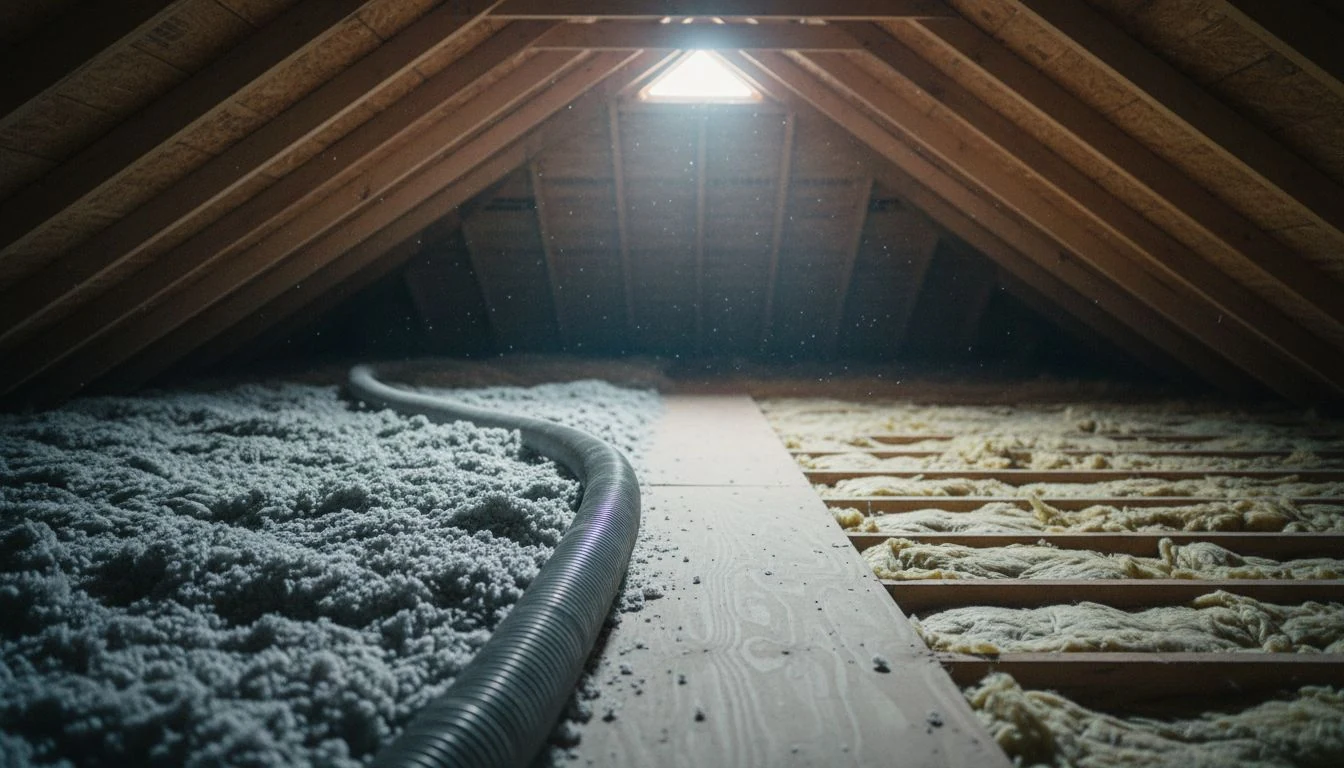
The window was fine. The trouble was the attic above it, where the “insulation” turned out to be about four inches of old yellow batts, flattened by forty years of gravity and a few boxes of Christmas decorations I had stacked right on top of them.
Attic insulation cost in 2026 runs roughly $1,500 to $3,500 for a typical 1,000 to 1,200 square foot attic topped up with blown-in insulation, which works out to about $1.25 to $3.00 a square foot installed. Batts land in a similar range if the attic is easy to get around in. Spray foam on the underside of the roof is a different animal, often $5,000 to $12,000. Pulling out old insulation first adds $1,000 to $2,500 on top.
I got three quotes for my 1,100 square foot attic: $2,850, $1,980, and $2,140. I paid the last one, and I will explain why the cheapest was not the best deal and why the most expensive one included a job I did not need.
I am a homeowner with an old house and a folder of receipts, not a licensed insulation contractor or an energy auditor. What follows is what I paid, what I learned, and what I would ask next time.
Jump to what you need:
- Attic insulation cost in 2026
- Blown-in vs batts vs spray foam
- How much you actually need
- Air sealing, the step quotes skip
- Attic insulation removal cost
- Doing it yourself with a rented blower
- Cost table by attic size and material
- Frequently Asked Questions
Attic insulation cost in 2026, and what moves the number
Insulation is priced by the square foot of attic floor and by how deep you go. The deeper the layer, the higher the R-value, and the more bags the crew empties into your house.
For a top-up, where you blow new insulation over what is already there, most quotes I saw landed between $1.25 and $3.00 per square foot. On my 1,100 square feet, that is $1,375 to $3,300 before anything else gets added. What pushed my quotes around more than the material was the attic itself.
Access first. My attic hatch is a 22 by 30 inch hole in a hallway closet ceiling, and the far end of the attic has about 18 inches of clearance at the eaves. One crew charged extra for the eaves. The other two did not mention it.
Then depth. Going from R-11 to R-49 takes a lot more material than going from R-30 to R-49. More on the target number below.
And the prep work, which is easy to skim past on a quote: baffles at the soffit vents, a dam around the hatch, covers over old recessed lights, and air sealing. They’re small items, $50 here and $200 there, and they make the difference between insulation that works and insulation that just sits there.
If insulation is one line on a bigger winter list, our full checklist on how to winterize a house shows where it fits against the cheaper jobs you can knock out in a weekend.
Blown-in insulation cost vs batts vs spray foam
Every contractor who came out had a favorite. Here is how the three options actually compared on my house.
Blown-in (loose-fill) insulation
Cellulose or fiberglass, shredded, blown through a long hose from a machine parked in the driveway. It fills around wires, pipes and odd joist spacing without gaps, which is its whole advantage in an old attic. The Department of Energy puts loose-fill cellulose and fiberglass at up to about R-3.6 to R-3.8 per inch at the right density, which is why the installer’s skill matters so much.
Cost: about $1.25 to $3.00 per square foot installed for a typical top-up. This is what two of my three quotes used, and what I bought.
Cellulose is heavier and settles a bit over the first year, so a good crew blows it slightly deep. Fiberglass loose-fill is lighter and a little cheaper per bag. Both work. I went with cellulose because the crew I trusted most used it and could explain why, which counted for more than the material itself.
Fiberglass batts
The pink or yellow rolls you see stacked at the hardware store. They are fine in an open attic with standard 16 or 24 inch joist spacing and not much in the way. They are a pain in an attic like mine, with wiring running across the joists every few feet, because every cut and gap leaks heat.
Cost: roughly $1.00 to $2.50 per square foot installed, and about $0.50 to $1.10 per square foot for the material if you lay it yourself. The $2,850 quote was batts plus removal. More on that below.
Spray foam
Sprayed on the underside of the roof deck instead of the attic floor, which turns the attic into part of the heated house. It makes sense if your furnace or ductwork lives up there, and that’s a fair reason to price it. For warming up one cold bedroom, it’s overkill.
Cost: often $5,000 to $12,000 for a whole attic, depending on open cell or closed cell and thickness. Nobody quoted it for my house after I said the ducts were in the basement, and the one salesman who brought it up dropped it fast.
How much attic insulation you actually need
This is the part I wish I had known before the first estimator walked in, because it is the number every quote hangs on.
ENERGY STAR publishes recommended attic insulation levels by climate zone. For an attic that already has 3 to 4 inches, the target is R-38 in zones 2 and 3 and R-49 in zones 4 through 8. Starting from nothing, it is R-49 in zones 2 and 3 and R-60 from zone 4 north. Zone 1, the southern tip of Florida and Hawaii, is the exception at R-25 to R-30.
I live in zone 5. My four flattened inches were doing maybe R-11. So the target was R-49, which meant roughly another 10 to 11 inches of cellulose on top.
Here is the cheap check you can do yourself. Take a tape measure up there, push it down through the insulation until it touches the drywall, and read it in three or four spots. Then look across the attic. If you can see the tops of the joists, you need more. Mine stuck up like fence rails.
One thing to look for while you are up there: if the old insulation looks like small gray-brown or gold pebbles instead of fluff, stop. That could be vermiculite, and some of it contains asbestos. The EPA’s advice on protecting your family from asbestos is blunt: if in doubt, treat the material as if it contains asbestos and leave it alone. Get it tested before anyone blows, pulls, or walks through it.
Air sealing, the step that decides if the money works
The $1,980 quote was the cheapest, and it was cheap because it skipped this entirely. Blow and go.
Heat leaves a house two ways. It creeps through the insulation, and it rides up with air through every hole in the ceiling: gaps around the plumbing vent, the chase where ducts or pipes run up from below, electrical boxes, the attic hatch itself, and old can lights. Pile fresh cellulose on top of those holes and the warm air keeps going, just a little slower, and now it carries moisture into the insulation.
ENERGY STAR’s page on sealing and insulating treats the two as one job for that reason. The crew I hired spent about three hours on it before the hose came out: foam around the vent stack and wire holes, a foam board box over two old recessed lights rated for contact, weatherstripping and a rigid insulated cover on the hatch.
On my invoice that was $460 of the $2,140. Across quotes from friends, air sealing ran $350 to $1,200 for a normal attic, more when there are a lot of can lights or a big open chase from a remodel.
The difference showed up the first cold week. The back bedroom stopped being the cold room. It is still a degree or two cooler than the front of the house, because it has two exterior walls, but my daughter went back to pajamas. Our gas bill for January came in $38 lower than the year before, in a month that was colder on average. One winter is not a study, and I would not promise that number to anyone. It was enough for me.
If a room stays cold after the attic is done, look at the heat source next. Our guides to furnace repair cost and heat pump repair cost walk through what a service call finds.
Attic insulation removal cost, and when you can skip it
The $2,850 quote had a line I almost did not question: “Remove existing insulation, $1,100.”
Removal is a real job. A crew brings a huge vacuum on a truck and sucks the old stuff out through a hose, bags it, and hauls it off. Around the country it runs roughly $1.00 to $2.50 per square foot, so $1,000 to $2,500 for an average attic, more if it is contaminated.
But you only need it for a reason. Removal makes sense when the old insulation is:
- Wet, moldy, or water stained from a roof leak
- Full of rodent droppings or nesting
- Smoke or fire damaged
- Vermiculite that tested positive for asbestos, which is a job for a licensed abatement contractor, not an insulation crew
- In the way of air sealing so badly that it is cheaper to pull than to dig around
Mine was dry, clean and squashed flat. The other two crews blew right over it after air sealing, and so did the one I hired. That line alone was most of the gap between $2,850 and $2,140.
If you do find water stains up there, fix the leak before you pay for insulation. We covered what that typically runs in roof repair cost, and it is money better spent first.
Doing it yourself with a rented blower
I thought hard about this one. A friend down the street did her own attic two falls ago, and she is the reason I know the numbers.
Big box stores will usually lend you the blowing machine free for a day or two when you buy a minimum number of bags, often 10 to 20. Cellulose bags run around $15 to $20 each. How many you need depends on the depth, and the chart printed on the bag is the one to trust. For her 1,000 square feet going from about R-19 to R-49, she bought 32 bags and spent about $590 on material. The machine was free. The masks, gloves, goggles and a couple of cans of foam added $60.
Her advice: do the air sealing on day one, by itself, and blow on day two. Once the cellulose goes down you can’t see a single hole, and you’re not digging back through a foot of it to find one.
What you can do yourself:
- Measure your current depth and figure out your target R-value.
- Clear everything stored on the attic floor. (My Christmas boxes did real damage.)
- Seal small holes around pipes and wires with a can of foam, if you can reach them safely.
- Staple baffles at the soffits so insulation does not choke the vents.
- Run the blower for a friend, or feed the hopper while they run the hose.
What I would pay for:
- Any attic with vermiculite, mold, knob and tube wiring, or signs of animals.
- Low eaves you cannot crawl into without kneeling on drywall.
- Covering or boxing recessed lights, which has fire safety rules attached.
- Removal of old insulation.
I paid for it because my attic has 18 inch eaves and I’m not built for that. If yours is walkable, the DIY route can cut the bill by more than half.
Take this list to every attic insulation estimate. What R-value is up there now, and did you measure it. What R-value are you quoting, and how many inches after settling. Blown-in or batts, cellulose or fiberglass, and how many bags. Is air sealing included, and exactly which holes. Are baffles, a hatch cover and light covers included. Is removal on the quote, and why do I need it. Will you leave the bag count and a depth marker in the attic. Is there a certificate or card showing the depth and R-value. Get three estimates in writing, and ask each one to walk you through the attic photos.
Once the estimates are in, lining them up side by side is its own skill, and our guide on how to tell if a contractor quote is fair covers the questions that shaved $700 off mine.
Attic insulation cost by attic size and material
Find the size of your attic floor in the left column. These are 2026 ranges for a top-up to R-38 or R-49 over existing insulation. Removal and spray foam are listed separately because they change the math completely.
| Job | 600 sq ft attic | 1,000 sq ft attic | 1,500 sq ft attic |
|---|---|---|---|
| Blown-in top-up, hired | $750 – $1,800 | $1,250 – $3,000 | $1,900 – $4,500 |
| Fiberglass batts, hired | $600 – $1,500 | $1,000 – $2,500 | $1,500 – $3,750 |
| Blown-in, DIY with free rental blower | $250 – $450 | $400 – $700 | $600 – $1,050 |
| Air sealing, hired | $300 – $700 | $350 – $1,200 | $500 – $1,600 |
| Old insulation removal | $600 – $1,500 | $1,000 – $2,500 | $1,500 – $3,750 |
| Spray foam at the roof deck | $3,500 – $7,500 | $5,000 – $12,000 | $7,500 – $18,000 |
What blows the attic insulation budget
- Paying to remove insulation that is fine. Dry, clean, squashed insulation can stay. Blowing over it saved me about $700 against the quote that wanted it gone.
- Buying the cheapest quote with no air sealing. My $1,980 bid skipped it. The $160 difference to the quote I took bought three hours of sealing, which is the part I felt in the back bedroom.
- Counting on a tax credit that ended. The federal credit for insulation, the 25C energy efficient home improvement credit, covered property placed in service before the end of 2025, according to the IRS page on the credit. A 2026 job does not qualify. Check your utility and state for rebates instead, and read the rules before you sign.
If insulation is competing with bigger projects for the same money this year, our roundup of home renovation costs helps you decide what goes first. And for the small, cheap comfort fixes that make a room feel warmer while you save up, see cozy winter home ideas.
Frequently Asked Questions
How much does attic insulation cost for a 1,000 square foot attic?
A blown-in top-up over existing insulation usually runs about $1,250 to $3,000 hired in 2026, and roughly $400 to $700 in materials if you do it yourself with a free rental blower. Add $350 to $1,200 for air sealing and $1,000 to $2,500 if old insulation has to come out. These are estimates, and region and access move them.
Is blown-in insulation cheaper than batts?
Per square foot they are close, often $1.25 to $3.00 installed for blown-in and $1.00 to $2.50 for batts. Blown-in usually wins in older attics with wires, pipes and uneven joists because it fills gaps that batts leave behind, and it is the easier one to top up over what you already have.
Do I need to remove old attic insulation before adding more?
Usually not. If the old insulation is dry, clean and free of mold or droppings, new insulation can go right over it after air sealing. Removal makes sense for wet, moldy, pest-damaged or smoke-damaged material. If it looks like gray-brown pebbles, it may be vermiculite, so leave it alone and get it tested first.
All prices here are 2026 estimates gathered from real invoices, written quotes and store prices, and they vary by region, climate zone, attic size, access and the condition of what is already up there. Tessa is a hands-on homeowner who has paid these bills and kept the paperwork, not a licensed insulation contractor, energy auditor or tax professional. Nothing here is tax advice. Use these ranges to ask sharper questions and read your own quotes, not as a price for your house.
Free DIY Project Cost Estimator
The spreadsheet I use to price out a project before I start, so a weekend job never blows the budget. Join the newsletter and I’ll send it over.
No spam, ever. Unsubscribe anytime. — Tessa
Keep reading — more on Remodel & Renovation Costs
Boiler Replacement Cost: Gas, Oil, and Combi Boilers Compared
My friend Marisol called me on a Sunday in October with her coat on inside the…
Read article →
HVAC System Replacement Cost: Furnace, AC, or Both at Once
The tech who told me my air conditioner was done also handed me a second price…
Read article →
Furnace Tune Up Cost: What a Fall Service Includes (and What to Skip)
Three companies left door hangers on my porch the same week in September. One said $79.…
Read article →
Furnace Blower Motor Replacement Cost in 2026: PSC vs ECM
My dad called on a Sunday in January and opened with “the furnace is running but…
Read article →