
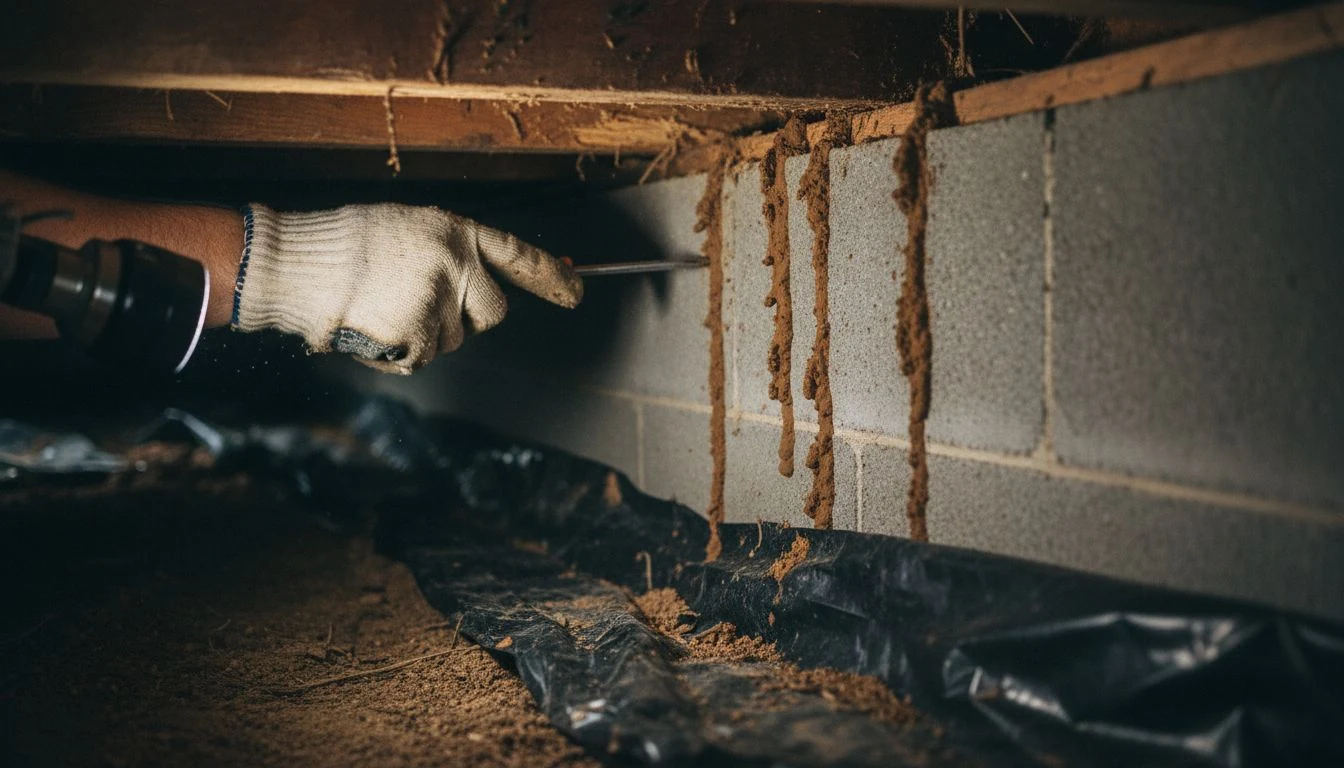
The inspector was in my crawl space for about twenty minutes. When he came out, he had cobwebs in his hair and a flashlight in his teeth, and he said the four words every new homeowner dreads: “You’ve got some tubes.”
Mud tubes. Pencil-width tunnels of dirt running up the block foundation to the sill plate. That termite inspection cost me $125 as part of the purchase. The first treatment quote that followed it was $3,900, and it came with a salesman who wanted a signature before he left my driveway.
I paid $1,650 in the end, three weeks later, to a different company. Here is how.
Termite inspection cost in 2026 runs from free to about $150 for a routine look by a pest company, and roughly $75 to $325 for the formal wood destroying insect report a lender asks for when you buy a house. The inspection is the cheap part. What matters is what it finds, because treatment starts around $250 for a spot job and climbs past $4,000 when a house has to be tented.
Below is what each kind of inspection costs, what the inspector actually checks, what treatment runs if they find termites, and the questions that saved me $2,250.
I am a homeowner with an old house and a folder of receipts, not a licensed pest control operator. Anything involving termiticide application belongs to someone who is licensed in your state.
Jump to what you need:
- Termite inspection cost in 2026
- Why so many inspections are free
- What the inspector checks
- Termite treatment cost if they find them
- The annual renewal nobody explains
- Damage repair, the bill that is not on the quote
- What you can do yourself
- Cost table: inspection, treatment and renewal
- Frequently Asked Questions
Termite inspection cost in 2026, by the reason you need one
The same guy with the same flashlight can cost you nothing or $300. The difference is paperwork.
A routine inspection, the kind you call about because you saw wings on the windowsill, is free at most national and regional pest companies I contacted. A few smaller outfits charged $75 to $150 and credited it toward treatment if I hired them. That is fair. Somebody crawling under your house for half an hour is real labor.
A real estate inspection is different. When you buy a home with an FHA or VA loan, or when the appraiser notes damage, the lender wants a wood destroying insect report, usually the one-page NPMA-33 form. That report is a legal document with a license number on it, and it runs $75 to $325. Mine was $125, bundled into the general home inspection. Friends in Florida and Texas paid closer to $150 to $200 because their states use their own forms and termite pressure is heavier there.
The VA also changed its list of counties that require this report in July 2025. If you are buying with a VA loan in a place that did not used to need one, ask your lender early instead of finding out at the appraisal.
Then there is the annual inspection that comes with a service plan. If you already have a termite warranty, the yearly visit is usually included in the renewal fee. More on that fee below, because it is the line item that surprised me most.
Why so many termite inspections are free
I was suspicious of free. You should be too, but for the right reason.
A free inspection is a sales call with a flashlight, and I don’t hold that against anyone. The company makes its money on treatment and on the yearly renewal, so a careful inspection is their marketing. A careless one turns into a scare.
The first company that came out after closing found the same tubes my home inspector found. The rep also told me my joists were “hollowed out,” that the colony was “probably in the walls by now,” and that his special price expired Friday. He tapped one joist with a screwdriver. He did not probe a single other board.
The University of Kentucky entomology department has a line in its termite control guide for homeowners that I wish I had read that afternoon: termites damage wood slowly, and the damage from taking an extra day, week or month to decide is generally inconsequential. The same guide warns against firms that push you to sign immediately with specials or scare tactics.
So I got two more free inspections. Both found the tubes. Neither found hollow joists. One found a second active spot near the back porch that the first guy missed entirely. Three free inspections, three very different reports, and the most thorough one came from the company with the smallest truck.
My rule now: free is fine. Free plus a deadline is not.
What a termite inspection actually checks
A proper inspection covers the visible and accessible parts of the house. That phrase matters. Nobody opens your walls, and the report will say so in writing.
Here is what the good inspector did at my house, in order:
- Walked the outside perimeter looking at the foundation for mud tubes, cracks, and any spot where soil or mulch touches siding.
- Checked the porch, deck posts, fence posts touching the house, and the stack of firewood I had leaned on the garage wall (a mistake, which he pointed out politely).
- Went through the crawl space with a light and a screwdriver, probing the sill plate, joists and subfloor for soft or hollow spots.
- Looked for moisture: a sweating pipe, a wet corner, standing water near a pier. Subterranean termites need it.
- Inside, checked baseboards, door frames, and window sills for blistered paint, frass, or discarded wings.
- Went into the attic, mostly for drywood signs and roof leaks.
The whole visit took about 45 minutes. The screwdriver part is the one to watch. The EPA’s page on how to identify and control termites suggests exactly that method, probing exposed wood with a flathead screwdriver for hollow spots. An inspector who only looks and never probes is guessing.
Ask what kind of termite they found. Native subterranean termites are the most common in most of the country. Drywood termites live inside the wood with no soil contact, and the invasive Formosan termite is its own, more aggressive problem in the South. The answer decides the treatment, and the treatment decides the bill.
If your crawl space is damp, the inspection report will probably say so, and it is worth reading our guide to crawl space encapsulation cost before you pay for anything. Fixing the moisture is part of fixing the termites.
Termite treatment cost if they find termites
This is where the numbers get big, and where quotes stop being comparable. Three companies quoted my house three different ways.
Liquid barrier treatment
A liquid termiticide applied to the soil around the whole foundation. The crew trenches along the outside, drills through concrete where there is a slab or a patio against the house, and injects the product. The most common approach in the country, and what I bought.
Cost: roughly $1,200 to $3,000 for a typical house, often priced per linear foot of foundation at around $4 to $16 a foot. My house has about 170 feet of perimeter and a small porch slab. $1,650.
The Kentucky guide says modern liquid products last at least five years when applied according to the label, and most are now non-repellent, meaning termites pass through the treated soil without noticing and carry it back to the colony.
Bait system
Stations set in the ground every 10 to 20 feet around the house, filled with a cellulose bait laced with a slow-acting insecticide. Workers feed on it and share it with the colony. Less product in the soil, no drilling through the patio.
Cost: $1,500 to $3,500 to install, then $300 to $500 a year for monitoring. The install number looks similar to liquid. The yearly number is the real difference. One company quoted me bait at $1,980 plus $420 a year, and over five years that is $4,080.
Spot treatment
A small, targeted application at one known entry point. $250 to $900. Sounds like a bargain, and for drywood termites in a single piece of trim it can be. For subterranean termites coming up through a foundation, it treats the tube you can see and ignores the rest of the perimeter. I would not buy it for that.
Tenting and heat for drywood termites
Drywood colonies live in the wood itself, so a soil barrier does nothing. If they are spread through the house, the fix is fumigation under a tent. You move out for two or three nights, bag your food and medicine, and the whole structure gets treated.
Cost: roughly $1,200 to $4,500, or about $1 to $4 per square foot, plus a hotel. Whole-structure heat treatment is the no-chemical alternative at about $800 to $2,800, but it has limits on large or heavily insulated houses. A cousin in California paid $2,700 to tent a 1,500 square foot house and another $340 for the motel and the dog’s boarding.
If a quote does not say which of these methods it is, it is not a quote yet.
The annual renewal, or the part that costs more than the treatment
Every treatment quote I got came with a warranty, usually called a bond or a service agreement. Here is what nobody explained until I asked.
The warranty is only good while you pay the renewal. Expect $150 to $400 a year, and it usually includes the yearly inspection. The Kentucky guide describes the typical deal: the company will come back and retreat the affected area at no charge as long as the annual renewal is kept up.
The word that matters in that sentence is retreat. I had assumed a warranty meant they would fix the wood, and I was wrong. There are two kinds:
- Retreatment only. If termites come back, they treat again for free. Any new damage is yours to pay for.
- Repair and retreatment. They also pay to fix new damage, usually up to a cap. Costs more per year, and proving when the damage started can turn into an argument.
My $1,650 treatment came with a retreatment-only warranty at $185 a year. Over ten years, the renewal adds up to more than the treatment did. I kept it for three years, until I sold the house, because a transferable warranty helped the sale. The buyer’s agent asked for it by name.
Ask whether the warranty transfers to a new owner, whether there is a fee to transfer, and what happens if you skip one year. Some companies will not reinstate a lapsed bond without a full retreatment.
Damage repair: the bill that is not on the termite quote
Pest companies kill termites. They do not fix wood. That is a separate contractor, a separate estimate, and sometimes the bigger number.
At my house, the carpenter replaced about six feet of sill plate and sistered two joists near the tubes. $1,400, two days, and he found nothing hollow past the first joist. That is the report the “your joists are hollowed out” guy was selling against.
Light damage like that runs $500 to $3,000. Once it reaches the structure, sill plates along a whole wall, rim joists, posts under the house, you are closer to the numbers in our foundation repair cost guide. A porch or deck with termite damage is its own job, and what deck repair costs walks through when a board swap is enough and when it is not.
Get the damage looked at by a carpenter or a structural person, not only by the pest company. I asked the pest inspector to mark the soft spots with chalk, took photos, and handed those to the carpenter. It saved an hour of him crawling around looking for them.
What you can do yourself, and what I would not
You can do a lot of the prevention and a fair bit of looking. What I would leave alone is the soil treatment.
Things I do every spring, free or close to it:
- Pull mulch and soil back so there are a few inches of visible foundation between dirt and siding.
- Move firewood, lumber and cardboard away from the house. That woodpile against my garage was a buffet.
- Fix drips, clean gutters, and make sure downspouts dump water away from the foundation.
- Take a flashlight and a screwdriver into the crawl space and probe the sill plate in a few spots. Ten minutes.
- Knock down any mud tube I see and check a week later. If it is rebuilt, they are active.
Store-bought termite stakes and hardware store liquid exist, and I understand the temptation when a quote says $3,000. I would not rely on them for an active infestation. The EPA specifically warns that improperly applied soil treatments can contaminate the home and nearby wells, and it tells homeowners to hire a licensed and trained professional and to check the company’s state license. Your state department of agriculture usually has a lookup.
Where DIY does pay: prevention after treatment. Termites came back at a neighbor’s house because she let the flower bed creep back up over the treated zone. Nobody’s warranty covers mulch.
Take this to every termite inspection and quote. What type of termite did you find, and where exactly. Can you mark the spots and show me photos. Is there active damage, or old damage. Which treatment are you quoting: liquid, bait, spot, fumigation or heat. What is the price per linear foot or per square foot, and how many feet did you measure. Which product, and can I see the label. Is the warranty retreatment only, or repair and retreatment, and what is the cap. What is the yearly renewal, and does it transfer if I sell. What is your state license number. Get three inspections, get every quote in writing, and do not sign anything the same day.
If you are lining up several bids for the treatment and the repair, putting them side by side is covered in how to tell if a contractor quote is fair.
Termite inspection cost, treatment and renewal at a glance
Find your situation in the left column. The last column is what moved my own numbers the most, and it is usually missing from the first quote.
| Service | Typical 2026 cost | What you get | What pushes it up |
|---|---|---|---|
| Routine termite inspection | $0 – $150 | Perimeter, crawl space, interior and attic check | Large house, hard crawl space access |
| Real estate WDI report (NPMA-33 or state form) | $75 – $325 | Licensed written report for the lender | State-specific forms, rush timing |
| Spot treatment | $250 – $900 | One targeted area | Drilling, hard-to-reach wood |
| Liquid barrier treatment | $1,200 – $3,000 | Full perimeter soil treatment, often 5+ years | Slabs, patios and porches to drill |
| Bait system install | $1,500 – $3,500 | Stations around the house | Big lot, more stations |
| Bait monitoring | $300 – $500 a year | Station checks and bait refills | Monthly vs quarterly visits |
| Fumigation (tenting) | $1,200 – $4,500 | Whole structure, drywood termites | Square footage, hotel nights |
| Heat treatment | $800 – $2,800 | Whole structure or rooms, no chemicals | Heavy insulation, house size |
| Warranty renewal | $150 – $400 a year | Annual inspection, free retreatment | Repair coverage added |
| Damage repair (carpentry) | $500 – $3,000+ | Sill plate, joists, trim | Structural wood, foundation work |
What blows the termite budget
- Signing on the first visit. My first quote was $3,900 with a Friday deadline. The third was $1,650 for the same method on the same house. I had time to shop, and so do you.
- Forgetting the renewal math. A cheaper install with $400 a year of monitoring can cost more over five years than a pricier liquid job with a $185 renewal. Add up five years before you compare.
- Treating without fixing the water. A wet crawl space or a downspout dumping on the foundation invites them back. Fix the drainage in the same month you pay for the treatment.
If termites are one item on a longer list this year, our roundup of home renovation costs helps you rank what gets paid first. And if the inspector also flagged a musty smell or fuzzy growth under the house, read mold remediation cost before the next quote comes in.
Frequently Asked Questions
How much does a termite inspection cost in 2026?
A routine termite inspection is free at many pest companies and about $75 to $150 at others, often credited toward treatment. A real estate wood destroying insect report, like the NPMA-33 form used for FHA and VA loans, usually runs $75 to $325. These are estimates, and region and house size move them.
How much is termite treatment if they find termites?
A liquid barrier treatment runs roughly $1,200 to $3,000 for a typical house. Bait systems cost $1,500 to $3,500 to install plus $300 to $500 a year to monitor. Spot treatment is $250 to $900, and tenting for drywood termites runs about $1,200 to $4,500. Damage repair is a separate bill from a carpenter.
How often should you get a termite inspection?
Once a year is the common recommendation, and it is usually included if you keep a warranty renewal. You will also need one when you buy a house with certain loans. Between visits, keep soil and mulch off the siding, keep wood away from the foundation, and check for mud tubes in spring when swarms show up.
All prices here are 2026 estimates gathered from real invoices, written quotes and local price sheets, and they vary by region, termite type, house size and foundation. Tessa is a hands-on homeowner who has paid these bills and kept the paperwork, not a licensed pest control operator or a licensed contractor. Nothing here is instruction for applying termiticides. Use these ranges to ask sharper questions and read your own quotes, not as a price for your house.
Free DIY Project Cost Estimator
The spreadsheet I use to price out a project before I start, so a weekend job never blows the budget. Join the newsletter and I’ll send it over.
No spam, ever. Unsubscribe anytime. — Tessa
Keep reading — more on Remodel & Renovation Costs
Boiler Replacement Cost: Gas, Oil, and Combi Boilers Compared
My friend Marisol called me on a Sunday in October with her coat on inside the…
Read article →
HVAC System Replacement Cost: Furnace, AC, or Both at Once
The tech who told me my air conditioner was done also handed me a second price…
Read article →
Furnace Tune Up Cost: What a Fall Service Includes (and What to Skip)
Three companies left door hangers on my porch the same week in September. One said $79.…
Read article →
Furnace Blower Motor Replacement Cost in 2026: PSC vs ECM
My dad called on a Sunday in January and opened with “the furnace is running but…
Read article →