
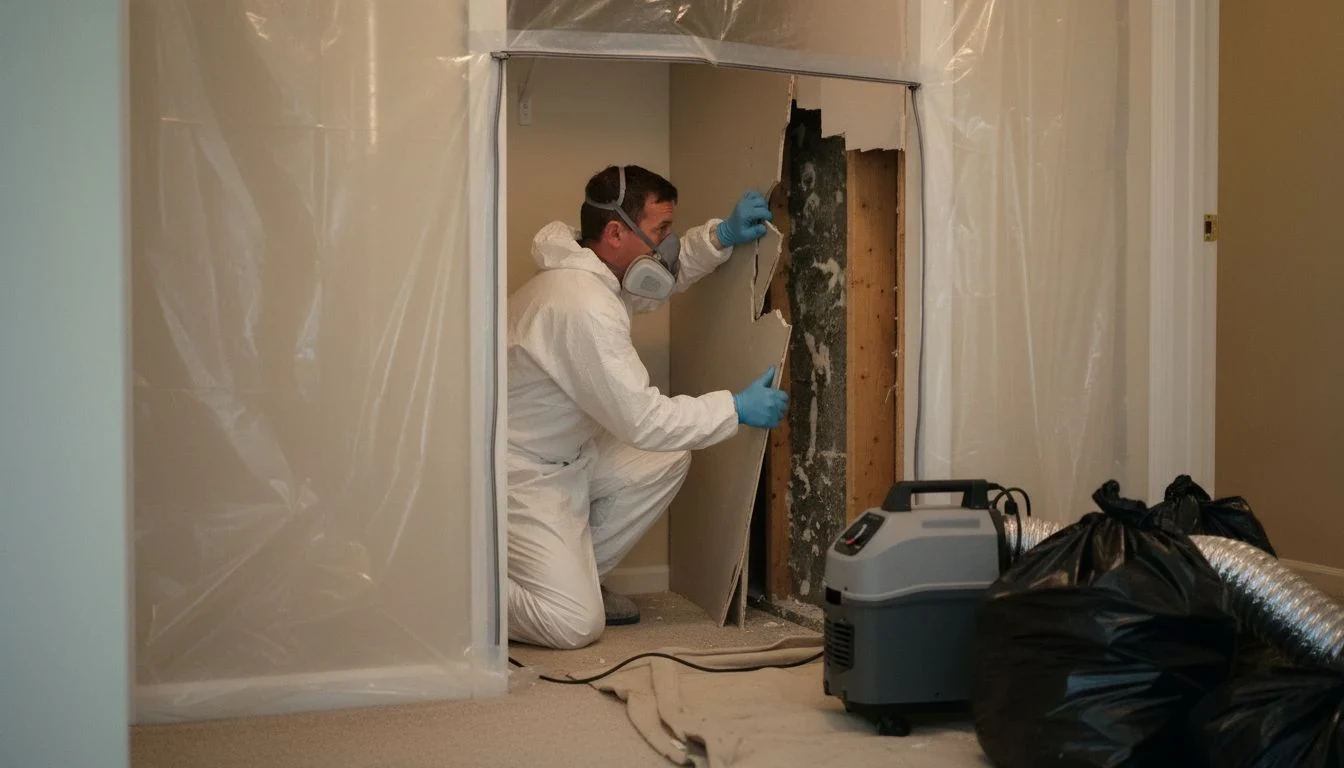
The first sign was a smell in the hall closet, the one that shares a wall with our upstairs shower. Wet cardboard, a little sweet. I blamed the old winter boots in there for about three weeks. Then I pulled the towels off the bottom shelf and saw a gray-green bloom climbing the drywall from the baseboard up, and I spent that night reading about mold remediation cost instead of sleeping.
The numbers first. A mold remediation cost in 2026 usually runs about $1,200 to $4,000 for one contained area like a bathroom wall, a closet or a section of crawl space. Small surface jobs can come in under $800, and whole-house work with a lot of demolition can go past $15,000. My three quotes for the same closet wall were $2,850, $4,600 and $7,900. I paid $4,600, plus $375 for an independent clearance test and $1,140 to put the wall and the tile back.
I’m a homeowner who reads every line of an invoice, not a mold professional. What follows is what each quote actually included, the size rule EPA uses to separate a weekend cleanup from a hired job, and the leak I should have fixed a year earlier.
Jump to what you need:
- Mold remediation cost in 2026, and my three quotes
- The 10 square foot line: when it is a DIY wipe
- What a mold remediation quote should list
- Testing before and after: when it is worth paying for
- Why the same patch costs more in the attic or crawl space
- The leak is the real job
- Mold remediation cost by location and scope
- Frequently Asked Questions
Mold remediation cost in 2026, and my three quotes
Our closet wall measured about 4 feet wide and 5 feet tall where the growth showed. Twenty square feet on the surface. The first thing all three companies did was put a moisture meter on it, and the first thing all three said was that the back of the drywall was probably worse than the front.
They were right. But they priced that problem in very different ways:
- $2,850 to “treat and remove” the closet wall. No containment on the written quote, no air filtration listed, and a spray treatment for the whole upstairs “to be safe.”
- $4,600 for a sealed plastic work area with negative air, removal of the drywall to 2 feet past the last visible growth, HEPA vacuuming, cleaning of the studs, a drying check with a meter, and a written scope. Rebuild not included.
- $7,900 for the same work plus their own before and after air tests, fogging of the entire house, and rebuilding the wall and tile with their crew.
That is a $5,050 spread for one wall in one house. The cheapest quote was cheap because it skipped the plastic and the air machine, which are the parts that keep the spores in the closet and out of the bedroom next door. The priciest one was expensive mostly because of the whole-house fogging and the rebuild markup.
So I took the middle one, hired our usual tile guy for the rebuild, and paid a separate inspector for the clearance test. All in, $6,115. Not fun. Still $1,785 under the top quote, with a test from someone who had no stake in passing the job.
The 10 square foot line: when mold remediation is a DIY wipe
Not every spot of mold needs a company. EPA’s brief guide to mold, moisture and your home draws the line at size: if the moldy area is less than about 10 square feet, roughly a 3 foot by 3 foot patch, in most cases you can handle it yourself.
I’ve done the small version. Two winters ago the caulk line along our basement window sill went black, maybe a foot long and an inch tall. I scrubbed it with detergent and water, dried it with a fan, cut out the old caulk and ran a new bead. Cost me about $14 and an hour. It hasn’t come back, because I also started running the dehumidifier down there.
Where I stop and call someone:
- The patch is bigger than that 3 by 3 square, or I can’t tell how big it is because it goes behind a wall or under a floor.
- It keeps coming back in the same spot, which means the water is still getting in.
- The material is soaked and soft. EPA notes that porous things like ceiling tiles and carpet may have to be thrown away once they get moldy, and pulling out wet drywall is a different job than wiping a sill.
- Anyone in the house has health concerns. That is a question for your doctor, not for me or a blog post.
One more line from that same EPA guide that I taped inside our cleaning cabinet: never mix chlorine bleach with cleaners that contain ammonia, because it can produce toxic fumes. I don’t use bleach on mold at all now. Detergent and water did the sill fine.
Before you call anyone, write down these five things. The size of the visible area in feet, measured with a tape, not guessed. Where it is (closet, attic, crawl space, behind a tub). Any leak or flood you know about and roughly when it happened. What the material is: painted drywall, wood, carpet, tile grout. And photos in daylight with the tape in the shot. Hand the same sheet to every company so the three quotes describe the same job.
What a mold remediation quote should list
The $2,850 quote was one line and a total, and you can’t compare a one-liner to a scope. After reading all three side by side, here is what I now expect to see written down:
- The square footage of material being removed, and how far past the visible growth they cut.
- Containment: plastic sheeting, a zipper door, and whether the work area is kept under negative air pressure.
- Air filtration equipment and how many days it runs.
- What gets thrown out versus cleaned. Drywall and insulation usually go. Studs usually get cleaned and dried.
- How they confirm the wood is dry before anyone closes the wall.
- Whether rebuild is included, and if not, what state they leave the wall in.
- Who fixes the water source. None of my three quotes included the shower valve.
EPA’s guide also suggests checking references and asking a contractor to follow the recommendations in its Mold Remediation in Schools and Commercial Buildings guide. I asked all three if they did. Two said yes without blinking. The first one asked me what that was.
Also look up your state’s rules before you sign. A handful of states license mold work, and some of them do not allow the same company to both assess and remediate the same job. If you live in one of those states, a company offering to test, find mold and then fix it has a conflict built into the quote.
And watch the pressure. The $7,900 company told me the price was good “if we can start Monday.” The FTC’s page on how to avoid a home improvement scam lists pressure for an immediate decision as a warning sign, and it tells you to get more than one written estimate. A wall that has had mold in it for a year can wait three days for a second opinion. My own checklist for reading any bid lives in how to tell if your contractor quote is fair.
Mold remediation testing: when it is worth paying for
This is the line item I understood least going in. Mold inspections with air or surface samples usually run about $300 to $900 in 2026, depending on how many samples and how big the house is.
But EPA’s own position is that if you can see mold growing, sampling is usually unnecessary. You already know it’s there. I could see mine from the hallway. Paying $600 to confirm that a green wall had mold on it would have been money spent on a report, not on the fix.
Where a test did earn its keep for us was at the end. After the crew finished, I paid an independent inspector $375 for a clearance check before the tile guy closed the wall. He looked at the cavity, took readings on the studs, and took a couple of samples. The job passed. I would not have trusted a pass from the company I had just paid $4,600.
My rule now: skip the test when the mold is visible and small, pay for one when you smell it but can’t find it, and pay an independent one at the end of any job big enough to have containment.
Why the same mold remediation costs more in the attic or crawl space
Twenty square feet in a closet is not the same job as twenty square feet in an attic. The price is mostly labor, and labor gets slow when the crew can’t stand up.
An attic often means working bent over on joists in summer heat, cleaning roof sheathing overhead, and bagging old insulation down a ladder. A crawl space means lying on your back on a vapor barrier, if there is one. Both usually cost more per square foot than an open basement wall.
When I wrote up our crawl space encapsulation cost, the contractor’s point was the same one every mold company made: clean the wood without fixing the dampness and you’re buying the same job again in two years. And if your basement plans are bigger than a cleanup, get the moisture sorted before you talk to basement finishing contractors. Framing and drywall over a damp slab is how people end up calling a mold company in the first place.
The sneakiest location is behind a wall, like ours. You pay for demolition you couldn’t see coming, and you pay again for the rebuild. Our tile guy charged $1,140 to hang new drywall in the closet, patch the shower side and reset nine tiles we had to pull to reach the valve. If you’re pricing that part on its own, my drywall repair cost guide has the per-patch numbers.
The leak is the real job
Now my mistake. About a year before the closet smelled, the shower handle started dripping for a few seconds after we turned it off. I knew what it was. I’d even written about how to fix a leaking shower faucet. I just didn’t do it.
When the crew opened the wall, the back side of the valve body had a slow weep at one fitting, a drop every so often running down inside the cavity for months, into the bottom plate, into the drywall, into the closet. A $40 repair turned into a $6,115 afternoon plus a plumber.
EPA’s guide says that if wet materials are dried within 24 to 48 hours after a leak or spill, mold usually won’t grow. Drying fast costs a box fan and a day. It also says to keep indoor humidity below 60%, ideally between 30% and 50%. I bought a $20 humidity meter for the upstairs hall after this, and the bathroom fan now runs on a timer for 20 minutes after every shower.
No remediation company can promise the mold stays gone if the water keeps coming. Ask every one of them what they think caused it, and get that answer in writing too. Ours wrote “suspected plumbing leak at shower valve, homeowner to repair prior to rebuild.” That one sentence saved me from closing up a wall over a leak that was still dripping.
Mold remediation cost by location and scope
These are the ranges I pieced together from my own quotes, a neighbor’s attic job and two friends’ basements, lined up against the scopes the companies wrote. Treat them as a starting point for questions, not a price list.
| Job | Typical 2026 range | What drives the price | What people forget |
|---|---|---|---|
| Small surface cleanup under 10 sq ft (often DIY) | $10 – $60 DIY, $400 – $900 hired | Material, access | Fixing the moisture that caused it |
| Bathroom or closet wall, contained | $1,200 – $4,500 | Square feet removed, containment days | Rebuild, tile and paint |
| Basement section, open wall or slab edge | $1,500 – $5,000 | Finished vs unfinished, carpet | Dehumidifier and drainage fixes |
| Crawl space | $1,500 – $6,000 | Height, wood cleaning, debris | Vapor barrier or encapsulation |
| Attic sheathing and insulation | $2,000 – $7,000 | Roof size, insulation removal | Bath fan or vent ducts that caused it |
| Inspection with samples | $300 – $900 | Number of samples, house size | Often skippable when mold is visible |
| Independent clearance test | $250 – $600 | Samples, travel | Should be booked before rebuild |
| Whole-house or post-flood remediation | $10,000 – $30,000+ | Demolition, contents, drying equipment | What your policy covers: check it, don’t assume |
| Line item | Quote A | Quote B (hired) | Quote C |
|---|---|---|---|
| Containment and negative air | Not listed | Included | Included |
| Drywall and insulation removal | “Treat and remove” | To 2 ft past growth | To 2 ft past growth |
| Air testing | None | None (I hired it separately, $375) | Their own, before and after |
| Whole-house fogging | Included | Not offered | Included |
| Rebuild | No | No (my tile guy, $1,140) | Yes |
| Total | $2,850 | $6,115 all in | $7,900 |
What blows the mold remediation budget
- Remediating before the leak is fixed. Clean studs over a dripping valve just give the mold a fresh start. Get the plumber, roofer or gutter fix done first, or at least in the same week.
- Paying for tests you don’t need. If the growth is visible and small, a $600 sample report tells you what your eyes already did. Save the testing money for an independent clearance check at the end.
- Buying the whole-house add-on by default. Fogging every room for one closet wall was $1,200 of the top quote. Ask what problem it solves in your house, and ask why the containment isn’t enough.
If this whole thing started from a damp basement rather than a leak, the radon mitigation system cost post is worth a look while you have contractors in the house. A few of the companies that came to our place quote both.
Frequently Asked Questions
How much does mold remediation cost in 2026?
Most contained jobs for a single area, like a bathroom wall, closet or section of crawl space, fall between about $1,200 and $4,000. Small surface patches can cost under $800 or be a DIY cleanup, while whole-house or post-flood work can pass $15,000. Rebuild and testing are often billed on top. These are estimates that move with region and scope.
Can I remove mold myself?
EPA says that if the moldy area is less than about 10 square feet, roughly a 3 by 3 foot patch, in most cases you can handle it yourself. Bigger areas, mold inside walls or growth that keeps coming back are jobs for a professional. If anyone in the home has health concerns, talk to a doctor before you start.
Do I need a mold test before remediation?
Not usually when you can see the mold. EPA notes that sampling is generally unnecessary when visible growth is present. Testing makes more sense when you smell mold but can’t find it, or as an independent clearance check after a contained job and before the wall gets closed up.
All prices here are 2026 estimates and vary by region, local labor rates, state licensing rules, access and what is found once materials are opened up. Tessa is a hands-on homeowner who has hired this work and compared the quotes, not a licensed mold assessor, remediator or medical professional. Nothing here is health advice or an inspection of your home. Check your state’s mold licensing rules and your own insurance policy. Use these ranges to ask sharper questions, not as a quote.
Free DIY Project Cost Estimator
The spreadsheet I use to price out a project before I start, so a weekend job never blows the budget. Join the newsletter and I’ll send it over.
No spam, ever. Unsubscribe anytime. — Tessa
Keep reading — more on Remodel & Renovation Costs
Boiler Replacement Cost: Gas, Oil, and Combi Boilers Compared
My friend Marisol called me on a Sunday in October with her coat on inside the…
Read article →
HVAC System Replacement Cost: Furnace, AC, or Both at Once
The tech who told me my air conditioner was done also handed me a second price…
Read article →
Furnace Tune Up Cost: What a Fall Service Includes (and What to Skip)
Three companies left door hangers on my porch the same week in September. One said $79.…
Read article →
Furnace Blower Motor Replacement Cost in 2026: PSC vs ECM
My dad called on a Sunday in January and opened with “the furnace is running but…
Read article →