
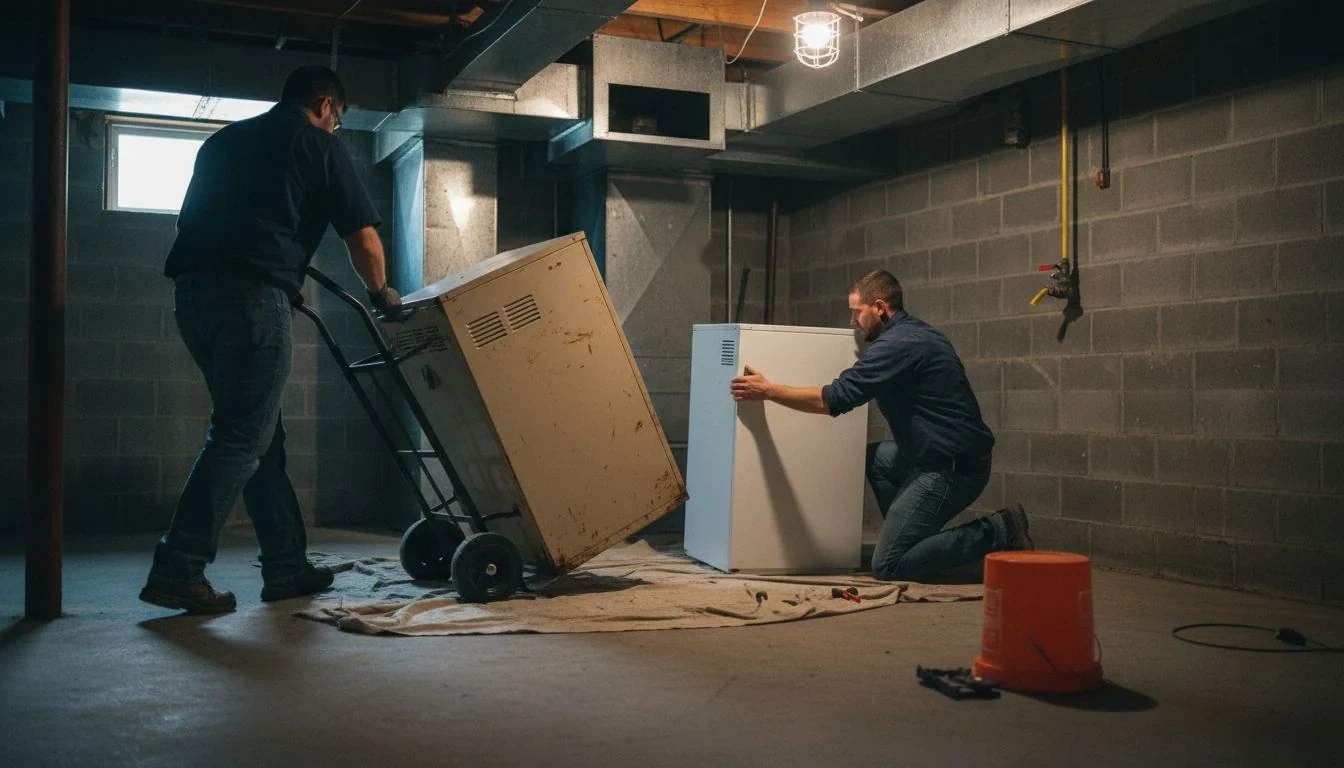
Last April the furnace in our basement started to howl. The little motor that pulls exhaust up the chimney made a dry, rising whine every time the heat kicked on, loud enough to hear from the kitchen. The tech who came out listened for about four seconds and said the draft inducer bearings were going. The part and labor came to $740, and that was the afternoon I started looking up furnace replacement cost instead.
I did the math from my own furnace repair cost notes right there on the basement stairs. $740 times a 17-year-old furnace is 12,580. Anything over about 5,000 and I stop thinking about the repair. So I didn’t fix it. I nursed it through the last cold snaps of spring, turned the heat off in May, and spent August collecting quotes.
A furnace replacement cost in 2026 runs about $4,000 to $8,500 for a standard 80% efficiency gas furnace, and $6,000 to $12,000 for a high-efficiency condensing unit that needs new venting and a drain. My three quotes for the same basement came in at $6,400, $9,150 and $12,900. I paid $9,150, and the reasons are most of this post.
I’m a homeowner who reads every line of an invoice, not an HVAC tech. Below are the lines from those quotes, the payback math nobody ran for me, and a cost in my chimney that the priciest quote left out until I asked about it.
Jump to what you need:
- Furnace replacement cost in 2026, and my three quotes
- The signs it is actually time
- What a furnace replacement quote should list
- 80% or 96%: the payback math
- The line item hiding in my chimney
- Three quotes, one house
- What I did myself before anyone came
- Furnace replacement cost by fuel and efficiency
- Frequently Asked Questions
Furnace replacement cost in 2026, and my three quotes
Our old furnace was a 2009 builder-grade gas unit: 80% efficiency, 100,000 BTU, one speed, vented into the brick chimney it shared with the water heater. Pretty much the default furnace in a lot of houses built around then.
Three companies came out in the same two weeks of August. Their numbers:
- $6,400 for another 80% furnace, the same 100,000 BTU size, venting into the same chimney.
- $9,150 for a 96% two-stage furnace sized at 60,000 BTU after a load calculation, with new plastic venting out the side wall and a liner for the chimney.
- $12,900 for a 97% modulating furnace, again at 100,000 BTU, with a smart thermostat, a UV lamp and a duct cleaning bundled in.
That’s a $6,500 spread in furnace replacement cost for one basement. The furnace itself explained maybe a third of it. The rest was sizing, venting and whatever each company decided to bundle in.
These are my numbers from one house in a cold state. Your region, your labor rates and the way your house vents will move them, sometimes by thousands.
The signs it is actually time to replace a furnace
Every installer who walked through my basement put the normal life of a gas furnace at 15 to 20 years. Age alone isn’t a reason, though. Plenty of 20-year-old furnaces just keep going. What pushed me over was a pile of signs showing up at once.
The first one is arithmetic. Multiply the repair quote by the furnace’s age in years. Under about 5,000, fix it. Over 5,000, get replacement quotes before you approve anything. A $300 ignitor on a 12-year-old unit comes to 3,600, so you fix it. My $740 inducer on a 17-year-old unit came to 12,580.
Then there’s how often you’re calling. The inducer was the third service call on this furnace in a few years, after a flame sensor and a pressure switch. Once the calls start coming every season or two, I assume the next one is already on its way.
The gas bills had crept up, too. Same thermostat settings, a little more gas every winter. I pulled three years of bills and the heating months were up about 9%. Rate hikes explain some of that. Not all of it.
And the big one, which we didn’t have: a cracked heat exchanger. On an older unit that’s the repair that turns into a replacement, because the heat exchanger is what keeps combustion gases out of the air you breathe. It’s also the scare line that gets used on people. If someone tells you yours is cracked, ask to see it on their camera, and get a second company out before you sign anything.
Carbon monoxide is the reason that last one matters. The EPA’s page on carbon monoxide and indoor air lists leaking furnaces and back-drafting from furnaces and gas water heaters among the sources, and it passes along the CPSC’s advice: a CO alarm on every level of the house, outside each sleeping area, and a professional inspection of fuel-burning appliances every year. We have three alarms. If one ever goes off, everybody goes outside first and we make the call from the driveway.
What a furnace replacement quote should list
The $12,900 quote was one line. “Furnace system, installed.” That’s where I got stuck, because you cannot compare one line against anything.
The $9,150 quote broke out every piece, and it adds up to the dollar:
| Line on my quote | What I paid | Typical 2026 range |
|---|---|---|
| 96% two-stage gas furnace, 60,000 BTU | $3,400 | $2,200 – $5,500 (condensing) |
| Labor: remove old unit, set and wire new one (2 techs, 1.5 days) | $3,050 | $1,500 – $4,000 |
| PVC intake and exhaust, condensate line to floor drain | $650 | $300 – $1,200 |
| Stainless liner for the water heater’s chimney | $1,150 | $800 – $2,500 |
| Sheet metal transition to the existing ducts | $450 | $200 – $1,000 |
| New gas shutoff and sediment trap | $300 | $150 – $600 |
| Mechanical permit and inspection | $150 | $50 – $400 |
| Haul-away, start-up and combustion test | $0 | $0 – $250 |
| Total | $9,150 |
Two things I didn’t know to ask for until I saw them written down.
First, the load calculation. The same installer spent 45 minutes going room to room with a tape measure and a laptop, counting windows and checking the attic insulation. That’s the industry method, usually called a Manual J. It said our house loses about 44,000 BTU an hour on the coldest design day. The old furnace put out roughly 80,000. For 17 years we had a furnace almost twice the size of the house, which explains why it ran in short blasts and the back bedroom was always cold.
Second, the permit. The $6,400 company told me I could “save a little” by pulling the permit myself. The FTC’s page on how to avoid a home improvement scam lists that as a tactic to watch for: a contractor asking you to get the required permits. I am not calling that company a scam. But the installer should be the one standing next to the inspector, and a furnace connects to your gas line.
Five things to hand every furnace installer. The age and BTU rating from your old furnace’s nameplate. Twelve months of gas bills. Your square footage and a count of the windows. A photo of where your water heater vents. And one question: “Will you do a load calculation, and can I have a copy?” If a company quotes a size without measuring anything, ask what the number is based on.
80% or 96%: the payback math on a new furnace
AFUE is the share of the fuel that becomes heat in your house over a season. At 80%, about 20 cents of every gas dollar goes up the chimney. At 96%, about 4 cents.
ENERGY STAR’s furnace criteria split the country in two. A gas furnace needs 97% AFUE or better to earn the label in the northern states and 95% in the southern ones. Its furnace page puts the average savings at about $160 a year for a certified gas furnace in the North and about $60 in the South.
For our house I ran it with real bills. Our gas bills from November through March came to $1,610 last winter. The summer months run about $45 for the water heater, dryer and stove, so heating was roughly $1,385. Going from 80% to 96% cuts the gas for the same heat by about a sixth, so call it $230 a year.
The high-efficiency quote cost $2,750 more than the 80% quote. So about 12 years to break even, on a furnace that should last 15 to 20.
| Where the house is | Yearly savings, 95%+ vs 80% | Extra cost up front | Rough payback |
|---|---|---|---|
| Southern state (ENERGY STAR average) | ~$60 | $2,500 | 40+ years |
| Northern state (ENERGY STAR average) | ~$160 | $2,500 | about 16 years |
| My house, cold winters, basement unit | ~$230 | $2,750 | about 12 years |
| Large, drafty house, long heating season | ~$400 | $2,500 | about 6 years |
Where I landed: in a cold state, a condensing furnace usually earns its premium. In a warm one, a good 80% furnace installed right is a sane choice, and I’d put the difference into sealing the ducts. Before you pick, ask your gas utility whether it runs a rebate on high-efficiency furnaces this year. A rebate can knock years off that last column.
The line item hiding in my chimney
Our old furnace and our gas water heater shared the brick chimney. A 96% furnace doesn’t vent into a masonry chimney the way the old one did. Its exhaust is cool and wet, so ours runs through plastic pipe out the side wall. Take the furnace out of the chimney, and the water heater is left alone in a flue that was sized for two appliances.
Installers call that an orphaned water heater. The chimney is now too big for the small amount of warm exhaust going up it, so the exhaust can cool and stall on the way out instead of rising the way it should. The EPA’s carbon monoxide page names a flue that is improperly sized as one of the ways a combustion appliance ends up leaking CO into a house. The usual fix is a stainless liner sized for the water heater, dropped down the old chimney.
That liner was $1,150 of my $9,150, which is why I now read the venting lines first on any furnace replacement cost quote. The $12,900 quote didn’t mention it until I asked, and then it became “an additional $1,400.” The $6,400 quote didn’t need it, because an 80% furnace stays in the chimney.
If you had your chimney looked at recently, pull out that report, since it may already say what shape the flue is in. My notes on what a chimney inspection costs cover what a Level 2 inspection checks. And if your water heater is close to the end anyway, price that job alongside the furnace, because the venting plan changes if both go at once. What a water heater replacement costs has those numbers.
Three quotes, one house: how I picked
I almost signed the $6,400 quote. It was the cheapest, the installer was friendly, and “same as what you have” sounded safe. My husband pointed out that “same as what you have” also meant the same oversized furnace and the same cold back bedroom.
The FTC’s advice, on the same page, is not to automatically choose the lowest bidder, and to ask for an explanation when estimates are far apart. So I did. I asked each company why their number was their number.
The $12,900 salesman spent most of an hour on the UV lamp and the duct cleaning. He had a financing plan at $179 a month. He also had a price that was “good through Friday.” That night I multiplied it out on my phone: 120 payments of $179 is $21,480. The FTC page lists pressure for an immediate decision and a lender the contractor knows as two more of the tactics to watch for. I got both.
The $9,150 company was the only one that measured the house or asked where the water heater vented, and it put every line in writing. That’s the method in how to tell if a contractor quote is fair: when you can see every line, you can tell whether the price is fair.
Timing helped too. I booked in August and they installed six days later, on a Tuesday in early September. The same company told me that by January their wait for a replacement runs weeks, and emergency installs run higher. If your furnace is limping, fall is the time to shop, not the first cold morning. It’s the same reason I book the heating tune-up in September in my winterize house checklist.
What I did myself before anyone came
I didn’t touch the furnace, the gas line or the venting. That’s licensed work, and I want whoever connects the gas to carry a license and insurance. A lot of the prep was mine, though, and it made every quote sharper.
I read the nameplate on the old furnace with a flashlight: model, serial, input BTU and the efficiency rating. The serial number usually encodes the manufacture date, and the manufacturer’s customer line will decode it if you can’t.
I pulled 12 months of gas bills from the utility’s website and wrote down the winter and summer averages. That’s how I got the $1,385 heating number above.
I measured from the furnace to the floor drain, 9 feet, because a condensing furnace needs somewhere to send its condensate. No drain nearby means a condensate pump, which adds $150 to $400.
And I cleared out the storage bins stacked in front of the old unit, which saved the crew an hour. That part took me a Saturday morning and a lot of donating.
If you are weighing a heat pump instead, ask for that price too. I did, and the same company quoted $15,800 for a cold-climate ducted heat pump. With our electric rates the math didn’t close, and it would likely have meant a bigger electrical service. What an electrical panel upgrade costs covers that side. If you already have one, my heat pump maintenance notes cover keeping it alive.
Furnace replacement cost by fuel and efficiency
Find your setup before you read any quote. The furnace type sets the floor of your furnace replacement cost, and the venting and ductwork decide how far above it you land.
| Replacement type | Installed total, 2026 | What drives the cost | Watch for |
|---|---|---|---|
| Gas furnace, 80% AFUE, like for like | $4,000 – $8,500 | Size, labor, reusing the chimney | Copying the old size without a load calculation |
| Gas furnace, 95%+ AFUE condensing | $6,000 – $12,000 | PVC venting, condensate drain, two-stage or modulating burner | An orphaned water heater that needs a liner |
| Electric furnace | $2,500 – $6,500 | Size, electrical circuit | High running cost in cold climates |
| Oil furnace | $5,500 – $10,500 | Unit, tank condition, chimney | An old oil tank that needs replacing too |
| Ducted heat pump replacing a furnace | $8,000 – $18,000+ | Cold-climate rating, line set, electrical service | A panel upgrade on older houses |
| Dealer package with add-ons and financing | $11,000 – $16,000+ | Bundled extras, brand, sales commission | The total of the monthly payments |
What blows the furnace replacement budget
- Copying the old furnace’s size. Ours was nearly twice what the house needed. A load calculation costs a good installer 45 minutes and often costs you nothing. Ask for it in writing.
- Forgetting the water heater. If the old furnace shared a chimney with a gas water heater, a high-efficiency furnace can leave that water heater orphaned. My liner was $1,150, and one quote left it out until I asked.
- Signing the same night. A price that expires Friday and a financing plan at the kitchen table are how a $9,000 job turns into a $21,000 payment schedule. Get three written quotes and compare line by line.
Before a dead blower talks you into a whole new furnace, run the age math on the motor alone. My dad’s came to 860 dollars for a new blower motor on an eleven-year-old unit.
If the AC sitting on top of that furnace is about as old, price the two together before you sign. I compared furnace-only, AC-only and full-system quotes in my HVAC system replacement cost breakdown.
If your house heats with radiators or baseboard loops instead of ducts, you have a boiler, and the numbers are different. I helped a friend price gas, oil and combi options in what a new boiler costs in 2026.
Frequently Asked Questions
How much does furnace replacement cost in 2026?
Most gas furnace replacements land between $4,000 and $8,500 for a standard 80% efficiency unit and $6,000 to $12,000 for a 95%+ condensing furnace that needs new venting and a condensate drain. Dealer packages with bundled extras often run higher. These are estimates that move with region, labor rates and how your house vents.
Should I repair or replace my furnace?
Multiply the repair quote by the furnace’s age in years. Under about 5,000, the repair usually makes sense. Over 5,000, get replacement quotes before you approve the repair. A confirmed cracked heat exchanger on an older furnace almost always means replacement, but ask to see it and get a second opinion first. My furnace repair cost guide breaks down what each part should cost.
How long does it take to replace a furnace?
A like-for-like swap is often done in a single day. Switching to a high-efficiency furnace with new PVC venting, a condensate drain and a chimney liner can take a day and a half to two days. Ours took a day and a half with two technicians, plus a short visit from the inspector the following week.
All prices here are 2026 estimates and vary by region, local labor rates, fuel prices, venting, ductwork and local permit rules. Tessa is a hands-on homeowner who has hired this work and compared the quotes, not a licensed HVAC contractor. Nothing here replaces a load calculation or an inspection of your own house. Gas lines, venting and combustion work belong to a licensed professional. Use these ranges to ask sharper questions, not as a quote.
Free DIY Project Cost Estimator
The spreadsheet I use to price out a project before I start, so a weekend job never blows the budget. Join the newsletter and I’ll send it over.
No spam, ever. Unsubscribe anytime. — Tessa
Keep reading — more on HVAC & Hiring a Contractor
Chimney Inspection Cost: What I Paid Before Lighting the First Fire
The first cold night in my fixer-upper, I had a stack of firewood on the porch,…
Read article →
Heat Pump Maintenance: What It Costs and Why It Beats the Repair
The tech pulled the top grille off my outdoor unit, tipped it toward me, and let…
Read article →
Interior House Painting Service: How to Hire One Without Getting Burned
The first interior house painting service to quote this house described the entire job in five…
Read article →
Furnace Repair Cost in 2026: What Each Part Runs, and When to Replace
The furnace in this house is a 2009 builder-grade gas unit that lives in the basement…
Read article →