
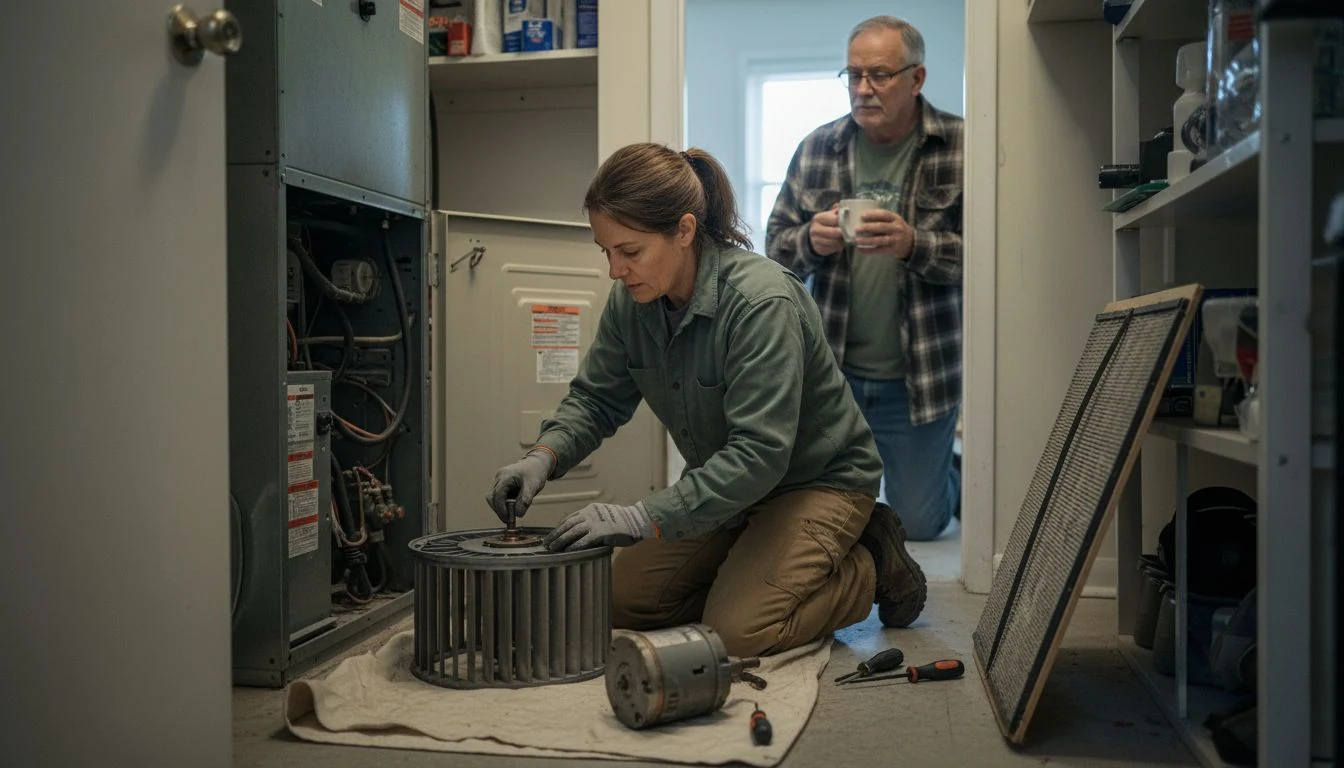
My dad called on a Sunday in January and opened with “the furnace is running but it isn’t doing anything.” I could hear it behind him. A low hum, a click, then nothing, then the hum again. His thermostat said 58. By the time I got there with a space heater in the back seat, I had already spent twenty minutes reading about furnace blower motor replacement cost in a grocery store parking lot.
The burner was lighting fine. You could see the blue flame through the little window. But no air was coming out of the vents, and after a few minutes the furnace would shut itself off because the heat had nowhere to go. That is the high-limit switch doing its job, and it is the classic picture of a blower that has quit.
In 2026, replacing a furnace blower motor usually costs about $400 to $1,500 installed, and most homeowners pay somewhere between $500 and $1,100. That was the number I wanted in the parking lot. An older single-speed motor sits at the low end, around $400 to $900. A newer ECM motor, the kind almost every furnace built since mid-2019 has, runs about $600 to $1,500, and a factory variable-speed motor on a high-end furnace can push past $1,800.
Dad got three quotes: $1,480, $395 and $860. He paid the $860. The cheapest one was for a part his furnace does not even have, which I will get to, because I made the same mistake first.
I am a homeowner who keeps receipts and asks too many questions, not a licensed HVAC tech. This is what we paid, what the techs told us, and what I would check before you approve a motor.
Jump to what you need:
- Furnace blower motor replacement cost in 2026
- PSC vs ECM motors
- Signs the blower is failing
- Cheaper fixes to rule out first
- Replacing it yourself
- Repair or replace the furnace
- Cost table by job
- Frequently Asked Questions
Furnace blower motor replacement cost in 2026, piece by piece
A blower motor quote is four numbers glued together. Pull them apart and the padding gets easier to see.
The motor. A universal single-speed PSC motor, the older style, costs about $120 to $350 at a supply house. A constant-torque ECM replacement is usually $250 to $700. A factory variable-speed ECM with the brand’s own programming can cost $500 to over $900 for the part alone, and the tech has to order it.
The labor. Most swaps take one and a half to three hours. The motor lives inside the blower housing, so the tech pulls the whole blower assembly out of the furnace, unbolts the motor from the wheel, and puts it back together. At $100 to $175 an hour, plus the service call, labor lands around $200 to $550.
The diagnostic fee. Expect $75 to $200 just to have someone confirm it is the motor. Good companies fold that into the repair if you say yes. Ask before they start.
The timing. Blowers tend to quit in the first cold week, after a summer of pushing air for the AC. After-hours and weekend rates added $150 to $300 to Dad’s most expensive quote, and the tech said as much when I asked what the line called “priority dispatch” meant.
Where you live moves all of this. The same swap that runs $650 in a small Ohio town can be $1,000 in Boston or the Bay Area, mostly because of labor rates.
PSC vs ECM: the motor type sets the price
The first two techs never mentioned this, and it matters more than the brand on the furnace.
Older furnaces mostly use a PSC motor, short for permanent split capacitor. It is a simple induction motor with a few fixed speeds and a small run capacitor, a metal can about the size of a soda can, that helps it start and keeps it spinning. PSC motors are cheap, common and easy for any tech to find on the truck.
Newer furnaces use an ECM, an electronically commutated motor. It has a small computer bolted to the back of it, uses far less electricity, and ramps up gently when it starts. The Department of Energy’s furnace fan efficiency rule took effect for new furnaces on July 3, 2019, and the easiest way for manufacturers to meet it was an ECM. DOE figured a typical furnace fan was using around 1,000 kilowatt-hours a year, close to a tenth of an average home’s electricity.
That explains the price gap. An ECM costs more to buy, and a factory variable-speed ECM sometimes has to be programmed for your exact furnace model.
And it explains the $395 quote. Dad’s furnace was built in 2014, but it had a constant-torque ECM motor as an upgrade. The cheap company quoted a new run capacitor over the phone without seeing it. ECM motors do not use one. I know this because I had already ordered a $19 capacitor online on the drive over, feeling clever, and then stared at the motor looking for the can that was not there. Eleven dollars of return shipping later, lesson learned.
So before you compare quotes, find out which motor you have. Pull the furnace door off (power off first) and look at the sticker on the motor. If it lists a capacitor rating in microfarads, it is a PSC. If there is a chunky control module on the back and a multi-wire plug, it is an ECM. Snap a photo of the label. Every tech will ask for the model number anyway.
Signs your furnace blower motor is failing
Some of these point straight at the motor. Others look the same and cost much less. I list them together because Dad’s symptoms fooled me twice.
- The burner lights, but little or no air comes from the vents.
- A hum or buzz from the furnace with no fan movement. On a PSC motor, that is often the capacitor, not the motor.
- Squealing, screeching or a grinding sound when the fan starts. That is usually bearings on their way out.
- A hot electrical or burning smell near the furnace, beyond the dusty smell of the first cold day.
- The furnace heats for a few minutes, shuts off, then tries again, over and over. No airflow means the heat builds up and trips the limit switch.
- The breaker for the furnace trips, or the fan only runs when you set it to “on” at the thermostat.
- The air conditioning stops working too. In most houses the furnace blower also pushes the cold air in summer, so one dead motor takes out both.
If the furnace blower dies in August, you will call it an AC problem. It is the same motor.
Cheaper fixes to rule out before you buy a motor
A motor replacement is the right call when the motor is dead. But I have now watched two techs find something smaller first, and I would make any company rule these out in writing.
The filter. A clogged filter does not kill a motor in a day, but it makes the motor work harder for years and can make the furnace cycle on the limit switch like Dad’s was doing. Dad’s filter was the 1-inch kind, and it was gray and bowed inward. A new one cost $9. It did not fix the motor, but it was part of why the motor died at eleven years instead of fifteen. The EPA’s guide to air cleaners and furnace filters is worth a read before you buy a thick, high-MERV filter, because some furnaces cannot push air through them.
The run capacitor, on PSC motors only. A weak capacitor makes a PSC motor hum and fail to start, or start slowly. The part costs $10 to $40, and a tech usually charges $120 to $300 installed with the visit. If your motor is a PSC and it hums, this is the first thing to test. Our guide to AC capacitor replacement cost walks through the same part on the outdoor unit.
The ECM module. On many ECM motors, the electronics on the back fail while the motor itself is fine. Some brands sell the module separately. It runs about $200 to $500 for the part and $400 to $900 installed. It is not always cheaper than a universal replacement motor, so ask for both prices.
A dirty blower wheel. The squirrel-cage wheel the motor spins can pack with dust until it moves half the air. Cleaning it runs about $150 to $400 because the whole assembly comes out. It will not save a burned-up motor, but it will save a new one from the same fate.
The control board or a loose wire. Sometimes the motor is fine and the board never tells it to run. A tech with a meter can find this in fifteen minutes. A board is its own repair, often $300 to $700, and the furnace repair cost guide covers it next to the other common failures.
Take this list to every blower motor quote. Is my motor a PSC or an ECM, and what does the label say. Did you test the capacitor or the module before calling the motor dead. Are you quoting a factory part or a universal replacement, and does the universal one fit my furnace’s airflow settings. Is the blower wheel being cleaned or checked while it is out. Is the diagnostic fee credited if I approve the repair. Is there an after-hours or priority charge in this price. What is the warranty on the part and on your labor, in writing. How old is my furnace, and are you recommending a replacement, and why. Get two or three quotes if the furnace is still heating at all, and write down what each tech says the problem is.
When the numbers are in, I line them up with the questions from our guide on how to tell if a contractor quote is fair. That is how I spotted that the $1,480 quote included a “system flush” nobody could explain.
Can you replace a furnace blower motor yourself?
Some people can. I did not, and I would not tell you to unless you are already comfortable with electrical work.
On a PSC motor, the job is mechanical. You shut off power at the furnace switch and the breaker, pull the blower assembly out, loosen the set screw on the wheel, swap the motor and capacitor, and match the speed wires to the old ones. A universal motor and capacitor run $150 to $400. People who have done it say it takes two to four hours the first time. Take photos of every wire before you touch anything, because the colored speed taps are easy to mix up.
There are real risks, though. A capacitor stores a charge even with the power off and can bite you, so it has to be discharged properly. Some blower assemblies are heavy and awkward to get out. And if the motor fits wrong or runs on the wrong speed, the furnace can overheat. The ENERGY STAR furnace page recommends having a contractor check the system for a reason: airflow is what keeps the heat exchanger from running too hot.
On an ECM motor, I would hire it out. The module may need to be programmed, universal ECM replacements have their own setup, and the parts are expensive enough that one wrong plug costs more than the labor.
What you can do yourself, safely, on any furnace: change the filter, check the breaker and the furnace service switch, look at the motor label, and listen. Telling the tech “it hums but the fan never turns” saves them time and you money.
Repair the blower or replace the furnace?
Every tech who came to Dad’s house mentioned replacing the whole furnace. One of them did it gently. One opened with it.
I use the same rule from our furnace replacement cost guide: multiply the repair quote by the age of the furnace in years. Under about 5,000, fix it. Over 5,000, get replacement quotes before you approve anything.
Dad’s $860 motor on an eleven-year-old furnace came to 9,460. That is over the line, so we slowed down. But the rest of the furnace was in good shape: no cracks the tech could see, no carbon monoxide readings, and the flame sensor and inducer were fine. A new furnace was quoted at $5,200. Spending $860 to get five or more winters out of a sound furnace made more sense than $5,200 today. So we used the rule to decide which questions to ask, and let the inspection make the call.
Where I would lean toward replacing: a furnace over fifteen years old, a second big repair in two winters, or a tech who finds anything wrong with the heat exchanger. Gas furnaces generally last fifteen to twenty years. I would not put a new motor in a furnace that is already on its way out.
If your system is a heat pump with an air handler instead of a gas furnace, the blower motor is the same idea and similar money, and our heat pump repair cost guide covers the other parts that fail in that setup.
Furnace blower motor replacement cost by job
Find the line that matches what the tech told you. These are 2026 estimates from Dad’s three quotes, my own furnace invoices, supply-house prices and what other homeowners have shared with me.
| Job | Part only | Installed by a pro | Typical time |
|---|---|---|---|
| Diagnostic visit | None | $75 – $200 | 30 – 60 min |
| Run capacitor (PSC motors only) | $10 – $40 | $120 – $300 | Under 1 hour |
| Blower wheel cleaning | None | $150 – $400 | 1 – 2 hours |
| Blower motor, PSC single-speed | $120 – $350 | $400 – $900 | 1.5 – 3 hours |
| ECM module only | $200 – $500 | $400 – $900 | 1 – 2 hours |
| Blower motor, constant-torque ECM | $250 – $700 | $600 – $1,200 | 2 – 3 hours |
| Blower motor, factory variable-speed ECM | $500 – $900+ | $900 – $1,800+ | 2 – 3 hours, plus part order |
| Blower wheel and motor together | $300 – $900 | $700 – $1,800 | 2 – 4 hours |
| After-hours or weekend surcharge | None | +$100 – $300 | None |
What blows the furnace blower motor budget
- Buying a part before you know the motor type. I bought a capacitor for a motor that does not use one. A company that quotes a PSC fix for an ECM motor, or the reverse, has not looked at your furnace yet.
- Calling on the first cold night. The priority charge on Dad’s highest quote was $225. If your blower is squealing in October, book it on a weekday before the first freeze.
- Replacing the motor and ignoring the filter. A new motor pushing air through a clogged filter wears out early. Dad now has a sticky note on the furnace with the month he last changed it.
If the furnace is only part of a bigger list of house projects this year, our overview of home renovation costs helps put a motor repair next to everything else competing for the same money.
A tech measuring amp draw on the blower during a fall service is often how a failing motor gets caught early. For what that visit should run, see my furnace tune up cost guide.
Frequently Asked Questions
How much does it cost to replace a furnace blower motor?
Most homeowners pay about $500 to $1,100 in 2026, inside a wider range of $400 to $1,500 installed. An older PSC motor is usually $400 to $900. An ECM motor runs about $600 to $1,500, and a factory variable-speed motor can cost more. These are estimates that change with region, furnace brand and timing.
How long does a furnace blower motor last?
Many last 10 to 20 years. Dirty filters, a packed blower wheel and running the fan on “on” all year can shorten that. Squealing, humming without spinning or weak airflow are signs it is near the end.
Is it worth replacing the blower motor on an old furnace?
Multiply the repair price by the furnace’s age in years. Under about 5,000, the repair usually makes sense. Over that, get a replacement quote too. A sound furnace under fifteen years old is often worth a new motor; one with heat exchanger problems usually is not.
All prices here are 2026 estimates gathered from real invoices, written quotes and supply-house prices, and they vary by region, furnace brand, motor type, access and timing. Tessa is a hands-on homeowner who has paid these bills and kept the paperwork, not a licensed HVAC technician or electrician. Use these ranges to ask sharper questions and read your own quotes, not as a price for your house, and hire a licensed pro for gas, electrical and combustion safety work.
Free DIY Project Cost Estimator
The spreadsheet I use to price out a project before I start, so a weekend job never blows the budget. Join the newsletter and I’ll send it over.
No spam, ever. Unsubscribe anytime. — Tessa
Keep reading — more on Remodel & Renovation Costs
Boiler Replacement Cost: Gas, Oil, and Combi Boilers Compared
My friend Marisol called me on a Sunday in October with her coat on inside the…
Read article →
HVAC System Replacement Cost: Furnace, AC, or Both at Once
The tech who told me my air conditioner was done also handed me a second price…
Read article →
Furnace Tune Up Cost: What a Fall Service Includes (and What to Skip)
Three companies left door hangers on my porch the same week in September. One said $79.…
Read article →
Sump Pump Replacement Cost in 2026 (and Signs Yours Is About to Fail)
The alarm went off at 2:40 in the morning during the second night of a March…
Read article →