
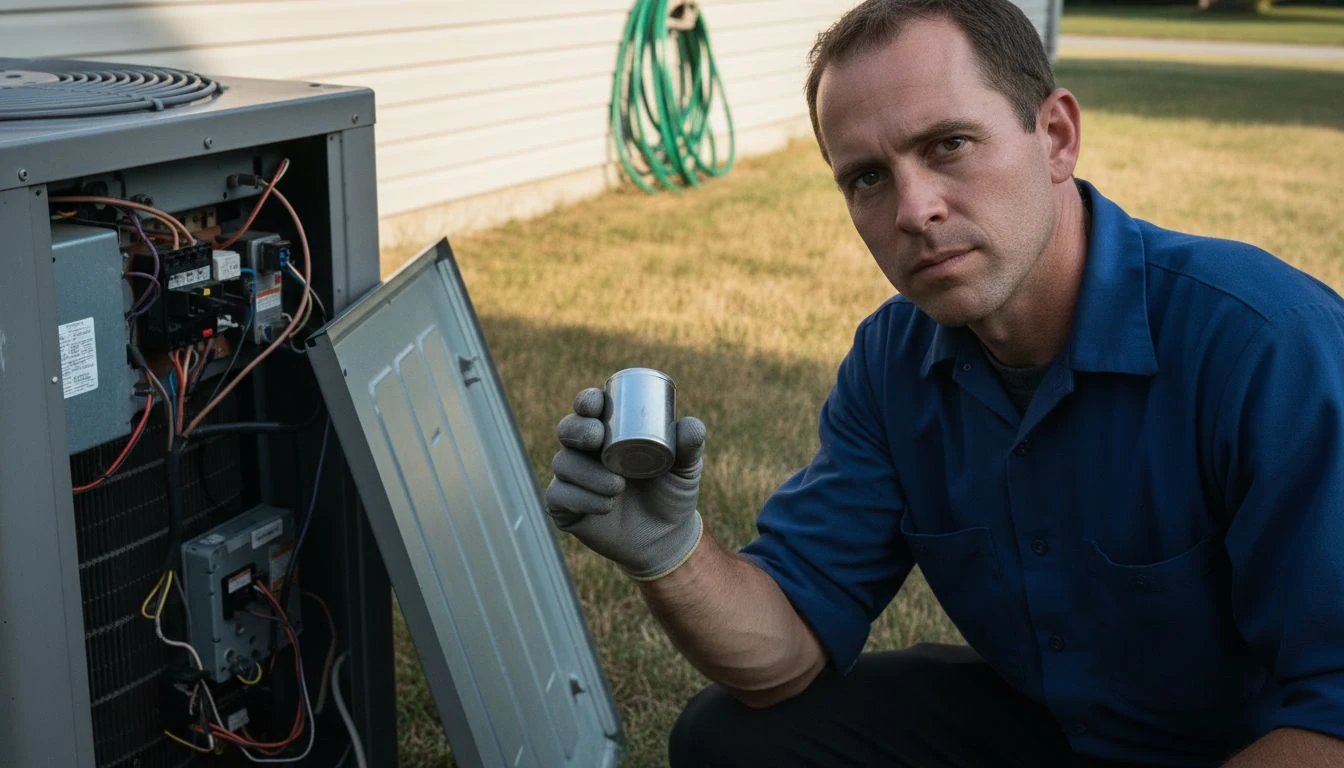
It was a Sunday in July, 97 degrees, and the outside unit was making a low hum like a fridge with an attitude while the fan sat there doing absolutely nothing. I called the emergency line. Ninety minutes later a tech named Dev swapped out a silver cylinder the size of a soda can and handed me a bill for $389.
The part cost him about $22.
AC capacitor replacement cost in 2026 runs $120 to $400 installed for most homeowners, with the part itself sitting between $10 and $60. The spread comes from the service call, the hour of the day you picked up the phone, and whether anybody checked your warranty first. Mine did not, and that is the $389 story.
Jump to what you need:
- What it costs in 2026
- Why a $22 part becomes a $389 bill
- How to tell it is the capacitor
- MFD and voltage, and why they change the price
- The one repair I will not touch
- Check your warranty before you pay
- The pitch that rides along with it
- What belongs on the quote
- FAQ
What does AC capacitor replacement cost in 2026?
The honest range first, then the parts of it you can move.
$120 to $400 installed, during normal business hours. That is what a run capacitor swap on a residential central AC costs most people in 2026. The middle of that band, somewhere near $180 to $250, is where a fair weekday quote usually lands.
$10 to $60 for the part. A generic single run capacitor is under $15 at a supply house. A dual run capacitor from a name brand, in the size a 3-ton system wants, is more like $25 to $60. There is no version of this part that costs hundreds of dollars.
$75 to $200 just for showing up. The diagnostic fee is its own line, and plenty of companies waive it or roll it in if you approve the repair. Ask. It is the single easiest thing to get taken off a bill.
$250 to $600 after hours, weekends and holidays. This is the tail that most cost articles quietly leave out, and it is where my $389 came from. Same part, same twenty minutes of work, a Sunday afternoon in the worst week of summer.
If your quote is over $450 on a weekday and nothing else was replaced, something else is on that invoice. It might be legitimate. Ask what it is before you sign, the same way you would with any other estimate, which is the whole point of my guide on whether your contractor quote is fair.
This repair is common because the equipment is everywhere. The EIA’s residential survey found that nearly 90% of U.S. households used air conditioning in 2020, and the capacitor is the component in all of them that dies first and dies in heat. You are not unlucky. You are on schedule.
Why a $22 part turns into a $389 bill
This is the part nobody explains at the door, and once I understood it I stopped feeling robbed and started asking better questions.
Most residential HVAC companies do not bill you hourly. They price from a flat rate book, which assigns one fixed price to “replace run capacitor” no matter whether it takes the tech eighteen minutes or an hour and a half. That price has to carry the truck, the parts inventory riding around in it, the insurance, the dispatcher who answered at 1pm on a Sunday, the drive time, and the jobs where they diagnose for free and the customer says no thanks.
So the invoice reads like you paid $389 for a $22 capacitor. What you actually bought was a same-day emergency visit with the part already on board.
That is a real service and worth real money. It is also why the identical repair, booked for Tuesday morning, is frequently half the price. The flat rate book usually has a separate, higher column for after hours, and the tech at your door is not going to volunteer which column they just read from.
If the house is livable, ask what the same repair costs on the next business day. On mine that one question was worth about $200, and I did not ask it.
I have made this mistake in the other direction too, on a water heater, where I waited to save money and ended up with a soaked utility closet. The judgment call is whether the delay causes damage. A dead AC in a house with no infants, no elderly parents and no medical need is uncomfortable. Water is different, which is the argument I make in the water heater replacement cost guide.
How to tell it is the capacitor before anyone drives out
You cannot confirm it without a meter, and I am not going to pretend otherwise. But there is a symptom pattern that points at it hard enough to be worth knowing, because it changes what you say on the phone.
- The outdoor unit hums but the fan does not spin. The classic. The motor is trying to start and has no jolt to start with.
- The fan spins if you nudge it, then keeps going. Do not do this with a stick through the grille. I am telling you the symptom, not the test.
- It starts hard, with a groan, then runs fine. A capacitor on its way out, sometimes for weeks.
- The AC kicks on and shuts off in a few minutes, repeatedly. Short cycling has other causes too, so this one is weaker evidence.
- Inside air is blowing but it is not cold. The indoor blower runs off its own capacitor, so the house feels ventilated and warm at the same time.
If you get the hum with no fan, say exactly that when you call: “outdoor unit hums, condenser fan is not turning.” A dispatcher hears that and puts a capacitor on the truck. That alone can save you a second trip charge, which is real money on a repair this small.
One thing worth ruling out first, free: check that the breaker did not trip and that the disconnect box on the wall beside the outdoor unit is still pushed in. I have called for service on a tripped breaker. Once. It was educational and it cost me $95.
MFD and voltage, the two numbers that decide your part price
The capacitor has a rating printed on the top of it, and the tech has to match it. Getting familiar with the two numbers takes four minutes and it makes the conversation completely different.
MFD (also written as µF, microfarads) is the storage size. A 45/5 MFD dual run capacitor is really two capacitors in one can: 45 for the compressor, 5 for the fan motor. Voltage is usually 370V or 440V, and it is a ceiling, not a target. A 440V part can replace a 370V part. Never the other way around.
A tech measuring your old one should tell you the reading. Most run capacitors are considered failed once the measured value drifts more than about 6% off the rating, and plenty of them read 30 on a part rated 45, which is not a judgment call. That one is just failed.
| What it is | Where it lives | Typical rating | Part cost | Notes |
|---|---|---|---|---|
| Single run capacitor | Condenser fan or blower motor | 4 to 12.5 MFD | $8 to $25 | The cheapest and most common failure |
| Dual run capacitor | Outdoor unit, serves compressor and fan | 25/5 to 80/5 MFD | $18 to $60 | One can, two jobs, most central systems |
| Blower (indoor) capacitor | Air handler or furnace cabinet | 5 to 15 MFD | $10 to $30 | Air moves, nothing cools |
| Start capacitor | Compressor, on some systems | 88 to 250 MFD | $20 to $50 | Short duty, only during startup |
| Hard start kit | Added to the compressor circuit | Kit, not a rating | $50 to $150 | An add-on, not a repair. See below. |
Two practical things fall out of that table. A universal or multi-tap capacitor covers several MFD values from one part, which is why the truck can carry three of them instead of thirty, and it is a perfectly good part. And the gap between the cheapest and the priciest correct capacitor for your system is roughly $40. Nobody’s bill swings by $250 because of which brand went in.
This is the one repair I will not touch, and I do plenty
I have cut my own window trim, patched my own drywall and painted my own cabinets. I do not go into the condenser cabinet, and I would ask you not to either.
A capacitor stores electrical energy and it stays charged after the power is off. That is its entire job. Cutting the breaker does not make it safe, and the stored charge in an AC capacitor is enough to seriously hurt you.
This is not internet caution, it is written into federal workplace safety rules. OSHA’s standard on electrical work practices, 29 CFR 1910.333, states that “capacitors shall be discharged and high capacitance elements shall be short-circuited and grounded, if the stored electric energy might endanger personnel,” and that when workers handle them to do that, the capacitors “shall be treated as energized.” Trained electrical workers are required to treat a disconnected capacitor as live. You are not better equipped than they are because you own a screwdriver.
So: no step by step here, on purpose. Plenty of videos will give you one. What you get from me instead is the number, so that when the tech comes out you know a fair price and cannot be sold a system on the back of a $22 part.
The rest of the AC does have homeowner-safe maintenance, and it is worth doing. Rinsing the condenser coil, keeping two feet of clearance around the unit and changing the filter on schedule all cut the heat load that kills capacitors in the first place.
Check your warranty before you approve the repair
This is the money one, and the mistake I still regret.
My system went in during 2021. Most residential AC manufacturers cover parts for five to ten years, provided the system was registered within the first sixty to ninety days after install. Capacitors are a covered part on many of those warranties. Mine was covered. Dev did not ask, I did not know to ask, and I paid retail for a part the manufacturer would have supplied free.
The catch, and it is a real one: the parts warranty almost never covers labor. Even with a valid claim you are still paying the service call and the labor line, so on a repair this small the free part might only save you $25 to $60. It can also come with a wait, because the covered part gets pulled from a distributor rather than off the truck.
Which makes the useful version of this simple. Before you approve anything, find the model and serial number on the data plate on the outdoor unit, and ask: is this system still under parts warranty, and if it is, does that change the price today or only if I wait? Sometimes waiting is worth it. Sometimes it is not. You should be the one deciding.
The pitch that rides along with the capacitor
A failing capacitor is a routine repair on a healthy system. It is also, reliably, the moment somebody floats replacing the whole thing.
Watch for these three. They show up together and they sound technical.
“Your compressor is drawing high amps, it is on borrowed time.” High amp draw can be a genuine sign of a struggling compressor. It is also exactly what a compressor does when it has been trying to start against a dead capacitor. Reading amps before replacing the capacitor and quoting a new system off that number is meaningless. Ask them to re-check the amps after the new part is in, then talk.
“You should add a hard start kit while I am here.” A real product with a real use, for compressors that genuinely struggle to start. On a system that just needed a capacitor it is a $150 to $350 add-on solving a problem you do not have yet. It is not a scam, and it is frequently not necessary either.
“At this age it makes more sense to replace.” Sometimes true. A full AC replacement in 2026 runs $5,000 to $12,000 installed, so this is a fork in the road that deserves its own week, not a decision made in a driveway while you are sweating. If the pitch is real it will still be real on Thursday. My broader AC repair cost guide walks the repair-versus-replace math across every other part, and a capacitor sits at the very bottom of the list of reasons to buy a new system.
What belongs on an AC capacitor replacement cost quote
A capacitor invoice should be short. If yours is not, these are the lines to look for, and the ones to ask about when they are missing.
- The diagnostic or service call fee, stated separately, and whether it is waived with the repair.
- The part, named by type and rating. “Dual run capacitor, 45/5 MFD, 440V” and not “part.”
- The measured reading off the old capacitor, so there is a documented reason it was replaced.
- Regular hours or after hours labor, marked as such.
- Warranty on the part and, separately, on the labor. Ninety days on labor is common, a year is better.
- Any add-on, priced on its own line and approved by you before it goes in.
- Whether a maintenance plan discount was applied, if you carry one.
AC capacitor replacement cost by the situation you are in
Same part. Wildly different bills. This is the table I wish somebody had shown me at 2pm on that Sunday.
| Your situation | Realistic 2026 total | What is driving it | Worth doing |
|---|---|---|---|
| Weekday, business hours, no plan | $150 to $280 | Service call plus one flat rate line | Approve it, this is the fair band |
| Weekday, maintenance plan member | $110 to $200 | Waived trip fee plus 10% to 20% off repairs | Ask if the plan pays for itself this visit |
| After hours, weekend or holiday | $250 to $600 | Premium labor column, same 20 minutes of work | Only if the heat is a real risk |
| Under manufacturer parts warranty | $120 to $260, part free | Labor is not covered, and the part may be ordered | Ask before approving, not after |
| Capacitor plus hard start kit | $300 to $700 | The add-on, not the repair | Decline unless the compressor genuinely struggles |
| Second capacitor within 2 years | $150 to $280, plus a real diagnosis | Something is cooking it: heat, a failing motor, voltage | Pay for the diagnosis this time |
What blows the capacitor bill
- Calling on a Sunday when Tuesday would do. The premium labor column is the largest single variable on this repair, bigger than brand and bigger than system size. My identical fix would have been roughly $190 on a weekday. I paid $389 for a hot afternoon.
- Not asking about the parts warranty. A five to ten year manufacturer parts warranty covers the capacitor on many systems, and nobody at the door is required to bring it up. It is worth $25 to $60 and it takes one question off the data plate.
- Letting a dead capacitor sell you a compressor. Amp readings taken while the capacitor is dead say nothing about the compressor’s health. Insist the numbers get re-taken with the new part in before anyone quotes you a system.
Grab my free Project Cost Estimator. Put in the repair, your metro, and whether it is an after hours call, and you will walk into the conversation already holding your own fair range. That is the entire trick, on this repair and every other one.
Frequently Asked Questions
How much does it cost to replace an AC capacitor?
Expect $120 to $400 installed in 2026 on a weekday, with most fair quotes landing near $180 to $250. The capacitor itself is only $10 to $60. The rest is the diagnostic or trip fee, which runs $75 to $200, and a flat rate labor line. An after hours, weekend or holiday call moves the same repair to $250 to $600.
Can I replace an AC capacitor myself and save the money?
Please do not. A capacitor holds a charge after the power is switched off, which is what it is built to do, and shutting off the breaker does not make it safe. OSHA’s electrical work practice rules require trained workers to discharge capacitors and to treat them as energized while doing it. The savings on a $22 part are not worth the risk. Coil rinsing, clearance and filter changes are the AC maintenance that is genuinely yours.
How long should an AC capacitor last?
Ten to twenty years is the design intent, but in hot climates and on units that sit in full afternoon sun, five to eight years is closer to reality. Heat is what kills them. If you are on your second capacitor in two years, stop replacing and start diagnosing: an undersized replacement part, a failing fan motor pulling too hard, low voltage or a coil packed with dirt will all cook a new one on the same schedule.
Is a $400 AC capacitor replacement cost a ripoff?
Not automatically. On a Sunday, a holiday or after 6pm it sits inside the normal after hours band. On a Wednesday at 10am with nothing else replaced, it is high, and the fair question is what else is on the invoice. Ask for the diagnostic fee, the labor line and the part to be shown separately. A company that will not itemize a repair this simple is telling you something.
All prices here are 2026 estimates and vary by region, system size, company pricing model and the hour you call. Tessa is a hands-on homeowner, not a licensed HVAC technician; use these ranges to ask sharper questions, and leave capacitor testing and replacement to a qualified pro.
Free DIY Project Cost Estimator
The spreadsheet I use to price out a project before I start, so a weekend job never blows the budget. Join the newsletter and I’ll send it over.
No spam, ever. Unsubscribe anytime. — Tessa
Keep reading — more on HVAC & Hiring a Contractor

Furnace Replacement Cost in 2026: My Three Quotes and the Signs It Was Time
Last April the furnace in our basement started to howl. The little motor that pulls exhaust…
Read article →
Chimney Inspection Cost: What I Paid Before Lighting the First Fire
The first cold night in my fixer-upper, I had a stack of firewood on the porch,…
Read article →
Heat Pump Maintenance: What It Costs and Why It Beats the Repair
The tech pulled the top grille off my outdoor unit, tipped it toward me, and let…
Read article →
Interior House Painting Service: How to Hire One Without Getting Burned
The first interior house painting service to quote this house described the entire job in five…
Read article →