
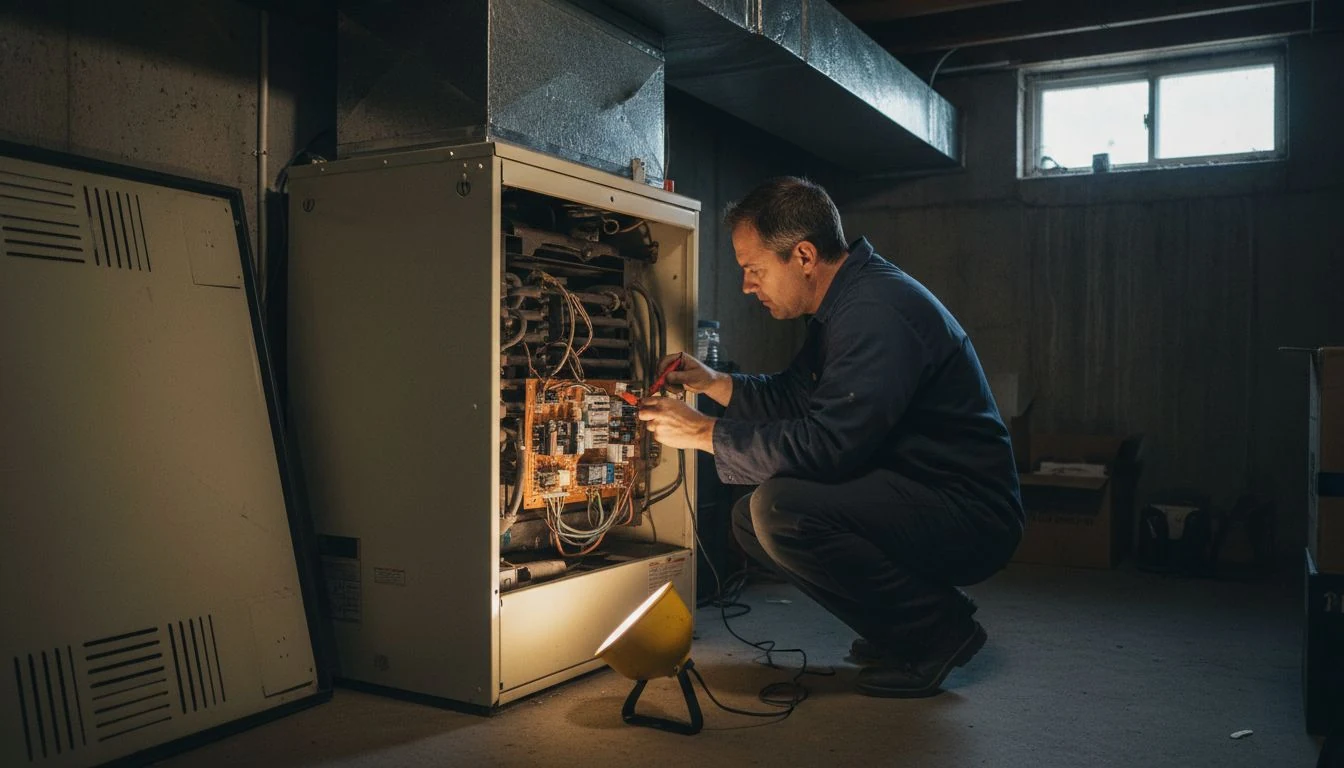
The furnace in this house is a 2009 builder-grade gas unit that lives in the basement behind a stack of storage bins, and for eleven winters I ignored it completely. Then one January morning it ran for about ninety seconds, clicked, and quit. Ran, clicked, quit. Over and over, while the house slid down to 58 degrees and I sat on the stairs in a parka reading the error code through the little sight glass.
The first company out quoted me $2,850 and said the words “at this age” four separate times in ten minutes.
It was a flame sensor. A $38 metal rod coated in soot.
Furnace repair cost in 2026 runs $150 to $650 for the failures most houses get, and $400 to $1,500 once you are into motors and control boards. Exactly one failure honestly pushes you toward a whole new furnace, and it is almost never the one you get quoted first.
Below is what each part costs, what the diagnostic alone should run, how to tell an honest replacement recommendation from a sales pitch, and the four things I check myself before I pick up the phone. I am not a licensed HVAC tech. I am the person who has now paid for this twice and reads every line of the invoice.
Jump to what you need:
- What it costs in 2026
- The diagnostic visit
- Cost by the part that failed
- The heat exchanger problem
- The tune-up special
- What I check before I call
- When a new furnace honestly wins
- Cost by symptom
- FAQ
What furnace repair cost actually looks like in 2026
Most furnace repairs are small. You will not hear that from the company hoping to sell you a system.
A furnace is a burner, a blower, a set of safety switches, and a board that decides whether all of them agree. When it stops heating, one cheap component in that chain has usually drifted out of spec, and the safeties do their job and shut the whole thing down. The failure feels catastrophic because the house is cold. The part costs $40.
$150 to $650 covers the majority of real-world furnace repairs in 2026: sensors, ignitors, switches, capacitors, thermostats.
$400 to $1,500 is the range for draft inducer motors, blower motors, gas valves, and control boards.
$1,500 to $3,500 is the heat exchanger, and that one gets its own section because the number is not really the point.
These are 2026 estimates and they move with your metro, your labor rates, and whether the part is on the truck or has to be ordered. A Tuesday afternoon in Ohio and a Sunday night in Seattle are different invoices for identical work.
What the diagnostic visit costs before anyone touches a screw
Every furnace repair cost starts with somebody driving out and naming the problem. Expect $75 to $200 for a standard weekday diagnostic. After hours, weekends, and holidays run $150 to $400, and January is when everybody discovers this.
Ask one question when you book: is the diagnostic fee applied to the repair if I approve the work today? Plenty of companies credit it. Some do not. It is a $150 swing and it takes eight seconds to ask.
I got this wrong the first time. I called at 7am on the coldest morning of the year, which is the single worst moment to be a customer. Emergency rates, nothing to bargain with, and a technician who has six more cold houses waiting. If your house is holding above 55 degrees and you have space heaters, booking for the next weekday afternoon can cut the visit cost roughly in half. Same tech. Same fix.
The invoice should name the part, the reading that condemned it, and the labor time. If it says “furnace repair” and a number, ask for the breakdown before you pay. That habit is the whole subject of my guide to telling a fair contractor quote from a padded one, and it applies to a $300 invoice as much as a $30,000 one.
Furnace repair cost by the part that actually failed
Part prices below are what the component costs on its own, next to what the job typically bills out at installed. The gap between those two columns is labor, and labor is most of what you are buying.
| What failed | Part alone | Typical installed 2026 | Bench time |
|---|---|---|---|
| Flame sensor (clean or replace) | $15 to $45 | $80 to $250 | 20 to 40 min |
| Hot surface ignitor | $25 to $90 | $150 to $450 | 30 to 60 min |
| Run capacitor | $10 to $40 | $120 to $300 | 20 to 30 min |
| Thermostat (standard to smart) | $30 to $250 | $130 to $500 | 30 to 90 min |
| Limit or rollout switch | $20 to $70 | $150 to $400 | 30 to 60 min |
| Pressure switch | $25 to $80 | $150 to $400 | 30 to 60 min |
| Draft inducer motor | $120 to $350 | $400 to $900 | 1 to 2 hr |
| Blower motor, older PSC type | $120 to $350 | $400 to $900 | 1.5 to 3 hr |
| Blower motor, ECM variable speed | $250 to $700 | $600 to $1,500 | 2 to 3 hr |
| Gas valve | $90 to $350 | $350 to $800 | 1 to 2 hr |
| Integrated control board | $120 to $450 | $400 to $900 | 1 to 2 hr |
| Heat exchanger | $500 to $1,600 | $1,500 to $3,500 | 6 to 10 hr |
The top six rows are the calls, over and over, and every one of them lands under $500 installed.
The flame sensor deserves a note because it is the cheapest part on the list and the most common no-heat call in the country. It is a thin rod that sits in the burner flame and confirms the flame exists. Soot builds on it over a few seasons, the board stops seeing the flame, and the board shuts the gas off after a few seconds. Which is exactly what it should do. Nothing in there has broken. The little eye that watches the flame is dirty.
If you have read my breakdown of what an AC capacitor replacement should cost, the shape of this is familiar: a cheap part, a dramatic symptom, and a quote that has very little to do with either.
The heat exchanger is the one repair that is not really a repair
The heat exchanger is the metal chamber that holds the fire and lets your house air pass over the outside of it without ever mixing. That separation is the entire safety design of a gas furnace. When it cracks, combustion gases can reach the air moving through your ducts.
This is the one place in this whole post where I stop talking about money first.
The Consumer Product Safety Commission reports that more than 200 people a year die from unintentional non-fire carbon monoxide poisoning tied to consumer products, and it names heating equipment among the top contributors. A cracked exchanger is a red tag, the gas gets shut off, and no honest technician will relight it for you.
The $1,500 to $3,500 in the table above is real, and it is also mostly theoretical. On a furnace over twelve years old, that repair is within shouting distance of a new furnace, the labor is a full day of pulling the guts out, and you end up with a twelve-year-old machine wearing one new organ. Most people replace. That is usually the right call, and it is the one situation where “you need a new furnace” is a straight answer instead of a sales line.
Two things protect you here. First, ask to see it: a combustion analysis reading, a borescope photo, or the crack itself. A verbal condemnation with no evidence is not a diagnosis. Second, put a CO alarm on every level of the house and outside the bedrooms, which you should have regardless of what your furnace is doing tonight.
The tune-up special, and what that $89 is really buying
Annual service is legitimate, and the cheapest furnace repair cost is the one that never happens. CPSC recommends a yearly professional inspection of every fuel-burning system in the house, furnace included, and the reason is the section you just read.
The $89 fall special is a different animal from that inspection, and you should know which one you booked.
A real maintenance visit is 60 to 90 minutes: burners cleaned, flame sensor pulled and polished, ignitor checked, blower wheel inspected, amp draws measured, safeties tested, gas pressure verified, combustion analyzed, filter changed. Priced honestly that is $120 to $250, and it is worth it, because the flame sensor that stranded me at 58 degrees would have been cleaned in year six as part of it.
The loss-leader version is 20 minutes, a filter, and a printed sheet of recommendations. I have sat through one. The technician spent more time on the tablet showing me a system quote than on the furnace, and the “aging heat exchanger” he flagged has now heated this house for four more winters without incident.
How to tell them apart before you book: ask what the visit includes and how long it takes. If the answer does not include a combustion reading and a number for how long they will be there, it is a lead generation appointment with a filter change attached. Book the $180 one instead.
What I check myself before I call anybody
Four things, ten minutes, no tools that cost money. I have avoided two service calls this way, and I have also called anyway twice when none of it worked, which is the correct outcome.
- The filter. A clogged filter starves airflow, the furnace overheats, and the high limit switch shuts it down on a cycle. It looks exactly like a dying furnace. A filter is $12.
- The thermostat. Fresh batteries, set to heat, set five degrees above room temperature. I have watched a “dead furnace” start on a $4 pair of AAs.
- The switches. The furnace has its own light-switch-looking service switch nearby, and its own breaker. Both get flipped by accident, usually by somebody carrying laundry.
- The condensate drain. High-efficiency furnaces make water, and if the drain or the little pump backs up, a float safety kills the burner. A clogged tube is a shop vac problem, not a $600 problem.
What I do not touch: the gas valve, the burners, anything behind the sealed combustion door, and the board. Gas and combustion venting are where a confident amateur gets somebody hurt. Cleaning a flame sensor is a genuine homeowner job that plenty of people do with an emery cloth, and I still let the tech do mine now, because I would rather pay $140 and have somebody put eyes on the burner tray once a season.
Grab my free Project Cost Estimator. Put in the repair, your metro, and how old your system is, and you walk into the second quote already holding your own fair range. On a no-heat call in January, having a number before they arrive is the whole game.
When a new furnace honestly beats another repair
I use the same arithmetic here that I use on the cooling side in my AC compressor replacement breakdown: multiply the repair quote by the age of the equipment in years. If the answer clears roughly 5,000, replacement starts winning.
A $400 inducer motor on a nine-year-old furnace is 3,600. Fix it. A $2,600 exchanger on an eighteen-year-old furnace is 46,800. Do not fix it.
Gas furnaces generally run 15 to 20 years, which is longer than the air conditioner they usually share a blower with. The honest comparison adds two columns to repair versus replace: how many winters the rest of the machine has left, and what the fuel bill gap does across those winters. The cooling side of the same system has its own math, which I laid out in my AC repair cost guide.
That last piece is where efficiency comes in. ENERGY STAR rates furnaces on Annual Fuel Utilization Efficiency, and its certified gas furnaces in the northern half of the country are up to 18 percent more efficient than baseline models, which it estimates saves about $160 a year in energy costs. In the southern half, where houses need less heat, the figure is up to 16 percent and around $60 a year. Sixty dollars a year does not rescue a $7,000 decision. It is a tiebreaker at best, and any salesperson who leads with the savings is doing the math backwards.
At some point the furnace repair cost stops being the question and the replacement price takes over. Full replacement in 2026 lands around $4,000 to $8,500 for a standard efficiency install, and $6,000 to $12,000 for high-efficiency condensing units that need new venting and a condensate drain. When our own 2009 furnace got there, I collected three quotes for the same basement, and the line items and payback math are in my furnace replacement cost breakdown. If you are weighing this against other big-ticket work, my whole-house renovation cost guide puts it next to everything else competing for the same money.
2026 furnace repair cost by symptom, and what a fair quote looks like
The part table tells you what things cost once somebody has diagnosed them. This one works the other direction, from what your furnace is doing right now, which is the information you actually have at 6am.
| What it is doing | Usual cause | Fair installed range | Yours or theirs |
|---|---|---|---|
| Lights, runs seconds, shuts off, retries | Dirty flame sensor | $80 to $250 | Theirs, cheaply |
| Blower runs, no heat at all | Ignitor or gas valve | $150 to $800 | Theirs |
| Clicks, hums, never starts | Capacitor or inducer motor | $120 to $900 | Theirs |
| Heats, then quits mid-cycle, repeats | Dirty filter, then limit switch | $12 to $400 | Start it yourself |
| Nothing at all, totally dead | Breaker, service switch, thermostat | $0 to $500 | Start it yourself |
| Loud grinding or squealing on startup | Blower motor or bearings | $400 to $1,500 | Theirs, soon |
| Water pooling under a high-efficiency unit | Condensate drain or pump | $0 to $400 | Start it yourself |
| Soot marks, rust streaks, or a CO alarm | Combustion or exchanger problem | Stop and call today | Theirs, urgently |
What blows the furnace repair bill
- Calling at 6am on the coldest day. Emergency dispatch adds $75 to $200 before anybody diagnoses anything, and it is the moment you have the least ability to say no to whatever comes next.
- Approving a system quote during a no-heat call. Nobody makes a good $8,000 decision in a cold house. Get heat restored or get space heaters, then collect two written quotes on a normal day.
- Skipping the filter for three seasons. Restricted airflow cooks the heat exchanger and shortens the blower motor’s life, which turns a $12 habit into a $900 motor and eventually into the one repair you cannot justify.
If your furnace is the backup to a heat pump, the outdoor half fails on its own schedule, and what a heat pump repair runs in 2026.
If your furnace vents through a chimney flue, that flue wants a look on the same visit, and sweeping it runs less when it is bundled.
Before you blame the furnace for a cold upstairs room, check how much insulation is over it, because the attic insulation cost is often lower than a repair.
If the tech says the blower motor is the problem, find out first whether it is an older PSC motor or an ECM, because that decides most of the bill. I broke down what a furnace blower motor replacement costs.
The flame sensor that stranded me would have been cleaned during a normal fall visit. If you are pricing this year’s service, I broke down what a furnace tune-up costs and which add-ons to turn down.
Frequently Asked Questions
How much does a furnace repair cost on average?
Most 2026 furnace repairs land between $150 and $650 installed, because the parts that fail most often are sensors, ignitors, switches and capacitors. Motors, gas valves and control boards run $400 to $1,500. Add $75 to $200 for a weekday diagnostic, or $150 to $400 after hours. A heat exchanger is the outlier at $1,500 to $3,500, and on an older furnace most people replace the unit instead.
Is it worth repairing a furnace that is 15 years old?
Usually yes, for anything under about $500. Gas furnaces commonly run 15 to 20 years, so a fifteen-year-old unit often has winters left. Multiply the quote by the age: a $300 repair on a fifteen-year-old furnace is 4,500 and worth doing, while a $2,000 repair on the same unit is 30,000 and is really a replacement conversation. The exception is a cracked heat exchanger, where age tips the decision almost every time.
Why does my furnace start and then shut off after a few seconds?
That pattern is very often a dirty flame sensor. The sensor confirms the burner lit, soot builds on it over a few seasons, the control board stops seeing a flame and closes the gas valve as a safety. It is a $15 to $45 part and an $80 to $250 visit. Check your filter first, since restricted airflow can produce a similar stop-start cycle through the high limit switch.
Do I really need an annual furnace tune-up?
The inspection, yes. CPSC recommends a yearly professional inspection of all fuel-burning heating systems because combustion problems are invisible until they are dangerous. A genuine visit takes 60 to 90 minutes and costs $120 to $250. The $89 seasonal special is often a 20-minute filter change and a sales presentation, so ask what is included and how long they will be there before you book.
One more winter thing worth doing while you are down there thinking about heat: my notes on keeping a house warm without touching the thermostat are the cheapest heating upgrade in this whole post.
All prices here are 2026 estimates and vary by region, labor rates, part availability, furnace age and efficiency type. Tessa is a hands-on homeowner, not a licensed HVAC contractor. Gas, combustion venting and heat exchanger work are jobs for a licensed technician, and a carbon monoxide alarm is not optional. Use these ranges to ask sharper questions and to compare two written quotes.
Free DIY Project Cost Estimator
The spreadsheet I use to price out a project before I start, so a weekend job never blows the budget. Join the newsletter and I’ll send it over.
No spam, ever. Unsubscribe anytime. — Tessa
Keep reading — more on HVAC & Hiring a Contractor
Furnace Replacement Cost in 2026: My Three Quotes and the Signs It Was Time
Last April the furnace in our basement started to howl. The little motor that pulls exhaust…
Read article →
Chimney Inspection Cost: What I Paid Before Lighting the First Fire
The first cold night in my fixer-upper, I had a stack of firewood on the porch,…
Read article →
Heat Pump Maintenance: What It Costs and Why It Beats the Repair
The tech pulled the top grille off my outdoor unit, tipped it toward me, and let…
Read article →
Interior House Painting Service: How to Hire One Without Getting Burned
The first interior house painting service to quote this house described the entire job in five…
Read article →