
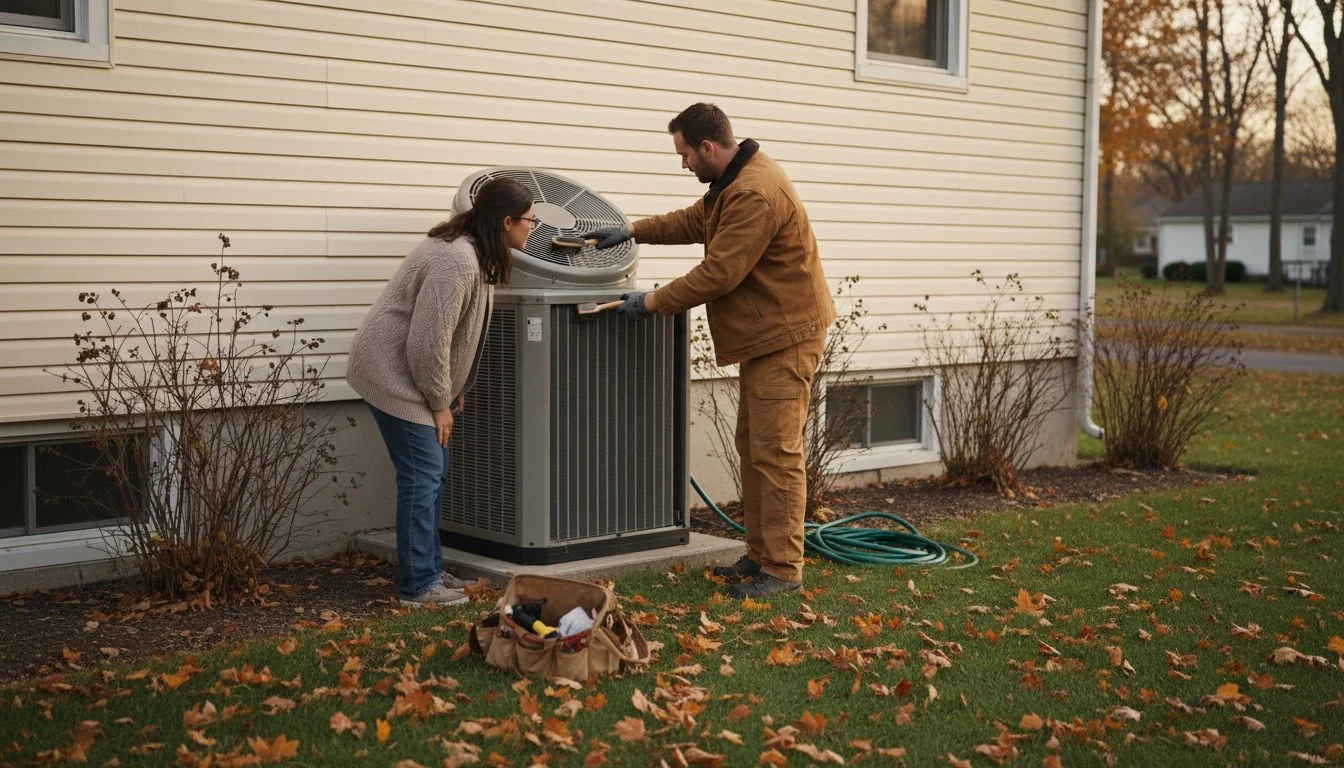
The tech pulled the top grille off my outdoor unit, tipped it toward me, and let me look down inside. Maple leaves and cottonwood fluff were matted flat against the coil, thick enough that I could not see daylight through the fins.
He charged me $149. Then he said the thing I still think about: the house he had been to on Tuesday needed a $1,180 compressor, and its coil had looked exactly like mine.
Heat pump maintenance costs about $100 to $200 per visit in 2026, or roughly $150 to $350 a year if you do the two visits a heat pump actually wants. A yearly plan from a local company usually lands between $150 and $400. That is the whole bill.
The reason to care is on the other side of the ledger. A heat pump is the one machine in the house that runs in both seasons, so it logs close to double the hours of a furnace or an air conditioner alone. I skipped it for two years at my last place because it felt like a subscription I had not agreed to. Then I paid $620 for a defrost board in February. Here is what the visit buys, what I do myself between visits, and where the maintenance plan is quietly a bad deal.
Jump to what you need:
- What heat pump maintenance costs in 2026
- What a real tune-up visit includes
- The heat pump maintenance you do yourself
- The arithmetic, which is the actual argument
- When a maintenance plan is worth it
- Why the fall visit beats the January one
- Heat pump maintenance costs by service type
- Frequently Asked Questions
What heat pump maintenance costs in 2026
Companies quote this three different ways, which is why calling around feels like comparing nothing to nothing. One shop gives you a flat visit price. The next gives you a membership. The third gives you a low number and finds $300 of extras once the panel is off. Ask for line items and the fog lifts.
| What you are paying for | Typical 2026 range | Notes |
|---|---|---|
| Standard tune-up, one visit | $100 – $200 | The base call. Inspection, cleaning, readings |
| Second seasonal visit | $75 – $175 | Often discounted when booked with the first |
| Annual plan, two visits | $150 – $400 | Usually adds priority scheduling and a parts discount |
| Deep condenser coil cleaning | $100 – $250 | Add-on when the coil is packed, not routine |
| Blower wheel pull and clean | $150 – $400 | Indoor unit, every few years, not annual |
| Filters you buy yourself | $10 – $40 each | Yours to do. See below |
| Refrigerant leak search | $250 – $600 | Diagnostic, separate from any repair |
My $149 was a standard visit with no add-ons. The coil cleaning that day would have been $180 more, and I turned it down, then cleaned it myself the next Saturday with a garden hose and a fin comb in about forty minutes. That is a real option. It is also the only part of the job I would take on.
What a real tune-up visit includes
This is where I got taken the first time. A guy spent eleven minutes in my yard, hosed the outside of the cabinet, wrote “system checked” on a carbon copy, and charged me $95. I paid it. I did not know what to ask for.
ENERGY STAR publishes the checklist, and it is short enough to hold a contractor to. Its heating and cooling maintenance checklist says a typical check-up should include checking thermostat settings, tightening all electrical connections and measuring voltage and current on motors, lubricating moving parts, inspecting the condensate drain, and checking the start-up cycle so the system “starts, operates, and shuts off properly.” On the cooling side it adds cleaning the evaporator and condenser coils and checking refrigerant level.
Loose electrical connections, in ENERGY STAR’s words, “can cause unsafe operation of your system and reduce the life of major components.” And a plugged condensate drain “can cause water damage in the house.” Neither is dramatic on the invoice. Both are how a cheap visit turns into a wet ceiling.
Ask these four questions before you book, and again when the tech is packing up. What are the readings, specifically, and can I see them written on the invoice? Was the condensate drain cleared or only looked at? Were the electrical connections tightened and the motor amps measured? And is anything on this system trending toward failure, or is it fine for another year? A shop that answers all four in plain language is the shop you keep. Save that invoice. Next year’s readings only mean something sitting next to this year’s.
Heat pumps also have parts a furnace does not, and those are worth naming out loud: the reversing valve that flips the system between heating and cooling, and the defrost control that clears ice off the outdoor coil in winter. If the tech never mentions testing the defrost cycle, they are servicing your heat pump like an air conditioner. Mine failed in February, which is exactly when you find out.
The heat pump maintenance you do yourself
A real share of this job is homeowner work, and skipping it is what makes the paid visit find problems.
Filters are the big one. ENERGY STAR lists inspecting, cleaning or changing air filters under “Actions To Do Yourself” and says a dirty filter “can increase energy costs and damage your equipment, leading to early failure.” The same page puts the efficiency hit from airflow problems at up to 15 percent. My filters run $18 apiece and I write the date on the cardboard edge in marker, because I forget otherwise.
The rest of my list, and it is short:
- Keep two feet clear all the way around the outdoor unit. Mine had a hydrangea growing into it, which I had decided was fine because it looked nice.
- Rake the leaves off the top and out of the base every fall. This is the free version of the $180 coil cleaning.
- Rinse the coil fins with a garden hose, from the inside out, with the power off at the disconnect. Low pressure. A pressure washer bends the fins flat and makes it worse.
- Look at the pad in winter. A little frost is normal and the defrost cycle handles it. A solid block of ice around the base is not, and that is a call.
Then there is the line I do not cross, and neither should you. Anything involving the refrigerant circuit belongs to a certified technician, and that is not a preference, it is federal law. EPA regulations under Section 608 of the Clean Air Act require that technicians who maintain, service, repair or dispose of equipment that could release ozone depleting refrigerants “must be certified.” So when a listing sells you a can of refrigerant with a gauge on it, understand what is being sold: a way to mask a leak that a certified tech has to find anyway, on a circuit you are not licensed to open.
The arithmetic, which is the actual argument
I did not start booking this because someone told me to be responsible. I started when the numbers stopped being abstract. Mine look like this.
Two visits a year at the middle of the range is roughly $250. Over ten years, call it $2,500, and that is generous, because plans usually discount the second visit.
Now the other column. A run capacitor is a $150 to $400 job and it is the cheapest thing on the list, which is why I wrote up what a capacitor replacement costs separately. A defrost control board runs $300 to $700, and mine was $620. A reversing valve, the part only a heat pump has, is $600 to $1,600, because most of that is labor and refrigerant recovery. A compressor is $1,500 to $3,500 or more, and at that price plenty of people replace the whole system instead, which is why compressor replacement costs are worth reading before you agree to one.
One compressor eats a decade of maintenance and asks for more. That is the whole argument, and it is not close.
One caveat, and it is a real one. Maintenance does not make a heat pump immortal. Capacitors fail on well-kept systems too. What the visit buys is a smaller chance of the expensive failures, a shot at catching the cheap ones while they are still cheap, and the efficiency you are already paying for month to month. Insurance with a side of lower bills, not a guarantee.
When a maintenance plan is worth it
I am on one now and I was not for years, so let me give you both sides.
A plan earns its price when it discounts the second visit enough to beat two separate calls, when it moves you up the list in a cold snap, and when the parts discount applies to a system old enough that you will use it. Priority scheduling sounds like marketing until it is 19 degrees out and the answering service says Thursday.
It is not worth it when it costs the same as two full-price visits with a sticker on it, when it locks you to a company you have never tested, or when it auto-renews at a number nobody quotes you. I would not sign one in year one. Pay for a single visit, watch how they work, read the invoice, decide in the spring. And get more than one price: the way I read any trade quote is in how to tell if a contractor quote is fair.
Why the fall visit beats the January one
Timing costs nothing, and it took me three years to use it.
ENERGY STAR’s advice on that same checklist is plain: because contractors get busy once summer and winter arrive, “it’s best to check the cooling system in the spring and the heating system in the fall.” September and early October is the quiet window. The phone gets answered. The schedule has room. And nobody is quoting you emergency rates because it is the first cold night and half the county called at once.
There is a second reason, and it is specific to heat pumps. The failures that strand you, the defrost board and the reversing valve, only show themselves in heating mode. A visit in September can run the system in heat and watch it flip over. A visit in July tells you nothing about February.
The tune-up sits on the same fall list as everything else in my house winterizing checklist. If the heat pump has a backup furnace, or you are weighing the two side by side, furnace repair costs is the other half of that conversation. And if the tech raises the electrical service while they are out there, which happens on older houses, upgrading an electrical panel has those numbers.
Heat pump maintenance costs by service type
Four ways to buy this, because the word “maintenance” gets used for all of them and they are not the same purchase.
| How you buy it | 2026 estimate | What you get | Right for |
|---|---|---|---|
| Single tune-up, once a year | $100 – $200 | One seasonal visit, usually before heating season | Newer systems, mild climates, testing a new company |
| Two visits a year, paid separately | $175 – $375 | Spring cooling check plus fall heating check | Heat pumps, which run hard in both seasons |
| Annual maintenance plan | $150 – $400 | Both visits, priority scheduling, parts discount | Systems past eight years, or anyone who forgets to book |
| Homeowner tasks only | $40 – $120 a year | Filters, clearing the unit, rinsing the coil | Nobody, on its own. Do it between paid visits |
What blows the heat pump maintenance budget
- Waiting for the first cold night to call. Same job, emergency pricing, and a two-week wait behind everyone else who also waited. The September version of this call costs less and gets scheduled in days, which is exactly why ENERGY STAR puts the heating check in fall.
- Buying the cheapest visit on the results page. The $79 special exists to get a van in your driveway, and the money is made on what gets found once it is there. A $149 visit with written readings on the invoice is cheaper over three years than three $79 visits that each discover something.
- Letting the filter slide. It is the $18 item that protects a $1,500 one. Restricted airflow makes the whole system work longer for the same comfort, and ENERGY STAR puts the efficiency loss from airflow problems at up to 15 percent.
Maintenance keeps most of these calls away, but when something does break, I priced out every common part in my heat pump repair cost guide.
If part of your house runs on a wall-mounted ductless unit instead of ducts, the routine is different: the filters clog in weeks, not months. I wrote up my mini split maintenance checklist and what a pro charges.
If the house also has a gas furnace as backup heat, it needs its own yearly check with a combustion reading. Here is what a real furnace service includes and costs.
Frequently Asked Questions
How much does heat pump maintenance cost?
Budget $100 to $200 for a single tune-up visit in 2026, or roughly $150 to $400 a year for a plan covering the two seasonal visits a heat pump wants. Deep coil cleaning and blower wheel service are add-ons at $100 to $400 in the years they are needed. These are estimates, and they shift with your region, labor rates, and how accessible the equipment is.
How often should a heat pump be serviced?
Twice a year is the standard for a heat pump, because it both heats and cools and logs roughly double the hours of a single-season system. ENERGY STAR recommends checking the cooling side in spring and the heating side in fall. If you only do one visit, make it the fall one, since the defrost cycle and the reversing valve can only be tested in heating mode.
Is a heat pump maintenance plan worth it?
It is worth it when the plan costs less than two separate visits, includes priority scheduling, and carries a parts discount on a system already several years old. It is not worth it in year one with a company you have never used, or when it auto-renews at a price nobody quotes you. Pay for one visit first, see how they work, then decide.
What heat pump maintenance can I do myself?
Change the filter on schedule, keep two feet clear around the outdoor unit, rake leaves off and out of it each fall, and rinse the coil fins gently with a garden hose with the power off at the disconnect. Stop there. Anything touching the refrigerant circuit requires an EPA Section 608 certified technician under federal law, and electrical work inside the cabinet is not homeowner territory either.
Does maintenance actually lower my energy bill?
It protects the efficiency you already paid for rather than adding new efficiency. A clogged filter, a leaf-packed coil or a dirty blower all make the system run longer for the same comfort, and ENERGY STAR puts the loss from airflow problems alone at up to 15 percent. The savings are real, but they show up as a bill that did not climb, which is a hard thing to feel good about and an easy thing to skip.
If the visit turns up something bigger than a tune-up, the numbers are in what HVAC repairs cost, and for where any of this sits next to the rest of the house, my home renovation cost guide has the full picture.
All prices here are 2026 estimates and vary by region, climate, system age and size, access, and local trade rates. Tessa is a hands-on homeowner who has hired this work and read the invoices, not a licensed HVAC contractor. Nothing here is a diagnosis of your system. Refrigerant work requires an EPA Section 608 certified technician under federal law, and electrical work inside the equipment belongs to a professional. Use these ranges to ask sharper questions of the people bidding on your house, not as a quote.
Free DIY Project Cost Estimator
The spreadsheet I use to price out a project before I start, so a weekend job never blows the budget. Join the newsletter and I’ll send it over.
No spam, ever. Unsubscribe anytime. — Tessa
Keep reading — more on HVAC & Hiring a Contractor

Furnace Replacement Cost in 2026: My Three Quotes and the Signs It Was Time
Last April the furnace in our basement started to howl. The little motor that pulls exhaust…
Read article →
Chimney Inspection Cost: What I Paid Before Lighting the First Fire
The first cold night in my fixer-upper, I had a stack of firewood on the porch,…
Read article →
Interior House Painting Service: How to Hire One Without Getting Burned
The first interior house painting service to quote this house described the entire job in five…
Read article →
Furnace Repair Cost in 2026: What Each Part Runs, and When to Replace
The furnace in this house is a 2009 builder-grade gas unit that lives in the basement…
Read article →