
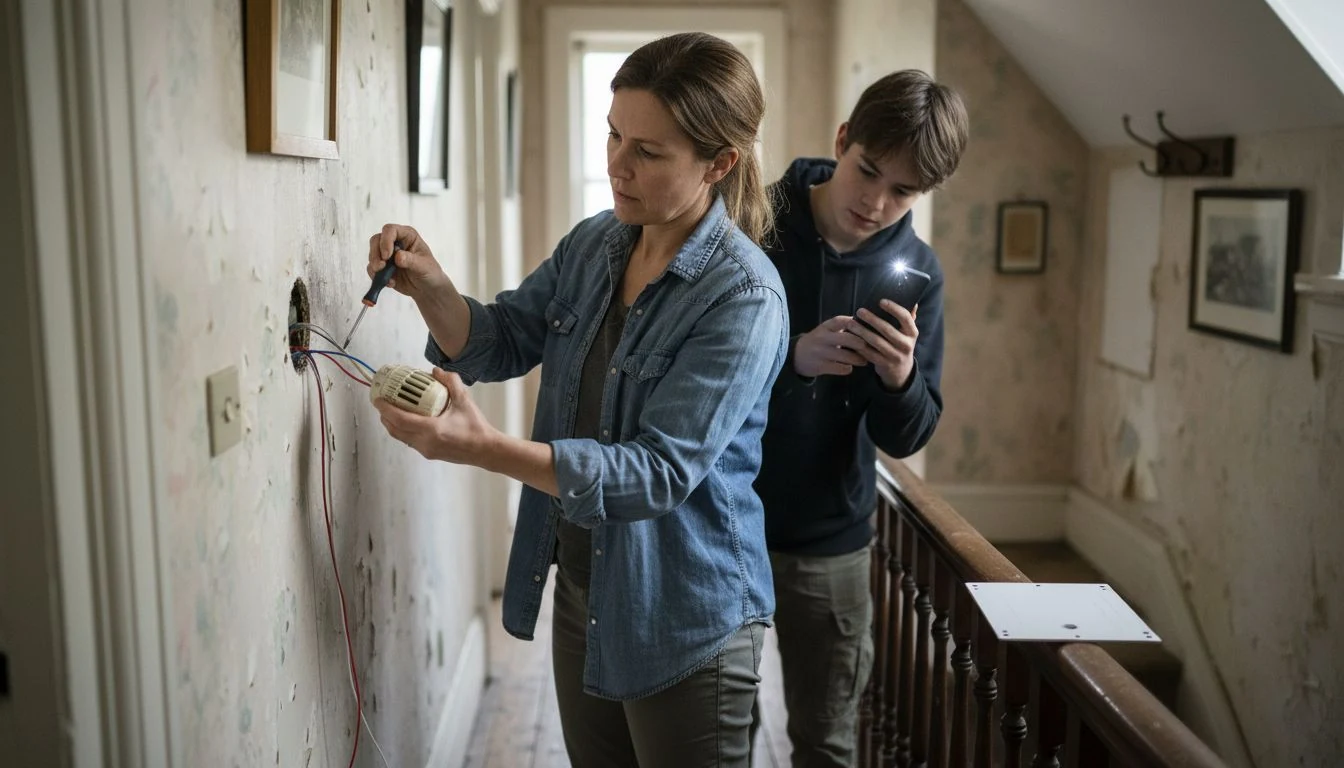
The thermostat in my hallway came with the house. Beige plastic, a tiny screen, a schedule set around 2009. The first cold morning in October, it said 68 and the house said 61. I tapped it. The screen went blank, came back, and the furnace downstairs clicked off.
Two days later a smart thermostat sat in a box on my counter, $169 on sale. Getting it on the wall took longer and taught me what a C-wire is.
The thermostat installation cost in 2026, short version: if you do it yourself, you pay for the thermostat, roughly $20 to $60 for a basic one, $30 to $120 for a programmable one and $100 to $300 for a smart one. A pro usually charges $100 to $250 in labor on top of that, so a smart thermostat installed by an HVAC tech often lands around $200 to $550 all in. Missing wires, heat pump setup and electric baseboard heat are what push it higher.
Below: what each type costs, the C-wire problem that stopped my DIY attempt cold, my three quotes, and the one job in this whole topic I’d never do myself.
Jump to what you need:
- Thermostat installation cost in 2026
- Basic, programmable or smart
- The C-wire problem
- My three thermostat installation quotes
- Heat pump thermostats
- Line-voltage thermostats for baseboard heat
- What you can do yourself
- Thermostat installation cost by type
- Frequently Asked Questions
Thermostat installation cost in 2026
Most houses with a furnace, an AC or a heat pump use a low-voltage thermostat. A thin cable with a few colored wires runs from the wall to the furnace or air handler, and those wires carry 24 volts, not house current. Swapping one low-voltage thermostat for another is a common homeowner job. It’s also a common service call, and that’s where the price range comes from.
From the three companies that came to my house, plus what an electrician told me about my sunroom, the labor side broke down like this:
- Straight swap, same type, wires already there: about $100 to $175 for a pro. Usually under an hour.
- Smart thermostat that needs a power solution: about $150 to $300, more if someone has to run new wire through a wall.
- Heat pump or two-stage system: about $150 to $350, because the setup takes longer and mistakes get expensive.
- Line-voltage thermostat for electric baseboard: about $150 to $350 per thermostat from an electrician.
Then add the thermostat itself. Some companies will only install a unit they supply, and they mark it up. Ask about that on the phone, before anyone drives over. These are estimates, and they swing with region, the age of your system and how easy it is to get at the furnace.
Basic, programmable or smart: what each thermostat costs
A basic thermostat holds whatever temperature you set. Dial or digital, no schedule. They run about $20 to $60, and they almost never need extra wiring. My grandmother had one for thirty years and never touched it.
A programmable one runs a schedule you set once: cooler at night, warmer at 6:30 when everyone gets up. About $30 to $120. My old hallway unit was one of these, and the schedule was wrong for us the entire time we lived there, because nobody ever reprogrammed it. A programmable thermostat saves money only if the schedule matches your life, and most people (me) set it once and forget it.
A smart thermostat connects to Wi-Fi, lets you change it from your phone, and many learn your patterns or notice when the house is empty. About $100 to $300. Energy Star has a page on certified smart thermostats, and their first buying tip is the one that bit me: make sure the thermostat is compatible with your heating and cooling system. Many smart models need steady power, and that’s where the C-wire comes in.
I’m not going to tell you which brand to buy. I’d rather you check your wires first and pick from what’s compatible.
Smart thermostat installation and the C-wire problem
The C-wire, or common wire, gives the thermostat a constant 24-volt return path so it can stay powered all the time. Old thermostats ran on AA batteries or sipped power in tiny amounts and didn’t need it. A lot of smart thermostats do, for the screen and the Wi-Fi.
On my Saturday attempt, I turned off the furnace at its switch and the breaker, pulled the old thermostat off the wall, and took a photo of the wires before touching anything. Four wires: red, white, yellow, green. Red is power, white calls for heat, yellow calls for cooling, green runs the fan. No blue, nothing on a terminal marked C. I put the old one back and went to the hardware store for nothing in particular, which is how I handle defeat.
If you’re missing a C-wire, the usual fixes look like this:
- A hidden spare. Lots of thermostat cables have five or more conductors, and an installer just folded the extra one back into the wall. Check behind the plate and at the furnace end.
- An adapter or power extender kit. Many smart thermostats include one or sell it for about $20 to $40. It mounts at the furnace control board and lets four wires do the work of five. Not hard, but you’re working inside the furnace cabinet.
- New thermostat wire. Running fresh 18-gauge cable from the furnace to the wall costs about $150 to $400 from a pro, more if the path goes through finished ceilings or a second floor.
- A model that doesn’t need a C-wire. Some smart thermostats run on batteries. Check the compatibility tool from whatever company makes the one you’re looking at.
One fix I’d say no to: moving the green fan wire over to C. It’s a known shortcut, and it does power the thermostat. It also means the furnace fan can’t run on its own anymore, which matters if you want the fan circulating air or your AC depends on it. Somebody offered me exactly this. More on that below.
My three thermostat installation quotes
Same house, same week. Gas furnace in the basement, central AC that went in this August, four wires at the wall. I already owned the $169 smart thermostat.
Quote 1: $640, and they wouldn’t use mine. A big company with trucks everywhere. The scheduler said on the phone that they only install “approved equipment.” The tech who came out looked at my four wires for under a minute and said my thermostat “won’t work with this system,” without opening the furnace. Their package included their own smart thermostat and a “power upgrade.” I asked what the power upgrade was. He said it was “basically a C-wire fix.” That’s the same adapter I could buy for $30, tucked inside a $640 number.
Quote 2: $95 cash from a handyman. Friendly guy, honest about not being an HVAC tech. His plan was to move the green wire to C and be done in twenty minutes. That’s the shortcut from the last section. I said I’d think about it, which is my polite version of no.
Quote 3: $185 flat from the HVAC tech who installed my AC. He took the thermostat plate off, then went down to the furnace with a flashlight. The cable was a five-conductor run. The blue one had been cut short and folded back at both ends by whoever installed the old thermostat. He stripped it, landed it on C at the furnace board and on C at the wall, mounted my thermostat, set it up for a single-stage gas furnace with AC, and ran heat and then cooling before he left. About forty minutes. He also wrote the wire colors and terminals on the back of the receipt, which I taped inside the furnace door.
I took Quote 3. All in, $169 for the thermostat plus $185 in labor, so $354. Could I have found the blue wire myself? Maybe. I didn’t know to look at the furnace end, and I’ll admit I was nervous about opening that panel. Since he was already there, he checked the flame sensor too, at no charge. If your furnace hasn’t been looked at in a while, our furnace tune-up cost guide covers what that visit should include.
The thing I learned from Quote 1: when someone says your thermostat “won’t work” without opening the furnace, they haven’t checked. They’re guessing, or they’re selling.
Heat pump thermostat installation: where DIY goes wrong
My sister’s house is newer and runs on a heat pump with electric backup heat. She swapped in a smart thermostat herself last winter, followed the app, and everything seemed fine. Then her January electric bill came in about $140 higher than December’s.
Heat pumps use extra wires that a furnace doesn’t. One switches the system between heating and cooling (often labeled O or B, and different brands use them opposite ways). Another runs the auxiliary or emergency heat strips, which are basically big toasters in the air handler. They warm the house fast and cost a lot to run. Her thermostat was set up so those strips kicked in way more often than they needed to, any time the house fell a degree or two behind.
A tech fixed the settings for a $129 service call. He changed how far behind the house had to fall before backup heat came on, and he confirmed the O/B setting was right. Her February bill dropped back to normal.
For heat pumps, I’d buy a thermostat that says it supports heat pumps with auxiliary heat, and either have a pro set it up or have one check your settings afterward. Our heat pump maintenance guide explains the aux heat light and what’s normal for it. Two-stage furnaces and zoned systems fall in the same bucket. They have extra wires and settings, and a wrong setting can cost you for months before anyone notices.
Line-voltage thermostats for baseboard heat: call an electrician
The back of my house has a sunroom that someone closed in decades ago. It’s heated by two electric baseboard heaters and a thermostat on the wall that looks nothing like the hallway one. Thick, with big wires, and it clicks loudly.
That’s a line-voltage thermostat. It switches the actual house current going to the heaters, usually 240 volts on a dedicated circuit. The low-voltage thermostat in my hallway can’t hurt me. This one can. It’s a different job, and the smart thermostat in my box could never have worked on it. You need a model built for line voltage, and the box will say so.
I got one quote: $225 from a licensed electrician, $165 labor plus a $60 programmable line-voltage thermostat. He confirmed the breaker was off with a tester before touching anything, and he told me the old one’s wire connections were loose and scorched at one end. That sentence alone was worth the $165.
This is the job I’d never DIY. If you have baseboard heaters, wall heaters or radiant floor heat with a thick thermostat on the wall, hire a licensed electrician. Expect roughly $150 to $350 per thermostat, a bit less each if you replace several in one visit.
What you can do yourself
A low-voltage thermostat swap is one of the friendlier DIY jobs in a house, as long as the wiring is simple and you stop when something doesn’t match. Before calling anyone, I’d do this much:
- Turn off power to the furnace or air handler at its switch and at the breaker. If you also have baseboard heat, find its breaker and label it while you’re at the panel.
- Pull the old thermostat off its base and photograph the wires and the letters they’re attached to. Do this before you unscrew a single wire.
- Count the wires and look for a spare folded back into the wall.
- Run the compatibility checker for the thermostat you want, using that photo. Most brands have one on their site.
- Check what kind of old thermostat you’re removing. A round dial with a small glass bulb inside contains mercury, and the EPA’s page on mercury in consumer products says old mercury thermostats need proper disposal, typically at a household hazardous waste collection site. Don’t toss it in the trash.
If you have the four wires I had and no spare in sight, the adapter kit is a doable afternoon for someone careful. If the photo shows more than five wires, letters you don’t recognize, or the words “heat pump” anywhere on your outdoor unit, I’d pay for the hour. And if the thermostat on your wall is thick with heavy wires, stop. That one goes to an electrician.
Ask every installer these before you agree to a price. Will you install a thermostat I already bought, and if not, why. Did you check the furnace or air handler end of the wire, not just the wall. Is there a spare conductor that could be used as a C-wire. If not, are you using an adapter or running new wire, and what does each cost. Will the fan still run on its own after the install. For a heat pump, will you set up the reversing valve and the backup heat settings. Will you test heating and cooling before you leave. Is it a flat price or by the hour. What is the labor warranty. Get every answer in writing.
Thermostat installation cost by type
I built this from my three quotes, the electrician’s quote for the sunroom, my sister’s service call and the thermostat prices I saw while shopping. Use it to read your own quotes, not as a price list.
| Thermostat job | Thermostat cost | Pro labor | Total installed (2026 estimate) |
|---|---|---|---|
| Basic non-programmable, DIY swap | $20 – $60 | $0 | $20 – $60 |
| Basic or programmable, pro install | $20 – $120 | $100 – $175 | $120 – $300 |
| Smart thermostat, C-wire already there | $100 – $300 | $100 – $200 | $200 – $500 |
| Smart thermostat plus adapter kit | $120 – $340 | $125 – $250 | $245 – $590 |
| Smart thermostat plus new wire run | $100 – $300 | $250 – $500 | $350 – $800 |
| Heat pump or two-stage system setup | $120 – $300 | $150 – $350 | $270 – $650 |
| Line-voltage thermostat for baseboard heat | $25 – $200 | $150 – $300 (electrician) | $175 – $500 |
What blows the thermostat installation budget
- Paying for a package when you only needed a wire. Ask whether anyone checked the furnace end for a spare conductor before you agree to a “power upgrade.”
- Getting heat pump settings wrong. Backup heat running when it doesn’t need to can cost more in one winter than a pro setup would have.
- Replacing the thermostat on a system that’s near the end. If the furnace or AC is old and failing, a new thermostat won’t save it. Our HVAC system replacement cost guide shows how a thermostat usually gets bundled into that quote.
Last night the forecast said 34 degrees. The hallway thermostat dropped the house to 64 at 10:30, like I told it to, and at 6:00 this morning it was already 68 when I came down to make coffee. The sunroom, which used to be the coldest room in the house, is now where my daughter does her homework. I didn’t touch either one all night, and nobody in my house has complained about the cold since, which is a first for October.
Frequently Asked Questions
How much does it cost to have a thermostat installed?
In 2026, pro labor for a standard low-voltage thermostat usually runs about $100 to $250, plus the thermostat itself. A basic model installed often totals $120 to $300, and a smart thermostat installed usually lands around $200 to $550. These are estimates and vary by region and system.
Do I need a C-wire for a smart thermostat?
Many smart thermostats need one for steady power, but not all. If you don’t have one, check for a spare conductor folded back in the wall and at the furnace, use the adapter kit the manufacturer offers, run new thermostat wire, or choose a model that runs without a C-wire.
Can I install a thermostat myself?
Swapping a low-voltage thermostat on a simple furnace and AC system is a reasonable homeowner job if you turn the power off at the breaker and photograph the wiring first. Heat pumps and multi-stage systems are worth a pro setup, and line-voltage thermostats for baseboard heat should go to a licensed electrician.
All prices here are 2026 estimates from my own written quotes, an electrician’s quote, a family member’s service call and retail prices I saw while shopping, and they vary by region, system type and wiring. Tessa is a hands-on homeowner, not a licensed HVAC contractor or electrician. Always turn the power off at the breaker before removing a thermostat, and hire a licensed electrician for line-voltage thermostats on baseboard or other electric heat.
Free DIY Project Cost Estimator
The spreadsheet I use to price out a project before I start, so a weekend job never blows the budget. Join the newsletter and I’ll send it over.
No spam, ever. Unsubscribe anytime. — Tessa
Keep reading — more on Remodel & Renovation Costs
Whole House Humidifier Installation Cost (and Whether You Need One)
Last January the little hygrometer on my bookshelf read 21 percent. I’d bought it for $14…
Read article →
Gas Fireplace Installation Cost: Inserts, Built-Ins, and Venting
My sister Jen has a brick fireplace in her 1962 ranch that she has used exactly…
Read article →
Shower Remodel Cost: Refresh, Walk-In, and Full Tear-Out
My mom called me in August because the floor of her shower had started to flex.…
Read article →
Gas Line Installation Cost: For a Stove, Dryer, Fireplace, or Generator
For nine days last winter, a brand new gas range sat in the middle of our…
Read article →