
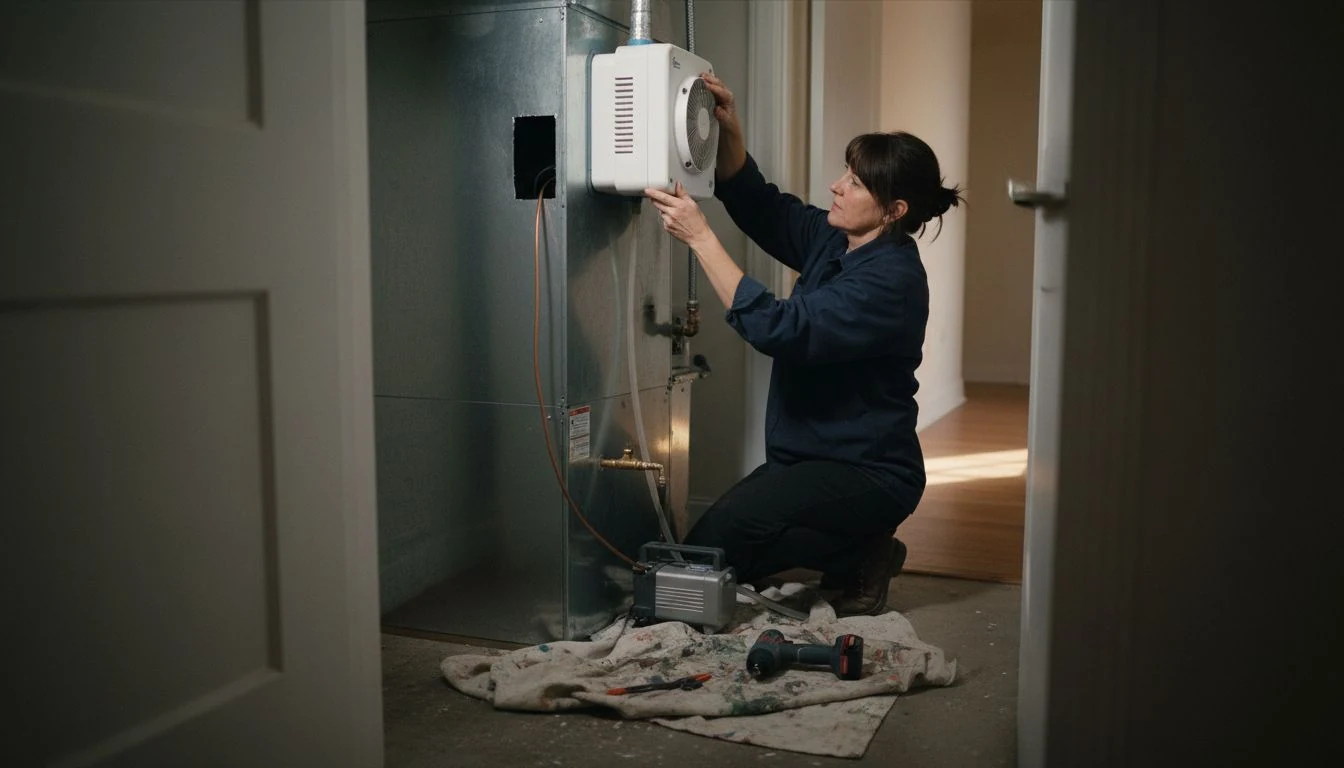
Last January the little hygrometer on my bookshelf read 21 percent. I’d bought it for $14 after a week of zapping myself on every doorknob, waking up with a sandpaper throat, and watching a gap open between two floorboards in the hallway wide enough to lose a dime in. My rental duplex has a gas furnace in a hall closet, and every time it kicked on it pushed hot, bone-dry air through the whole place.
So this fall I priced it out for my landlord, and the whole house humidifier installation cost came back in three quotes: $640, $1,050 and $2,300. Nationally, a bypass humidifier usually runs about $450 to $900 installed, a fan-powered one about $700 to $1,300, and a steam unit anywhere from $1,200 to $2,800. The spread had almost nothing to do with the box itself.
I’m Tessa. I rent, I fix what I’m allowed to fix, and I get three quotes for everything. Below are the line items from each quote, the parts I’d pay a pro for, and the cases where a $40 portable unit does the job.
Bypass, fan-powered, or steam: the three kinds
A whole-house humidifier bolts onto your furnace ductwork and adds moisture to the air as the furnace runs. There are three designs, and the quote depends heavily on which one you get.
A bypass humidifier is the simplest. Warm air from the supply side gets pushed through a wet pad and back into the return through a short loop of duct. No motor. It needs room for that loop, though, and it only works when the furnace blower is running.
A fan-powered unit has its own small fan that blows air through the pad, so it doesn’t need the bypass duct. It puts out more moisture and fits in tighter spaces. It also needs a plug or a hardwired connection for the fan.
A steam humidifier boils water with an electric element and injects the steam into the duct. It’s the most powerful and the only one that can humidify without the furnace heat running. It usually needs a dedicated 240-volt circuit, which is where the price jumps.
For most houses with forced-air heat, bypass or fan-powered is plenty. Steam makes sense for big, leaky houses, heat pump systems with lukewarm supply air, or people with a medical reason to hold a steady number all winter.
My three quotes for one furnace closet
All three contractors came out in late September. The closet is about 3 feet wide, the furnace is 11 years old, and the nearest drain is the laundry standpipe 14 feet away. Those three facts drove everything.
Quote one, $640: a bypass humidifier with a manual humidistat, a saddle valve on the cold water line, and a drain line run to the laundry standpipe. The installer told me straight out he’d have to squeeze the bypass duct in against the closet door frame and it might rattle.
Quote two, $1,050: a fan-powered unit, a digital control with an outdoor temperature sensor, a proper quarter-turn valve instead of a saddle valve, a condensate pump to move the drain water to the standpipe, and one year of pads. No bypass duct, so no fight with the door frame.
Quote three, $2,300: a steam unit, a new 240-volt circuit from the panel, a dedicated water line with a filter, and a drain. It would have made the hallway feel like a spa. It was also about three times what a 1,100-square-foot duplex needs.
My landlord took quote two. The outdoor sensor was the part I pushed for. Two winters ago I learned what happens without one.
What goes into a whole house humidifier installation cost
Once the unit type is picked, the rest of the bill is plumbing, drainage and wiring. All three contractors itemized these when I asked. A quote that leaves them off is often hiding a shortcut.
The unit itself runs about $150 to $350 for a bypass, $250 to $550 for fan-powered, and $600 to $1,500 for steam. Labor for a standard install is typically $250 to $600, about two to four hours.
Water supply: the cheap way is a self-piercing saddle valve clamped onto a copper line. Plenty of pros won’t use them anymore because they can leak over time. A tee with a real shutoff valve adds maybe $50 to $150 and is the one I’d insist on.
Drain: bypass and fan-powered units send some water down a drain line. If there’s a floor drain beside the furnace, that’s nearly free. If there isn’t, a condensate pump adds about $100 to $250. Ours needed one.
Electrical: a fan-powered unit needs 120 volts, often from the furnace itself. Steam needs a dedicated 240-volt circuit, which can be $300 to $900 depending on how far your panel is and whether there’s space in it.
If your furnace is near the end of its life, hold off. A new furnace usually changes the plenum, and the humidifier often has to be remounted or replaced anyway. I walked through how to judge that in my HVAC system replacement cost guide.
Do you actually need a whole house humidifier?
Measure first. A basic hygrometer costs $10 to $20 at a hardware store. Put it in the room you spend the most time in and check it for a week once the furnace is running every day.
The EPA’s guide to mold, moisture and your home says to keep indoor humidity below 60 percent, ideally between 30 and 50 percent. Its page on the use and care of home humidifiers goes further and says to keep it at or below 50 percent, because higher levels encourage dust mites and mold.
If your house sits at 35 percent all winter, you don’t need this. If it sits at 20 to 25 percent, like mine did, you probably do. Signs that line up with a low reading: static shocks, cracked lips, gaps opening in wood floors or trim, guitars going out of tune, and houseplants that crisp up no matter what.
Small apartment, or just one bedroom that feels dry? A portable evaporative unit for $40 to $120 might be enough. I tried that route first, and it’s a big part of why I pushed for the whole-house one.
My portable humidifier mistake
Two winters ago I bought an ultrasonic “cool mist” humidifier for $45 and ran it in the living room on tap water. Within a week there was a fine white film on the TV, the bookshelf and the black side table. That was minerals from our hard water, sprayed straight into the air I was breathing.
I also cranked it to its highest setting during a cold snap. The next morning the inside of the windows was dripping, and by February there was a dark spot of mildew in one corner of the sill. Too much moisture against cold glass is how you trade a dry-air problem for a mold problem. If that’s already happened at your place, my mold remediation cost guide covers when it’s a wipe and when it isn’t.
The EPA says ultrasonic and impeller units disperse the most minerals and microorganisms, and it recommends distilled water and emptying and refilling portables daily. I was refilling twice a day, running out of distilled water, and losing. A whole-house unit fixed both problems for me. It’s plumbed in, nobody refills it, and the evaporative pad keeps the minerals in the pad instead of on my TV.
Why the outdoor sensor was worth paying for
The right humidity number changes with the outdoor temperature. When it’s 30 degrees out, 40 percent inside is comfortable. When it’s 5 below, 40 percent inside can sweat the windows, because the glass is so cold.
A manual humidistat means you have to remember to turn it down every time a cold front comes through. I did not remember, as the window sill proved. A digital control with an outdoor sensor drops the target automatically when it gets colder, and that’s the $100 to $200 upgrade I’d spend on before a fancier unit.
Ours is set to “auto.” On a mild day the hallway hygrometer reads around 40 percent. On the coldest night so far this season it read 33, and the windows stayed dry.
Running and maintenance costs
Bypass and fan-powered units are cheap to run. They use a little water, a lot of which goes down the drain, and the fan uses very little power. The real ongoing cost is the water panel, about $15 to $35, replaced once a season or more often with hard water.
Steam units use more electricity because they boil water to make steam. Expect a noticeable bump on your winter electric bill, and canisters or descaling every season on hard water.
Whatever type you get, plan on a yearly check. I fold it into the fall furnace check: new pad, open the valve, check the drain line isn’t clogged, confirm the damper on a bypass is set to “winter.” If you already book a furnace tune-up, ask the tech to do the humidifier at the same visit. Ours charged $35 extra. At the end of the season, close the water valve so nothing sits wet all summer.
What you can DIY, and what to pay for
If you own your home, are comfortable cutting sheet metal, and your furnace sits next to a floor drain and a cold water line, a bypass humidifier is one of the more DIY-friendly HVAC jobs. The kits come with a template for the duct cutout. You’d save the $250 to $600 in labor.
I’d still pay for it if any of these are true: you’d need a new electrical circuit, there’s no drain nearby, you’re on a heat pump, or you rent. As a renter, the job isn’t mine to do. What I could do was the legwork: measure the closet, photograph the furnace label and the water line, get three written quotes on the same scope, and hand my landlord a one-page comparison.
Pair it with sealing drafts. A humidifier in a leaky house is fighting cold dry air pouring in around every door. My winterize your house checklist is the cheap first round I did before any of this.
Whole house humidifier cost by type, 2026 estimates
These ranges come from my three quotes plus the line items the contractors broke out when I asked. They assume a standard gas furnace with forced air in a single-family home or duplex.
| Type | Unit | Typical extras | Installed total | Yearly upkeep |
|---|---|---|---|---|
| Bypass, manual humidistat | $150 to $350 | Bypass duct, water tap, drain line | $450 to $900 | $15 to $35 pad |
| Fan-powered, digital control | $250 to $550 | Outdoor sensor, 120 V, drain or pump | $700 to $1,300 | $15 to $35 pad |
| Steam | $600 to $1,500 | 240 V circuit, water line, drain | $1,200 to $2,800 | $40 to $120 canister or descale, plus power |
| Condensate pump (no floor drain) | Moves drain water to a sink or standpipe | add $100 to $250 | Check yearly | |
| Outdoor temperature sensor | Auto-adjusts target to stop window sweating | add $100 to $200 | None | |
| Portable evaporative (one room) | $40 to $120 | None | $40 to $120 | Filters plus daily refills |
What blows the humidifier budget
- No drain near the furnace. This was the condensate pump on my quote and a chunk of the price. Look for a floor drain or standpipe before anyone comes out, and tell them the distance.
- Buying steam when you didn’t need it. The 240-volt circuit can cost more than the unit. Unless your house is large, very leaky, or on a heat pump, a fan-powered unit usually keeps up.
- Installing it on a furnace that’s about to die. If your furnace is 15 or more years old, get the replacement conversation done first, or you may pay to mount the humidifier twice.
Grab my free Project Cost Estimator. Give each contractor a column and fill in unit type, control, water tap, drain or pump, electrical and pads. The empty boxes are where the surprises live. It’s the same sheet I handed my landlord with the three quotes on it.
Frequently Asked Questions
How much does it cost to install a whole-house humidifier?
Most homes pay about $450 to $1,300 in 2026 for a bypass or fan-powered unit installed on a forced-air furnace, including the water tap and drain. Steam units with a new 240-volt circuit run about $1,200 to $2,800. My three quotes for one duplex were $640, $1,050 and $2,300, and the gap came mostly from drainage and electrical work, not the unit.
Is a whole-house humidifier worth it?
It’s worth it if a hygrometer shows your home sitting around 20 to 25 percent humidity for weeks in winter and you’re dealing with static, dry skin or floors gapping. If you’re already at 30 to 40 percent, skip it. For one dry bedroom, a portable evaporative unit is cheaper, as long as you keep up with cleaning and refills.
What humidity should I set a whole-house humidifier to?
The EPA recommends keeping indoor humidity between 30 and 50 percent and below 60 percent overall. In very cold weather, set it lower so the windows don’t sweat. An outdoor temperature sensor does that automatically, and it’s the add-on I’d prioritize.
All prices are 2026 estimates from three quotes for one home plus contractors’ itemized lines, and they vary by region, furnace setup, water and drain access, electrical work and the unit you choose. Tessa is a hands-on renter and DIYer, not a licensed HVAC contractor. Electrical and gas-appliance work should be done by a licensed professional where your local code requires it.
Free DIY Project Cost Estimator
The spreadsheet I use to price out a project before I start, so a weekend job never blows the budget. Join the newsletter and I’ll send it over.
No spam, ever. Unsubscribe anytime. — Tessa
Keep reading — more on Remodel & Renovation Costs
Gas Fireplace Installation Cost: Inserts, Built-Ins, and Venting
My sister Jen has a brick fireplace in her 1962 ranch that she has used exactly…
Read article →
Shower Remodel Cost: Refresh, Walk-In, and Full Tear-Out
My mom called me in August because the floor of her shower had started to flex.…
Read article →
Gas Line Installation Cost: For a Stove, Dryer, Fireplace, or Generator
For nine days last winter, a brand new gas range sat in the middle of our…
Read article →
Drywall Installation Cost: Per Sheet, Per Square Foot, and Per Room
The back bedroom in our house had dark 1970s wood paneling, the kind that makes a…
Read article →