
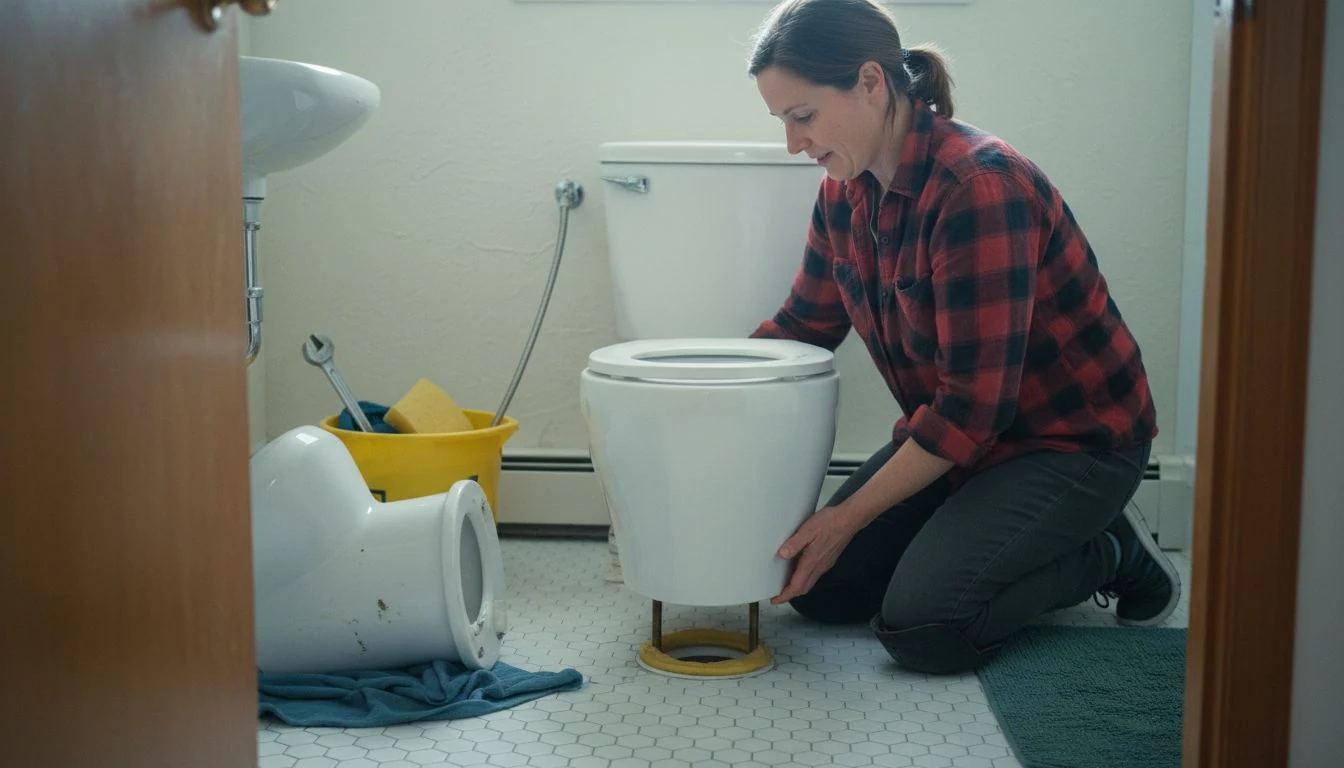
The upstairs toilet had been rocking for a month. A little tilt when you sat down, a faint click, nothing dramatic. Then a tan ring the size of a dinner plate showed up on the dining room ceiling right under it, and I went from “I’ll get to it” to googling toilet installation cost at eleven at night with a flashlight in my teeth.
The numbers first. In 2026, the toilet installation cost for a straight swap, old toilet out and new one in on the same drain, usually lands around $150 to $500 in labor. Add the toilet itself and most people pay $350 to $1,100 all in. My upstairs job came to $752, and only $289 of that was the toilet. The half-bath downstairs I did myself a year later for $318, toilet included.
I’m a homeowner, not a plumber. Below is what my quotes listed line by line, the add-ons that nearly doubled my bill, and where I stop doing it myself.
Jump to what you need:
- Toilet installation cost in 2026: my two toilets
- The toilet is the cheap part
- What gets added to a toilet installation quote
- When toilet installation is a Saturday DIY
- The 1.6 vs 1.28 gallon question
- How I compared three toilet installation quotes
- Toilet installation cost by job type
- Frequently Asked Questions
Toilet installation cost in 2026: my two toilets
The upstairs one first, because that’s the one that went wrong.
The rocking meant the wax ring had failed. Every flush pushed a little water out under the base, into the subfloor, and down through the ceiling. By the time I saw the stain it had been happening for weeks. The upgrade I’d been putting off had turned into a leak repair with a toilet sitting on top.
I called three plumbers. All three wanted to see it before quoting, which I’ve learned is a good sign. For installing a toilet I’d buy myself, they came back with:
- $185 flat to “swap it out.” Nothing else written down. When I asked about the floor, he said he’d look once the old one was up.
- $340 for removal, a new wax ring and bolts, a new braided supply line, setting and testing the new toilet, and hauling the old one away. It also listed $95 to $275 extra if the flange was damaged.
- $560 for the same work plus a new quarter-turn shutoff valve and a caulk bead at the base, with a line that said subfloor repair would be “time and materials.”
I went with the middle one. And yes, the flange was cracked on one side. That added $123. With the $289 toilet, the total was $752 before I touched the ceiling, which I patched and painted myself later for about $40.
The downstairs half-bath was the opposite story. No leak, no rocking, just an ugly 1990s toilet that ran all night. I bought a $279 toilet, $39 in parts, and spent most of a Saturday on it. More on that below.
The toilet is the cheap part
This surprised me more than anything. When people ask me what a new toilet costs, they’re usually picturing the price tag in the store aisle. That’s the easy number.
A basic two-piece toilet runs about $150 to $400 in 2026. Comfort height and elongated bowls sit in the $250 to $600 range. One-piece models with the tank molded on go higher, and toilets with a built-in bidet seat can pass $1,000 before anyone picks up a wrench. I’m not going to tell you which brand to buy. What I will say is that my $289 toilet and my $279 toilet both flush fine, and neither one was the expensive part of the job.
The labor is where the spread lives. A plumber in most of the country charges somewhere between $150 and $500 to swap a toilet on an existing drain, depending on your area, whether it’s a flat rate or hourly, and whether they think they’ll find a surprise. Big-city rates run toward the top. My three quotes covered a $375 range for what was supposedly the same hour of work.
My first tip is boring, and it saved me money: decide the labor before you fall in love with a toilet. If the install is going to be $500 because your flange is shot, maybe the $600 one-piece becomes the $300 two-piece.
What gets added to a toilet installation quote
A clean swap is quick. The bill grows from what’s under the old toilet, and you can’t see it until it’s up. These are the add-ons I saw on my own quotes and on my neighbor’s, with the ranges the plumbers gave me:
- A broken or corroded flange: about $90 to $300. Mine was $123 because a repair ring fit over the old one. A full flange replacement in cast iron costs more.
- A new shutoff valve: roughly $75 to $250. If yours is the old multi-turn kind that barely moves, replace it while the water is off anyway.
- A new supply line: $10 to $30 in parts. Cheap enough that I’d never reuse the old one.
- Hauling away the old toilet: $25 to $75. Some plumbers include it. Ask.
- Soft or rotted subfloor around the drain: this is the one that hurts. Anywhere from a few hundred dollars to over $1,000 once flooring and a second trade get involved.
That last one is exactly what a slow wax-ring leak causes. We got lucky. The subfloor upstairs was stained but still solid when he pushed on it with a screwdriver. If the toilet in your house has been rocking for a while, assume the floor number is possible and ask the plumber to write down how they’ll price it before they start.
Moving the toilet is a different job altogether. Shifting the drain even a foot means opening the floor, rerouting pipe and usually a permit. People I know who did it as part of a bigger remodel paid $1,500 to $4,000 for that piece alone, which is why the bathroom remodel cost breakdown treats “same layout” as the biggest money decision in the room.
Measure this before you buy a toilet. The rough-in: the distance from the finished wall behind the toilet (not the baseboard) to the center of the bolts holding it down. Most homes are 12 inches. Some older houses are 10 or 14. A toilet made for the wrong rough-in either won’t fit or will sit a weird gap off the wall. Also note the bowl shape you have now, the height you want, and whether the shutoff valve turns. Write it on one sheet and send the same sheet to every plumber.
When toilet installation is a Saturday DIY
I did the downstairs one myself, so I’ll be straight about what that looked like.
It took me about five hours, and a pro would have done it in one. The steps themselves aren’t hard. Shut the water off at the valve. Flush and sponge out what’s left in the tank and bowl. Disconnect the supply line, pull the caps and nuts off the bolts, and lift the old toilet off. That lift is the part I underestimated. It’s heavy, awkward, and there’s still water in the trap, so I had a towel and a bucket ready and I still made a mess.
Then scrape the old wax off the flange, stuff a rag in the drain so sewer gas stays down there, set new bolts and a new wax ring, lower the new toilet straight down, and tighten the nuts a little at a time, side to side. I cracked nothing, but I came close. You tighten until it stops rocking, not until your arm gets tired. Crack the base and you’re buying the toilet twice.
My parts list was $39: wax ring, closet bolts, a braided supply line, a small tube of caulk and a pack of plastic shims for a floor that wasn’t quite level. Total with the toilet, $318. Compared to a $340 plumber quote plus the same toilet, I saved about $300 and a chunk of my back.
Where I’d hand it off without thinking twice:
- The toilet is rocking or has been leaking at the base, because you might be looking at a flange or floor repair, not a swap.
- The shutoff valve won’t close all the way. If it doesn’t hold, the fix is at the main, and replacing a valve is its own skill.
- You have a cast iron drain or an old lead bend under there. I don’t know what I’m doing with those and I’m not going to pretend.
- Anything that involves moving the drain or going through the wall.
Same logic as my garbage disposal replacement: if what you’re pulling out comes out clean and what you’re putting in fits the same spot, it’s a weekend job. If something under there is broken, you’re paying for a diagnosis, and a plumber’s diagnosis is worth the money.
The 1.6 vs 1.28 gallon question
The half-bath toilet I pulled out was the running kind, and it was also old enough to use far more water than anything sold now. According to EPA’s WaterSense page on residential toilets, toilets account for nearly 30 percent of an average home’s indoor water use, and older ones can use as much as 6 gallons per flush.
The current federal standard is 1.6 gallons per flush. WaterSense labeled models use 1.28 gallons or less, which EPA puts at 20 percent under the standard. EPA estimates that an average family replacing old, inefficient toilets with labeled ones can save nearly 13,000 gallons a year and more than $170 a year on water.
I didn’t pick a toilet for the water bill, but I did check for the label, and both of mine have it. Our quarterly water bill dropped a little after the downstairs swap, though I also fixed the running flapper, so I can’t give that toilet all the credit. What I can tell you is that the label cost me nothing extra at the price points I was shopping. If you’re already paying for toilet installation, it’s free savings.
If you’re on a well or softened water, the water softener installation cost post has what I learned about hard water and what it does to tank parts over time.
How I compared three toilet installation quotes
The $185 quote was the cheapest by a mile, and it was the one I trusted least. The plumber seemed fine. The problem was that nothing was written down, and on a job where the surprise lives under the old toilet, “I’ll look once it’s up” is how a $185 job becomes a $600 invoice with no warning.
The FTC’s advice on avoiding home improvement scams says to get multiple estimates, that a written estimate should describe the work, materials, completion date and price, and not to automatically go with the lowest bidder. That’s exactly the gap between my three. So I lined them up line by line:
- Does it include removal and haul-away of the old toilet?
- Wax ring, bolts and supply line: included, or billed as parts?
- What happens if the flange is broken, and is there a price or a range written down?
- What happens if the subfloor is soft? Time and materials is fine, as long as they tell you before they do it.
- Is there any warranty on the labor, and for how long?
The middle quote answered four of those five in writing. That’s why I picked it, and it’s also why I wasn’t angry about the $123 flange repair. It was on the paper before the old toilet came up. For the bigger version of this checklist, I keep a running list in is your contractor quote fair.
Toilet installation cost by job type
These ranges come from my two jobs, my neighbor’s, and what the plumbers told me when I asked what else they see. Treat them as questions to bring to a quote, not a price list.
| Job | Labor, 2026 estimate | Typical all-in with toilet | What moves the price |
|---|---|---|---|
| Straight swap, same drain, DIY | $0 (your Saturday) | $190 – $450 | Toilet choice, parts, a helper to lift |
| Straight swap, plumber | $150 – $500 | $350 – $1,100 | Local rates, flat vs hourly, haul-away |
| Swap plus flange repair | $250 – $700 | $450 – $1,300 | Repair ring vs full flange, pipe material |
| Swap plus new shutoff valve | $225 – $650 | $425 – $1,250 | Valve type, access, old pipe condition |
| Swap plus subfloor repair | $600 – $2,000+ | $800 – $2,600+ | How far the rot spread, new flooring |
| Wall-hung toilet with in-wall tank | $1,000 – $3,000+ | $1,800 – $4,500+ | Opening the wall, carrier frame, tile |
| Moving the toilet to a new spot | $1,500 – $4,000+ | $1,900 – $5,000+ | Drain reroute, permit, floor and finish |
| Line | Upstairs (plumber) | Downstairs (me) |
|---|---|---|
| Toilet | $289 | $279 |
| Labor | $340 | $0, about 5 hours |
| Flange repair | $123 | Not needed |
| Wax ring, bolts, supply line, shims, caulk | Included | $39 |
| Ceiling patch below | $40 (my own paint and patch) | None |
| Total | $792 | $318 |
What blows the toilet installation budget
- Ignoring a rocking toilet. Mine rocked for a month. Every week of that was water going into the subfloor. A $5 wax ring problem turns into a floor problem if you wait long enough.
- Buying the toilet before measuring the rough-in. A 12 inch toilet on a 10 inch rough-in won’t sit against the wall, and returning a toilet is its own weekend. Tape measure first, store second.
- Taking the one-line quote. A one-line number tends to grow once the old toilet is up. Get the flange and floor pricing on paper before the old toilet comes up.
If the bathroom has bigger plans coming, like pulling the tub, read the tub to shower conversion cost post before you set a new toilet. Doing the plumbing once, in the same visit, is cheaper than paying a plumber to come back twice.
Frequently Asked Questions
How much does toilet installation cost in 2026?
For a straight swap on an existing drain, labor usually runs about $150 to $500, and most people pay $350 to $1,100 including a standard toilet. A broken flange, a new shutoff valve or soft subfloor adds to that, and moving the toilet to a new spot can cost $1,500 or more on its own. These are estimates that change with your area and what’s under the old toilet.
Can I install a toilet myself?
If you’re swapping one toilet for another on the same drain and the floor and valve are in good shape, many homeowners do it in an afternoon with a wax ring, new bolts and a supply line. Call a plumber if the old toilet was rocking or leaking at the base, the shutoff valve won’t close, or the drain has to move.
How long does a toilet installation take?
A plumber usually finishes a simple swap in about one to two hours. My own DIY took about five, most of it spent on removal and cleanup. Flange or subfloor repairs can stretch it to a full day or longer, especially if flooring has to be replaced.
All prices here are 2026 estimates and vary by region, local labor rates, permit rules, access and what is found once the old toilet comes up. Tessa is a hands-on homeowner who has installed a toilet herself and hired a plumber for another, not a licensed plumber. Nothing here replaces an inspection of your own home. Use these ranges to ask sharper questions, not as a quote.
Free DIY Project Cost Estimator
The spreadsheet I use to price out a project before I start, so a weekend job never blows the budget. Join the newsletter and I’ll send it over.
No spam, ever. Unsubscribe anytime. — Tessa
Keep reading — more on Remodel & Renovation Costs
Boiler Replacement Cost: Gas, Oil, and Combi Boilers Compared
My friend Marisol called me on a Sunday in October with her coat on inside the…
Read article →
HVAC System Replacement Cost: Furnace, AC, or Both at Once
The tech who told me my air conditioner was done also handed me a second price…
Read article →
Furnace Tune Up Cost: What a Fall Service Includes (and What to Skip)
Three companies left door hangers on my porch the same week in September. One said $79.…
Read article →
Furnace Blower Motor Replacement Cost in 2026: PSC vs ECM
My dad called on a Sunday in January and opened with “the furnace is running but…
Read article →