
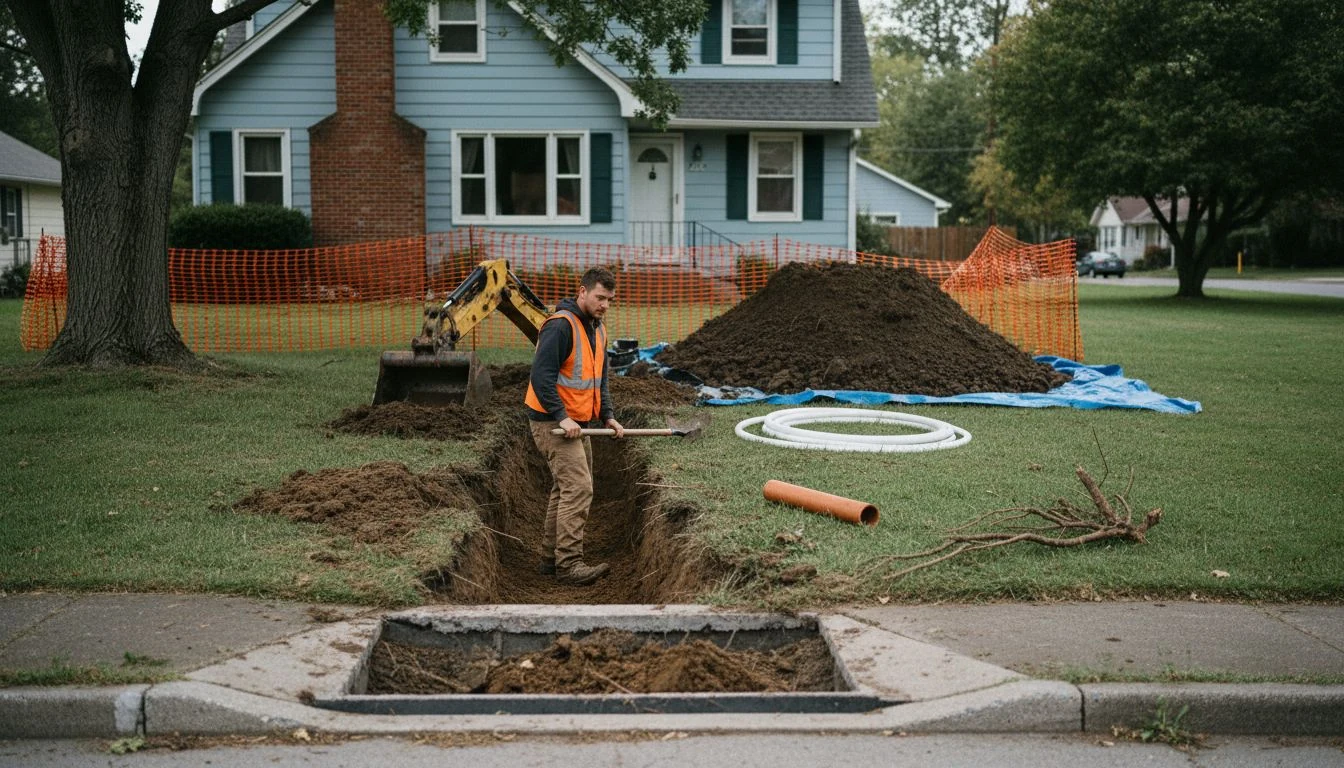
The laundry drain burped. That’s the only word for it. I started the washer, walked into the basement for a laundry basket, and the floor drain three feet away was pushing water back up at me.
The numbers first, because that’s what you came for. In 2026, sewer line replacement cost for a typical house runs about $4,000 to $12,000, or roughly $50 to $250 a foot depending on how they get at the pipe and what is sitting on top of it. Mine came to $13,550, and I wasted another $595 before that on two visits that fixed nothing.
I’m a homeowner, not a plumber. What follows is the camera inspection that finally told me the truth, the three quotes I lined up side by side, and the one line item I almost let a contractor leave out.
Jump to what you need:
- Sewer line replacement cost in 2026: what mine actually came to
- The camera comes before the quote
- Whose pipe is it, yours or the city’s
- Digging it up or going trenchless
- What gets added to a sewer line replacement quote
- How I compared three sewer line quotes
- Sewer line replacement cost by method
- Frequently Asked Questions
Sewer line replacement cost in 2026: what mine actually came to
Our house went up in 1958. Cast iron inside the walls, clay tile from the foundation out to the street, and about sixty feet of front yard in between with a maple tree sitting on top of it.
The first backup was in March. A guy came out with a cable machine, ran it, pulled back a wad of roots the size of a football, charged me $285 and told me to have it rodded every year. Fine. In September it backed up again. Same machine, same roots, $310 this time.
That second bill is the mistake I want you to skip. I paid $595 across two visits to clear a pipe that was broken, and neither visit told me it was broken, because nobody put a camera down there and I never asked.
The job, once I did ask:
- Camera inspection: $225, credited back when I hired the work.
- Pipe bursting, 61 feet, two access pits: $11,600.
- Permit and city inspection: $410.
- One sidewalk panel cut and repoured: $780.
- New exterior cleanout: $450.
- Topsoil and seed where the pits were: $310.
That’s $13,550 for the work, on a run that was longer than average and ended under a public sidewalk. Counting the two rodding visits I threw away first, the whole episode cost $14,145. A neighbor two doors down replaced a forty foot run in open trench the year before for $6,200, and her yard was flat, treeless and had nothing poured over it. Same street, less than half the bill, and the difference was almost entirely what sat on top of the pipe.
The camera comes before the quote
A sewer camera is a small waterproof head on a long push cable with a screen at the other end. The plumber feeds it down a cleanout and you both watch. It cost me $225 and most shops charge somewhere between $150 and $500, often crediting it if you hire them for the repair.
What mine showed, in order: a clean run for about eighteen feet, then a joint with a white lace of root hairs coming through it, then more joints doing the same, then at roughly forty feet the picture went sideways and stopped. Collapsed. Soil sitting where the top of the pipe used to be. The locator wand put that spot under the strip of grass between the sidewalk and the curb.
That footage changed the next three weeks. The quotes I got afterward were all describing the same pipe, so for the first time I could compare them. And I stopped letting anyone sell me another rodding, because you cannot cable your way out of a collapsed section. The cable just chews through what is left of it.
My advice, and I paid $595 to learn it: pay for the camera before you pay anyone to clear anything. Ask for the video file or at least a recording you can keep. Every quote I got wanted to run their own camera, and the two who watched mine first gave me tighter numbers because they already knew where the trouble was.
Whose pipe is it, yours or the city’s
I assumed the city owned everything past my property line. Wrong in most places, and that wrong assumption is why the first bill lands so badly.
The pipe from your house to the public main is usually called the lateral, and in most jurisdictions the property owner maintains it. Los Angeles County Public Works, to pick a big system that puts it plainly, says that homeowners are required to maintain the sewer line from their home to the main sewer line, and that the county notifies owners when roots or debris in their lateral start threatening the main. Some cities draw the line at the property line instead, and a few maintain the section under the street themselves.
So before you read a single quote, call your water or sewer utility and ask two questions. Where does my responsibility end. And do you have a record of my lateral’s material and age. My utility answered the first one in a minute, which told me the sidewalk portion was on me, and that one answer moved $780 onto my side of the ledger.
The same call is worth making about the stuff that gets the line in trouble. That county page is blunt about grease going down the drain, and my plumber said the same thing in fewer words while he was pulling my camera back out. Roots find a joint that is already weeping. Grease gives them something to catch on.
Digging it up or going trenchless
Three methods came up in my quotes, and what separates them is less the price per foot than what is left of your yard afterward.
Open cut is the one everybody pictures. They dig a trench along the whole run, lift the old pipe out, lay new PVC, backfill. Around $50 to $250 a foot in 2026. It is the cheapest method per foot and the most expensive in everything else, because whatever sits above that trench comes out. Lawn, shrubs, walkway, driveway apron.
Pipe bursting skips the trench. They dig two small pits, one at each end, then pull a bursting head through the old pipe. It splits the old line outward and drags the new one in behind it. Roughly $60 to $200 a foot. Your yard gets two holes instead of a scar.
Cured in place lining is the third option. A resin-soaked liner goes in through an access point and hardens into a new pipe inside the old one. About $80 to $250 a foot. It is the least invasive, and it has a real limit: the host pipe has to still be there. A collapsed section or a sag holding standing water cannot be lined, and my collapsed forty foot mark ruled it out.
Trenchless is not automatically cheaper. On paper my bursting quote was $3,750 more than the open trench quote. I picked it anyway, because the trench version ran straight through a maple I did not want to lose and a walkway I would have had to repour. Add the tree work and the concrete and the two numbers crossed.
Take this list to every sewer quote. Total length of the run in feet, and where it enters the main. Pipe material and depth. Method proposed, and why that method. Is a permit included, and who pulls it. Is restoration included, and to what finish: bare dirt, topsoil and seed, or matching concrete. Does the price include a cleanout. How many days from dig to backfill, and do I have water service meanwhile. What warranty covers the pipe, and what covers the labor. Send that same sheet to all three companies and make them answer on paper.
What gets added to a sewer line replacement quote
The pipe itself is not what makes these jobs swing by five figures. It is everything above and around it.
- Depth. A line four feet down is a different machine and a different day than one at ten feet. Deep trenches need shoring, and shoring needs time.
- Concrete. Sidewalk panels, driveway aprons, patios, garage slabs. My one panel was $780. A driveway section can run $1,500 to $6,000 once you count saw cutting, disposal and a pour that matches.
- Street or right of way cuts. Some cities require their own crew, their own permit and a road plate for a week. This is the line item most likely to be missing from a low bid.
- Permits and inspection. Mine was $410. Budget $150 to $800 and confirm in writing who pulls it, because the contractor pulling the permit is part of how you know they’re licensed for the work.
- Cleanout installation. $350 to $900. If your house has no accessible cleanout, add one while the hole is open. It makes every future camera run cheap instead of ugly.
- Restoration. Bare dirt is not a finished job. Topsoil, seed or sod, and replacing what got pulled out is worth pinning down before anyone starts.
The trap here is comparing a number that includes restoration against one that doesn’t. That’s the same trap I wrote about in is your contractor quote fair, and it shows up on every big outdoor job, including driveway replacement, where the demolition and haul-away can outweigh the concrete.
How I compared three sewer line quotes
All three came out, all three ran their own camera, and all three agreed on the diagnosis. Then the paper went in three directions.
- $7,900, open cut the full run, new PVC, backfill and rough grade. No permit line. No sidewalk. A sentence at the bottom said surface restoration was by others.
- $13,550, pipe bursting, two pits, permit and inspection, the sidewalk panel, a new cleanout, topsoil and seed. Two year labor warranty, manufacturer warranty on the pipe.
- $10,300, spot repair of the collapsed section plus lining the rest. Honest about the fact that lining would not fix the slight sag the camera showed at fifty feet.
The $7,900 was the cheapest and the most misleading. Add a permit, a sidewalk panel, a tree I would have lost and a lawn I’d have to rebuild, and it lands within a few hundred dollars of the bursting quote, with a trench across the yard as a bonus.
The FTC’s guidance on avoiding home improvement scams is worth reading before you sign anything on a job this size. Get multiple estimates. Don’t automatically take the lowest bidder, and ask why the prices differ. Don’t pay for everything up front. And watch for anyone pressuring you into a same day decision, which is exactly the pitch I got from the company that wanted a check before the excavator arrived.
I paid a third at the start, a third at rough inspection, and the rest after the city signed off and the seed was down. Nobody argued about that schedule. If someone does argue, that tells you something.
Sewer line replacement cost by method
These ranges come from my three quotes, my neighbor’s job, and what the plumbers told me they see on a normal week. Treat them as questions to bring to a quote, not a price list.
| Job | 2026 estimate per foot | Typical total, 50 to 75 ft | What moves the price |
|---|---|---|---|
| Camera inspection and locate | Flat fee | $150 – $500 | Often credited toward the repair |
| Cabling or hydro jetting roots | Flat fee | $250 – $800 | Buys time, fixes nothing broken |
| Spot repair, one bad section | $60 – $250 | $1,200 – $4,500 | Depth, what is poured over it |
| Open cut full replacement | $50 – $250 | $4,000 – $18,000 | Trench length, depth, restoration |
| Pipe bursting, trenchless | $60 – $200 | $5,000 – $16,000 | Access pits, pipe material, bends |
| Cured in place lining | $80 – $250 | $5,000 – $18,000 | Host pipe has to be intact |
| Driveway or street cut, added | Per section | $1,500 – $6,000+ | City crew rules, matching the pour |
| Line | What I paid | Was it in the cheapest quote? |
|---|---|---|
| Two rodding visits before the camera | $595 | Spent before any quote |
| Camera inspection | $225, credited back | Yes |
| Pipe bursting, 61 ft, two pits | $11,600 | No, that one was open cut at $7,900 |
| Permit and city inspection | $410 | No |
| Sidewalk panel cut and repoured | $780 | No |
| New exterior cleanout | $450 | No |
| Topsoil and seed at the pits | $310 | No |
| Total for the work | $13,550 |
What blows the sewer line budget
- Paying to clear roots over and over. My $595 bought two clean weekends and zero information. A $225 camera would have told me the pipe was collapsed the first time.
- Anything poured over the pipe. Grass is cheap to put back. A driveway apron, a sidewalk or a patio is its own project bolted onto this one, and it belongs in the quote before the digging starts.
- A bid that ends at backfill. If the paper says restoration is by others, that is not a lower price. That is half a job with the other half still coming.
If the backups turn out to be on a septic system instead of a city main, the money goes somewhere else entirely. The septic servicing cost post covers pumping intervals and tank repairs, which is a different pipe and a different bill from the lateral running to a municipal sewer. And if this turns into a bigger dig around the house, what a general contractor costs explains when one is worth paying for coordination. Water showing up in the basement after heavy rain instead of after a flush is usually not the sewer at all, and foundation repair cost is the better place to start reading.
Frequently Asked Questions
How much does sewer line replacement cost in 2026?
Most homeowners pay about $4,000 to $12,000, working out to roughly $50 to $250 a foot. Short, shallow runs under open lawn land at the low end. Long runs, deep pipe, and anything under concrete or a street push past that. Mine was $13,550 for 61 feet with a sidewalk panel and a permit included. These are estimates, and the camera inspection is what turns them into a real number.
Is trenchless sewer replacement cheaper than digging?
Usually not, at least not per foot. Pipe bursting and lining cost more than an open trench for the pipe work itself. They get cheaper once you count what stays intact: mature trees, a driveway, a sidewalk, a finished lawn. Ask for both quotes with restoration included in each, then compare the totals instead of the methods.
Does homeowners insurance cover a sewer line replacement?
Read your own policy and call your insurer before you assume either way. Standard policies commonly treat a failing buried line as maintenance rather than a covered loss, and coverage for water damage inside the house is a separate question from replacing the pipe. Some utilities sell optional service line plans. Get the answer in writing before the work starts, not after.
All prices here are 2026 estimates and vary by region, pipe depth and length, local permit rules, access and what the camera finds. Tessa is a hands-on homeowner who paid for this job and kept the paperwork, not a licensed plumber or a contractor. Nothing here replaces an inspection of your own line. Use these ranges to ask sharper questions, not as a quote.
Free DIY Project Cost Estimator
The spreadsheet I use to price out a project before I start, so a weekend job never blows the budget. Join the newsletter and I’ll send it over.
No spam, ever. Unsubscribe anytime. — Tessa
Keep reading — more on Remodel & Renovation Costs
Boiler Replacement Cost: Gas, Oil, and Combi Boilers Compared
My friend Marisol called me on a Sunday in October with her coat on inside the…
Read article →
HVAC System Replacement Cost: Furnace, AC, or Both at Once
The tech who told me my air conditioner was done also handed me a second price…
Read article →
Furnace Tune Up Cost: What a Fall Service Includes (and What to Skip)
Three companies left door hangers on my porch the same week in September. One said $79.…
Read article →
Furnace Blower Motor Replacement Cost in 2026: PSC vs ECM
My dad called on a Sunday in January and opened with “the furnace is running but…
Read article →