
In August, the upstairs bedroom was three degrees cooler with the new AC, and I was proud of that for about a week. Then I put my hand over the register in that room and compared it to the one in the kitchen. The kitchen vent was blowing hard. Upstairs felt like someone breathing on my palm from across the room.
One of my HVAC quotes had a $2,400 line for ductwork that I skipped at the time, and I’d written “probably need someday” next to it. Someday turned out to be this fall.
The air duct replacement cost in 2026, short version: replacing all the ductwork in a typical 1,500 to 2,500 square foot house usually runs about $4,000 to $10,000, and more when ducts are buried in finished walls and ceilings. Installed, that works out to roughly $15 to $45 per linear foot depending on the material. Replacing a few bad runs or a return is often $500 to $3,000. And plenty of houses don’t need new ducts at all. They need sealing, which can be a few hundred dollars.
Below: how to tell which of those you need, my three quotes, a neighbor’s full attic replacement, and the one quote line I’d question every time.
Jump to what you need:
- Air duct replacement cost in 2026
- Replace or seal
- My three ductwork quotes
- My neighbor’s attic job
- What moves the price
- What you can do yourself
- Duct replacement cost by job
- Frequently Asked Questions
Air duct replacement cost in 2026
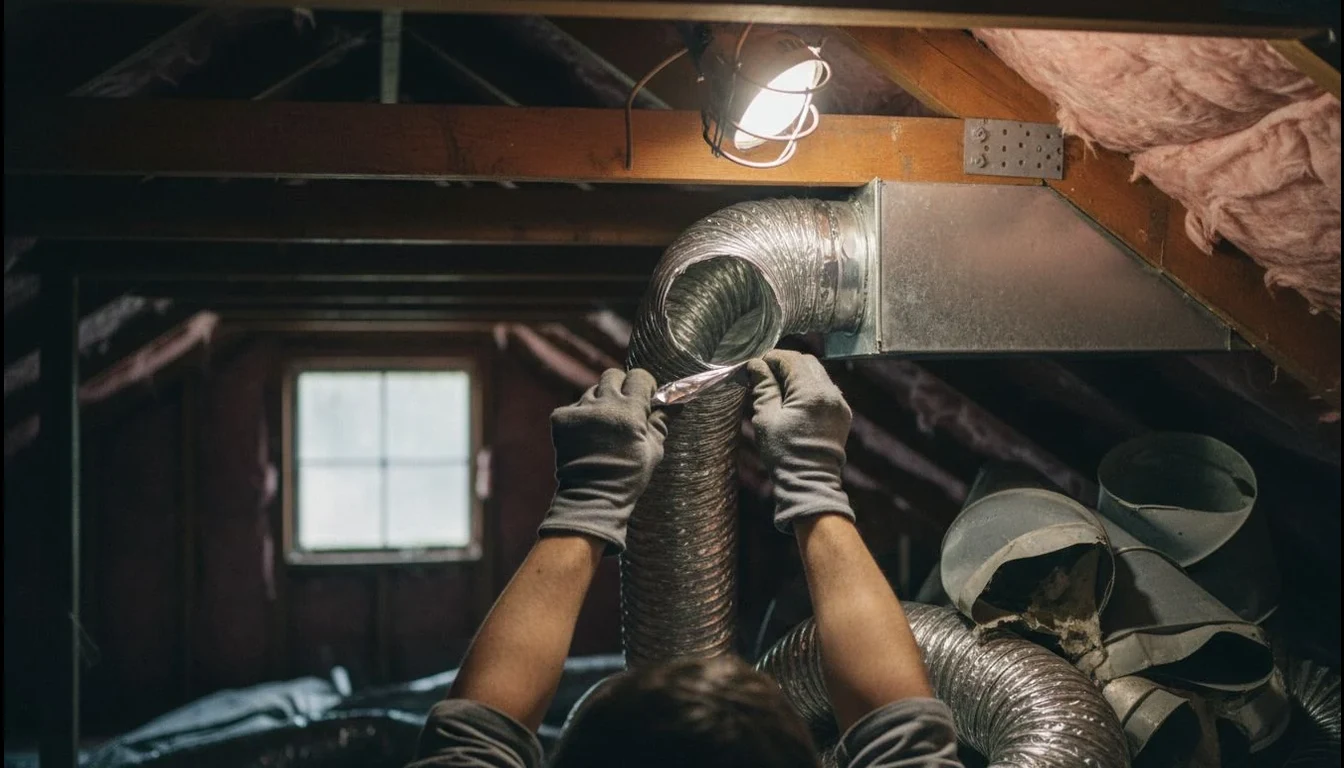
Ducts are the metal and flexible tubes that carry air from the furnace or air handler to each room (supply) and back again (return). In my house they hang from the basement ceiling: a big rectangular sheet metal trunk line down the middle, with smaller round runs branching off to each register. A lot of ranch houses have the same layout in the attic instead.
The material makes a big difference in price. These are installed ranges I heard from the contractors who came out, plus my neighbor’s invoice:
- Flexible duct, the ribbed silver or gray tube: about $15 to $30 per foot installed. Cheapest and fastest, and also the easiest to crush, kink or sag.
- Sheet metal, round or rectangular: about $25 to $45 per foot installed. Lasts the longest and moves air best when it’s sized right.
- Fiberglass duct board: about $20 to $35 per foot. Common in some regions, and harder to clean if it ever gets wet or moldy.
A whole-house job adds the plenum connections, new registers or boots, sealing, insulation where the ducts run through unheated space, and haul-away. That’s how you get to the $4,000 to $10,000 range for most houses. These are estimates, and they swing a lot with region, house size and how much drywall someone has to open.
Air duct replacement or sealing: which one you need
This is the question that saved me the most money. Energy Star’s duct sealing page says about 20 to 30 percent of the air moving through a typical duct system is lost to leaks, holes and poorly connected ducts. That’s a lot of the air you paid to heat. But most of that is fixed by sealing the joints, not by tearing out the metal.
The signs Energy Star lists sound a lot like my house: high bills in summer and winter, rooms that are hard to heat or cool, and ducts in an attic, crawlspace or garage. Those are reasons to have the ducts checked. On their own, they don’t mean replace.
From my quotes, here’s how the contractors drew the line:
- Sealing is usually enough when the ducts are in decent shape, sized right, and just leaky at the seams. Sheet metal can last for decades.
- Replacing makes sense for runs that are crushed, torn, disconnected or rusted through, for flex duct that has sagged into long dips, and for ducts that are the wrong size for the system.
- Replacing is also the answer for contaminated insulated ducts. The EPA’s page on whether to have air ducts cleaned says that once fiberglass duct liner is contaminated with mold, cleaning won’t stop it from growing back, and recommends replacing wet or moldy insulation.
Rodents count too. If mice nested in a flex duct, you’re replacing that run, not vacuuming it. Our mouse exterminator cost guide covers getting rid of them first, which you should do before anyone installs new duct.
My three duct replacement quotes
Same house, same two weeks in September. Gas furnace in the basement, new AC from August, about 1,900 square feet over two floors. The complaint was weak airflow to the two upstairs bedrooms.
Quote 1: $8,900 to replace all the ductwork. The salesman went down the basement stairs, looked up at the trunk line for maybe a minute, and said it was “original to the house and past its life.” He didn’t measure anything. When I asked about sealing, he said it was “a band-aid.” That’s a big number for a diagnosis made by looking up.
Quote 2: $650 to seal the basement joints with mastic and tape. Honest and cheap, and it would have helped. But he never went upstairs and never checked the runs to the bedrooms, and the problem was upstairs.
Quote 3: $2,850 for a partial job. This was the tech from my AC install, the one who measured static pressure back in August. He came back with a little gauge, a flashlight and a camera on a stick. The trunk line was fine, just leaky at the joints. The return was too small for the new system, which is why that August quote had the line in it. And the two long flex runs that fed the upstairs bedrooms had sagged between the joists into deep dips, with one squashed flat where somebody had stored boxes on it years ago.
His quote: a larger return, about 50 feet of new insulated flex for the two bedroom runs, pulled tight and supported every few feet, and mastic on every joint of the trunk. Plus a before and after airflow reading at each register, written on the quote.
I took Quote 3. If you’re staring at quotes that are thousands apart for “the same” ducts, our guide on how to tell if a contractor quote is fair shows how I lined mine up.
My neighbor’s full air duct replacement in the attic
Sometimes the whole system really does need to go. The ranch house two doors down has all its ducts in the attic, and when the couple there had their attic insulation redone in the spring, the crew found flex duct that was torn in three places, one run completely disconnected and blowing heated air into the attic, and evidence of mice in two runs.
Patching that wasn’t worth it. They replaced every run with new insulated flex, a new supply plenum and new sealed boots at each ceiling register. It took a crew of two about two and a half days. Their total was $6,700 for a 1,600 square foot house. Their gas bill that winter dropped enough that she showed me the two bills side by side on her phone, which is how I know she was happy about it.
If your ducts are in the attic, the insulation and the ducts are worth thinking about together. Our attic insulation cost guide has the numbers for that half of the job, and doing both in one visit means the crew is only crawling around up there once.
What moves the air duct replacement cost
Two quotes for “new ductwork” can be thousands apart. Read every quote for these lines.
- Access. Ducts hanging in an open basement or attic are the cheap case. Ducts inside finished walls and ceilings mean opening drywall, then patching and painting, and the price can climb past $12,000 for a whole house.
- Sizing. A good contractor checks whether the ducts match the furnace and AC. Undersized returns are common, especially after a bigger AC goes in. Ask whether anyone measured static pressure.
- Insulation. Ducts in an attic, crawlspace or garage should be insulated. Insulated flex costs more per foot than bare duct.
- Number of runs and registers. Each room adds a run, a boot and a register, usually $150 to $400 per run on a partial job.
- Asbestos. Some older houses have asbestos tape or wrap on the ducts. Testing is cheap. Abatement isn’t, and it has to happen before anyone cuts.
- Permits. Some towns require one for duct replacement. Ask who pulls it.
The one line I’d question every time: whole-house replacement with no measurements. Static pressure, airflow at the registers, a look at every run. If a quote for thousands of dollars doesn’t mention any of that, ask why.
What you can do yourself
Some of this is a good homeowner job. Energy Star says some people do their own duct sealing with mastic sealant or metal tape. It also says plain duct tape doesn’t last, and that most heating and cooling contractors also repair ductwork if you’d rather hire it out.
I did one Saturday of my own work before the contractor came:
- Walked the basement with a flashlight and wrote down every joint with dust streaks around it. Those streaks are where air has been leaking out.
- Checked every register in the house was open and not blocked by a rug, a dresser or a toy bin. My daughter’s bed was half covering hers. Embarrassing, and free to fix.
- Changed the furnace filter. A clogged filter cuts airflow everywhere, and it’s the first thing a tech checks. Our furnace tune-up cost guide lists the other quick checks.
- Bought a tub of mastic and a brush for about $25 and sealed two easy joints near the furnace to see how messy it was. Messy. Doable.
What I left to the pro: anything that meant cutting, re-routing or resizing duct, anything connected to the furnace plenum, and the return. Bad airflow is invisible from the living room, and it can keep a furnace working harder for years before anyone notices. And if there’s a gas furnace or water heater nearby, pulling more air out of that room than it’s getting back can affect how the appliance vents. That’s a reason to have a pro look at the whole system, not just the duct.
Ask every duct contractor these before you sign. Did you measure static pressure, and what was it. Which runs are you replacing, and why. Is sealing an option, and what would it fix. What material are you using, and is it insulated where the ducts pass through unheated space. Are you resizing the return or any supply runs. How many registers and boots are included. Will you open drywall, and who patches it. Does my house have asbestos tape or wrap, and have you tested it. Is the permit included. Will you measure airflow at the registers before and after, and write it down. What is the labor warranty. Get every answer in writing.
Air duct replacement cost by job
I built this from my three quotes, my neighbor’s invoice and the per-foot prices the contractors gave me. It’s for reading your own quotes, not a price list.
| Duct job | When it fits | Installed cost (2026 estimate) | What pushes it higher |
|---|---|---|---|
| DIY sealing with mastic or foil tape | Leaky joints you can reach | $25 – $100 in materials | Ducts you can’t reach |
| Professional sealing, accessible ducts | Sound ducts, leaky seams | $400 – $2,000 | Attic or crawlspace access |
| Replace one to three runs | Crushed, sagging or torn flex to a few rooms | $500 – $1,500 | Long runs, second-floor rooms |
| New or larger return | Return too small for the system | $800 – $2,000 | Cutting through finished walls |
| Full replacement, open basement or attic | Damaged or contaminated system, easy access | $4,000 – $10,000 | House size, insulation, new plenum |
| Full replacement, ducts in finished walls | Remodel, or ducts that can’t be reached | $8,000 – $15,000+ | Drywall repair, asbestos abatement |
What blows the duct replacement budget
- Replacing ducts that only needed sealing. Ask for measurements first. A leaky seam is a mastic job, not a new system.
- Installing new duct before dealing with pests or mold. Get rid of mice and fix the moisture problem first, or the new runs end up like the old ones.
- Doing the ducts and the furnace in separate years without sizing them together. If a new system is coming soon, size the ducts for it. Our HVAC system replacement cost guide shows how ductwork fits into that quote.
If one room is the whole problem and the ducts can’t reach it well, a single ductless unit can cost less than reworking the runs. The numbers are in our ductless mini split installation cost guide. And for how this compares with other big projects, see our overview of home renovation costs.
The crew finished on a Wednesday in late September. The tech’s before and after numbers were on the quote: the upstairs bedroom register went from barely moving air to about the same as the kitchen. Last week the first cold night came, the furnace kicked on, and my daughter came downstairs to complain that her room was too warm. I’ll take it.
Frequently Asked Questions
How much does it cost to replace ductwork in a house?
Replacing all the ductwork in a typical 1,500 to 2,500 square foot house usually costs about $4,000 to $10,000 in 2026 when the ducts are in an open basement or attic. Ducts inside finished walls can push it past $12,000. These are estimates and vary by region and access.
How do I know if my ducts need replacing or just sealing?
Sealing usually fixes ducts that are in good shape but leak at the joints. Replacement is for runs that are crushed, torn, disconnected, rusted through, contaminated with mold or rodents, or the wrong size. Ask the contractor to measure static pressure and airflow before quoting.
Can I replace air ducts myself?
Sealing accessible joints with mastic or foil tape is a reasonable homeowner job. Re-routing, resizing or replacing runs and anything connected to the furnace is better left to an HVAC contractor, because airflow mistakes make the system work harder and can affect how gas appliances vent.
All prices here are 2026 estimates from my own written quotes, a neighbor’s invoice and what HVAC contractors told me, and they vary by region, house size, duct material and access. Tessa is a hands-on homeowner, not a licensed HVAC contractor. Duct sizing, furnace connections and anything near gas appliances should be handled by a licensed pro, and asbestos should be tested before anyone cuts old duct.
Free DIY Project Cost Estimator
The spreadsheet I use to price out a project before I start, so a weekend job never blows the budget. Join the newsletter and I’ll send it over.
No spam, ever. Unsubscribe anytime. — Tessa
Keep reading — more on Remodel & Renovation Costs
Whole House Humidifier Installation Cost (and Whether You Need One)
Last January the little hygrometer on my bookshelf read 21 percent. I’d bought it for $14…
Read article →
Gas Fireplace Installation Cost: Inserts, Built-Ins, and Venting
My sister Jen has a brick fireplace in her 1962 ranch that she has used exactly…
Read article →
Shower Remodel Cost: Refresh, Walk-In, and Full Tear-Out
My mom called me in August because the floor of her shower had started to flex.…
Read article →
Gas Line Installation Cost: For a Stove, Dryer, Fireplace, or Generator
For nine days last winter, a brand new gas range sat in the middle of our…
Read article →