
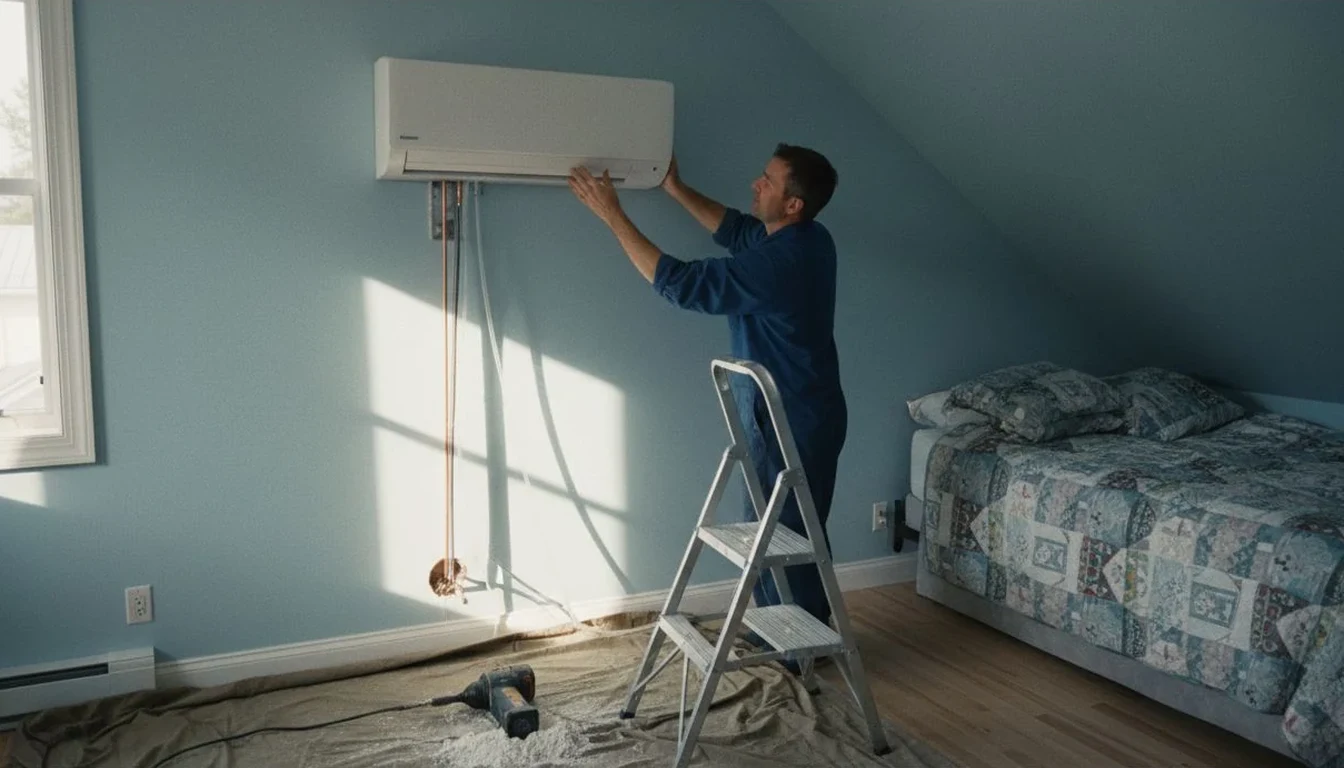
The room over our garage was the reason I started reading about mini splits. In July it hit 88 degrees by four in the afternoon, even with a rattling window unit going full blast. In January the old baseboard heater ticked and pinged and the room still felt like a mudroom. We called it the bonus room. Nobody wanted to be in it.
So last spring I got three written quotes, and the gap between the cheapest and the most expensive was almost $5,500 for what started as the same job.
The ductless mini split installation cost in 2026, in one line: a single-zone system, one outdoor unit and one indoor head, usually runs about $3,000 to $5,500 installed. Each extra zone adds roughly $2,000 to $4,000, so a whole house with four or five heads can land anywhere from $12,000 to $22,000 or more. The equipment is less than half of it. Most of the money goes to labor, the electrical work and how far the refrigerant lines have to run.
Below are my three quotes line by line, the per-zone math, the add-ons that rarely make the first page of a quote, and the one part of the job I would never try myself.
Jump to what you need:
- Ductless mini split installation cost in 2026
- The per-zone math
- My three mini split installation quotes
- The add-ons that change the price
- DIY mini split kits: what you save and what you risk
- Tax credits and rebates in 2026
- Mini split installation cost by number of zones
- Frequently Asked Questions
Ductless mini split installation cost in 2026
A ductless system has two halves. The outdoor unit is the compressor, about the size of a big suitcase, sitting on a pad or a wall bracket. The indoor head mounts high on a wall and blows the air. They’re connected by a line set: two insulated copper refrigerant lines, a communication wire and a drain hose, all bundled through a hole about three inches wide.
Energy Star’s page on ductless heating and cooling describes it the same way and makes the point that matters for the price: no ductwork. You’re not paying anyone to crawl through an attic cutting sheet metal. You’re paying for the equipment, a skilled install, and electrical.
My three bids and two neighbors’ invoices broke down roughly like this:
- Equipment (outdoor unit, one indoor head, line set, remote): about $1,200 to $2,800, depending on size and brand tier.
- Labor for mounting, drilling, running and flaring the lines, pulling a vacuum and starting it up: about $1,500 to $2,500.
- Electrical, which is usually a new 240-volt circuit and a disconnect box outside: $300 to $1,200 if your panel has room.
- Pad or wall bracket, line hide covers, permit: another $200 to $700.
That’s how you get to $3,000 to $5,500. A 9,000 BTU unit for a small bedroom sits low. A 24,000 BTU unit for an open living area with a cold-climate rating sits high. These are estimates, and they swing a lot by region and by how easy your house is to work on.
The per-zone math for mini split installation
“Zone” means one indoor head with its own thermostat. One outdoor unit can feed one head (single-zone) or several (multi-zone, sometimes two to five heads on one compressor).
Multi-zone looks cheaper per room on paper because you’re buying one outdoor unit. But the outdoor unit gets bigger and more expensive, and every head still needs its own line set run, its own hole in the wall and its own drain. My rough rule after talking to all three installers:
- First zone: $3,000 to $5,500.
- Each additional zone on the same outdoor unit: about $2,000 to $4,000.
- Heads in rooms far from the outdoor unit cost more, because the line set has to travel through closets, an attic or along the outside of the house.
So a three-zone system for a bonus room, a primary bedroom and a home office would run something like $8,000 to $14,000. That’s a big range. The low end is a one-story house where every head is on an outside wall near the compressor. The high end is a two-story where one line set has to go up through a closet and across an attic.
It surprised me that a separate single-zone system for each room can come out close to a multi-zone system in price, and if one compressor fails, the other rooms keep running. One installer recommended that setup to me. Another said the opposite. Ask both ways.
My three mini split installation quotes
Same room, same month. The bonus room is about 320 square feet, with a sloped ceiling on one side and two west-facing windows that cook it all afternoon.
Quote 1: $9,800. This salesman spent ten minutes in the bonus room and twenty in my kitchen. He quoted a two-zone system, adding a head in our primary bedroom, “since you’ll want it there next year anyway.” For the bonus room alone he wrote $5,900. He never measured the windows and never asked about insulation.
Quote 2: $5,400 for an 18,000 BTU single zone. This one was my fault, partly. I’d told him the room was miserable and I wanted it fixed for good, and he heard “make it big.” Larger unit, a condensate pump because he wanted the head on an inside wall, and a 1-year labor warranty.
Quote 3: $4,350 for a 12,000 BTU single zone. This installer measured everything, asked what was above the room, looked at my electrical panel and wrote it all down. She ran a load calculation and came back with 12,000 BTU, not 18,000. Price included the new 240-volt circuit and disconnect, a wall bracket so the outdoor unit sits above the snow line, line hide on the outside wall, the permit, and a 2-year labor warranty on top of the manufacturer’s parts warranty.
Energy Star says the same thing she did: an oversized or undersized system struggles, and your contractor should size it with a Manual J calculation. A unit that’s too big cools the room fast and shuts off before it pulls the moisture out, so the room ends up cold and clammy. I was ready to pay $1,000 more for a worse result.
I went with Quote 3. With a $150 electrician’s fee for adding a breaker space in my panel (she found it was full and fixed it the same day), my all-in was $4,500. If your quotes don’t line up the way mine didn’t, our guide on how to tell if a contractor quote is fair walks through comparing them line by line.
The add-ons that change the ductless mini split installation cost
The equipment price is easy to look up. These are the lines that make two quotes for the same unit come out $2,000 apart.
- Long line sets. Most quotes include 15 to 25 feet. Beyond that, expect roughly $15 to $40 per extra foot, installed. My neighbor’s head was 45 feet from the compressor and it added about $600.
- Electrical panel upgrades. If there’s no space for a new 240-volt breaker, you might need a subpanel or a full panel upgrade. That’s $1,500 to $4,000, and it’s the biggest surprise I’ve heard about.
- Condensate pumps. If the head can’t drain by gravity to the outside, a small pump moves the water. Add $150 to $400, plus a part that can fail later.
- Line hide covers. The plastic channel that hides the lines on the outside wall. $100 to $300 per run, and worth it if the lines are on the front of your house.
- Wall brackets vs a pad. A ground pad is cheap. A wall bracket costs $100 to $300 more and keeps the unit out of snow and away from the dog.
- Permits. $50 to $500 depending on your town. A quote that leaves the permit out moves that cost onto you later.
Energy Star has a placement tip I didn’t think of: keep the outdoor unit away from doors and walkways, because it drips water when it defrosts in winter and that water can freeze into an ice patch. Ours went on the side of the garage, not next to the back steps where I’d first pictured it.
DIY mini split kits: what you save and what you risk
I almost did this. There are pre-charged “DIY” mini split kits online for about $1,500 to $2,500, with quick-connect line sets so you don’t need a vacuum pump or flaring tools. I had one in my cart.
The electrical is what stopped me. The kit only covers the refrigerant side. You still need a dedicated 240-volt circuit, and in my town that’s a permitted job for a licensed electrician, about $400 to $1,200. You still need to drill a three-inch hole through an exterior wall in the right spot, with a slight downward slope so the drain works. And a lot of manufacturer warranties on standard systems require professional installation, which is the whole reason the DIY kits exist as a separate product.
When I added the electrician, a core drill rental, the wall bracket and a free Saturday, the kit saved me maybe $1,200 against Quote 3. For a garage or a shed I’d think about it. For a bedroom that sits over my car I wanted the 2-year labor warranty.
What I did do myself, and what you can too:
- Cleared the wall and moved the bed before the crew came, which saved them half an hour.
- Patched and painted the old window unit’s sleeve area once it was gone.
- Learned the filter routine. The indoor head has washable filters that need a rinse every few weeks during heavy use. Our mini split maintenance checklist covers what to do yourself and when a pro cleaning is worth the money.
Ask every mini split installer these before you sign. Did you do a Manual J load calculation, and can I see it. What BTU size are you quoting and why. How many feet of line set are included, and what is the price per extra foot. Is the electrical circuit and disconnect included, and does my panel have room. Pad or wall bracket. Does the head drain by gravity, or do I need a pump. Is the permit included. Is the system cold-climate rated if we get freezing winters. What is the labor warranty, separate from the parts warranty, and do I have to register the unit. Get every answer in writing.
Tax credits and rebates in 2026
I almost counted money I was never going to get. Two of my three quotes still mentioned a federal tax credit of up to $2,000, and when I looked it up, Energy Star’s own ductless page still said the credit ran through 2032.
The IRS says otherwise. Its page on the Energy Efficient Home Improvement Credit says the credit is allowed for qualifying property placed in service before December 31, 2025. A system installed in 2026 doesn’t qualify. The IRS is the one that decides your taxes, so that’s the page I went by. If a salesperson leans on the federal credit to close a 2026 sale, take that number out of their math.
Utility rebates are a different story and some are still around. My electric company had a $300 rebate for a qualifying heat pump, which brought my real cost to $4,200. Energy Star has a rebate finder by ZIP code, and calling your utility directly takes ten minutes. Rebates usually need the unit’s model number and proof of professional installation, so ask before you sign, not after.
If the mini split is replacing old electric baseboard heat, like mine, the savings show up on the power bill too. Energy Star says certified mini splits use up to 60% less energy than standard electric radiators. Our baseboard heater in that room is now just a thing I dust.
Mini split installation cost by number of zones
I built this from my three quotes, two neighbors’ invoices and one cousin’s whole-house job in a two-story. It’s a starting point for reading your own quotes, not a price list.
| Setup | Typical use | Installed cost (2026 estimate) | What pushes it higher |
|---|---|---|---|
| 1 zone, 9,000-12,000 BTU | Bedroom, bonus room, office | $3,000 – $4,800 | Panel with no breaker space |
| 1 zone, 18,000-24,000 BTU | Open living area, garage apartment | $4,000 – $6,500 | Cold-climate model, long line run |
| 2 zones, one outdoor unit | Two bedrooms, or bedroom + office | $6,000 – $10,000 | Heads on different floors |
| 3 zones | Upstairs of a smaller house | $8,000 – $14,000 | Line sets through attic or closets |
| 4-5 zones (whole house) | Home with no ductwork, radiator or baseboard heat | $12,000 – $22,000+ | Two outdoor units, panel upgrade |
| DIY pre-charged kit, 1 zone | Garage, shed, workshop | $1,500 – $2,500 kit + $400 – $1,200 electrician | Wall drilling, permit, warranty limits |
What blows the mini split installation budget
- Buying bigger “to be safe.” An oversized unit costs more up front and short-cycles, leaving a room cold and damp. Ask for the load calculation.
- Finding out about the panel on install day. A full panel can add $1,500 or more. Have the installer open it during the quote visit.
- Counting a tax credit that’s gone. The federal 25C credit ended for equipment placed in service after 2025. Check your utility for rebates instead.
If the system you’re replacing is a whole furnace and central air, not one room, our HVAC system replacement cost guide compares a ducted swap with going ductless. And if you already have a heat pump that’s acting up, the heat pump repair cost breakdown lists what each part runs before you replace the whole thing. For how this project stacks up against other big upgrades, see our overview of home renovation costs.
It’s October now. The first cold morning came last week, and I went up to the bonus room with my coffee to see if it would heat the place. It did. My kid moved her desk up there in August and hasn’t moved it back. The window unit is in the garage with a “free” sign on it, and nobody has taken it yet.
Frequently Asked Questions
How much does it cost to install a ductless mini split?
A single-zone ductless mini split usually costs about $3,000 to $5,500 installed in 2026, including the equipment, labor, a new electrical circuit and a basic line set. Each additional zone adds about $2,000 to $4,000. These are estimates and vary by region and house layout.
Is it cheaper to install one multi-zone mini split or several single-zone units?
Multi-zone is often a little cheaper for two or three rooms that are close to each other, because you buy one outdoor unit. Several single-zone systems can cost about the same and keep the other rooms running if one compressor fails. Get both priced.
Can I install a mini split myself?
Pre-charged DIY kits exist and can save around $1,000 or more, but you still need a dedicated 240-volt circuit, which in most places is a permitted job for a licensed electrician. Standard systems often require professional installation to keep the manufacturer warranty.
All prices here are 2026 estimates from my own written quotes, neighbors’ invoices and what installers told me, and they vary by region, system size, number of zones and electrical work. Tessa is a hands-on homeowner, not a licensed HVAC contractor or electrician. Refrigerant handling and electrical circuits should be done by licensed pros, and tax and rebate rules should be checked with the IRS and your utility before you count on them.
Free DIY Project Cost Estimator
The spreadsheet I use to price out a project before I start, so a weekend job never blows the budget. Join the newsletter and I’ll send it over.
No spam, ever. Unsubscribe anytime. — Tessa
Keep reading — more on Remodel & Renovation Costs
Whole House Humidifier Installation Cost (and Whether You Need One)
Last January the little hygrometer on my bookshelf read 21 percent. I’d bought it for $14…
Read article →
Gas Fireplace Installation Cost: Inserts, Built-Ins, and Venting
My sister Jen has a brick fireplace in her 1962 ranch that she has used exactly…
Read article →
Shower Remodel Cost: Refresh, Walk-In, and Full Tear-Out
My mom called me in August because the floor of her shower had started to flex.…
Read article →
Gas Line Installation Cost: For a Stove, Dryer, Fireplace, or Generator
For nine days last winter, a brand new gas range sat in the middle of our…
Read article →