
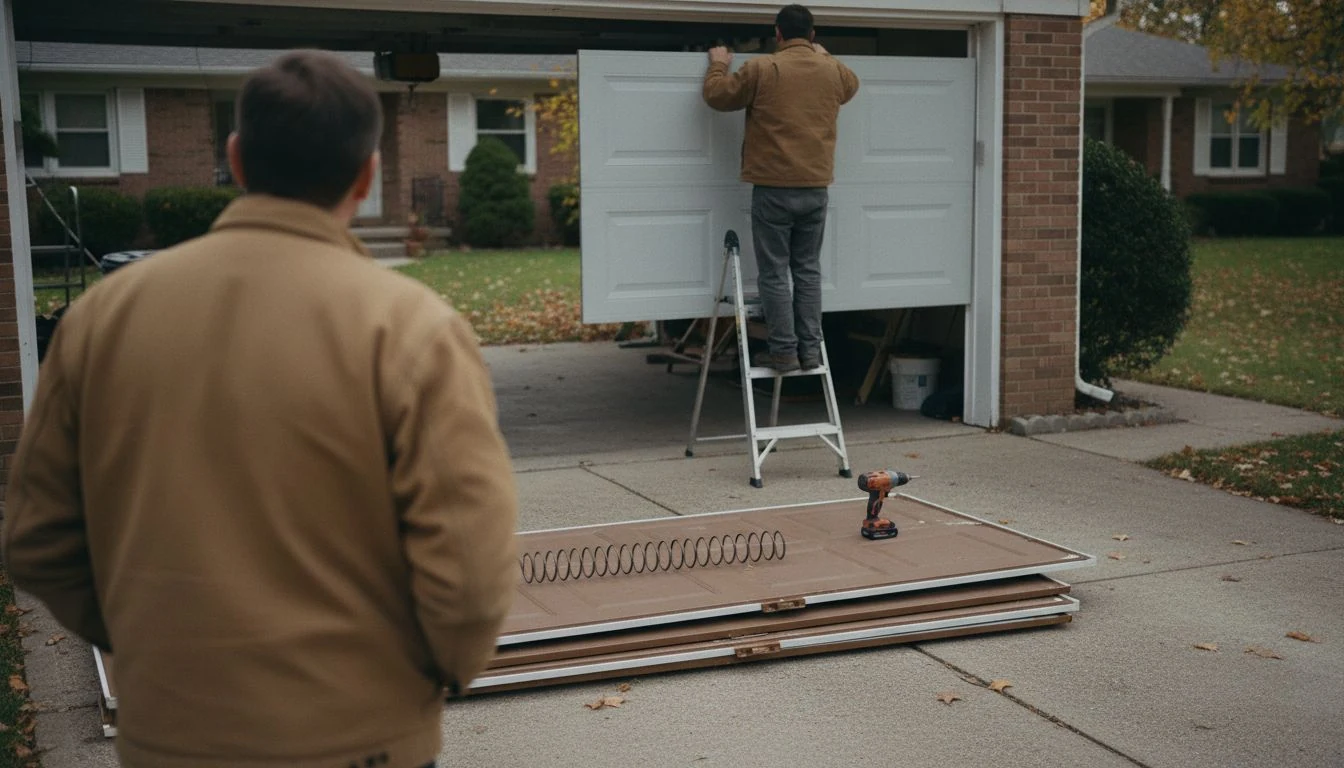
My husband backed the truck into our garage door on a Tuesday in March. Not hard. Just enough to fold the bottom panel in the middle like a bad taco, and just hard enough that the door started making a sound on the way up that I can only describe as a complaint.
I assumed we were buying a panel. One panel. We ended up buying the whole door, and no one had explained the reason to me before I was standing in the driveway with a contractor.
The cost to replace a garage door in 2026 runs about $750 to $2,200 installed for a single-car door and about $1,200 to $6,000 for a standard double, depending almost entirely on insulation and material. Most people replacing a builder-grade double door land somewhere near $2,400. The opener is a separate number, and so is hauling the old door away, and both of those surprised me.
This is the post I wanted before I made three phone calls. What each tier really costs, the math that tells you whether to repair the door you have instead, the spec that moves your price more than any other, and the one mistake I almost made that would have cost me an extra $1,100 for nothing. I have replaced exactly one garage door and read three written quotes line by line. I am not a licensed installer. The point of all of this is to help you talk to one without getting rolled.
Jump to what you need:
- What my three quotes actually said
- When the old door is worth saving
- What drives the cost to replace a garage door up
- Insulation is the spec that decides the rest
- The opener is a separate number, and a safety one
- Can you install a garage door yourself
- Cost to replace garage door: the 2026 tiers
- Frequently Asked Questions
What my three quotes actually said
Three companies, same 16 by 7 double door, same week. The spread was almost $1,900.
The first quote was $1,850 for a non-insulated steel door, installed, old door hauled off. The second was $2,690 for an insulated steel door with a vinyl backer, new tracks, and new rollers. The third was $4,400 for a carriage-style insulated door with decorative hardware and a new belt-drive opener rolled in.
All three were legitimate. None of them were quoting the same job. I did not understand that going in, and it is why comparing garage door prices over the phone is close to useless. I keep a longer version of how to read a spread like that in my guide to whether your contractor quote is fair, because this problem is not unique to garage doors.
What made the difference readable was asking each of them to write down four things: the R-value of the door, whether new tracks and springs were included, whether the old door removal was in the price, and whether the opener was new or reused. Once those four lines existed on paper, the $1,850 and the $2,690 stopped looking like two prices for the same thing. They were not.
When the old door is worth saving
The rule I landed on after living through it is boring. Repair if the door is under about 15 years old, the panels are straight, and the failure is a part. Replace if the door is older than that, or if more than one section is bent, or if you are already paying for hardware.
Parts are cheap compared to doors. A broken torsion spring runs roughly $150 to $400 installed, which is the most common garage door failure there is, and I wrote the whole breakdown in my garage door spring replacement cost guide. Rollers are $100 to $250 for a full set. A single dented section is $250 to $800 depending on whether the manufacturer still makes your panel, which for a door older than about twelve years is a real coin flip.
That last part is what got us. Our door was a 1998 builder-grade steel double. Two shops told me the same thing without knowing each other: the panel existed, sort of, in a color that no longer matched, and it would run $620 by the time it was hung. We were also two winters away from the springs going.
The math I used was cold. If the repair costs more than about half of a basic new door, and the door is past fifteen years, you are buying time at a bad exchange rate. $620 against an $1,850 door on a 28-year-old opening was not close.
The flip side is real too, and installers will not volunteer it. If your door is eight years old and a spring snapped, you do not need a new door. You need a $250 spring. A company that answers “well, at that age, honestly” is selling.
What drives the cost to replace a garage door up
Six things move the number, roughly in order of how much they move it.
Size comes first. A double is not twice a single, but it is close. Single-car openings, usually 8 or 9 feet wide, sit at the bottom of every range, and 16-foot doubles sit at the top of the same tier.
Material is next, and it is where the tiers come from. Steel is the default and the value pick. Composite and faux-wood overlays step up. Real wood is its own universe, $4,000 to $10,000 and up for a double, and it wants staining every few years. Full-view aluminum and glass is the modern-house look and runs $4,000 to $9,000 installed.
Insulation gets its own section below, because it is where most of the upsell lives.
Then hardware: new tracks, new rollers, and correctly sized springs. On a door swap this is often $200 to $500, and it is the line most often missing from the cheap quote.
Windows add roughly $200 to $800 for a row. Carriage hardware, the handles and hinges that make a modern door look like it swings, adds $100 to $400 and does nothing but look good.
Removal is last and smallest. Hauling the old door away is $50 to $200, and it is a line item rather than a courtesy. Two of my three quotes included it. One did not, and had I gone with that one I would have found out on install day.
Insulation is the spec that decides the rest
Garage doors are sold by R-value, and the range is wider than people expect. A basic single-layer steel door is effectively R-0 to R-2. A two-layer door with polystyrene sits around R-6 to R-9. A three-layer polyurethane door gets to R-12 through R-18. The price gap between the bottom and the top of that range on a double door is roughly $700 to $1,400.
I almost made an expensive mistake right here. I had a quote in my hand for an R-16 insulated door and I was ready to sign it, because insulation sounds like the responsible choice and I am the person who reads the R-value on everything.
Our garage is detached. It is not heated, not cooled, has no living space above it, and shares no wall with the house. There is nothing on the other side of that door to keep warm. I was about to pay $1,100 extra to insulate a box that is already outside.
The question to answer first is what sits on the other side of that door.
- Attached garage with a bedroom or bonus room above it. Insulate. This is the case where you actually feel it, because that floor is cold in January and the garage is why.
- Attached garage, nothing above, shared wall with the house. Mid-tier is enough. R-6 to R-9 does the useful part, which is keeping the shared wall from being a heat sink.
- Detached garage you do not heat. Skip it. Buy the better hardware instead.
- Detached garage you use as a shop in winter. Insulate, and insulate the walls first, because the door is not your biggest leak.
One other thing insulation buys does not show up in the brochure, and it is the reason I would still consider it on an attached garage. A three-layer door is quieter by a wide margin. Ours is single-layer and I can hear it from the kitchen.
The opener is a separate number, and a safety one
Two of my three quotes assumed we were keeping our existing opener. That is normal and often correct, but there are two conditions on it that are worth knowing before you nod.
The first is weight. An insulated three-layer door is meaningfully heavier than the single-layer door it is replacing. The springs get re-sized for the new door as a matter of course, but a tired half-horsepower opener from the nineties pulling a heavier door is a machine you will replace within a couple of years anyway.
The second is safety, and this one is not optional. Automatic residential garage door operators manufactured for sale in the US on or after January 1, 1993 are required to have entrapment protection, which in practice means the photo-eye sensors mounted six inches off the floor on either side of the opening. The requirement lives in 16 CFR Part 1211, the federal safety standard for these openers. If your opener predates that and has no photo eyes, replacing the door is the moment to replace the opener too.
Budget $250 to $500 for a basic chain-drive installed, and $350 to $800 for a quieter belt-drive with a camera or app control. Ours was $410 and the quiet is worth more to me than the app.
Can you install a garage door yourself
You can. I did not, and I want to be specific about why, because I am usually the first person to tell you a job is more approachable than it looks.
The panels and the tracks are tedious but ordinary. The torsion spring is not. A torsion spring on a double door holds enough stored energy to break bones, and winding one requires the correct bars and a very specific procedure. This is the one job in my whole house where I stopped reading and picked up the phone.
If you want the middle path, some suppliers will sell you the door and let you handle the demolition and haul-away yourself, then send a crew for the install. That knocked about $150 off one of my quotes. Ask.
Labor alone, if you have the door already, tends to run $300 to $700 for a straightforward swap on an existing opening. Widening the opening itself is framing work and a different budget entirely, and it belongs in the same conversation as the rest of your home renovation costs.
Cost to replace garage door: the 2026 tiers
Every number below is installed, includes standard hardware, and assumes an existing opening in good shape. Find your row, then decide which direction insulation pushes you.
| Door type | Single (8-9 ft) | Double (16 ft) | Typical R-value |
|---|---|---|---|
| Single-layer steel, no insulation | $750 to $1,400 | $1,200 to $2,200 | R-0 to R-2 |
| Two-layer steel, polystyrene | $1,000 to $1,800 | $1,700 to $3,000 | R-6 to R-9 |
| Three-layer steel, polyurethane | $1,300 to $2,200 | $2,200 to $4,000 | R-12 to R-18 |
| Carriage-style composite or faux wood | $1,800 to $3,200 | $3,000 to $6,000 | Varies by core |
| Real wood, custom | $2,500 to $5,000 | $4,000 to $10,000+ | R-2 to R-6 |
| Full-view aluminum and glass | $2,400 to $4,500 | $4,000 to $9,000 | R-1 to R-6 |
| New opener, chain drive | $250 to $500 installed | n/a | |
| New opener, belt drive with app or camera | $350 to $800 installed | n/a | |
| New tracks, rollers, re-sized springs | $200 to $500 added | n/a | |
| Window row or decorative hardware | $100 to $800 added | n/a | |
| Old door removal and haul-away | $50 to $200 | n/a | |
| Labor only, you supply the door | $300 to $700 | n/a | |
What blows the budget
- Assuming the cheap quote includes hardware. The $1,850 door and the $2,690 door in my stack were separated mostly by tracks, rollers, and springs. A door hung on twenty-eight-year-old tracks is a door that binds. Ask which quote includes new hardware before you compare a single number.
- Buying insulation for a space that is already outside. R-value on a detached, unheated garage door does nothing for your energy bill. It is the single most common upsell in this category and it nearly took $1,100 off me. Decide what is on the other side of the door first.
- Forgetting the opener is a separate line. Two of my three quotes reused the existing opener, and neither one said so out loud. A heavier insulated door on an old half-horsepower unit is a second bill you have not budgeted for yet.
Before you call anyone, go measure and photograph. Width and height of the opening to the nearest inch, headroom above the opening, side room on both sides, and a photo of the label on the existing opener. Then ask all three companies for the same four written lines: R-value, hardware included or not, removal included or not, opener new or reused. Fifteen minutes of that turns three unrelated numbers into an actual comparison. The FTC’s guidance on avoiding home improvement scams is worth a read first if anyone is pushing you to sign the same day.
If the door itself is fine and it’s the motor that’s dying, you don’t need a whole new door. I priced that job separately in my garage door opener installation cost guide.
Frequently Asked Questions
How much does it cost to replace a garage door in 2026?
Expect $750 to $2,200 installed for a single-car door and $1,200 to $6,000 for a standard 16-foot double, with most builder-grade double replacements landing near $2,400. Material and insulation drive the spread more than anything else. Add $200 to $500 if new tracks, rollers, and re-sized springs are not already in the quote, and $50 to $200 for hauling the old door away.
Is it cheaper to repair a garage door than replace it?
Almost always in the short term, yes. A broken torsion spring runs $150 to $400 installed and a set of rollers is $100 to $250, against $1,200 and up for a new double door. The line I use: if the repair costs more than about half of a basic new door and the door is past fifteen years, replace it. A single replacement panel on an older door often runs $250 to $800 and may not match the color you have.
Do I need a new opener when I replace the garage door?
Not automatically, but check two things. If the new door is insulated it is heavier, and an aging half-horsepower opener will not last long pulling it. And if your opener has no photo-eye sensors near the floor, it predates the federal entrapment protection requirement in 16 CFR Part 1211 and should be replaced regardless. A new opener installed runs $250 to $800 depending on drive type.
If you are stacking this against everything else the house wants this year, the whole-house view lives in my home renovation cost guide, and the running numbers I keep updating are in the home improvement cost statistics roundup.
All prices here are 2026 estimates and vary by region, opening size, door weight and material, brand, and whether hardware, removal, and the opener are inside the quoted price. Tessa is a hands-on homeowner, not a licensed garage door installer or technician. Torsion springs store enough energy to cause serious injury and are not a DIY job. A door that has come off its tracks, a cable that has snapped, or an opener with no working safety reversal belongs to a licensed professional, in person. Use these ranges to ask sharper questions and to compare two written quotes against one written scope.
Free DIY Project Cost Estimator
The spreadsheet I use to price out a project before I start, so a weekend job never blows the budget. Join the newsletter and I’ll send it over.
No spam, ever. Unsubscribe anytime. — Tessa
Keep reading — more on Remodel & Renovation Costs
Whole House Humidifier Installation Cost (and Whether You Need One)
Last January the little hygrometer on my bookshelf read 21 percent. I’d bought it for $14…
Read article →
Gas Fireplace Installation Cost: Inserts, Built-Ins, and Venting
My sister Jen has a brick fireplace in her 1962 ranch that she has used exactly…
Read article →
Shower Remodel Cost: Refresh, Walk-In, and Full Tear-Out
My mom called me in August because the floor of her shower had started to flex.…
Read article →
Gas Line Installation Cost: For a Stove, Dryer, Fireplace, or Generator
For nine days last winter, a brand new gas range sat in the middle of our…
Read article →