
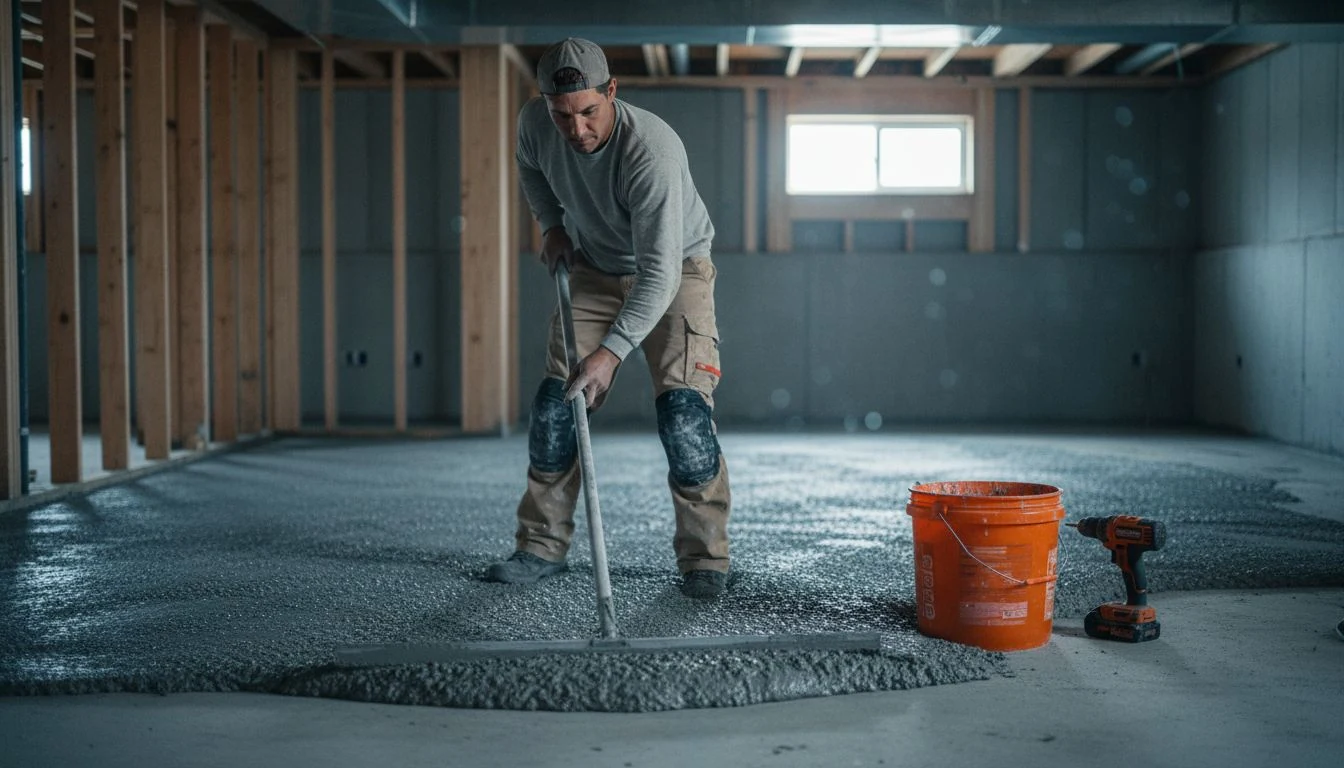
We pulled up the ruined carpet in the basement and there it was: a bare gray slab, dusty, stained from the water heater that let go before we bought the place, and sloping just enough toward the old floor drain that a marble would roll to it every time. My husband called it a problem. I called it a floor we did not have to buy, if we were willing to grind it, level the low corner, and finish it ourselves. That corner is where most of the money went, and nobody had warned me.
Concrete floor installation cost in 2026 runs about $2 to $30 per square foot installed, which is a huge spread because “concrete floor” covers everything from a rough new slab to a mirror-polished showroom finish. A new interior slab runs $4 to $8 a foot poured, and finishing an existing one, grinding, staining, sealing, or polishing, runs $3 to $12 on top. For a 400 square foot room, most people I know landed between $2,500 and $6,000 all in.
Jump to what you need:
- What concrete floor installation costs in 2026
- Cost by finish and job type
- The cost to level a concrete floor (the part that surprised me)
- New slab versus finishing what you have
- Why this is not a hardwood or tile quote
- What you can actually DIY
- What it costs you over ten years
- FAQ
What does concrete floor installation cost in 2026?
The honest band is $2 to $30 per square foot, and the reason it is so wide is that two completely different jobs share the name. Pouring a brand new slab is one thing. Turning a slab you already own into a finished floor is another. Most homeowners searching concrete floor installation cost want the second job and get quoted the first, or the other way around, and the numbers never line up.
Our basement room is 380 square feet. I got three quotes over about ten days in March. One shop wanted $3,900 to grind, patch, stain, and seal what we had. Another quoted $6,800 for a full mechanical polish with a densifier. A third, who I think misunderstood the job, came in at $11,000 to break out the old slab and pour fresh. Same room. Same three people standing on the same gray floor.
Labor is usually 40 to 60 percent of a concrete finishing bill, and the biggest hidden slice is surface prep, the grinding, patching, and crack repair that has to happen before any stain or coating goes down. When a bid comes in low, prep is almost always what got trimmed. That is also why a cheap epoxy floor peels in a year.
Concrete floor installation cost by finish and job type
Here is the table I built in my notes while the quotes came in, corrected afterward by what two neighbors paid on their own basements the same spring.
| Job | Installed per sq ft (2026 est.) | 400 sq ft room | Lasts |
|---|---|---|---|
| Clean, patch and seal existing slab | $2 to $5 | $800 to $2,000 | 3 to 7 yrs |
| Acid or water-based stain and seal | $3 to $8 | $1,200 to $3,200 | 5 to 10 yrs |
| Epoxy or polyaspartic coating with flake | $3 to $12 | $1,200 to $4,800 | 10 to 20 yrs |
| Ground and polished concrete | $4 to $12 | $1,600 to $4,800 | 20 yrs plus |
| Micro-topping or overlay over old slab | $5 to $15 | $2,000 to $6,000 | 10 to 20 yrs |
| Stamped concrete overlay | $8 to $20 | $3,200 to $8,000 | 15 to 25 yrs |
| New poured interior slab, unfinished | $4 to $8 | $1,600 to $3,200 | 50 yrs plus |
| New slab poured and finished | $8 to $18 | $3,200 to $7,200 | 50 yrs plus |
Two rows are worth a flag. Polished concrete looks like the premium pick and it nearly is, because it is the actual slab ground and hardened rather than a coating sitting on top, so there is no film to peel. Epoxy is the row people underbudget, because a $3 quote and a $12 quote are both called epoxy and one is a roller-and-a-kit garage job while the other is a moisture-tested, self-leveling, chip-broadcast system that will outlive the roller job four times over.
My mistake early on was reading the per-foot number and stopping there. Multiply it out for your actual room before you rank anything. The gap between a stain and a polish read like $4 a foot in my head, which sounds like nothing, and $1,500 across our room, which is a real decision.
The cost to level a concrete floor (the part that surprised me)
This is the line that was on none of my first quotes and ended up being the single biggest variable in the job, so I am giving it its own section.
A concrete floor that slopes, dips, or has a high spot has to be brought flat before almost any finish goes down, and the cost to level a concrete floor runs $2 to $8 per square foot for self-leveling compound, or $500 to $1,500 as a spot fix for grinding down a few high spots. If the slab has actually settled and dropped, mudjacking or foam jacking to raise it runs $3 to $12 per square foot of the affected area, which climbs fast.
| Leveling method | Cost (2026 est.) | Best for |
|---|---|---|
| Grinding down high spots | $1 to $3 per sq ft, or $300 to $800 spot | Small bumps, trowel ridges, old adhesive |
| Self-leveling underlayment | $2 to $8 per sq ft | Gentle dips and slopes under a new finish |
| Patching compound (spot repair) | $30 to $120 in materials, DIY | A few shallow low spots you do yourself |
| Mudjacking a settled slab | $3 to $12 per sq ft affected | A slab section that has dropped and cracked |
| Polyurethane foam jacking | $7 to $25 per sq ft affected | Faster, lighter lift, tighter access |
Our low corner took about four bags of self-leveling compound and a morning, roughly $180 in materials because I did it myself, and it would have been closer to $900 on a contractor’s line. Here is the part I would staple to every quote: ask the contractor to measure the slope with a level and a long straightedge before they price the finish, and get the leveling written as its own line. A floor that is out by half an inch across ten feet is invisible until the polisher hits it and skips the low spots, and then it is a change order.
New slab versus finishing what you already have
The cheapest good concrete floor is almost always the slab you already own. Finishing existing concrete, grinding, staining, sealing, or polishing, keeps the slab, the sub-base, and the vapor barrier you already paid for, and it runs a fraction of a fresh pour with finish.
You only need a new slab in specific cases: there is no slab yet, like a new addition or a garage conversion with a dirt or gravel floor, or the existing slab is so badly cracked, heaved, or contaminated that finishing it is throwing good money after bad. A new interior slab means excavation, a compacted base, a vapor barrier, sometimes rigid foam and wire or rebar, then the pour and the cure. That is why an unfinished new slab at $4 to $8 a foot is a different animal from a $2 stain-and-seal.
One thing worth knowing before you finish a below-grade slab: concrete is porous, and a basement floor sits against soil. Moisture and radon both move through it, so a good installer moisture-tests the slab first and the vapor barrier under a new pour is not optional. The EPA’s guidance on radon-resistant construction basics covers why the barrier and a sealed slab matter below grade, and it is a five-minute read that changed how I thought about sealing ours.
Why this is not a hardwood or tile quote
I nearly filed concrete next to the other flooring quotes in my head and treated it like a material you install on top of a floor. It is not. Concrete usually is the floor, and the trade is different.
Hardwood, laminate, vinyl plank, tile, and carpet all get fastened or glued down over a subfloor, and the labor is carpentry and setting. A concrete floor is flatwork and finishing: grinding, chemistry, sealing, sometimes a pour. The crews are different, the failure modes are different, and the money goes to different places. If it turns out you actually want something on top of the slab, you want what vinyl plank flooring costs to install, which is a common basement choice over concrete, or what tile installation costs if you are tiling over the slab. For a warmer feel, hardwood floor installation cost lays out that route, though hardwood over a basement slab needs its own moisture strategy.
And if it is a whole basement you are working through, not just the floor, the floor is one line in a much bigger number. It is worth seeing it beside what it costs to finish a basement so the floor decision fits the budget instead of eating it. When a bid comes back and you cannot tell whether it is fair, run it through how to tell if a contractor quote is fair. The FTC’s page on avoiding home improvement scams is worth reading before you hand anyone a deposit, especially the part about never paying in full up front.
What you can actually DIY on a concrete floor
More than I expected, and less than the YouTube tutorials imply.
You can absolutely clean, patch small cracks, spot-level a low area with a bag of self-leveling compound, and roll on a stain and a sealer. That is a real weekend or two, it runs $150 to $600 in materials on a 400 foot room, and on a sound slab it can be all you need. I did our staining and sealing myself after practicing on a scrap corner behind the furnace. Good thing I did, because my first sealer pass went on too heavy and dried cloudy, and I would much rather have learned that in the corner nobody sees.
What I would not DIY is a mechanical polish or a real epoxy system. Polishing needs a rented planetary grinder and a feel for how hard to hit each pass, and the swirl marks from a bad pass do not come out. A proper epoxy floor needs moisture testing, exact mixing, and a working time measured in minutes across the whole room at once, and if you stop to answer the door you get a lap line forever. A 400 square foot floor is not where you learn either skill.
The split that saved us real money: I ground the old adhesive off, did all the patching and the corner leveling, and cleaned the slab spotless, then paid a pro only for the stain application and the densifier. Doing the prep myself, which is the labor-heavy, low-skill part, knocked roughly $700 off the quote.
What a concrete floor actually costs you over ten years
An installation quote is a one-day number, and it hides the resealing cycle completely. This is the table I wish someone had put in front of me in March, because it changed which finish I picked.
| Path (400 sq ft) | Up front (2026 est.) | Reseal cycle | Rough 10-yr total |
|---|---|---|---|
| Stain and seal only | $1,200 to $3,200 | Reseal every 2 to 4 yrs | $2,400 to $6,500 |
| DIY kit epoxy | $300 to $900 | Often redone by yr 3 to 5 | $900 to $2,700 |
| Pro epoxy or polyaspartic | $1,200 to $4,800 | Rarely inside 10 yrs | $1,200 to $5,200 |
| Ground and polished concrete | $1,600 to $4,800 | Reburnish once, if ever | $1,800 to $5,200 |
| Micro-topping or overlay | $2,000 to $6,000 | Reseal every 3 to 5 yrs | $2,800 to $8,000 |
Look at the DIY kit epoxy row against the polished row. The kit looks like the bargain, and up front it is, but the honest ten-year line often lands close to a polish that never needs redoing, because most kit floors get stripped and redone once or twice as they wear at the door and under chair legs. Polished concrete stops looking expensive around year six. That is the whole argument for it, and it is not in any product box.
What blows the concrete floor budget
- Leveling that was never in the bid. A slope or a low spot has to be flattened before a finish goes down, and it is the line low bids leave off. Ask every contractor to measure the slab with a straightedge and write leveling as its own line. Our surprise was a settled corner, and it would have been a $900 change order if I had not caught it in the walkthrough.
- Skipping the moisture test on a below-grade slab. Basement and slab-on-grade floors pull moisture from the soil, and a coating over a wet slab bubbles and peels no matter how good the product is. A calcium chloride or RH test costs little and is the difference between a floor that lasts and one you redo. Insist on it before any epoxy or overlay.
- Calling a stain a polish, or a kit a system. The words are used loosely by the people selling the job, and a $3 epoxy and a $12 epoxy are not the same floor. Get the exact process written down, grit steps for a polish, number of coats and whether moisture is tested for an epoxy, before you compare two numbers that only look alike.
If the concrete floor is one line in a bigger project year, it helps to see it beside what home renovations cost in 2026, and if you are finishing outdoor concrete rather than an interior room, what pool deck resurfacing costs covers the same chemistry in the sun.
Grab my free Project Cost Estimator. Before you take a single concrete floor quote, fill in your square footage, whether the slab is level or slopes, whether it is below grade, and how much grinding and patching you are willing to do yourself. It is the same one-page sheet that showed me a $3,900 bid and a $6,800 bid were not remotely the same job.
Frequently Asked Questions
How much does it cost to install a concrete floor?
Budget $2 to $30 per square foot installed in 2026, depending on whether you are finishing an existing slab or pouring a new one. Finishing what you have, a stain and seal, an epoxy coating, or a mechanical polish, runs $2 to $15 a foot. A new interior slab runs $4 to $8 a foot unfinished and $8 to $18 poured and finished. Concrete floor installation cost also depends heavily on leveling and crack repair, which are usually billed on top of the per-foot price.
How much does it cost to level a concrete floor?
Plan on $2 to $8 per square foot for self-leveling underlayment, or $300 to $800 as a spot fix to grind down a few high spots. If the slab has actually settled and dropped, raising it with mudjacking runs $3 to $12 per square foot of the affected area and foam jacking runs more. Get leveling written as its own line on any quote, because it is the most common surprise on a concrete floor job.
Is polished concrete cheaper than epoxy?
Up front they overlap, roughly $4 to $12 a foot for a pro polish against $3 to $12 for a real epoxy system. Over ten years polished concrete usually wins, because it is the slab itself hardened rather than a coating on top, so there is no film to peel or reapply. A cheap DIY epoxy kit is the lowest number of all at first and often the most expensive by year ten, because it gets stripped and redone as it wears.
All prices here are 2026 estimates and vary by region, room size, slab condition and level, whether the floor is below grade, access, and local labor rates. Tessa is a hands-on homeowner, not a licensed contractor or concrete professional; use these ranges to ask sharper questions and always confirm figures, moisture testing, and permit requirements with local pros and your building department.
Free DIY Project Cost Estimator
The spreadsheet I use to price out a project before I start, so a weekend job never blows the budget. Join the newsletter and I’ll send it over.
No spam, ever. Unsubscribe anytime. — Tessa
Keep reading — more on Flooring & Tile Costs
How Much Does Epoxy Floor Installation Cost in 2026? (I Paid Twice)
The kit came in a box with a picture of a showroom floor on it. I…
Read article →
How Much Does Carpet Installation Cost in 2026? (By Room, Fiber + DIY vs. Pro)
Three installers walked my upstairs hallway with the same laser measure, wrote down the same 620…
Read article →
How Much Does Laminate Flooring Installation Cost in 2026?
The first quote I got for laminate in my hallway and two bedrooms was $4,900, and…
Read article →
How Much Does Vinyl Plank Flooring Installation Cost in 2026? (Real Prices)
Vinyl plank flooring installation cost in 2026 runs $3 to $7 per sq ft installed. See…
Read article →