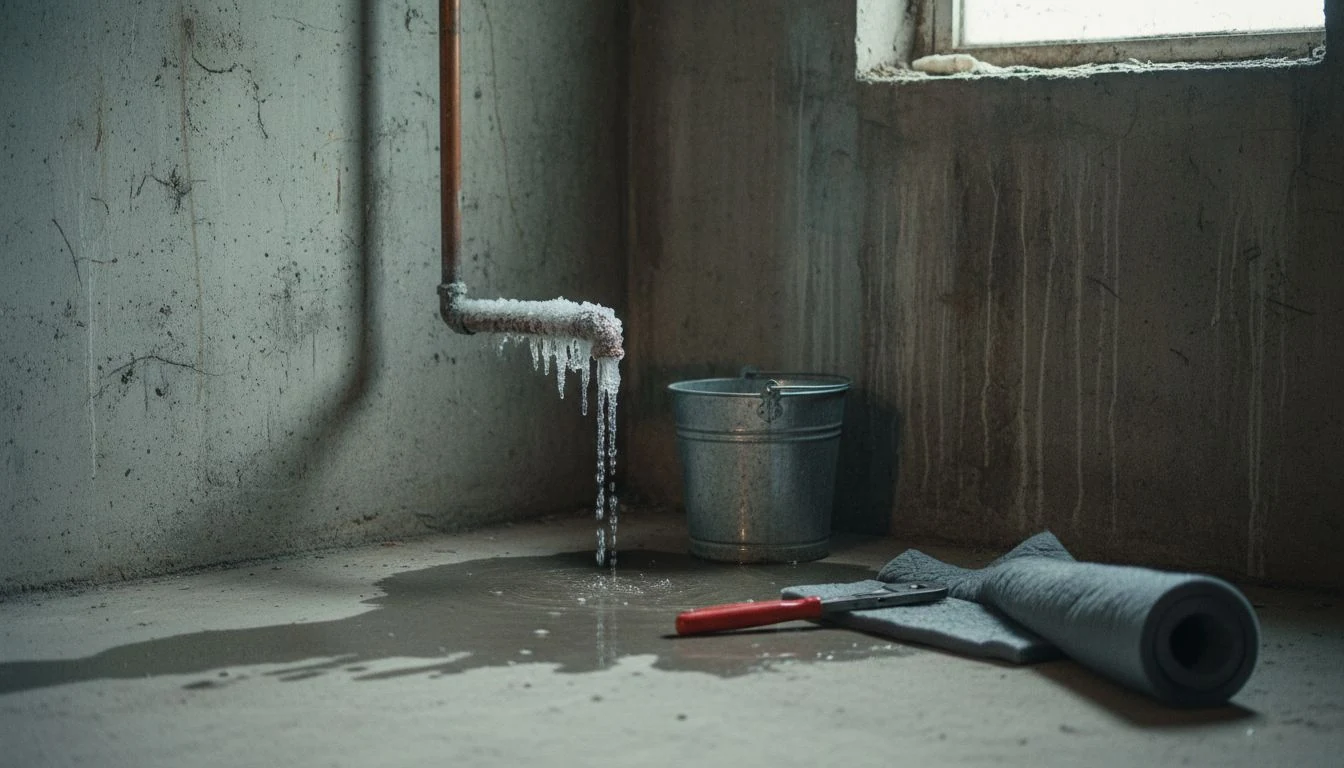
It was 6:40 a.m. last January, minus 8 degrees outside, and nothing came out of my kitchen faucet. Not a drip. The bathroom sink worked fine, so I stood there in my coat with the coffee pot in one hand trying to figure out why one tap would freeze and the other wouldn’t.
The answer was an exterior wall, and the final frozen pipe repair cost for that morning was $670: $225 for an emergency plumber to thaw it, $185 to cut out a cracked section, and $260 to patch the drywall later. That’s on the cheap end. Nationally, thawing a pipe usually runs about $100 to $500, repairing a small crack about $200 to $1,000, and a burst pipe inside a wall with water damage can go well past $5,000.
I’m Tessa. I rent, my landlord paid most of this bill, and I’d still like to never do it again. Here’s what each piece cost, what you can safely do yourself before the plumber shows up, and the $40 of prevention I’ve done every fall since.
My frozen pipe morning, step by step
My kitchen sink sits on the north wall of the duplex. Under the cabinet, the hot and cold lines run up through the floor about four inches from the outside wall, with almost no insulation behind them. On the coldest night of the year, the cold line froze somewhere between the floor and the valve.
I did three things right and one thing wrong. Right: I opened the faucet and left it open, I opened the cabinet doors to let warm air in, and I called my landlord before calling anyone else. Wrong: I pointed a hair dryer at the pipe for 40 minutes without checking whether it had already cracked.
It had. When the plumber thawed the rest of the line and the pressure came back, a hairline split about two inches long started spraying the back of the cabinet. He shut off the main in about ten seconds. I’d have taken a lot longer, because I didn’t know where the main was.
Go find your main shutoff today. I’ll wait. Mine is behind a panel in the laundry closet that I’d never opened.
What to do the moment a pipe freezes
The American Red Cross frozen pipes guide is the clearest version I’ve found. If only a trickle comes out of a faucet, suspect a frozen pipe. Keep the faucet open so water can move as the ice melts, and apply heat to the pipe with an electric heating pad, a hair dryer, a space heater kept away from anything that burns, or towels soaked in hot water.
The Red Cross is blunt about what not to use: no blowtorch, no kerosene or propane heater, no charcoal stove, no open flame of any kind. And if you can’t find the frozen spot, can’t reach it, or can’t thaw it, call a licensed plumber.
My additions, learned the hard way: know where your main shutoff is before you start, keep a towel and a bucket under the pipe, and check every other faucet in the house. The Red Cross says that if one pipe freezes, others may too.
Frozen pipe vs. burst pipe: why the bill jumps
A frozen pipe that thaws without cracking costs you a service call. A pipe that cracks or bursts costs you a repair plus whatever the water touched, and that second part is where people get hurt.
Water expands as it freezes. The Red Cross puts it this way: expanding water can break pipes no matter how strong the container. The split often doesn’t show until the ice melts and the pressure comes back, which is why a pipe can look fine while frozen and start spraying an hour after you “fixed” it.
How big can the damage get? The Insurance Information Institute’s homeowners insurance facts page lists “water damage and freezing” as one category, with an average claim of $15,400 across 2019 to 2023. That number includes all kinds of water damage, not only frozen pipes, but it tells you what happens when water runs inside walls and ceilings for a few hours.
My split was in an open cabinet, caught in seconds. My downstairs neighbor wasn’t so lucky two winters ago. Her garage line burst while she was away, and her repair bill ran into the thousands before insurance.
What goes into a frozen pipe repair cost
Every frozen pipe bill I’ve seen, mine, my neighbor’s and two my coworker collected, broke down into the same few pieces.
The service call. Plumbers charge more for nights, weekends and cold snaps, because that’s when everyone’s pipes freeze at once. A regular visit might be $100 to $250. My 7 a.m. call on a frigid weekday was $225 with the first half hour included. After-hours emergency rates can run $300 to $500 before any work starts.
Thawing. If the pipe is accessible, thawing is often covered by the service call or adds an hour of labor. Pipes inside a wall or ceiling may need a small opening or a pipe thawing machine, which costs more.
The repair. A small split in an exposed copper or PEX pipe can be cut out and replaced with a short piece and two fittings. Mine was about two feet of PEX and two push-fit connectors, $185. Repairs inside walls, or several cracked sections, can run $500 to $1,500.
Walls and ceilings. Any opening has to be patched. My cabinet back wall patch was $260 including paint. If you need it, my drywall repair cost guide has the ranges.
Water cleanup. This is the big unknown. Wet drywall, insulation and flooring need drying or removal, and a water mitigation company can charge $1,000 to $5,000 or more for a single room. Call your insurer before the cleanup crew if the damage is big.
The cheap prevention I do every fall
The Red Cross list is my checklist now. Before cold weather: drain and store hoses, close the inside valve to each outdoor spigot and open the outside tap so it can drain, insulate pipes in unheated spaces like basements, crawl spaces, attics, garages and under-sink cabinets on exterior walls.
During a cold snap: open cabinet doors on exterior walls, let the cold water drip from faucets fed by exposed pipes, and keep the thermostat at the same temperature day and night. If you’re leaving town, the Red Cross says to keep the heat on and set no lower than 55 degrees.
What it costs me: foam pipe sleeves at about $2 to $5 per 6-foot piece, $12 of them under the kitchen sink. A $9 foam spigot cover for the outdoor faucet. That’s it, plus remembering to open the cabinet the night the forecast drops below 10. If your outdoor faucet drips after a freeze, my leaky outdoor faucet fix walks through the repair, and my winterize your house checklist has the rest of the fall list.
Heat tape for frozen pipes: worth it?
Heat tape, sometimes called heat cable, is an electric cable you run along a pipe that warms it in freezing weather. Many kits have a built-in thermostat that turns on only when the pipe gets cold. A kit for a few feet of pipe costs about $30 to $80. Having a plumber or electrician install it, especially on longer runs or in a crawl space, can cost $150 to $400.
It makes sense for a pipe you can’t keep warm any other way: a line in a crawl space, a garage, or a mobile home skirt. The Red Cross says to use UL-listed heat tape, heat cable or similar products. I’d add: follow the manufacturer’s instructions exactly, plug it into a GFCI outlet, and don’t wrap a cable over itself unless the instructions say that model allows it. Heat tape that’s old, cracked or installed wrong is a fire risk.
My kitchen pipe didn’t need it. Sleeves and an open cabinet door were enough. My neighbor’s garage line got heat tape after her flood, and it has held through two winters.
Who pays when a pipe freezes in a rental?
This depends on your lease and your state, so read yours. In my case, the lease says the landlord handles plumbing repairs unless I caused the problem. I hadn’t, but I’d also never been told to drip faucets or open cabinets, so we split the difference: he paid the plumber and the patch, I paid for the sleeves and spigot cover.
My renter’s insurance covers my stuff, not the building. If water had soaked my rug and couch, I’d have filed. Homeowners usually call their own insurer for big water damage. Either way, take photos before anything gets cleaned up.
Frozen pipe repair cost by situation, 2026 estimates
These ranges come from my own bill, my neighbor’s, two my coworker collected and the line items plumbers broke out when we asked.
| Situation | Typical cost | What’s usually included |
|---|---|---|
| Thaw only, exposed pipe, no damage | $100 to $400 | Service call, up to an hour of thawing |
| After-hours or emergency thaw | $250 to $600 | Higher service call rate, thawing |
| Small crack, exposed pipe | $200 to $600 | Cut out section, new pipe and fittings |
| Burst pipe inside a wall or ceiling | $500 to $1,500 | Opening, repair, basic patch |
| Water damage cleanup, one room | $1,000 to $5,000+ | Extraction, drying, removing wet drywall or flooring |
| Heat tape, pro installed | $150 to $400 | Cable, thermostat, GFCI check |
| Foam sleeves and spigot covers, DIY | $15 to $60 | Materials for a typical home |
What blows the frozen pipe budget
- Not knowing where the main shutoff is. Every minute a split pipe sprays costs more than the plumber. Find the valve this weekend and make sure it turns.
- Thawing without watching for a crack. Keep the faucet open, a bucket under the pipe, and your hand near the shutoff when pressure comes back.
- Leaving town with the heat turned way down. The Red Cross minimum is 55 degrees. A few dollars of gas is cheaper than a week of water running inside a wall.
Grab my free Project Cost Estimator. Use one column for each plumber or mitigation company and fill in service call, thaw, repair, wall patch, cleanup and prevention. The empty boxes are the “we’ll see once it’s open” charges. It’s the sheet I handed my landlord the week after.
The cheapest fix on this whole page is the one you do in October. I wrapped 38 feet of crawl space pipe for about sixty dollars, and I wrote up how I insulate pipes before the first hard freeze.
Frequently Asked Questions
How much does it cost to fix a frozen pipe?
In 2026, thawing a frozen pipe usually costs about $100 to $500, depending on time of day and access. Fixing a small crack in an exposed pipe runs about $200 to $600, and a burst pipe inside a wall is often $500 to $1,500 before water cleanup. My own bill was $670 total, with the drywall patch.
Will a frozen pipe thaw on its own?
Sometimes, once temperatures rise. But it may crack while frozen and start leaking as it thaws, so keep the faucet open, watch the pipe, and know where the shutoff is. The Red Cross recommends safe heat sources and calling a licensed plumber if you can’t find or reach the frozen section.
Does homeowners insurance cover frozen pipes?
Many policies cover sudden damage from a burst pipe, but coverage varies and some insurers deny claims if the home wasn’t kept heated. Read your policy and call your insurer. Renter’s insurance usually covers your belongings, not the building’s pipes.
All prices are 2026 estimates from four bills and quotes plus plumbers’ itemized lines, and they vary by region, time of day, pipe material and location, and the extent of water damage. Tessa is a hands-on renter and DIYer, not a licensed plumber or insurance professional. Call a licensed plumber for repairs and your insurer or landlord about coverage.
Free DIY Project Cost Estimator
The spreadsheet I use to price out a project before I start, so a weekend job never blows the budget. Join the newsletter and I’ll send it over.
No spam, ever. Unsubscribe anytime. — Tessa
Keep reading — more on Remodel & Renovation Costs
Pest Control Cost in 2026: What Each Plan and Bug Really Costs
The ants showed up the second week of May, a neat little line from the window…
Read article →
Bathtub Replacement Cost: What My 3 Quotes Taught Me (2026)
Our upstairs tub had a crack running from the drain toward the front wall, about the…
Read article →
Chimney Cap Installation Cost (and Why a Missing One Costs More Later)
It started with a sound behind the living room wall. Scratching, then quiet, then scratching again,…
Read article →
Gutter Guard Installation Cost: Mesh, Screen, and Foam Compared
My mom has two big maple trees, and every October they drop what looks like the…
Read article →