
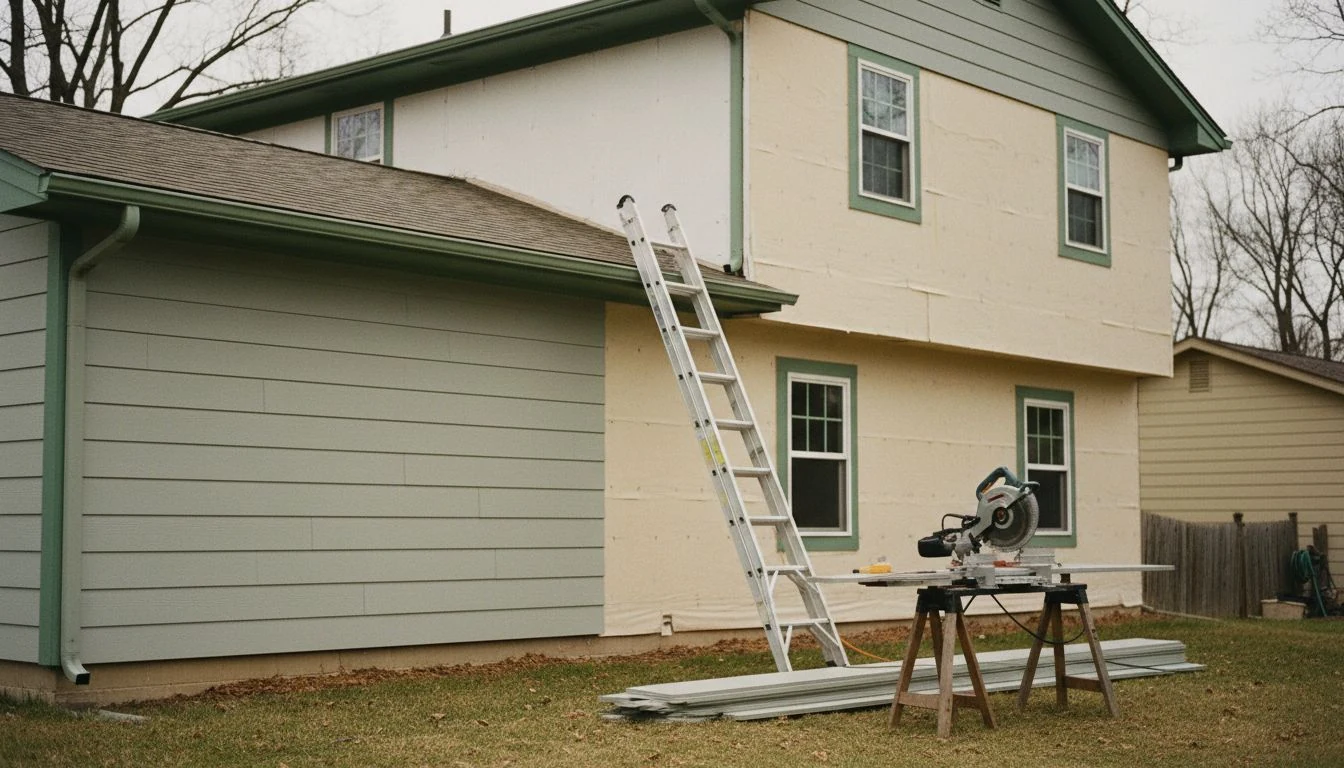
My neighbor Dana got three siding quotes last spring and they came back at $9,200, $16,800, and $31,000. Same house. Same walls. She called me half-panicked, sure that somebody was either lowballing her into a disaster or robbing her blind. The truth was messier than either: one guy quoted vinyl, one quoted fiber cement, and one quoted fiber cement plus a full tear-off, new house wrap, and rotted-sheathing repair he’d baked into the lump sum without itemizing a thing. That spread is the entire reason I sat down and pulled the whole siding replacement cost apart, line by line.
Here’s the short version before we get into the tables. The siding replacement cost in 2026 runs about $4 to $14 per square foot installed, depending almost entirely on the material you pick. For a typical 2,000-square-foot house you’re usually looking at $9,000 to $16,000 all in, with vinyl landing near the bottom and fiber cement like James Hardie near the top. The siding boards themselves aren’t what break the bank. What actually moves your siding replacement cost is the material, whether the old siding has to come off, how many corners and stories and windows your house has, and what a contractor quietly folds into that one big number.
How much does siding replacement cost in 2026?
As of mid-2026, replacing the siding on an average single-family home runs roughly $9,000 to $16,000 for a standard job, materials and labor together. The single fastest way to sanity-check any quote is to ignore the total for a second and think in dollars per square foot, because that’s how the crews actually price the work. Here’s the range by tier.
| Tier | What you get | 2026 installed cost (per sq ft) |
|---|---|---|
| Budget | Standard vinyl, straightforward one-story box, siding goes over or after a simple tear-off | $4 to $7 |
| Mid-range (most jobs) | Thick insulated vinyl or engineered wood, full tear-off, new house wrap, standard trim | $7 to $11 |
| Premium | Fiber cement (Hardie), real wood, or steel; two stories; lots of corners and detail | $11 to $18+ |
Those are estimates, and they swing with your region, your home’s shape, and what’s hiding under the old siding. One thing to know up front so no quote confuses you: siding is priced by your exterior wall area, not your floor area. A 2,000-square-foot house often has somewhere between 1,800 and 2,500 square feet of actual wall to cover once you subtract windows and doors and add gables. When a contractor says “squares,” one square equals 100 square feet of wall. That vocabulary alone will keep you from feeling lost in the estimate.
Siding replacement cost by material
Material is the biggest lever on the whole job, bigger than labor, bigger than your zip code. This is where Dana’s $9k-versus-$16k gap actually came from, and it’s the first question you should pin down before you compare any two quotes. Here’s what each common material runs installed in 2026.
| Material | Installed cost (per sq ft) | Typical 2,000 sq ft home | Worth knowing |
|---|---|---|---|
| Vinyl | $4 to $12 | $8,000 to $16,000 | Cheapest, lowest maintenance, most common. Insulated vinyl costs more but helps energy bills. |
| Engineered wood (LP SmartSide) | $5 to $12 | $10,000 to $16,000 | Wood look, lighter and cheaper than fiber cement, DIY-friendlier. |
| Fiber cement (James Hardie) | $8 to $18 | $14,000 to $30,000 | Durable, fire-resistant, big resale draw. Heavy, needs a pro. The premium favorite. |
| Wood (cedar, etc.) | $7 to $16 | $12,000 to $24,000 | Beautiful, but needs repainting or staining every few years. |
| Steel / metal | $8 to $16 | $13,000 to $24,000 | Tough and modern; dents are the trade-off. |
| Stucco | $7 to $14 | $12,000 to $22,000 | Regional; labor-heavy and climate-dependent. |
My honest take for most people on a real budget: standard or insulated vinyl does the job and does it cheaply, and there is zero shame in it. I have vinyl on my own house. But if you’re planning to sell in the next few years, fiber cement is the one that shows up in listing photos and appraiser notes, and it tends to earn back a strong chunk of its cost at resale. Pick the material for how long you’ll stay, not for the Pinterest board.
Siding replacement cost by home size
Once you know your material’s per-foot rate, home size does the rest of the math. Bigger walls mean more material and more labor hours, plainly. Here’s roughly where the total lands for standard mid-range siding by house size, so you can gut-check whether a quote is even in the right universe.
| Home size | Approx. wall area | Vinyl total | Fiber cement total |
|---|---|---|---|
| 1,000 sq ft (small ranch) | ~1,000 sq ft | $5,000 to $9,000 | $9,000 to $15,000 |
| 1,500 sq ft | ~1,500 sq ft | $7,000 to $12,000 | $12,000 to $22,000 |
| 2,000 sq ft (average) | ~2,000 sq ft | $8,000 to $16,000 | $14,000 to $28,000 |
| 2,500+ sq ft (two-story) | ~2,600 sq ft | $11,000 to $20,000 | $18,000 to $35,000 |
Notice the two-story jump, because it’s the single biggest swing in siding replacement cost after material. It isn’t just more square footage. It’s scaffolding, more time on ladders, and a slower, more careful crew, and that labor premium is real and fair. Don’t fight a contractor on it. Fight them on the stuff below instead.
What actually drives your siding quote up
Two houses of the same size can quote thousands apart, and it’s rarely because one guy is greedy. It’s these factors, and knowing them is how you tell a fair premium from a padded one.
- Tear-off and disposal. Removing and hauling the old siding adds roughly $1,000 to $3,000. Sometimes crews go over the old material to skip this, but on a real replacement I’d want it off so they can see the sheathing underneath.
- Rotted or damaged sheathing. This is the wildcard. Nobody knows what’s behind the old siding until it’s off, and rotted plywood underneath can add $1,000 to $5,000. A good contractor flags this as a possibility upfront and gives you a per-sheet repair rate instead of a surprise.
- House wrap and trim. New weather-resistive barrier, plus trim around windows, doors, and corners, is standard on a quality job. It should be a line item, not a mystery.
- Corners, gables, and stories. Every corner and peak is more cuts and more waste. A simple square box is cheap; a Victorian with dormers is not.
When Dana and I laid her three quotes side by side, the $31,000 one wasn’t a scam at all. It was fiber cement, a full tear-off, and $2,800 of sheathing repair the inspector had actually found. The problem was he’d hidden all of it inside one number, so it looked insane next to the vinyl quote. Itemized, it made sense. That’s the whole game: make them itemize.
Can you DIY siding, or should you hire out?
I’ll be straight with you, because I’m not a licensed contractor and I won’t pretend siding is a casual weekend project. It mostly isn’t. Full-house siding involves working at height, cutting and flashing correctly so water can’t get behind it, and a mistake here doesn’t chip a wall, it rots your house from the inside over a few quiet years. Vinyl on a single-story ranch is the one scenario where a genuinely handy person with a helper can pull it off and save the labor half of the cost.
Where DIY makes real sense is the small stuff: replacing a few cracked vinyl panels, patching one damaged section, repainting wood or fiber cement instead of replacing it. Those I’ve done and I’d cheer you on. But a two-story fiber cement job? The boards are heavy, brittle, and full of silica dust you should not be breathing without proper protection. That one I hire out every time, and I don’t feel one bit bad about it. Knowing what to hand off is its own kind of handy.
The add-ons that hide in a siding quote
This is the section I wish someone had handed Dana before she panicked. Beyond the siding itself, here are the extras that ride along on almost every quote, what they roughly run in 2026, and whether they’re usually worth it. Treat every one of these as a line item you’re allowed to question.
| Add-on | Typical 2026 cost | Tessa’s take |
|---|---|---|
| House wrap / weather barrier | $0.50 to $1 per sq ft | Non-negotiable. Skipping it is how water gets behind your walls. |
| Insulated backing (foam) | $1 to $2 per sq ft | Worth it in cold climates; helps energy bills and dampens noise. |
| Trim & fascia replacement | $2 to $6 per linear ft | Do it now while walls are open. Redoing it later costs double. |
| Sheathing repair | $40 to $100 per sheet | Only pay for what they actually find. Ask for photos. |
| Old siding disposal | $500 to $2,000 | Fair. Just make sure it’s listed, not buried in the total. |
What blows the siding budget
- Accepting a single lump-sum number. If tear-off, wrap, trim, and possible sheathing repair aren’t broken out, you can’t compare quotes and you can’t catch padding. Demand the itemized version.
- Discovering rot after work starts. The one true surprise in siding is what’s under the old boards. Get a written per-sheet repair rate before day one so a bad wall doesn’t become a blank check.
- Upgrading material mid-project. Falling for fiber cement or a designer color after the vinyl quote is signed can quietly double your bill. Decide the material before you sign, not after.
How to save on siding replacement without cutting corners
You don’t lower a siding replacement cost by buying flimsier siding. You lower it by being a smart, organized buyer. Here’s what actually moves the number in your favor.
Get at least three quotes, and hand each contractor the exact same scope so you’re comparing apples to apples. Book in the off-season if you can. Late fall and winter are slower for siding crews in most of the country, and a slow crew sharpens its pencil. Choose standard vinyl or engineered wood over fiber cement if resale isn’t your near-term goal, since that single choice can cut the total in half. And if your home was built before 1978, know that siding work can disturb lead paint, so a properly certified crew and safe removal aren’t upsells, they’re the law under the EPA’s Renovation, Repair and Painting Rule. If insulation is part of your motivation, ENERGY STAR’s guidance on recommended insulation levels is worth a read before you pay extra for insulated backing you may not need in your climate.
One more that saved Dana about $1,400: she asked each contractor to separate the sheathing-repair rate from the base quote, then chose the one who was most honest about the “we won’t know until it’s open” reality instead of the one who pretended the walls were perfect. Honesty about the unknowns is the single best signal you’re dealing with a pro, not a closer.
Grab my free Project Cost Estimator. Before you call a single contractor, plug your home’s size and material into my printable estimator so you walk into every siding quote already knowing your own fair range. It’s the same one-page sheet I used to help Dana untangle her three bids.
Frequently Asked Questions
How much does it cost to replace siding on a 2,000 sq ft house?
In 2026, expect roughly $8,000 to $16,000 for vinyl and $14,000 to $28,000 for fiber cement on an average 2,000-square-foot home, materials and labor included. The wide spread comes down to material choice, whether the old siding is torn off, and your home’s shape. Get three itemized quotes to find your real number.
Is it cheaper to repair or replace siding?
If damage is limited to a few panels or one wall, repair almost always wins, often for a few hundred dollars. Full replacement makes sense when siding is widely rotted, faded, or failing, or when you’re after a resale upgrade. When more than about a third of the siding is damaged, replacement usually costs less per square foot than patchwork.
What is the cheapest siding to install?
Standard vinyl is the cheapest common siding at about $4 to $7 per square foot installed. It’s low-maintenance and widely available, which is why it sits on more American homes than any other material. Engineered wood is the next step up if you want a wood look without fiber cement’s price and weight.
All prices here are 2026 estimates and vary by region, home condition, and contractor. Tessa is a hands-on homeowner, not a licensed contractor; use these ranges to ask smarter questions and always confirm figures with local pros.
Free DIY Project Cost Estimator
The spreadsheet I use to price out a project before I start, so a weekend job never blows the budget. Join the newsletter and I’ll send it over.
No spam, ever. Unsubscribe anytime. — Tessa
Keep reading — more on Exterior & Structural Costs

Gutter Cleaning Cost: What I Paid, and the Month It Stops Being Optional
Gutter cleaning cost in 2026 runs $120 to $425 for most houses. Real quote numbers, what…
Read article →
Foundation Repair Cost in 2026: The Crack That Matters and the One That Does Not
A man in a branded polo put a level against my basement wall, made a face…
Read article →
Roof Repair Cost in 2026: What It Costs by What Actually Broke
The stain showed up on the upstairs hallway ceiling the morning after a March storm, about…
Read article →
Garage Door Spring Replacement Cost in 2026 (and Why I Do Not DIY This One)
It sounded like a rifle going off in the garage at 6:40 on a Tuesday morning.…
Read article →