
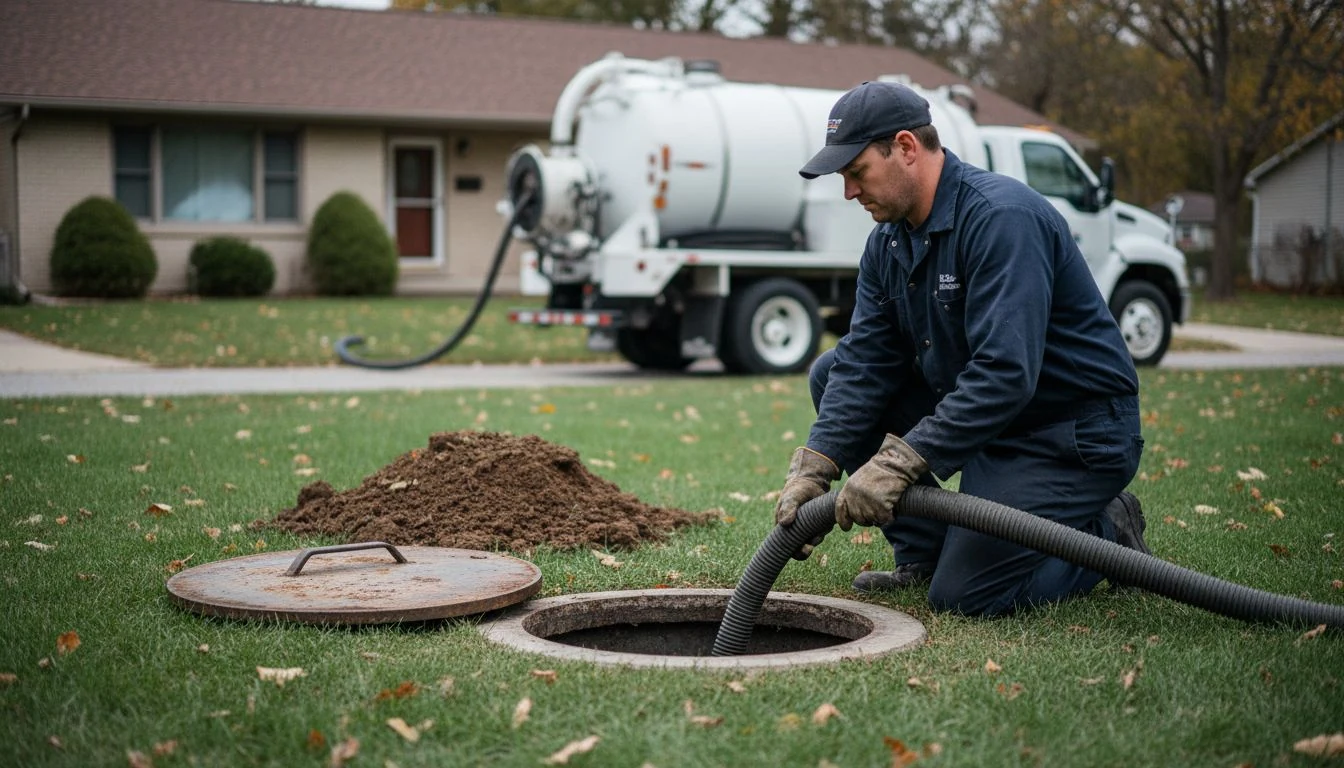
The man who sold us this house left exactly one useful thing behind: a napkin in the kitchen drawer with an X drawn on it and the words “tank, 14 paces from the back step.” I laughed at it for two years. Then I paid $180 to a crew with shovels because that napkin was off by about nine feet.
I grew up on city sewer. Everything I knew about septic servicing in 2024 was that it existed and that people made jokes about it. So when the postcard came saying we were due, I did what most people do, which is call the number on the postcard and hope.
Septic servicing in 2026 runs about $300 to $700 for a routine pump-out on a standard 1,000 to 1,500 gallon tank, and about $150 to $650 for an inspection, depending on whether it is a quick look or the full dye-test version a buyer’s lender wants. Most households land somewhere near $450 for the pump. The part nobody tells you is that those two things are separate line items, and plenty of homeowners pay for one thinking they got both.
This is the post I wanted before that first truck showed up. What each piece costs, how often you need it instead of how often the postcard says, the three numbers on your service report that prove the pump was necessary, and why the calendar between now and the first hard freeze matters more than any other stretch of the year. I am a homeowner who has now had this system pumped twice and read the paperwork both times. I am not a licensed septic contractor, and the whole point of what follows is to help you talk to one.
Jump to what you need:
- What septic servicing costs in 2026, line by line
- How often you actually need a pump
- The measurement that proves you needed the pump
- What a septic servicing visit includes, and what it does not
- Why fall is the septic servicing window
- The drainfield is the number all of this is protecting
- Skip the additives, and here is the EPA saying it plainly
- The three numbers that decide a septic servicing visit
- Frequently Asked Questions
What septic servicing costs in 2026, line by line
The pump is the cheap part. What got me was everything charged around it, and almost all of that is avoidable if you know about it before the truck is parked in your driveway.
$300 to $700 is a routine pump-out on a 1,000 to 1,500 gallon tank with an accessible lid. One truck, one guy, forty minutes. This is the number most people mean when they say septic servicing.
$600 to $1,000 covers a 2,000 gallon tank, a system that has not been touched in eight years, or a house at the end of a long gravel drive the truck has to work to reach. Volume and access, not greed.
$150 to $300 is an inspection on its own: lid off, levels measured, baffles checked, a look at the ground over the drainfield. $350 to $650 is the full version with a dye test and a written report, which is what shows up in a real estate transaction.
$50 to $250 is what they charge to find and dig up a buried lid. That is my $180. It is also the single most preventable line on the whole bill.
Installing risers, which are the plastic collars that bring the lid up to grade which puts the lid at ground level for good, runs about $300 to $700 each installed. I fought this one in my head for a while because it felt like paying to fix a non-problem. Then I did the math: two lids dug twice is roughly the cost of one riser, and the risers keep paying after that. We put one on the access lid last spring and the second pump-out cost us the flat rate and nothing else.
| Line item | Estimated 2026 range | When it lands on your bill |
|---|---|---|
| Routine pump-out, 1,000 to 1,500 gal | $300 to $700 | Every 3 to 5 years for most households |
| Pump-out, 2,000 gal or long overdue | $600 to $1,000 | Bigger tank, heavy sludge, hard truck access |
| Inspection only, visual and levels | $150 to $300 | EPA suggests at least every three years |
| Full inspection with dye test and report | $350 to $650 | Buying, selling, or refinancing the house |
| Locating and digging a buried lid | $50 to $250 | No riser, no map, no idea where it is |
| Riser and lid brought to grade, installed | $300 to $700 each | One time, then never dig again |
| Effluent filter cleaned or replaced | $0 to $300 | Often free with the pump, charged if replaced |
| Baffle or tee repair | $300 to $900 | Found during the inspection, not planned |
| Pump replacement, mound or aerobic system | $600 to $1,800 | Any system with a float switch and a motor |
| Annual contract, alternative systems | $200 to $500 per year | Required by many county permits |
| Emergency or after-hours call | Add $150 to $400 | Backup at 9pm on a Saturday |
Before you book anything, go find the lid. Walk out with the napkin, the plot plan, or the county permit record, and put a paver or a garden stake on the spot. Ten minutes of looking in daylight is worth $180 of somebody else’s shovel time, and you will want to know where it is anyway the day something goes wrong.
How often you actually need a pump
The EPA’s guidance is that a household septic system should be inspected at least every three years by a professional, and that household tanks are typically pumped every three to five years. Systems with electrical float switches, pumps or mechanical parts get looked at more often, generally once a year, which is why those service contracts exist.
Four things move that interval, and the EPA names them: household size, how much wastewater you generate, how much solid material is in it, and the size of your tank. Two people in a house with a 1,500 gallon tank are on a very different schedule than six people over a 1,000 gallon one.
So the postcard that shows up every 36 months is a marketing calendar, not a diagnosis. It might be right for your house. Mine was, roughly. But I would rather know than guess, and there is a way to know.
The measurement that proves you needed the pump
This is the part I wish somebody had told me before the first truck, and it is free.
When a septic professional opens your tank, they measure two layers: the scum floating on top and the sludge settled on the bottom. The EPA gives three thresholds for when a tank should be pumped. Your tank should be pumped if the bottom of the scum layer is within six inches of the bottom of the outlet, if the top of the sludge layer is within twelve inches of the outlet, or if more than 25 percent of the liquid depth is sludge and scum.
Those numbers belong on your service report. Ask for them. Write them down, because next time they tell you whether you are on a three-year cycle or a five-year one, and five-year cycles save real money over a decade of owning a house.
My honest confession: the first time, I did not ask. The truck came, the truck left, I paid, and I have no record of whether that tank needed anything at all. The second time I asked and the guy read the numbers off to me like it was the most normal request in the world, because it is. He also cleaned the effluent filter while he was in there and did not charge me for it.
If a company will not put those measurements in writing, that tells you something. It is the same instinct I wrote about in how to tell whether a contractor quote is fair: the people doing honest work are usually happy to show you the work.
What a septic servicing visit includes, and what it does not
A pump-out is a removal. A truck sucks the contents of the tank out and hauls it to a treatment facility. That is the whole job.
An inspection is a look. Scum and sludge levels, the condition of the inlet and outlet baffles or tees, whether the effluent filter is clogged, whether the tank is holding water where it should, and a walk over the drainfield checking for soggy ground or grass that is suspiciously greener in a stripe.
Plenty of good companies do both in the same visit and price it as one number. Plenty do not. Ask which one you are buying before they arrive, because “we pumped it” and “we checked it” are different sentences, and only one of them catches a failing baffle at $300 instead of finding it later attached to a much larger problem.
What is not included, anywhere, ever: fixing your drainfield. Nobody pumps a drainfield back to health.
Why fall is the septic servicing window
Two reasons, and neither is a sales pitch.
The first is dirt. If your lid is buried and it needs digging, doing that in October is a shovel and twenty minutes. Doing it in January in a northern state is a pick, a heat lamp, or a no. Frozen ground turns a routine visit into a scheduling problem, and if you have a backup in February you do not get to choose the day.
The second is the calendar every septic company runs on. Autumn is when the calls come in, and the good outfits book out. I called in mid-September once and got a date eleven days later, which was fine because nothing was wrong. If something had been wrong, eleven days would not have been fine.
September has one more thing going for it. The EPA runs SepticSmart Week, and the 2026 dates are September 14 through 18. It is the third week of September every year, it is in its fourteenth year, and local health departments and county programs often hang free workshops, records help, and occasional inspection vouchers off it. Worth ten minutes on your county’s website before you book.
The drainfield is the number all of this is protecting
The $450 pump is protecting a much bigger number.
Solids that stay in the tank too long get pushed out to the drainfield, where they clog the soil that is supposed to do the actual treating. Once that soil is clogged, it does not un-clog. A replacement drainfield is commonly a $5,000 to $20,000 job, and a full system replacement runs $10,000 to $35,000 depending on soil, permits, and whether your county requires an engineered alternative system on your lot.
That is the math. Somewhere between $300 and $700 every few years, or five figures once. It is the same shape as the argument I made about foundation repair cost, where the cheap thing you do on schedule is the thing that keeps you out of the expensive category entirely.
The EPA is also blunt about what you should not do to a drainfield: do not drive or park on it, do not build on it, and do not pave it. Compacted soil crushes the pipes, and concrete and asphalt cut off the evaporation and the oxygen the soil bacteria need. Our previous owner parked a trailer over ours for at least one summer. I think about that more than I would like to.
Skip the additives, and here is the EPA saying it plainly
There is an entire aisle of bottles and monthly-subscription pouches promising to eat your sludge, extend your pumping interval, and save your drainfield. The EPA’s own answer to whether additives are recommended is a one-word no, on the grounds that a septic tank already contains a significant population of bacteria, enzymes, yeasts and fungi, and that additive products can be ineffective or actively harm the system and the environment.
I bought one. It was $28 and it did nothing I could measure, which is the problem with the whole category: there is no outcome you can see. Put the $28 toward the riser.
What does help, according to the EPA’s guidance on caring for a septic system, is boring and free. Use water efficiently, because everything you send down a pipe ends up in that tank, and one running toilet can add as much as 200 gallons a day. Flush human waste and toilet paper, nothing else. Wipes are not flushable, whatever the package says. Grease, coffee grounds, cat litter and paint thinner belong somewhere other than your tank. If your water heater is the next thing on the list, the numbers for that live in my guide to water heater replacement cost.
The three numbers that decide a septic servicing visit
Print this, or screenshot it, and have it open when the tech is standing over the open lid. These are the EPA’s thresholds, translated into what you should say out loud.
| What gets measured | The threshold that means pump it | What to ask for |
|---|---|---|
| Scum layer, floating on top | Bottom of the scum is within 6 inches of the bottom of the outlet | The measurement in inches, written on the report |
| Sludge layer, settled on the bottom | Top of the sludge is within 12 inches of the outlet | The measurement in inches, written on the report |
| Combined share of the tank | More than 25 percent of the liquid depth is sludge and scum | The percentage, so you can set the next interval |
| Inlet and outlet baffles or tees | Cracked, missing, or corroded | A photo, and a price before they fix it |
| Effluent filter | Clogged | Whether cleaning it was included or billed |
| Ground over the drainfield | Soggy, smelly, or a stripe of greener grass | Where they looked, and what they saw |
What blows the septic servicing budget
- Not knowing where the lid is. It is the $180 I paid, and it repeats every single visit until somebody installs a riser. Find it once, mark it, and the charge disappears forever.
- Letting it go until something backs up. An emergency call adds $150 to $400 on its own, and the reason you are calling at 9pm is usually a problem that a $150 inspection would have named in daylight for a fraction of the price.
- Approving repairs at the tank, standing in the yard. A cracked baffle is a real repair and a fair one, but it is also the easiest place to be upsold. Ask for a photo and a written price, then decide indoors, the same way you would with any other trade.
Frequently Asked Questions
How much does septic servicing cost for a routine pump-out?
Plan on $300 to $700 in 2026 for a standard 1,000 to 1,500 gallon tank with an accessible lid, with most households near $450. A 2,000 gallon tank, a system that has gone eight years, or a house the truck has to fight to reach pushes it to $600 to $1,000. Digging up a buried lid adds $50 to $250 on top.
Is an inspection included when they pump the tank?
Sometimes, and you have to ask which you are buying. A pump-out is removal; an inspection is measuring the scum and sludge layers, checking the baffles and filter, and walking the drainfield. Many companies bundle them into one price, and many bill the inspection separately at $150 to $300. Get it clear on the phone, not in the driveway.
Do septic tank additives let you pump less often?
No. The EPA does not recommend additives, because the tank already has the bacteria and enzymes it needs, and the products can be ineffective or harmful to the system and the environment. Nothing in a bottle changes your pumping interval. Household size, water use, solids and tank size do, and the measured scum and sludge levels are what tell you where you stand.
If you are lining this up against everything else the house wants this year, the whole-house view sits in my home renovation cost guide, and the running numbers I keep updating live in the home improvement cost statistics roundup.
All prices here are 2026 estimates and vary by region, tank size and design, how long it has been since the last service, truck access, local disposal fees, and whether your system is conventional or an engineered alternative with pumps and floats. Tessa is a hands-on homeowner, not a licensed septic contractor, installer, or inspector. Nothing here is an inspection of your system. Sewage backing up into the house, standing effluent in the yard, or a system your county has flagged belongs to a licensed professional and your local health department, in person. Use these ranges to ask sharper questions and to compare two written quotes against one written scope.
Free DIY Project Cost Estimator
The spreadsheet I use to price out a project before I start, so a weekend job never blows the budget. Join the newsletter and I’ll send it over.
No spam, ever. Unsubscribe anytime. — Tessa
Keep reading — more on Plumbing Costs
Water Softener Installation Cost: My $5,900 Quote vs. the $1,874 I Paid
The salesman set a clear glass of my tap water on the kitchen table, squeezed in…
Read article →
Garbage Disposal Replacement: The Job, the Cost, and When to Call
I found it with my sock. I stepped into the cabinet under the kitchen sink to…
Read article →
How Much Does a Water Heater Replacement Cost? (DIY vs. Hire)
Water heater replacement cost in 2026 runs $900 to $3,500 for a tank. Real prices by…
Read article →