
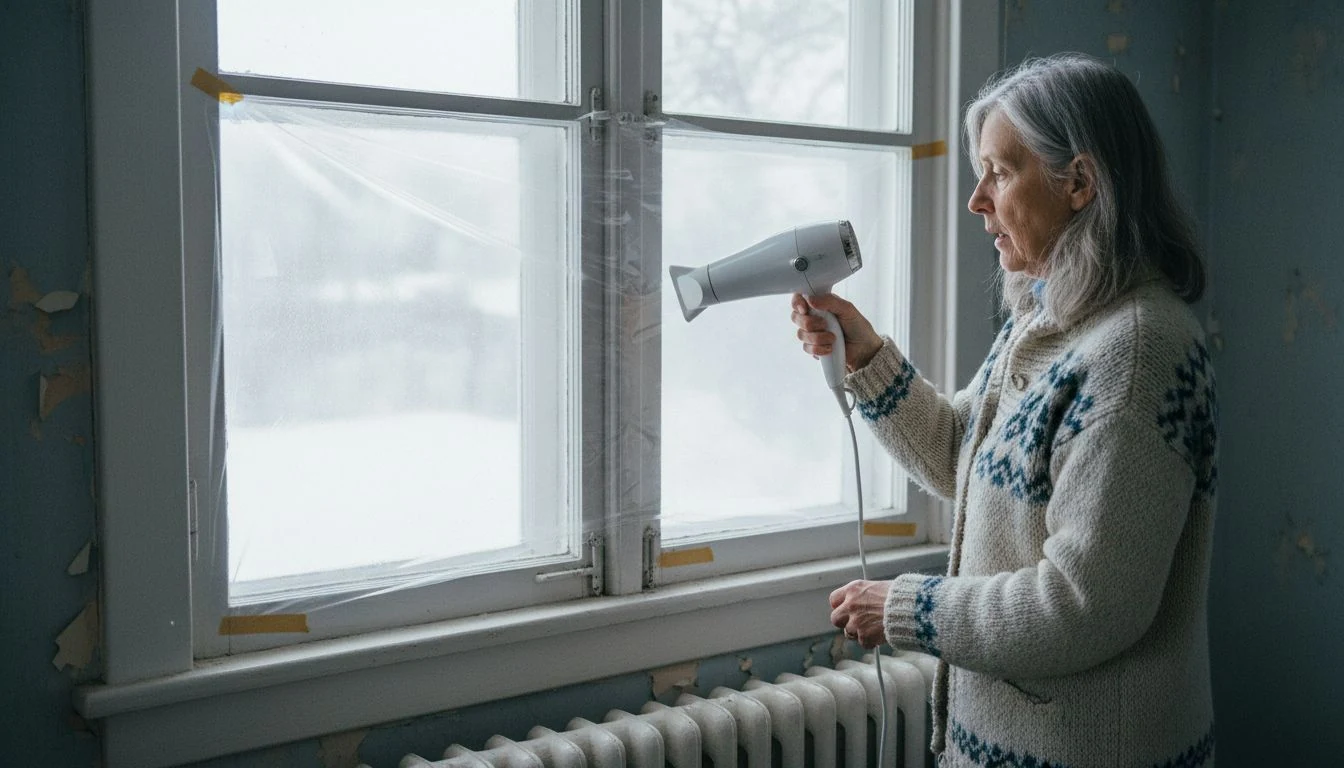
Last January I hung a thermometer on the sash of my bedroom window. It read 54 degrees. Three feet away, the radiator was going full blast and the room felt like someone had left a door open. A window company came out and quoted me $1,100 to replace that one window, then $16,000 for the house. I bought a $14 box of window insulation film instead and did the bedroom that night with my hair dryer.
The next morning the same spot read 63, and the curtains had stopped moving. That box won’t fix a rotten sash and it’s not a real replacement, but for $4 or so per window, it’s the best cold-room fix I’ve found in this house. I’ve now done 11 windows over two winters. I’ll tell you how I do it, what it can and can’t do, and where I went wrong the first time.
Quick answer: a shrink-film kit costs about $10 to $25, covers 3 to 5 average windows, takes 20 to 30 minutes each, and comes off in spring. Permanent low-e film is a different product that sticks to the glass, runs about $1 to $4 per square foot DIY or $6 to $15 installed, and stays up for years.
Two kinds of window insulation film, and which one you want
Shrink film is what I use. A sheet of clear plastic sticks to your window trim with double-sided tape, and a hair dryer pulls it tight like a drum. The plastic creates a still pocket of air and stops drafts from reaching the room. It’s seasonal. You peel it off in April and throw it out.
Low-e film goes right on the glass with water and a squeegee, the way you’d tint a car window. It reflects some heat back into the room. I tried it on one window. It looks better than plastic, and it helps some with sun in summer. But it doesn’t stop a single draft, because air coming through the sash doesn’t care what’s on the glass.
My window problem was air. If yours is too, go with shrink film. If you have tight modern windows and a sunny room that overheats in summer, low-e or sun-control film starts to make sense.
What you need for a window insulation film kit
- A kit sized for your windows. Measure first, since a 3-window kit from one store fits windows another brand won’t. I pay $10 to $25.
- A hair dryer. Any kind. Mine is from 2009.
- Scissors and a measuring tape.
- Rubbing alcohol and a rag for cleaning the trim.
- Extra double-sided tape, about $5. The roll in the kit runs out if you have big windows.
How to install window insulation film, step by step
- Lock the window, and take down curtains and blinds if they’re in the way.
- Clean the trim with alcohol and let it dry. Skip this and the tape lets go by Christmas. Ask me how I know.
- Stick tape along the top and both sides of the trim, about a quarter inch from the edge of the window. Press it down, then run tape along the bottom.
- Peel the backing off the top strip only. Cut your film a couple of inches larger than the window on all sides.
- Press the film to the top strip, let it hang, then work down the sides and bottom, peeling backing as you go. Don’t stress about wrinkles.
- Run the hair dryer on high, moving it around 3 or 4 inches from the plastic. Start at a corner. Wrinkles disappear in a minute or so.
- Trim the extra film with scissors or a sharp blade. Done.
Keep the hair dryer moving. On my second window I held it still in one spot to fight a stubborn wrinkle and melted a dime-size hole in it. I patched it with clear tape and it held all winter, but I’d rather you learn that from me.
Test for leaks with a stick of incense on a cold, windy day. Hold it near the edges. If the smoke bends, press the tape down again or add a strip.
Where I’d be careful with window film
Painted trim. Tape can pull paint off when you remove it. Mine is old paint on an old house, and I lost a few chips the first spring. Warm the tape with the hair dryer before you peel, slowly, and it comes off cleaner. If your house is pre-1978, assume the old paint could contain lead, and don’t scrape or sand any chips.
Bedroom exits. A taped-over window is harder to open in a fire. I leave one window in each bedroom film-free, or I at least make sure I could tear through it in a hurry. Do the same if there’s any chance someone would need that window to get out.
Double-pane glass and low-e film. Some window makers say certain films can void a warranty or stress the glass, because the film traps heat. Read your warranty before you stick anything to the glass. Shrink film attached to the trim doesn’t have this issue.
Pets. My cat learned the plastic makes a satisfying noise and put a claw through it the first week. You get to choose your battles.
How much does window insulation film save?
I can tell you what I measured, not what your bill will do. My gas bill fell about $18 a month the first winter, but I also did some air sealing and bled the radiators that year, so I can’t pin all of that on plastic.
The Department of Energy’s Energy Saver guide recommends a few things for older windows, including low-e film and storm windows, and says low-e exterior or interior storm windows can save 10% to 30% on heating and cooling costs, depending on what’s there now. That’s storm windows, a much pricier fix than a kit. A separate DOE study on window attachments from 2013 found that the combination of insulation and solar control matters, and several attachments gave little to no benefit in heating-dominated climates. So I’d stay skeptical of any “cut your bills by X” claim on the front of a box.
What I can say is that a cold room got warmer and I stopped sleeping in a hat. For $4 a window, I don’t need the math to be exact. If you can’t feel a draft anywhere, this is a lower priority than your attic. My attic insulation cost guide covers what that runs.
Window film vs. other fixes for drafty windows
I lined up everything I’ve priced for my drafty old double-hungs. Start at the top of this table and work down until the room feels right. For most of my windows, I never got past row two.
| Fix | Cost per window | Time | Stops drafts? | Lasts |
|---|---|---|---|---|
| Rope caulk | $1 to $3 | 10 min | Mostly | One season |
| Shrink film kit | $3 to $6 | 20 to 30 min | Yes | One season |
| Weatherstripping | $5 to $20 | 30 to 60 min | Mostly | Years |
| Permanent low-e film, DIY | $15 to $60 | 45 min | No | 10 or more years |
| Insulating cellular shade | $40 to $150 | 20 min | Partly | Years |
| Interior storm panel | $100 to $400 | 30 min | Yes | Decades |
| Full window replacement | $500 to $1,500+ | Half a day, pro | Yes | Decades |
The door gets the same treatment. If you’ve got cold air at floor level too, I walked through it in how to weatherstrip a door. And when a window’s frame is rotted or the sash won’t close, film just hides the problem. Price that out with my window replacement cost by region guide. The rest of my cold-weather list is in my winterize your house checklist.
What ruins a window film job
- Skipping the alcohol wipe. Dusty trim lets the tape peel off in the first cold snap, and you’ve lost the kit and the half hour you spent on it.
- Buying a kit without measuring. Tall windows and bay windows eat film fast, and a second box costs more than sizing up the first time.
- Using film to hide a bigger problem. Soft wood, water stains or condensation pouring down the glass need a fix, and plastic can hide that until spring.
Grab my free Project Cost Estimator. I list each window by room, what I did to it, and the thermometer reading before and after. By year two you’ll know exactly which ones to fix for good.
Frequently Asked Questions
Does window insulation film work?
It works best on older, drafty windows, where it stops moving air and adds a still layer in front of the glass. On tight, modern double-pane windows you’ll notice much less. Try one kit on your coldest room before buying for the whole house.
Can you open a window with insulation film on it?
Not with shrink film attached to the trim. You’d have to cut it. That’s why I leave at least one openable window in each bedroom and in any room where I’d want fresh air or a way out.
Can I reuse window insulation film next year?
No. Once the plastic is shrunk and peeled off, it’s done. A new kit runs about $10 to $25 and covers several windows. Permanent low-e film stays on for years, but it’s a different product that doesn’t stop drafts.
Prices and savings are 2026 estimates from my own receipts and store prices, and they vary by region, window size, climate and heating system. Follow the kit’s directions and check your window warranty first. Tessa is a hands-on homeowner and DIYer, not a licensed contractor or energy auditor. See my radiator guide if the cold spot is under the window, not in it.
Free DIY Project Cost Estimator
The spreadsheet I use to price out a project before I start, so a weekend job never blows the budget. Join the newsletter and I’ll send it over.
No spam, ever. Unsubscribe anytime. — Tessa
Keep reading — more on Seasonal Home Prep
How to Insulate Pipes Before the First Hard Freeze (Foam, Heat Cable, Costs)
The first winter in this house, I learned where my pipes ran by listening. There’s a…
Read article →
How to Winterize a House: The Checklist, and What Each Job Costs
The first house I owned taught me this lesson for $1,900. I left a garden hose…
Read article →