
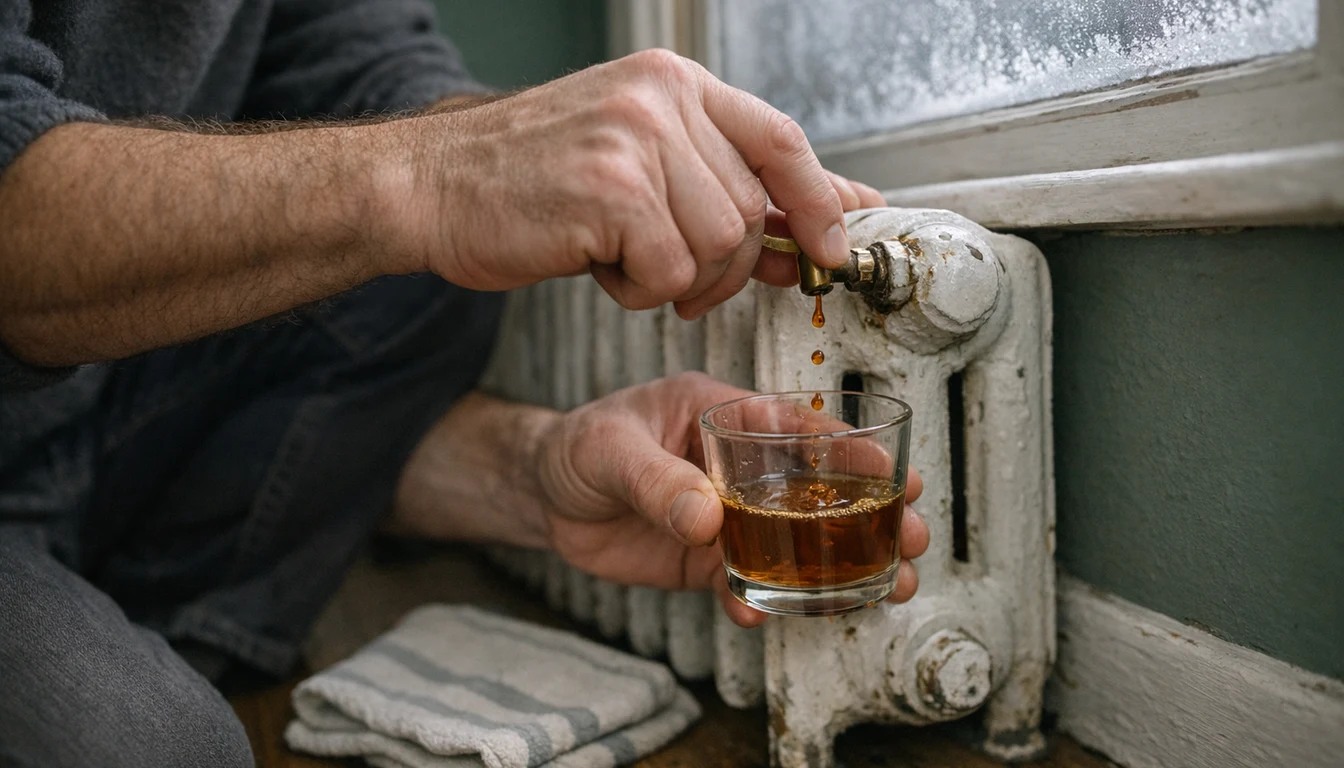
The radiator under my bedroom window was hot at the bottom and stone cold across the top. Every morning that first November in the house, I’d put my hand on it, feel the line where warm turned to cold, and go put on a second sweater. I assumed the boiler was dying. It wasn’t. The radiator was full of air.
Learning how to bleed a radiator took me one afternoon, a key that cost $4, and an old dish towel. I’ve done every radiator in the house twice since then, plus my neighbor Ruth’s baseboard heat. Below is the routine I use now, plus the cold spots bleeding can’t fix, so you don’t burn a Saturday on the wrong problem.
Short version: heat off, let it cool, open the little valve until it hisses and then drips water, close it, and check the boiler pressure when you’re done.
Signs your radiator needs bleeding
Air rises, so it collects at the top of the radiator. That’s why my bedroom one had that clean line, warm below and cold above. If you see that, it’s almost always air.
Other things I’ve noticed when a radiator has air in it:
- Gurgling or trickling sounds when the heat kicks on.
- One room never gets as warm as the rest, even with the thermostat turned up.
- The radiator takes much longer to warm up than the others.
If the radiator is cold at the bottom and warm at the top, that’s a different problem. I cover it further down, because bleeding won’t touch it.
First, check that you have hot water heat, not steam
Do this check before you touch a single valve. Bleeding is for hot water (hydronic) radiators. Steam radiators work differently, and you should not go opening valves on them.
How I tell them apart. A hot water radiator usually has a pipe going in on each end and a small square or slotted valve near the top of one side. That little valve is the bleeder. A steam radiator often has just one pipe at the bottom and a silver vent, about the size of a big thumb, sticking out the side partway up. That vent lets air out on its own while the system runs.
Also look at the boiler. A hot water boiler has a pressure gauge that reads in psi. A steam boiler has a glass sight tube showing the water level.
If you have steam and a radiator stays cold, the vent itself is often stuck or clogged. Replacement steam vents run about $15 to $40 each, and swapping one is a simple unscrew-and-screw job once the system is off and cool. But no bleed key. Steam can burn you badly.
What you need to bleed a radiator
My whole kit fits in a sandwich bag:
- A radiator bleed key, about $3 to $6 at any hardware store. Some valves take a flathead screwdriver instead, so look before you buy.
- An old towel or rag.
- A small cup or a yogurt container to catch the water.
- A flashlight if your radiators sit in dark corners like mine.
I bought two keys. One lives in the kitchen drawer, one lives taped to the side of the boiler. Keys disappear.
How to bleed a radiator, step by step
- Turn the heat off at the thermostat and give the system 30 minutes or more to cool. Hot water and a pump pushing it can spray, and the water inside is hot enough to hurt.
- Pick your order. I start downstairs at the radiator farthest from the boiler and work my way back toward it, then do the upstairs the same way. That’s the order an HVAC tech gave me the first winter, and it has worked every time.
- Fold the towel under the valve and hold the cup right below the opening.
- Fit the key into the valve and turn it counterclockwise slowly, about a quarter turn. You’ll hear a hiss. That’s the air.
- Wait. When the hissing stops and a steady stream of water comes out with no sputtering, turn the key clockwise to close it. Snug, not cranked. These are tiny brass parts and they strip.
- Wipe the valve dry and move to the next radiator.
- When you’ve done them all, check the pressure gauge on the boiler (see the next section), then turn the heat back on.
- Once the system is hot again, put your hand on each radiator top to bottom. Warm all the way up means you’re done.
My mistake the first time: I opened the valve a full turn, the little pin came almost all the way out, and I had a jet of rusty water hitting the wall. A quarter turn is plenty. If nothing happens, go another eighth.
The water that comes out is usually brown or black. That’s normal in an older system. It still stains, which is why I don’t skip the towel anymore.
Check the boiler pressure after you bleed
Letting air out of the system also lets a little water out, and that drops the pressure. On my boiler, the gauge sat at about 15 psi before and read closer to 11 after I bled six radiators.
Many residential hot water systems run somewhere around 12 to 15 psi when cold, but go by the label on your boiler or its manual, not by me. A lot of systems have an automatic fill valve that tops the water back up on its own. Mine does, and the needle crept back up within a few minutes.
If yours stays low, or keeps dropping over the next few days, that’s a call to a pro. Low pressure can starve the upstairs radiators, and a system that keeps losing pressure usually has a leak or a bad valve somewhere. If the gauge is reading high and close to the red, stop and call too.
How do you bleed baseboard radiators?
Ruth’s house has fin-tube baseboard heat, the long low metal covers along the walls. Hers had the same gurgle and one cold room, and the fix was almost the same, with one wrinkle.
Pop off the end cap of the baseboard cover, usually by lifting or pulling gently. Look for a small bleeder valve near the end of the pipe, often at a high point in the run. On hers it looked like a tiny brass nub with a slot. Same routine: heat off, cooled down, cup and towel, a slow quarter turn, close it when water comes out steady.
The wrinkle is that a lot of baseboard systems don’t have bleeders on each run. Instead, the air gets pushed out at the boiler through purge valves on the return pipe, using house water pressure. That job involves closing and opening several valves in the right order. I watched a tech do Ruth’s in about 40 minutes and decided it’s not my job. If you don’t see bleeders under the covers, that’s probably your setup.
When bleeding won’t fix the cold spot
I bled my upstairs bathroom radiator three times one December before I figured out it wasn’t air. How I sort it now:
Cold at the bottom, warm at the top: that’s usually sludge, the rust and grit that settles in old systems. Bleeding does nothing. The fix is a system flush, which I pay for.
The whole radiator is cold: check the valve at the bottom where the pipe comes in. Someone (me, in my case, while painting) may have turned it off. If it has a thermostatic head on top, make sure it isn’t set to the lowest number or stuck.
Only the upstairs radiators are cold: often low boiler pressure. Check the gauge first.
You need to bleed the same radiator every few weeks: air is getting in somewhere, or a part on the boiler that’s supposed to remove it has quit. That needs a service visit.
A radiator that leaks at the bleeder even when closed: the valve is worn. A new bleeder valve is cheap, a few dollars, but changing it means draining some water from the system, so I had the plumber do it during the yearly service.
Speaking of which, EPA’s page on carbon monoxide and indoor air recommends having a trained professional inspect and tune up central heating every year, since worn or poorly maintained boilers and furnaces are a carbon monoxide source. That’s the one heating job I never skip, and I keep a working CO alarm on each floor. If your boiler is old enough that the tech keeps finding new problems, my boiler replacement cost guide has the quotes I’d want to see before deciding.
Bleeding a radiator yourself vs. calling a pro, 2026 estimates
I can’t think of a cheaper heating fix. The prices below are what I’ve paid and what Ruth and I were quoted in our area this fall.
| Job | DIY cost | Pro, typical | Who should do it |
|---|---|---|---|
| Bleed hot water radiators | $3 to $6 for a key | $100 to $250 service call | You |
| Bleed baseboard with bleeders | $3 to $6 for a key | $100 to $250 service call | You |
| Purge a baseboard loop at the boiler | Not worth the risk for me | $150 to $300 | Pro |
| Replace a steam radiator vent | $15 to $40 per vent | $100 to $200 per visit plus parts | You, with system off and cool |
| Replace a leaking bleeder valve | A few dollars for the part | $125 to $250 | Pro, since it means draining water |
| Yearly boiler service and tune-up | Not DIY | $150 to $350 | Pro |
| Flush a sludged system | Not DIY | $300 to $800 | Pro |
What turns a free radiator fix into a repair bill
- Bleeding with the heat on. Hot water under pump pressure sprays, and the wall, the floor and your hand pay for it.
- Cranking the valve too far or too tight. A stripped or snapped bleeder pin turns a $4 job into a plumber visit.
- Ignoring the pressure gauge. Bleed six radiators, never check the boiler, and the upstairs goes cold again by morning.
Make it part of your fall routine
I bleed every radiator once in October before the first real cold snap, and again in January if anything starts gurgling. Ten radiators take me about an hour, including the walk to the boiler and back.
While I’m at it, I keep stuff off the radiators. The U.S. Fire Administration’s heating fire safety tips say to keep anything that can burn at least 3 feet from heat sources, radiators included. That’s my drying-laundry habit gone, sadly.
The rest of my cold-weather list, from hoses to gutters, lives in my winterize your house checklist. If your house still feels uneven after the radiators are all hot, the thermostat may be the weak link, and I priced that out in my thermostat installation cost post. And if you have a basement full of pipes, my frozen pipe repair cost guide is worth ten minutes before January.
Grab my free Project Cost Estimator. I list every radiator by room, write the date I bled it and the boiler pressure before and after. When the tech comes for the yearly service, I hand him the sheet and the visit goes faster.
Frequently Asked Questions
Should the heating be on or off when you bleed a radiator?
Off, and cooled down for at least 30 minutes. Some people bleed with the system warm so they can feel which radiators are cold, but the water can be very hot and the pump pushes it out fast. I check for cold spots first, then turn the heat off and wait.
How long does it take to bleed a radiator?
Usually under a minute per radiator once the valve is open. The air hisses out for a few seconds, then water comes out and you close it. A whole house with eight to ten radiators takes me about an hour, including checking the boiler pressure.
How often should I bleed my radiators?
Once a year before heating season is a good habit, plus any time you notice a cold top or gurgling. If one radiator needs it every few weeks, something is letting air into the system, and that’s worth a service call.
All prices are 2026 estimates from my own receipts and local quotes, and they vary by region, system type and the age and condition of your boiler. Follow your boiler manufacturer’s instructions for pressure settings. Tessa is a hands-on homeowner and DIYer, not a licensed plumber or heating contractor.
Free DIY Project Cost Estimator
The spreadsheet I use to price out a project before I start, so a weekend job never blows the budget. Join the newsletter and I’ll send it over.
No spam, ever. Unsubscribe anytime. — Tessa
Keep reading — more on Easy DIY & Repairs
How to Weatherstrip a Door (Front, Back, and Garage)
I found the draft with a dollar bill. Closed it in my back door last November,…
Read article →
Water Heater Flush: How to Do It Yourself (and What a Plumber Charges)
The first winter in this house, the water heater in my basement started making a noise…
Read article →
Mini Split Maintenance: The DIY Checklist and What a Pro Charges
The smell showed up first. Our mini split lives in the room over the garage, the…
Read article →
How to Patch a Drywall Hole (The Three Sizes, and the One You Should Not DIY)
The doorknob went through the hallway wall on a Tuesday, and I want to be honest…
Read article →