
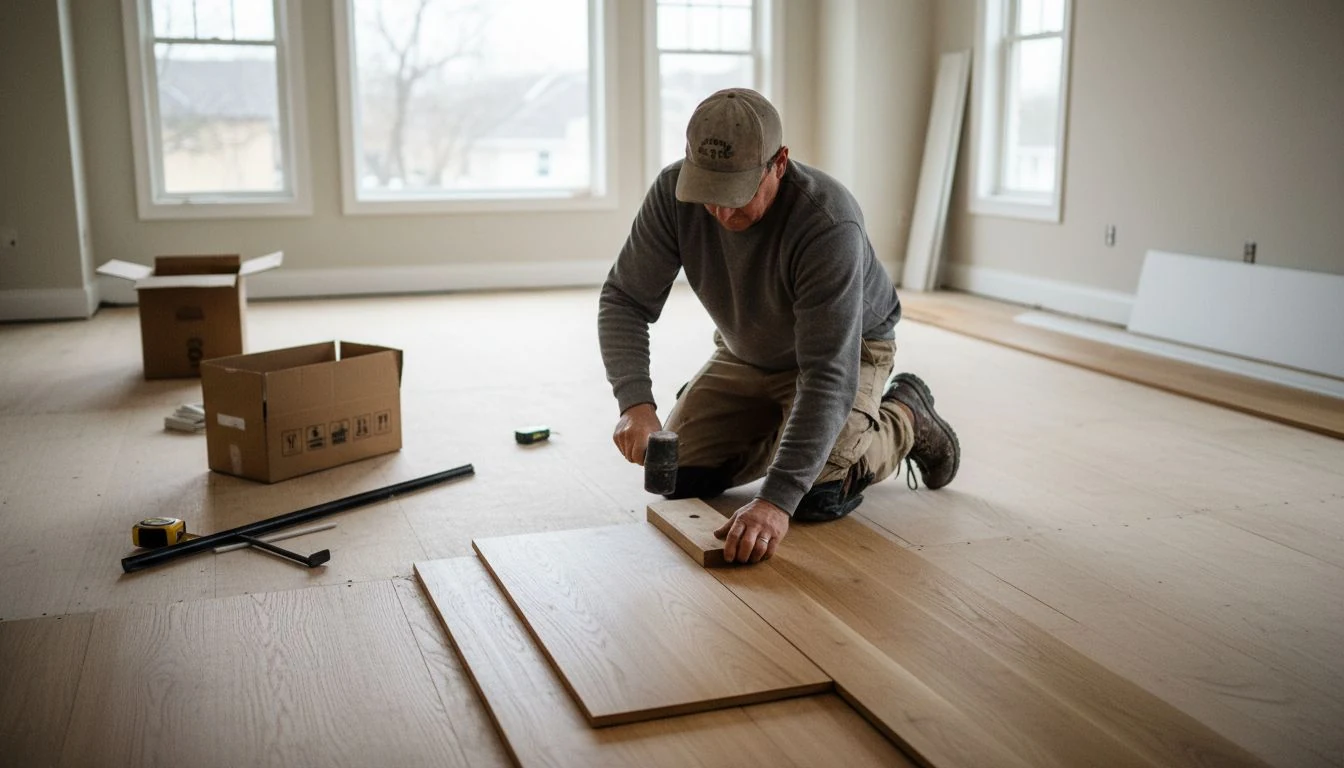
I bought the engineered white oak before I ever checked whether my floor was flat. Eleven boxes, acclimating in the dining room for a week while I felt very organized about the whole thing. Then the installer laid a straightedge across my hallway and I watched his face change. That dip cost me $540 in self-leveling compound and a lost day.
It also taught me the thing nobody puts in the brochure. The cost to install engineered hardwood comes down to which of the three installation methods your house lets you use, plus whatever your subfloor is hiding under the carpet. The wood itself is the part you get to choose.
If what you want is solid versus engineered, which one costs more and which one belongs in your house, I compared them head to head in my guide to hardwood floor installation cost. This post assumes you already picked engineered. Now we are talking about getting it down.
Jump to what you need:
- What it costs in 2026
- Cost by method: floating, glued, nailed
- Floating floors, and the sound problem
- Glue-down, the slab and basement answer
- Nail-down, and why it needs wood underneath
- The wear layer decides how long it lasts
- Subfloor prep, the line that blows up quotes
- The full line-item breakdown
- FAQ
What does it cost to install engineered hardwood in 2026?
Installed, most people land between $8 and $16 per square foot in 2026. Materials run roughly $3 to $14 of that, labor takes another $2 to $6, and everything else on the invoice is prep, trim and disposal.
My living room and hallway came to 430 square feet. All in, with the leveling disaster, I paid $5,180. That works out to just over $12 a foot, and I was buying a mid-grade 4mm wear layer, not the thin stuff.
A clean floating install over a flat plywood subfloor can come in around $6 a foot. A wide-plank glue-down over a slab that needs testing, leveling and a moisture barrier can pass $20. Same product category, more than triple the price, and the variable is almost never the wood.
Cost to install engineered hardwood by method
I wish someone had handed me this table before I picked a product. The method is not a preference. Your subfloor picks it for you, and each one carries a different labor rate.
| Method | Labor, per sq ft (2026 est.) | Extra materials | Works over |
|---|---|---|---|
| Floating (click-lock) | $2.00 – $4.00 | Underlayment $0.30 – $1.00/sq ft | Plywood, OSB, slab, existing tile or vinyl |
| Glue-down (full spread) | $3.00 – $6.00 | Adhesive $0.60 – $1.60/sq ft | Concrete slab, plywood, below grade |
| Nail or staple down | $3.00 – $5.50 | Fasteners and rosin paper, under $0.30/sq ft | Wood subfloor only, at or above grade |
Notice that floating is the cheapest labor line by a clear margin. That is why so many quotes default to it. It is also why so many people end up with a floor that sounds hollow, which brings me to the honest part.
Floating is cheapest to install and the easiest to regret
A floating floor is not attached to anything. The planks lock to each other and the whole assembly rests on a foam or cork underlayment, held in place by its own weight and the perimeter trim.
It goes down fast. It handles a slab without adhesive. A patient DIYer can do it over a weekend, and if you have laid a click floor before, the motion is nearly identical to the one in my walkthrough on vinyl plank flooring installation cost.
But it moves. You get a small amount of give underfoot, and in a room with any echo you hear a low drum sound when people walk. Cheap underlayment makes it worse. So does a subfloor with dips, because the plank bridges the low spot and flexes every time somebody steps there. That is the sound I was one straightedge away from living with.
Floating also demands an expansion gap, usually somewhere around a quarter to a half inch at every wall and every vertical obstruction, hidden under the shoe molding. Skip it and the floor buckles in humid months. I have seen a peaked seam in a sunroom where somebody trapped the floor under a door casing, and there is no fixing it without pulling the run apart.
Glue-down is the answer for slabs and basements
Full-spread adhesive is the quietest and the most solid of the three. No hollow drum, no bounce, and it is the method most manufacturers want under wide planks, because a seven-inch board floating on foam is a lever with nothing holding it down.
It is also the method that opens up the parts of the house solid wood cannot go. Below grade, a basement, a slab-on-grade addition. Engineered plank handles those because its plywood core resists the seasonal swelling that would cup a solid board.
Cannot skip the moisture step, though. Concrete gives off water vapor for a long time, and the slab under your feet is sitting on damp ground. The Department of Energy’s Building America program is blunt about why a capillary break beneath the slab matters: without it, ground moisture migrates up through the concrete into the conditioned space. Older houses frequently have no such break at all.
Which means a real installer tests before quoting a glue-down. A calcium chloride test or a relative humidity probe runs about $75 to $300 depending on how many spots. If the slab reads wet, you are buying a moisture-control membrane or a moisture-blocking adhesive, and that adds roughly $0.50 to $1.50 per square foot on top of the numbers above.
Anyone who quotes you glue-down over a basement slab without mentioning a moisture test is quoting on hope. If you are pricing that whole space out, I broke the rest of it down in what it costs to finish a basement.
Nail-down only works if you have wood under there
Cleats or staples through the tongue, into a plywood or OSB subfloor, usually with rosin paper between. It is the traditional method and it feels the most like a solid floor because it is fastened to the structure.
Two hard limits. You need a wood subfloor, so a slab rules it out entirely unless someone builds a plywood layer on top first, which nobody does for cost reasons. And you need enough thickness in the plank for a fastener to bite, which generally means around a half inch or more. Thin engineered, the three-eighths kind, floats or gets glued.
The labor sits close to glue-down. Where it wins is time, because there is no adhesive open time and no waiting to walk on it. Where it loses is the squeak risk if the subfloor was not screwed down tight first, and that is a repair you cannot reach later.
The wear layer is the number that decides how long the floor lasts
This is the spec that separates a floor you refinish once from a floor you replace. It is the thickness of the real hardwood on top of the plywood core, and it is where most of the price difference lives.
| Wear layer | Refinishing you get | Typical material cost/sq ft | Honest verdict |
|---|---|---|---|
| 0.6mm – 1mm | None. Screen and recoat only | $3 – $5 | Rental, low-traffic, or a short hold |
| 2mm | One light sanding, carefully | $5 – $8 | Fine for a bedroom, thin for a hallway |
| 3mm | One to two sandings | $7 – $10 | The sensible middle for most houses |
| 4mm – 6mm | Two to three sandings | $9 – $14 | Buy this if you are staying put |
A 1mm floor and a 4mm floor look identical the day they go down. Ten years and a dog later they do not. I paid roughly $3 more per square foot for the 4mm and it is the only upgrade in the whole project I have never second-guessed. Where those ranges sit against the rest of the market, with sources, is in my home improvement cost statistics roundup.
While you are reading the box, look for the TSCA Title VI compliance label. Engineered plank has a plywood core, which makes it a composite wood product, and the EPA’s formaldehyde emission standards for composite wood products require products sold in the US to be labeled as compliant. It is a five-second check on something that is going in your house permanently.
Subfloor prep is where the cost to install engineered hardwood explodes
Every installer I got a number from quoted the flat-floor price first. All three of them. The prep only appeared once somebody laid a straightedge down. That is not a scam. They cannot see a dip from the doorway any more than you can.
Flatness tolerance for most engineered installs runs somewhere around three-sixteenths of an inch over ten feet, and manufacturers vary, so the warranty language is worth reading. Fixing it means self-leveling compound in the low spots at roughly $1.50 to $4 per square foot of the area treated, or sanding down the high spots if it is plywood.
Then the rest of it. Tearing out the old floor and hauling it away runs about $1 to $3 per square foot, and tile is the expensive end of that because of the thinset. Squeaky boards need screwing down. And doorways need transitions, at $35 to $120 each, which is the same trim math I ran through in my laminate flooring installation cost breakdown.
Get all of it written into the bid before you sign. Three quotes that each assume a different amount of prep are three quotes you cannot compare, which is the whole point of my checklist on whether a contractor quote is fair.
The full line-item breakdown for a 400 square foot room
This is the version of the estimate I wish I had built before I ordered anything. Numbers are for a mid-grade 3mm to 4mm engineered plank, glued down over a slab, which is the most common real-world scenario people write to me about.
| Line item | Unit | 400 sq ft total (2026 est.) | Skippable? |
|---|---|---|---|
| Engineered plank, 3–4mm wear layer | $7 – $12/sq ft | $2,800 – $4,800 | No |
| Waste and cut allowance, 7 to 10 percent | of material | $195 – $480 | No, order it |
| Labor, glue-down | $3 – $6/sq ft | $1,200 – $2,400 | Only if DIY, and not on a slab |
| Adhesive | $0.60 – $1.60/sq ft | $240 – $640 | No |
| Slab moisture test | flat | $75 – $300 | No, this is the cheap insurance |
| Moisture membrane, if the slab reads wet | $0.50 – $1.50/sq ft | $200 – $600 | Only if the test says so |
| Self-leveling, low spots only | $1.50 – $4/sq ft treated | $150 – $700 | Depends on the straightedge |
| Old floor tear-out and disposal | $1 – $3/sq ft | $400 – $1,200 | Yes, if you do it yourself |
| Shoe molding or new baseboard | $2 – $5/linear ft | $160 – $400 | No, it hides the expansion gap |
| Transitions and thresholds | $35 – $120 each | $105 – $360 | No |
What blows the engineered hardwood budget
- Buying the floor before anyone checks the subfloor. This was my $540 mistake, and it is the most common one. Flatness decides which methods are even available to you, and a click-lock floor over a dipped hallway will drum underfoot for as long as you own it. Have somebody run a ten-foot straightedge across every room before you order a single box.
- Treating the slab moisture test as optional. A $150 test protects a $4,000 floor. Adhesive failing across a basement slab is not a repair, it is the whole floor coming back up, and manufacturers deny warranty claims on installs with no moisture documentation.
- Comparing quotes that assume different prep. One bid includes tear-out, one assumes you handled it, one is silent on leveling. The cheapest number on the table is usually the one that left the most out. Hand all three installers the same written scope and make them price that.
Grab my free Project Cost Estimator. Print it, walk each room, and write down three things: subfloor material, the worst dip you can find with a straightedge, and whether the room is above or below grade. Those three answers pick your installation method before a salesperson picks it for you.
Frequently Asked Questions
What is the cost to install engineered hardwood per square foot?
Roughly $8 to $16 per square foot installed in 2026, with materials at $3 to $14 and labor at $2 to $6. Floating sits at the low end, glue-down over a slab that needs testing and leveling sits at the high end. Prep and tear-out are the lines that move it most.
Can I install engineered hardwood myself?
Floating, realistically yes, if the subfloor is already flat and you are patient with the expansion gap and the first row. Glue-down and nail-down are harder to recommend. Adhesive has an open time you cannot pause, and a slab install carries a moisture test most homeowners are not equipped to run or document for the warranty.
Is engineered hardwood okay in a basement?
It is one of the few wood options that is, because the plywood core resists the seasonal movement that cups solid boards below grade. Glue-down or floating only, never nailed, and only after a moisture test on the slab. If the slab reads wet, the membrane or moisture-blocking adhesive is not optional.
Does engineered hardwood work over radiant heat?
Usually, and it is generally the preferred wood for it, but the manufacturer sets the rules and they are specific. Expect a maximum surface temperature limit, a required warm-up and cool-down schedule before and after installation, and an approved adhesive list. Install it outside those instructions and you have voided the warranty on a floor you cannot get back to.
How many times can engineered hardwood be refinished?
It depends entirely on the wear layer. Under 1mm, none, you screen and recoat instead. At 2mm, one careful pass. At 3mm, one or two. At 4mm to 6mm, two or three. If you plan to stay in the house more than a decade, the thicker wear layer is the upgrade worth paying for.
All figures here are 2026 estimates and vary by region, plank width and wear layer, subfloor condition, installation method, how much prep and tear-out your rooms need, and local labor rates. Flatness tolerances, radiant heat limits and moisture testing requirements are set by the flooring manufacturer and differ between products, so read the installation instructions that come with yours before anyone opens a box. Tessa is a hands-on homeowner, not a licensed contractor, and this is not code advice.
Free DIY Project Cost Estimator
The spreadsheet I use to price out a project before I start, so a weekend job never blows the budget. Join the newsletter and I’ll send it over.
No spam, ever. Unsubscribe anytime. — Tessa
Keep reading — more on Remodel & Renovation Costs
Whole House Humidifier Installation Cost (and Whether You Need One)
Last January the little hygrometer on my bookshelf read 21 percent. I’d bought it for $14…
Read article →
Gas Fireplace Installation Cost: Inserts, Built-Ins, and Venting
My sister Jen has a brick fireplace in her 1962 ranch that she has used exactly…
Read article →
Shower Remodel Cost: Refresh, Walk-In, and Full Tear-Out
My mom called me in August because the floor of her shower had started to flex.…
Read article →
Gas Line Installation Cost: For a Stove, Dryer, Fireplace, or Generator
For nine days last winter, a brand new gas range sat in the middle of our…
Read article →