
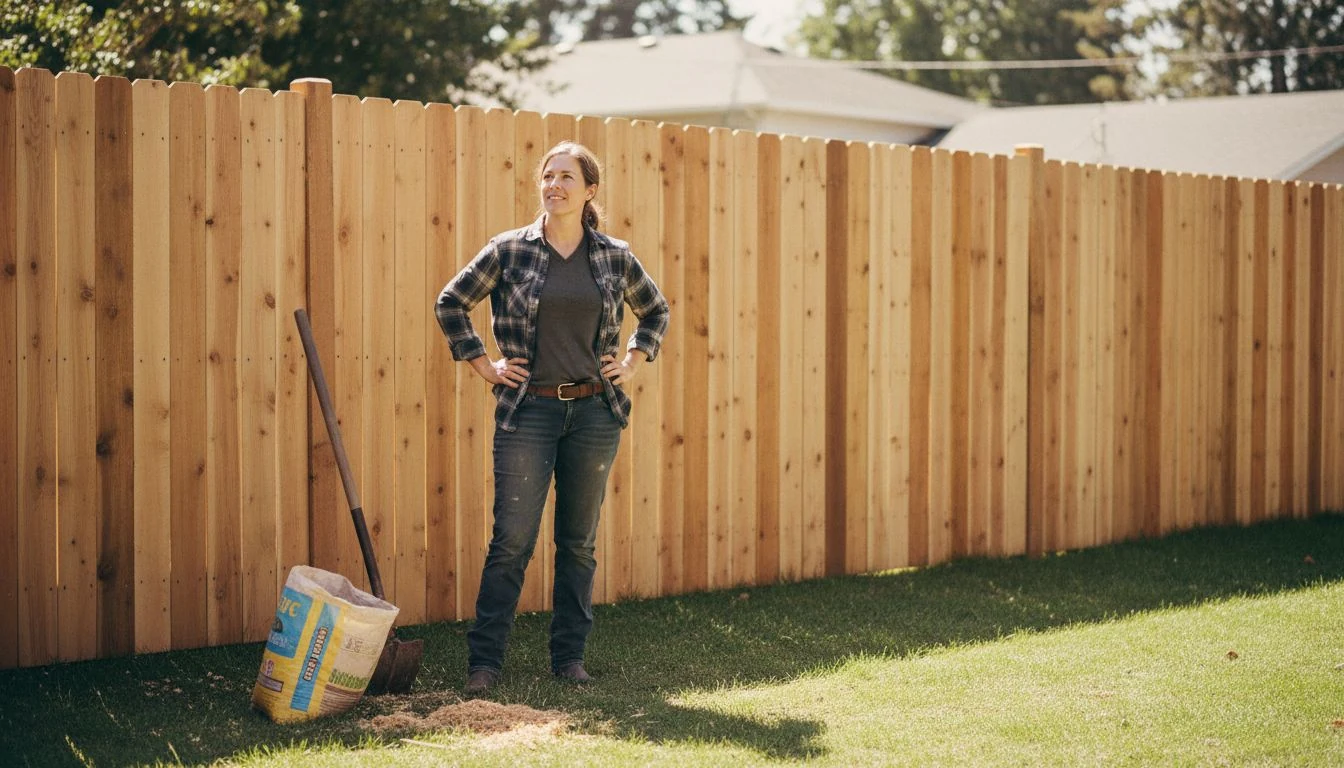
The first quote I got to fence my backyard was $9,200. For a yard I could walk the perimeter of in about ninety seconds. The guy said it like it was nothing, clicked his pen, and waited. I smiled, said I’d think about it, and went inside to figure out whether I was being ripped off or whether fences just cost a small car now. Turns out: a little of both.
Here is the honest version before the tables. The fence installation cost in 2026 runs about $15 to $60 per linear foot installed, materials and labor together, with most yard fences landing between $2,000 and $6,000 total. A standard 150-linear-foot wood privacy fence usually costs $3,000 to $6,500. Chain link is the budget floor at roughly $10 to $25 a foot. Vinyl, ornamental aluminum, and composite climb past $40. Below I break the fence installation cost down per linear foot, by material, by yard size, and by the line items that quietly never make it onto the lowball quote, so you can build your own number before anyone clicks a pen at you.
What does fence installation cost in 2026?
As of mid-2026, the national average to install a fence lands around $20 to $45 per linear foot installed. That is the all-in number: the pickets or panels, the posts, the concrete, the gates, the labor. The thing most people miss is that the fence material itself is often less than half of what you pay. The rest is digging post holes, mixing concrete, hauling off your old fence, and the slow, hot, dig-it-square-or-redo-it labor that a cheap quote loves to gloss over.
The fastest way to sanity-check any number is by quality tier.
| Install level | What you get | 2026 cost per linear foot installed |
|---|---|---|
| Budget | Chain link or basic 4 ft wood, flat lot, straightforward run | $10 to $20 |
| Mid-range (most jobs) | 6 ft wood privacy or vinyl, a gate or two, normal prep | $20 to $40 |
| Premium | Ornamental aluminum, composite, custom gates, sloped or rocky ground | $40 to $70+ |
My $9,200 quote was a mid-range job priced like a premium one. Same fence, two other companies, $5,400 and $6,100. The expensive guy wasn’t lying about anything. He was just betting I wouldn’t get a third quote, which is the single most expensive assumption you can let a contractor make about you.
Fence installation cost per linear foot
Per linear foot is the only honest way to compare fence quotes, because a 90-foot side yard and a 280-foot full wraparound are not the same job even with identical pickets. Split the per-foot price into its two real halves and you can check anyone’s math. Fence materials run $5 to $40 per linear foot depending on what you pick. Labor runs $8 to $25 per linear foot for a standard install on flat ground.
So a normal installed price of $20 to $40 a foot is mostly labor, more than you would guess. Fence labor is high because it is post-hole-digger, bag-of-concrete, get-it-plumb work, often in clay or rock, and there is no shortcut that holds up to a winter of frost heave. When a quote comes in way under $15 a foot for a wood privacy fence, someone is either setting posts too shallow, skipping concrete, or planning to disappear before the first freeze tells on them. When it sails past $50, ask what the material or the terrain is adding, because something specific is driving it.
One thing I wish I’d known sooner: gates are priced separately and they are not cheap. A single walk gate runs $150 to $400 installed, a double drive gate $400 to $1,200. I budgeted for fence and forgot the two gates entirely, then watched my “final” number jump $700 in one sentence.
Fence installation cost by material
The material you choose sets the bulk of your bill and changes the labor half too, since heavier or fussier systems take longer to set true. These are 2026 installed prices per linear foot, materials and labor together, for a standard flat-lot install.
| Fence material | Installed per linear foot | The honest take |
|---|---|---|
| Chain link | $10 to $25 | The budget workhorse; ugly to some, but it keeps the dog in and lasts decades |
| Wood (pine, spruce) | $15 to $35 | Cheapest privacy; needs sealing every few years or it grays and warps |
| Wood (cedar) | $20 to $45 | Worth the upcharge over pine; resists rot and bugs, ages far better |
| Vinyl / PVC | $25 to $60 | Costs more up front, near-zero upkeep; the long-game pick for privacy |
| Aluminum (ornamental) | $25 to $50 | That wrought-iron look without the rust; great around pools and front yards |
| Composite | $30 to $70 | Priciest privacy; looks like wood, never needs staining, heavy to work with |
I went cedar and would do it again. Pine would have saved me about $8 a foot up front, but my neighbor’s pine fence went silver and started cupping inside three summers, and now he’s staining it on his knees every other spring. If you want privacy and you plan to stay in the house, the math on cedar or vinyl beats cheap pine the first time you skip a re-stain. If you’re fencing to sell next year, pine does the job and nobody at the showing is going to test the wood species.
Fence installation cost by yard size
Once you know your per-foot price, the total is just perimeter math. The trap is that people picture a “yard” as one number, but you only fence the sides you actually need to. Here is what a mid-grade installed job (think 6 ft wood or vinyl, one or two gates) costs at common perimeters in 2026.
| What you’re fencing | Typical linear feet | 2026 installed cost |
|---|---|---|
| One side yard or dog run | 60 ft | $1,200 to $2,800 |
| Small backyard | 150 ft | $3,000 to $6,000 |
| Average suburban backyard | 200 ft | $4,000 to $8,000 |
| Quarter-acre full perimeter | 300 ft | $6,000 to $12,000 |
| Half-acre full perimeter | 420 ft | $8,400 to $17,000+ |
Measure your actual perimeter before you trust anyone’s “around $5k” guess. Walk it with a tape or a measuring wheel, and remember you usually share a side or two with neighbors who already have a fence, which means you might not be paying for the whole loop. A fence is a big outdoor line item the same way a deck is, and it helps to see it against the full cost to build a deck if you’re planning the whole backyard at once. For the wider picture of where a fence sits among other projects, I keep a running tally in my home renovation costs breakdown.
The hidden costs nobody puts on the fence quote
This is where my “simple” fence quotes quietly differed by thousands, and where most fence budgets blow up. None of this is shady on its own. It only becomes a problem when an installer leaves it off to win the bid and bills it later as a change order. Read every quote looking for these:
- Permits: $50 to $400 depending on your city and fence height. Most towns require one, and skipping it can mean tearing the fence back down.
- Old fence removal and disposal: $3 to $5 per linear foot. Pulling concrete-set posts is brutal work and the dump charges by the load.
- Property survey: $350 to $700 if your lines are unclear. Build a foot over the line and a grumpy neighbor can legally make you move it.
- Sloped or rocky ground: stepping or racking the fence on a slope, or augering through rock and clay, can add 20 to 40 percent to labor.
- Gates: $150 to $400 each for walk gates, $400 to $1,200 for a drive gate, almost always quoted separately from the per-foot run.
- Tree roots, sprinkler lines, and utility marking: hand-digging around obstacles is slow, and you must have buried utilities located first (free, but it takes days).
The fix is simple. Before you compare prices, make every installer quote the same scope in writing, including permit, old-fence removal, gate count, and how they handle your slope. The cheapest bid that “forgot” the gates and the demo is not cheaper. It is quoting a different, smaller job. That same instinct runs through my whole checklist on whether a contractor quote is fair.
Grab my free Project Cost Estimator
I put every line on this page, with its 2026 price range and a DIY-or-pay-for-it tag, onto one printable sheet. Print it, fill in your linear feet, material, and gate count, and you will have a real fence number before you call a single installer. No fluff, no upsell.
Where you can save on fence installation (and where you shouldn’t)
You can shave real money off a fence without buying a worse result. Smart places to save: pick quality pressure-treated pine or cedar over composite if upkeep doesn’t scare you, choose a 4 ft fence where you only need a boundary instead of 6 ft privacy, do your own old-fence demo and haul-away if you’re able, and split the cost of a shared property-line fence with the neighbor it benefits. Buying your own materials and hiring a crew labor-only can trim the bill too, as long as you order enough and stage it where they can reach it.
Where you should not cheap out: post depth and concrete. Posts need to sit below your local frost line and be set in concrete, or the first hard freeze heaves them and your straight fence turns into a slow wave by spring. Before any post hole gets dug, you also have to have your buried utilities located, which is free and required nationwide through the 811 “Call Before You Dig” service. Hit a gas or power line with an auger and the cost stops being about fences. And if you’re hiring out, vet the contractor the way you would any home project, because fence installers are a common spot for the take-the-deposit-and-vanish move the U.S. Federal Trade Commission warns homeowners about.
The long-term cost of owning each fence type
The install quote is only the start of your fence installation cost. What you spend over the years to keep it standing and looking decent matters too, and it’s where the cheap fence sometimes turns out expensive. Here is how the common types compare on upkeep and lifespan.
| Fence type | Upkeep needed | Yearly upkeep cost | Realistic lifespan |
|---|---|---|---|
| Vinyl / PVC | Rinse with a hose | Near $0 | 30–50 yrs |
| Aluminum | Almost none; touch up scratches | Near $0 | 40–60+ yrs |
| Chain link | Low; occasional rust spot | Low | 20–30 yrs |
| Wood (cedar) | Seal or stain every 2–4 yrs | $100–$300 | 15–30 yrs |
| Wood (pine) | Seal or stain every 2–3 yrs | $100–$300 | 10–20 yrs |
The mistakes that cost you twice
- Setting posts above the frost line or without concrete. They heave with the first hard freeze, and a leaning fence can’t be straightened, only reset, which means digging the whole thing again.
- Building before you know the property line. A fence even a foot over can be legally forced to move at your expense, so the survey you skipped becomes a demolition you pay for.
- Buying the cheapest pine and never sealing it. It grays, cups, and rots years early, so the budget pick becomes the replacement you pay for again.
FAQ
How much does fence installation cost in 2026?
The fence installation cost in 2026 runs about $15 to $60 per linear foot installed, materials and labor together, with most yard fences landing between $2,000 and $6,000 total. A standard 150-linear-foot wood privacy fence usually costs $3,000 to $6,500. Chain link is the budget floor near $10 to $25 a foot, while vinyl, aluminum, and composite climb past $40.
What is the cheapest fence to install?
Chain link is the cheapest at roughly $10 to $25 per linear foot installed, followed by basic pressure-treated pine at $15 to $35. If you only need a boundary rather than privacy, a shorter 4 ft fence costs less than a 6 ft one. You can also save by doing your own old-fence demo and haul-away or splitting a shared-line fence with a neighbor.
Is labor or material more expensive on a fence?
Labor, usually. On a typical wood or vinyl job the materials are often under half the bill, while labor and what labor needs (post holes, concrete, demo, gates) make up the rest. Labor alone runs about $8 to $25 per linear foot because setting posts plumb and deep, often in clay or rock, is slow, physical work with no shortcut that survives a freeze.
What hidden costs should I watch for in a fence quote?
The big ones are permits ($50 to $400), old-fence removal ($3 to $5 per linear foot), a property survey ($350 to $700 if lines are unclear), slope or rocky-ground premiums of 20 to 40 percent, and gates ($150 to $400 each, quoted separately). Make every installer quote the same scope so a low bid isn’t just leaving out the demo and the gates.
Do I need a permit to install a fence?
Usually yes. Most cities require a fence permit and have rules on height, setback from the property line, and what is allowed in front yards. Permits run $50 to $400. Building without one can mean fines or being ordered to tear the fence down, so confirm with your local building department, and check your HOA rules too if you have one.
Prices in this guide are 2026 national estimates and vary a lot by region, material, yard layout, and ground conditions. Always get itemized written quotes before you budget. I share what I have learned from my own projects, not professional construction or legal advice.
Free DIY Project Cost Estimator
The spreadsheet I use to price out a project before I start, so a weekend job never blows the budget. Join the newsletter and I’ll send it over.
No spam, ever. Unsubscribe anytime. — Tessa
Keep reading — more on Exterior & Structural Costs

Gutter Cleaning Cost: What I Paid, and the Month It Stops Being Optional
Gutter cleaning cost in 2026 runs $120 to $425 for most houses. Real quote numbers, what…
Read article →
Foundation Repair Cost in 2026: The Crack That Matters and the One That Does Not
A man in a branded polo put a level against my basement wall, made a face…
Read article →
Roof Repair Cost in 2026: What It Costs by What Actually Broke
The stain showed up on the upstairs hallway ceiling the morning after a March storm, about…
Read article →
Garage Door Spring Replacement Cost in 2026 (and Why I Do Not DIY This One)
It sounded like a rifle going off in the garage at 6:40 on a Tuesday morning.…
Read article →