
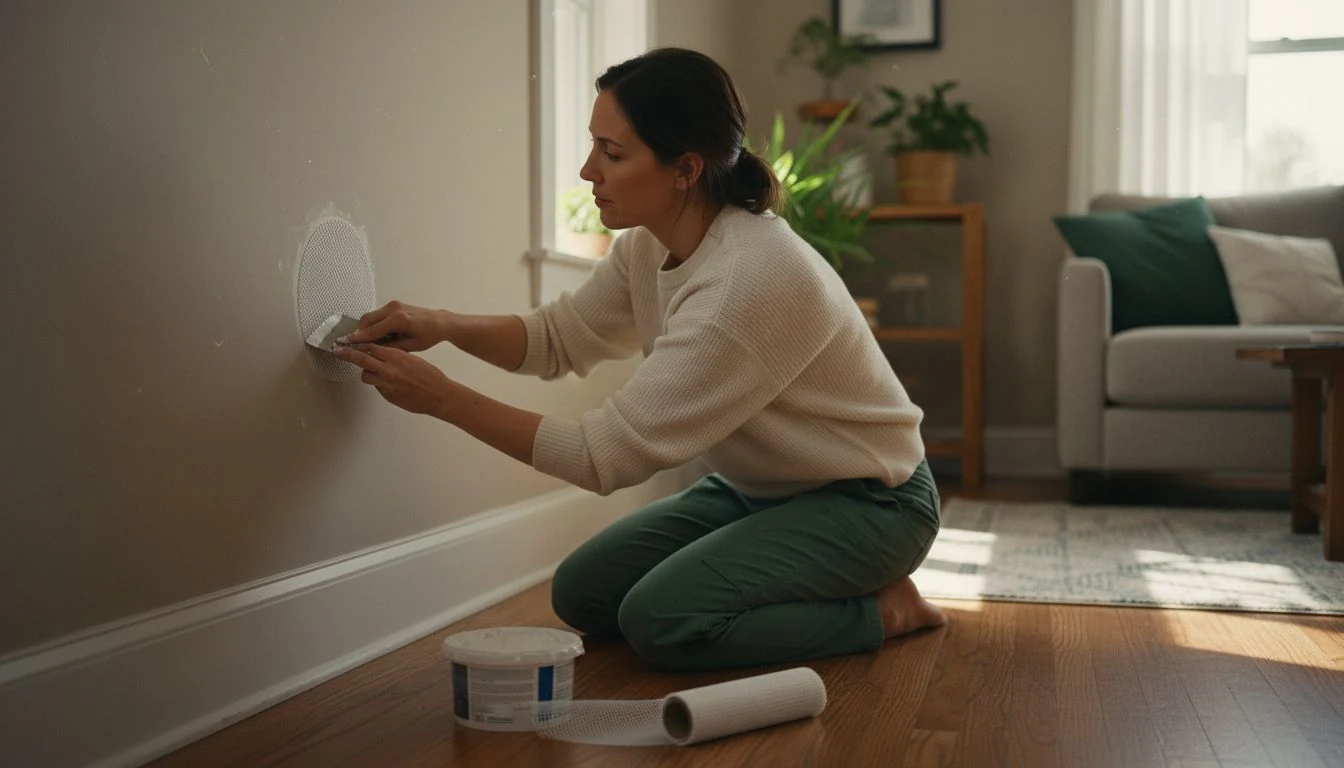
The first hole I ever patched was a doorknob-sized crater my dog put in the hallway wall the day we moved into the fixer-upper. I called a handyman, mostly out of panic, and he quoted me $220 to fix one hole the size of an orange. I nearly said yes. Then I looked at the little mesh patch kit at the hardware store, $12, and realized I was about to pay someone $208 to spread mud for twenty minutes. That afternoon taught me more about drywall repair cost than any article ever did, so let me save you the panic and the $208.
Here’s the short version before the tables. The average drywall repair cost in 2026 runs about $300 to $900 for a typical pro visit, or roughly $1.50 to $4 per square foot of wall they touch. Small stuff like nail holes and hairline cracks is genuinely a DIY afternoon for the price of a patch kit. But the number climbs fast the second water, ceilings, or a whole sheet get involved. What actually moves your drywall repair cost isn’t the drywall itself, which is cheap. It’s labor, texture matching, and whatever caused the damage in the first place.
How much does drywall repair cost in 2026?
As of mid-2026, a professional drywall repair on an average home lands somewhere between $300 and $900 for a standard job, materials and labor together. Most repair pros carry a minimum service charge, usually $150 to $400, because it’s not worth their truck and time to drive out for one nail hole. That minimum is the single thing that surprises people most, so know it going in. Here’s the range by size of the problem.
| Job size | What it covers | 2026 pro cost |
|---|---|---|
| Small | Nail holes, hairline cracks, a small ding or two (often hits the service minimum) | $150 to $350 |
| Medium | Fist-to-orange-sized hole, patch, tape, texture, ready for paint | $250 to $600 |
| Large / structural | Full sheet replacement, big hole, sagging or water-stained section | $400 to $1,200+ |
Those are estimates, and they swing with your region and how the damage happened. One thing to keep straight so no quote confuses you: patching a hole and replacing a sheet are two different jobs. A patch fills and blends what’s there. A replacement means cutting out a whole 4-by-8 panel, hanging new board, then taping, mudding, and texturing it to disappear. The board costs maybe $15. The disappearing is what you’re paying for.
Drywall repair cost by type of damage
Damage type is the biggest lever on the whole job, because it decides whether you’re patching, replacing, or chasing a bigger problem behind the wall. This is the table I wish I’d had the day of the dog crater. Here’s what each common kind of damage runs when you hire it out in 2026.
| Damage | Typical 2026 cost | Worth knowing |
|---|---|---|
| Nail / screw holes | $50 to $150 | Truly a DIY job. Spackle and a putty knife, done in an hour. |
| Small hole (up to 6″) | $100 to $250 | Mesh patch or a California patch. Very DIY-able. |
| Large hole (6″ to a full section) | $250 to $600 | Needs backing and a cut-in patch. Doable, but fiddly. |
| Cracks (settling / stress) | $150 to $400 | If cracks keep coming back, that’s a house-movement flag, not a mud problem. |
| Water-damaged drywall | $500 to $3,000+ | The wildcard. You’re paying to find the leak and rule out mold, not just patch. |
| Ceiling repair | $300 to $1,000+ | Overhead work, gravity fighting the mud. Always pricier than a wall. |
My honest take: everything above the water-damage line is fair game for a handy person on a budget, and I’ve done all of it myself. Below that line, hire it out or at least get eyes on it. Water in a wall is never really a drywall problem. It’s a plumbing or roof problem wearing a drywall costume, and if you patch over it without fixing the source, you’re just hiding the stain until it comes back bigger and browner. A failing water heater is one of the sneakiest culprits I’ve seen, so if yours is aging, it’s worth knowing what a water heater replacement costs before it floods a wall.
Drywall repair cost for a ceiling vs. a wall
People always assume a hole is a hole, but where it lives changes your drywall repair cost more than the size does. A wall patch you can stand in front of, comfortable, working at eye level. A ceiling patch means everything happens over your head with your arms up, mud trying to drip on your face, and a much harder time blending texture so it doesn’t show under overhead light. That’s real labor difficulty, and it’s a fair premium, not padding.
For the same size hole, expect a ceiling to run roughly 25% to 50% more than a wall. And if that ceiling has popcorn texture, brace yourself, because matching popcorn is a genuine art and often means re-texturing the whole ceiling rather than one spot. When my kitchen ceiling took a hit from an upstairs bathroom leak, the patch itself was minor. The texture matching and the water investigation were the whole bill. Which brings me to the part everyone underestimates.
What drives your drywall repair quote up
Two identical holes can quote hundreds apart, and it’s rarely greed. It’s these factors, and knowing them is how you tell a fair number from a padded one.
- Texture matching. Smooth walls are easy. Knockdown, orange peel, or popcorn all take skill to blend, and a bad match is more obvious than the original hole. This is where the real labor hours hide.
- Painting after. A patch is bare mud until it’s primed and painted, and paint almost never matches a wall that’s aged a few years. Many jobs end up painting the whole wall corner to corner, which is its own line item.
- Whatever caused the damage. A dog and a doorknob are one-time events. A recurring crack or a water stain means the drywall is the symptom, and diagnosing the cause adds cost.
- The service minimum. One small hole almost always hits a pro’s minimum, so bundling several little repairs into one visit is the smartest way to get your money’s worth.
The dog crater I opened with? A pro would have charged me the medium-job rate mostly because of that minimum, not because the hole was hard. Knowing the minimum exists is exactly why I did that one myself and saved the whole thing.
Can you patch drywall yourself, or should you hire out?
I’ll be straight with you, because I’m not a licensed contractor and I won’t pretend all drywall is a casual weekend job. Small patching genuinely is. If you can spread peanut butter on toast, you can fill a nail hole, and a 6-inch hole with a mesh patch is a confidence-building beginner project that’ll run you under $20 in supplies. I learned on that dog crater and never looked back. The tools are cheap, forgiving, and sandable, so mistakes wipe away.
Where DIY stops making sense is texture matching on a visible wall, ceiling work over your head, and anything touching water or a whole sheet. Hanging and finishing a full panel so it vanishes is a real skill that takes practice most of us don’t have, and a bad job announces itself forever under raking light. Water-damaged drywall I hand off every single time, because the drywall is the easy part and the leak hunt is the part worth paying for. Knowing what to do yourself and what to hire out is its own kind of handy, and there’s no shame in either column.
The hidden costs that ride along with drywall repair
This is the section I wish someone had handed me before my first real repair. Beyond patching the hole, here are the extras that quietly ride along on most drywall quotes, what they run in 2026, and whether they’re usually worth it. Treat every one as a line item you’re allowed to question.
| Add-on | Typical 2026 cost | Tessa’s take |
|---|---|---|
| Texture matching (smooth / knockdown / popcorn) | $50 to $300+ per spot | Popcorn is the priciest; sometimes the whole ceiling has to be redone to blend. |
| Prime & paint the repair | $150 to $500 per wall | Budget to paint the full wall, not just the patch. Old paint never matches. |
| Mold inspection / remediation | $500 to $6,000 | Only for water damage. Non-negotiable if it’s more than a small stain. |
| Finding the leak source | $150 to $500 (plumber/roofer) | Pay for this first. Patching over an active leak is money set on fire. |
| Lead-safe work (pre-1978 homes) | Built into a certified crew’s rate | Required by law if sanding disturbs old paint. Not an upsell. |
What blows the drywall repair budget
- Patching over water damage without finding the leak. The stain will bleed back through in weeks, and now you’re paying twice plus a possible mold bill. Fix the source before the wall, every time.
- Underestimating the paint. People budget for the patch and forget that a fresh mud spot needs primer and usually a full-wall repaint to disappear. That paint often costs more than the repair itself.
- Calling a pro out for one small hole. A single nail hole hits the service minimum, so you pay $200 for a $12 job. Bundle every little ding into one visit, or DIY the small stuff.
How to save on drywall repair without cutting corners
You don’t lower a drywall repair cost by using worse mud. You lower it by being a smart, organized homeowner. Here’s what actually moves the number in your favor.
Do the small stuff yourself, because nail holes and 6-inch patches are the definition of a cheap, forgiving DIY win. Bundle any pro work so one visit covers every hole in the house instead of triggering the service minimum twice. Ask whether the quote includes paint, because “repair” and “repaint” are two different jobs and assuming ruins a budget. And if your home was built before 1978, know that sanding old drywall and paint can disturb lead, so a properly certified crew isn’t an upsell, it’s the law under the EPA’s Renovation, Repair and Painting Rule. For anything water-related, read the EPA’s plain-English guidance on mold cleanup in your home before you let anyone seal a wall back up, because drywall that stayed wet longer than a day or two can hide mold you can’t see.
One more that saved me real money on that kitchen ceiling: I asked the plumber to fix the leak and photograph the dried-out cavity before the drywall guy ever showed up. That way I paid the drywall pro only to close a wall we both knew was clean and dry, not to guess. If drywall repair is one line in a larger remodel, it helps to see it against the full picture of what a home renovation costs room by room, and my guide to whether your contractor quote is fair walks through the same line-item logic, and since fresh drywall almost always needs paint, it pairs naturally with what interior painting costs in 2026.
Grab my free Project Cost Estimator. Before you call a single pro, plug the size and type of your drywall damage into my printable estimator so you walk into every quote already knowing your own fair range. It’s the same one-page sheet I use to keep repairs from ballooning into repaints I didn’t plan for.
If the wall is past patching and you need new board hung from scratch, I priced that too: what drywall installation costs per sheet and per room.
Frequently Asked Questions
How much does it cost to repair a hole in drywall?
In 2026, a small hole under about 6 inches runs roughly $100 to $250 with a pro, though a single hole often hits the service minimum of $150 to $400. A large hole or full-section repair runs $250 to $600. Nail holes and dings you can DIY for under $20 in supplies.
Is it cheaper to patch or replace drywall?
Patching almost always wins for isolated holes and cracks, often for a few hundred dollars. Full sheet replacement makes sense when a panel is water-damaged, sagging, or broken across a wide area. When more than about a third of a wall is compromised, replacing the whole sheet usually costs less than fighting endless patches.
Why is water-damaged drywall so expensive to fix?
Because you’re not really paying for drywall. You’re paying to find and fix the leak, dry the cavity, rule out or remediate mold, and only then close the wall. The drywall patch is the cheapest part. Skipping the leak hunt is the number one way a $400 job becomes a $3,000 one.
All prices here are 2026 estimates and vary by region, home condition, and contractor. Tessa is a hands-on homeowner, not a licensed contractor; use these ranges to ask smarter questions and always confirm figures with local pros.
Free DIY Project Cost Estimator
The spreadsheet I use to price out a project before I start, so a weekend job never blows the budget. Join the newsletter and I’ll send it over.
No spam, ever. Unsubscribe anytime. — Tessa
Keep reading — more on Painting & Finishing Costs
How Much Does Exterior House Painting Cost in 2026? (By Siding + DIY vs. Pro)
Last June I paid a crew $4,800 to paint the front and both sides of my…
Read article →
How Much Does Interior Painting Cost in 2026? (Per Room + DIY vs. Hire)
A painter walked my house last spring, nodded at every room, and handed me a number…
Read article →
How Much Does It Cost to Paint Kitchen Cabinets in 2026?
The real cost to paint kitchen cabinets in 2026: DIY vs pro tables, per-door pricing, kitchen-size…
Read article →