
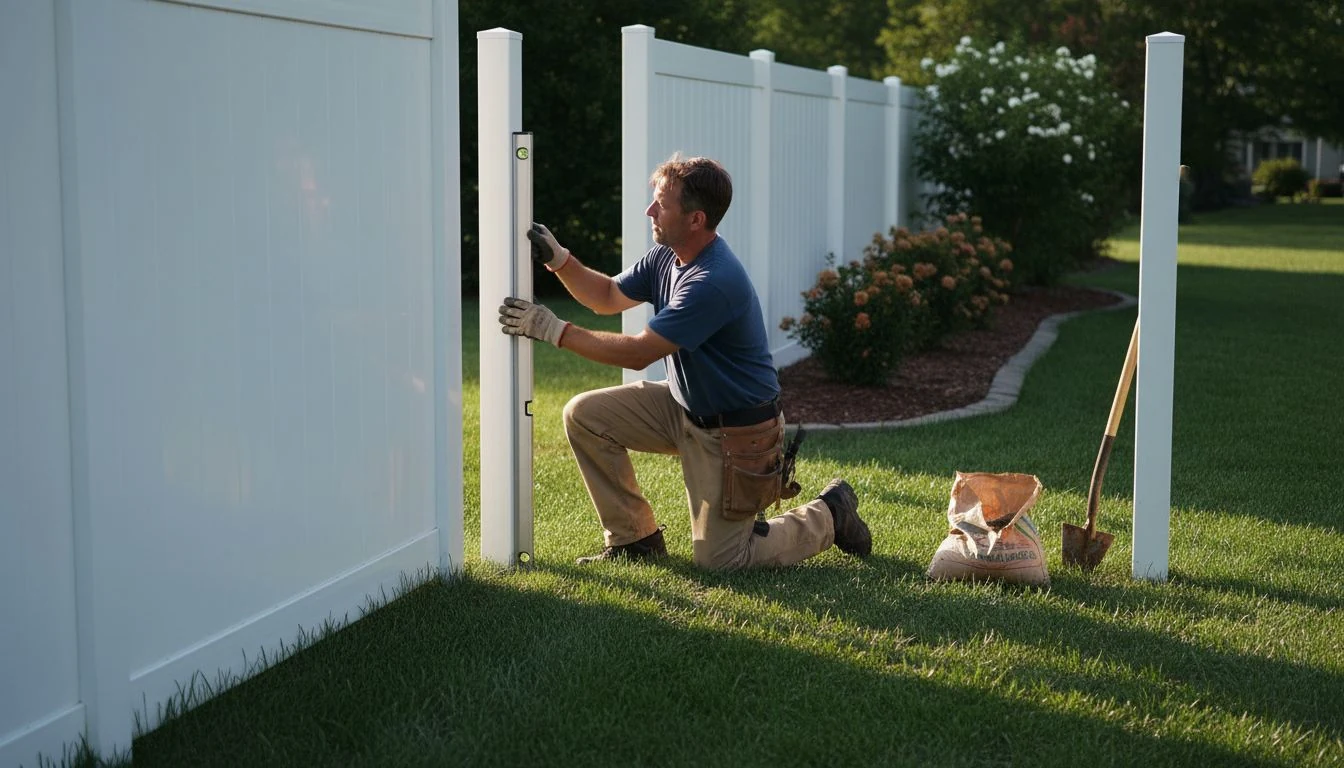
Two summers ago I stood in my backyard holding two quotes for the same 150 feet of fence. Wood came in at $3,300. Vinyl came in at $4,600. My first reaction was the obvious one: why would anyone pay $1,300 more for a fence? Then I remembered the two weekends I spent re-staining a wood fence at my old rental, on my knees, with a brush, cursing. I did the math on what that fence actually cost me per year. And I went vinyl.
So let me save you that afternoon. The average vinyl fence installation cost in 2026 runs about $15 to $40 per linear foot installed, which puts a typical yard somewhere between $3,000 and $6,000. A short front picket run can land near $2,000. A tall privacy fence around a big lot can pass $8,000. But that per-foot number hides everything that matters, because your real vinyl fence installation cost is decided by height, gates, and what your ground looks like once the crew starts digging.
Jump to what you need:
- What vinyl fence installation costs in 2026
- Cost per linear foot, by style
- Vinyl vs. wood vs. aluminum
- What drives your cost up
- Can you install it yourself?
- The real cost of owning a vinyl fence
- FAQ
What does vinyl fence installation cost in 2026?
The honest range looks like this. Most homeowners pay $15 to $40 per linear foot for professionally installed vinyl, and the national average vinyl fence installation cost sits near $25 to $30 a foot. For an average suburban backyard of about 150 linear feet, that works out to roughly $3,750 to $4,500 for a standard six-foot privacy run. My $4,600 quote was slightly high because two of my corners needed extra posts.
The split matters more than the total. Materials run about $10 to $25 per linear foot, and labor eats the other $5 to $15. So on a vinyl fence, unlike a lot of home projects, the product is actually a big chunk of the bill. Vinyl panels cost more up front than a stack of pine pickets. That is the whole reason the sticker looks steep. You are paying for a material that never needs paint.
One thing that surprised me: the price barely drops if you buy cheaper vinyl. Thin, hollow, bargain panels save you maybe $3 a foot and yellow within a decade. The labor to set posts in concrete is identical either way. So the savings on cheap vinyl are small and the regret is large. If you are going vinyl at all, buy the panel thickness you would want to look at for twenty years.
Vinyl fence installation cost per linear foot, by style
Style changes your vinyl fence installation cost as much as height does, because a solid privacy panel uses far more material than an open rail. Here is where the common styles land in 2026, installed, per linear foot, so you can see how much your chosen style moves the vinyl fence installation cost before you ever get a bid.
| Vinyl fence style | Typical height | Installed cost per linear foot |
|---|---|---|
| Ranch / post-and-rail | 3–4 ft | $12 to $25 |
| Picket | 3–4 ft | $15 to $30 |
| Semi-privacy (spaced or shadowbox) | 5–6 ft | $20 to $35 |
| Full privacy (solid) | 6 ft | $25 to $40 |
| Lattice-top or scalloped privacy | 6 ft | $30 to $45 |
I ran a picket across my front yard and full privacy across the back, and that mix is worth copying. The front is decoration and a boundary; a four-foot picket at $20 a foot does that job and keeps the house looking open from the street. The back is where you actually want to sit in your underwear on a Sunday, so that got the six-foot solid privacy. Matching the style to what each side is for saved me close to $600 versus wrapping the whole property in privacy panel.
Color and texture nudge the number too. Standard white is the cheapest. Tan, gray, and the wood-grain textured panels add roughly $2 to $6 a foot. I wanted the almond, talked myself into white to save the money, and honestly do not regret it. Nobody has ever looked at my fence and thought less of me for the color.
Vinyl vs. wood vs. aluminum: is vinyl worth the money?
This is the fork everyone stalls on, and it stalled me for a week. Wood is cheaper to install and more expensive to own. Vinyl is the reverse. Aluminum sits off to the side because it is a security-and-looks fence, not a privacy fence, so it only competes for the front-yard job.
A pressure-treated wood privacy fence runs about $15 to $30 a foot installed, so my 150 feet would have been that $3,300 quote. Real. Lower. But a wood fence wants cleaning and staining or sealing every two to three years, and every skipped cycle takes a year off its life. Left alone, a wood fence gives you ten to fifteen years before boards cup, gray, and start popping nails. I have owned that fence. I have stained that fence. I did not want to do it again.
Vinyl asks for a hose and ten minutes twice a year. That is the actual maintenance. It will not rot, it will not need paint, and a decent panel lasts twenty to thirty years. Aluminum lasts even longer and never rusts, but you can see straight through it, so it protects a front garden, not a hot tub. Once I put the upkeep and the lifespan into the same column, the $1,300 premium stopped looking like a splurge and started looking like pre-paying for a decade of weekends I would rather spend not painting.
What drives your vinyl fence installation cost up
The quote you get is not really about the fence. It is about your yard. These are the line items that separated my $4,600 bid from the tidy $3,750 the calculator promised.
- Gates. Every gate is a small custom build, not a panel. A walk gate adds $250 to $650, and a wide drive or double gate runs $400 to $1,200 because of the hardware and the extra-heavy posts. I have two gates. That is $700 right there.
- Height. Going from a six-foot to an eight-foot privacy fence is not 33% more panel; it is taller posts, deeper footings, and often a permit, so it can add 25% or more per foot.
- Sloped or rocky ground. Flat, soft soil is a crew’s dream. A slope means the fence has to step or rack down the grade, and rock or heavy clay means harder digging, both of which add labor.
- Tearing out the old fence. Removing and hauling away an existing fence usually runs $3 to $5 a linear foot, or $500 to $1,500. I did this part myself, which I will come back to.
- Permits and survey. Many towns require a fence permit, often $50 to $400, and if your property lines are fuzzy a survey can add $350 to $600. Cheap insurance against building on your neighbor’s dirt.
None of these are scams. But a bidder who leaves them off to look cheaper is not saving you money, he is hiding the bill until you cannot back out. When I compared my two fence quotes, the wood one had quietly left gate hardware off entirely. A suspiciously low vinyl fence installation cost is almost always a scope that got trimmed, not a deal, and the FTC’s own guidance on avoiding home-improvement scams flags exactly this kind of lowball-then-upcharge pattern. My guide on whether a contractor quote is fair walks through what to line up before you sign.
Can you install a vinyl fence yourself?
Some of it, yes, and this is where you can take real money off the top of your vinyl fence installation cost. A DIY vinyl fence runs about $10 to $25 a linear foot in materials, so you are keeping that $5 to $15 of labor per foot. On 150 feet that is a thousand dollars or more back in your pocket.
But setting fence posts plumb, level, evenly spaced, and in concrete that actually cures straight is harder than the videos make it look, and a vinyl fence is unforgiving because the panels are rigid. Wood you can fudge. Vinyl either lines up or it visibly does not. My honest split, and what I did: I demoed and hauled the old chain-link myself over a weekend to bank the removal cost, then let the pros set the posts and hang the panels. Best of both. I saved on the sweaty unskilled part and paid for the part where a fraction of an inch shows for twenty years.
One more thing, and it is the most important sentence in this post. Before anyone puts a shovel or an auger in your yard, call 811. It is free, it is federal, and a few days before you dig your local utilities come out and mark their buried lines so you do not hit one. I learned this the loud way at my old rental, when my brother-in-law’s auger clipped the buried cable line and took out internet for half the block. Two minutes on the phone would have painted that line orange. The US Department of Transportation lays out the whole call-811-before-you-dig process, and there is no version of skipping it that ends well.
The real cost of owning a vinyl fence
A fence quote is a one-day number. The smarter number is what the fence costs you per year over its whole life, because that is the math that actually decided my wood-versus-vinyl question. Your vinyl fence installation cost only looks high until you spread it across the years the fence keeps standing. Below is how the common materials compare once you fold in upkeep and lifespan.
| Material | Installed cost / linear ft | Yearly upkeep / linear ft | Typical lifespan | ~15-year cost / ft / year |
|---|---|---|---|---|
| Vinyl | $25 to $40 | ~$0 | 20–30 yrs | ~$2.00 |
| Wood (pressure-treated) | $15 to $30 | $1 to $3 | 10–15 yrs | ~$3.50 |
| Aluminum | $25 to $40 | ~$0 | 30+ yrs | ~$2.10 |
| Chain-link | $10 to $20 | ~$0.20 | 15–20 yrs | ~$1.20 |
Read the last column, because it is the one nobody puts on the quote. Chain-link is the cheapest fence you can own, and if privacy and curb appeal do not matter to you, it wins on money. But the second you want a fence you actually like looking at, the race is vinyl versus wood, and vinyl wins that one. Wood’s lower sticker gets eaten by stain, sealer, and a shorter life. My $1,300 premium buys back time, not just plastic.
What blows the vinyl fence budget
- Gates you add at the end. Homeowners price the fence, get comfortable with the number, then mention “oh, and two gates” as an afterthought. That afterthought is $700 to $2,000. Count and price every gate before you fall in love with the per-foot figure.
- Ground you did not warn the bidder about. A steep slope, buried tree roots, or rock turns a fast dig into a slow one, and a bid based on flat soil balloons mid-job. Walk the whole line with the estimator and point at the ugly corners on purpose.
- Old-fence removal and disposal. Tearing out and hauling the existing fence is $500 to $1,500 that people forget is not part of “installing a new fence.” Doing the demo yourself is the single easiest chunk of this whole project to claw back.
If you are fencing as part of a bigger yard plan, it helps to see this next to a couple of related numbers before you commit the season’s budget. A full fence-cost breakdown by material lets you sanity-check vinyl against everything else, and if a deck is also on the list, what it costs to build a deck often shares the same crew and the same permit trip. It all lands inside the wider picture of what home renovations cost in 2026.
Grab my free Project Cost Estimator. Before a single installer walks your property line, plug in your linear footage, style, and gate count so you meet every bid already knowing your own fair range. It is the same one-page sheet that caught the gate hardware one fence company had quietly left off my quote.
Frequently Asked Questions
How much does it cost to install 150 feet of vinyl fence?
Roughly $3,000 to $6,000 installed in 2026, depending on style and height. A four-foot picket run lands near the low end at about $15 to $25 a foot, while a six-foot privacy fence pushes $25 to $40 a foot. Gates, slope, and removing an old fence sit on top of that and are the most common reasons a real quote comes in above the calculator.
Is vinyl fencing cheaper than wood?
Not up front. Wood usually installs for $15 to $30 a foot versus $25 to $40 for vinyl, so wood wins the sticker. Over time it flips. Wood needs staining or sealing every few years and lasts ten to fifteen, while vinyl needs almost nothing and lasts twenty to thirty. Across fifteen years of ownership, vinyl usually costs less per year than wood once upkeep is counted.
How long does a vinyl fence last?
Twenty to thirty years for a quality panel, and often longer in a mild climate. It will not rot, warp, or need paint. The realistic enemies are a hard impact that cracks a rigid panel and years of harsh UV slowly chalking or yellowing a cheap, thin one. Buying a thicker panel grade up front is what buys you the top of that range.
All prices here are 2026 estimates and vary by region, yard conditions, and installer. Tessa is a hands-on homeowner, not a licensed contractor; use these ranges to ask sharper questions and always confirm figures with local pros. And whatever you do, call 811 before you dig.
Free DIY Project Cost Estimator
The spreadsheet I use to price out a project before I start, so a weekend job never blows the budget. Join the newsletter and I’ll send it over.
No spam, ever. Unsubscribe anytime. — Tessa
Keep reading — more on Exterior & Structural Costs

Gutter Cleaning Cost: What I Paid, and the Month It Stops Being Optional
Gutter cleaning cost in 2026 runs $120 to $425 for most houses. Real quote numbers, what…
Read article →
Foundation Repair Cost in 2026: The Crack That Matters and the One That Does Not
A man in a branded polo put a level against my basement wall, made a face…
Read article →
Roof Repair Cost in 2026: What It Costs by What Actually Broke
The stain showed up on the upstairs hallway ceiling the morning after a March storm, about…
Read article →
Garage Door Spring Replacement Cost in 2026 (and Why I Do Not DIY This One)
It sounded like a rifle going off in the garage at 6:40 on a Tuesday morning.…
Read article →