
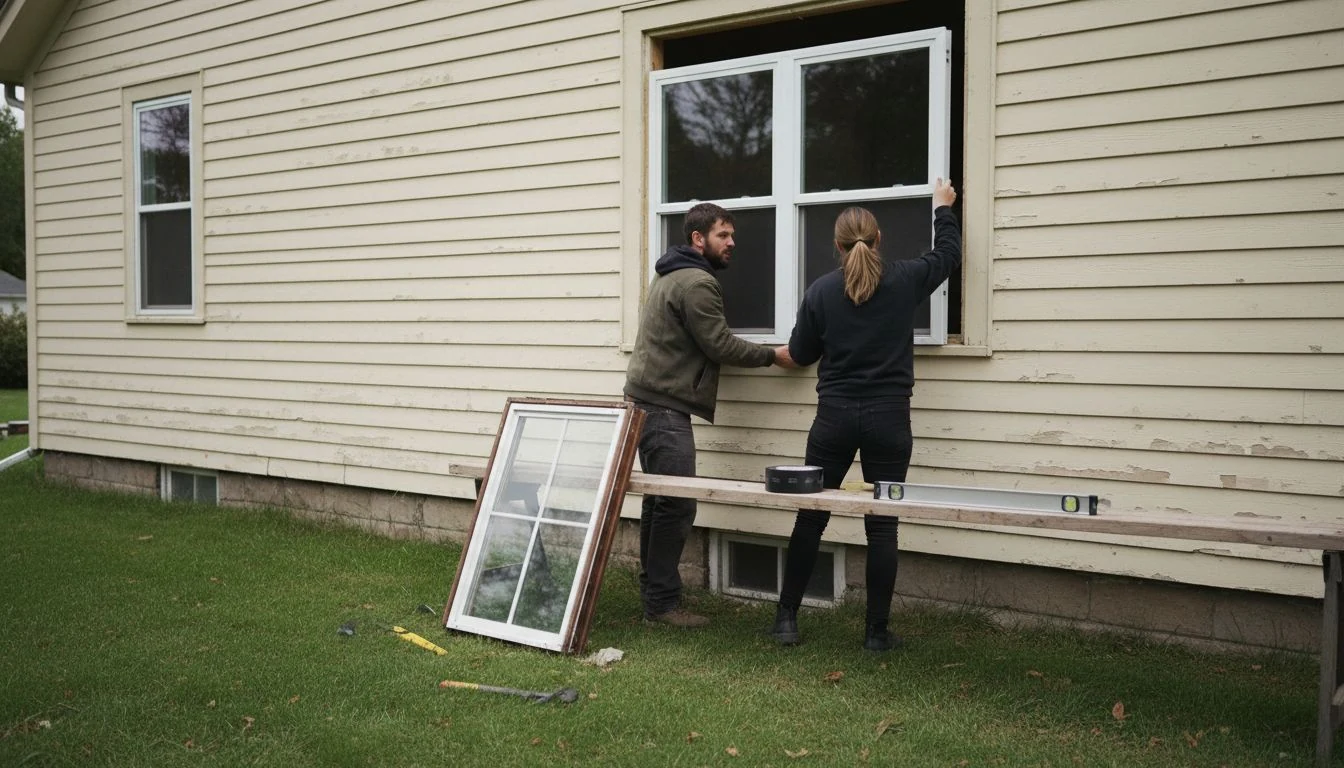
My cousin Dana and I replaced our windows the same spring. Same builder-grade white vinyl double-hungs, same white, same low-E package, nothing custom on either end. She did eleven of them outside Columbus for about $9,400. I did nine and paid $14,800. We put the two contracts side by side on a phone call that ran an hour and a half, and the windows themselves were within sixty dollars of each other.
Everything around the windows was different. That gap is what people are talking about when they say window replacement cost by region, and on a whole-house job it adds up to the price of a used car.
What a window costs by material and by style, I already broke down in my main guide to window replacement cost. This post takes the other axis: not what you buy, but where you’re standing when you buy it. Labor rates, energy code, coastal wind requirements, the age of the houses around you, and whichever township clerk sets your permit fee.
Jump to what you need:
- The 2026 regional spread
- Why labor moves more than the window
- Climate zones and what code makes you buy
- The coastal premium
- Old housing stock is a regional cost
- Permits and historic districts
- Translating a national average to your market
- FAQ
Window replacement cost by region: the 2026 spread
One standard mid-range vinyl double-hung, installed as part of a whole-house job, runs roughly $525 to $2,400 per window in 2026 depending on where the house sits. The low end is the inland South. The high end is a wind-borne debris zone on the coast. Most of the country lands between $600 and $1,400, and what moves your number inside that band is the crew, not the glass.
| Region | Installed, per window (2026 est.) | What is actually driving it |
|---|---|---|
| New England and the NY metro | $900 – $1,600 | Highest install labor in the country, oldest housing stock, cold-climate glazing package |
| Mid-Atlantic | $750 – $1,350 | Mixed labor rates, a lot of pre-1978 housing, townships that all permit differently |
| Midwest | $600 – $1,150 | Same cold-climate window as the Northeast, cheaper hands to install it |
| Inland South | $525 – $1,000 | Lowest labor rates, newer housing, solar-control glazing instead of triple pane |
| Gulf and Atlantic coast, wind-borne debris zones | $1,000 – $2,400 | Impact-rated glazing or approved shutters, engineered fastening, coastal inspection |
| Mountain West | $700 – $1,300 | Cold-climate package, long supply runs, seasonal crews with a short install window |
| Pacific Coast | $900 – $1,700 | High labor, strict state energy codes, retrofit detailing on older stucco and wood |
Run my nine windows through that table and the $14,800 stops looking like a rip-off. Run Dana’s eleven through it and hers stops looking like a miracle. Two ordinary quotes, six hundred miles apart.
Labor moves the number more than the window does
This took me the longest to accept. A vinyl double-hung leaves the factory at close to the same price whichever distributor picks it up. Manufacturers ship nationally, they discount by volume, and freight is a small slice of a product that stacks well on a truck. The unit in Dana’s wall and the unit in mine came off comparable lines.
Installation doesn’t work that way. Installation is two people, a day, a ladder, and a market rate. In an expensive metro those two people cost around double what they cost in a small Midwestern city, and that difference lands on every opening in the house. Nine windows times a few hundred dollars of labor spread is most of my gap right there.
Which means the advice homeowners give each other online has the lever backwards. Shopping harder for the window saves you tens of dollars per opening. Getting a real second and third installer bid saves you hundreds. If you’ve only got the energy for one fight, pick that one, and use my walkthrough on whether a contractor quote is fair to structure it.
Two things scale the labor side further, and both feed straight into window replacement cost by region whether you notice or not. Second-floor openings need staging or a lift and cost more per window than first-floor ones, so a market full of two- and three-story housing prices higher on average than a market of ranches. And full-frame replacement, where the old frame comes out to the studs, runs well above an insert that drops into the existing frame. Which one you need usually gets decided by the age and condition of the houses in your area rather than by your preference.
Your climate zone decides which window you’re allowed to buy
The second half of the regional gap is code, and people argue with it until they see the map.
ENERGY STAR splits the country into four climate zones for windows: Northern, North-Central, South-Central and Southern. The north gets graded mostly on keeping heat in, so qualifying units lean toward tighter U-factors, better spacers, more gas fill, sometimes a third pane. The south gets graded mostly on keeping the sun out, so qualifying units lean toward low solar heat gain coatings. The exact numbers change with each version of the specification, so pull the ENERGY STAR key product criteria for your zone instead of trusting a salesperson’s chart.
That plays out two ways on your invoice. The cold-climate package costs more to build, so the same catalog window is a more expensive window in Minnesota than it is in Georgia; triple pane, where code or a rebate pushes you there, commonly adds a couple hundred dollars per opening and enough weight to change the crew size. And your state energy code and your utility rebate both key off those same zones. California, Washington and several Northeastern states enforce tighter requirements than the federal baseline, which narrows what a contractor can legally install. You can’t shop that away. It’s inside every quote in those markets.
If your project also touches a patio slider, the same zone logic applies there, and I priced it separately in my guide to the cost to install a sliding glass door.
On the coast you’re buying a different window entirely
Live inside a wind-borne debris zone along the Gulf or the southern Atlantic and you can throw the national average out.
Codes in those areas require glazing that survives an impact test, or an approved shutter system covering ordinary glazing. Impact-rated windows use a laminated interlayer, heavier frames and specific engineered fasteners into the structure, and they commonly run 40 to 100 percent above a standard unit of the same size. Inspection is stricter, the fastening schedule isn’t negotiable, and somebody checks the product approval numbers.
Your contractor isn’t gouging you. That’s a window built to a different test, and it explains why a coastal Florida quote and an inland Alabama quote for the same house read like they came from different centuries. Homeowners in those zones often see insurance credits for the upgrade, which helps the math over a decade and does nothing for the check you write on install day.
Old housing stock is a regional cost, and it’s the one nobody puts in the quote
I missed this line item completely on my first read of my own contract.
The Northeast and the older Midwest are full of houses built before 1978, and federal law treats work on those differently. Under the EPA’s Lead Renovation, Repair and Painting rule, contractors disturbing painted surfaces in pre-1978 housing generally have to be certified and follow containment and cleanup practices. Window work disturbs paint by definition. The certification, the plastic and the slower pace cost real money, and in a region where most of the housing predates 1978, that shows up on most jobs.
Old houses cost more in ways that have nothing to do with lead. Weight-and-pulley sash pockets have to be insulated once the weights come out. Plaster interiors chip where drywall would have taken the hit. Openings framed by hand a century ago are rarely square, and an out-of-square opening either gets shimmed carefully or gets a custom-size unit ordered.
In theory none of that is regional. In practice all of it is, because housing age clusters hard by geography. Same reason my exterior painting numbers skew higher in the same markets.
Permits, historic districts, and the municipal lottery
Whether you need a permit to swap a window gets decided at a level of government most people can’t name.
Plenty of jurisdictions don’t require one for a like-for-like insert. Plenty require one for any window, and more require one the moment you change the size of the opening or touch structure. Fees I’ve seen quoted run from about $50 to a few hundred dollars, sometimes flat, sometimes scaled to project value. Coastal counties sit at the strict end.
Historic districts are the wildcard, and they cluster in exactly the old-housing regions above. A local commission can require wood over vinyl, specific sash profiles, matching muntin patterns, or an approval process that adds weeks before anyone orders anything. I watched a neighbor’s straightforward eight-window job turn into a nine-month conversation about grille dimensions.
Ask two questions before you sign: is the permit inside this price or billed on top, and who is pulling it. The contractor should pull it. A contractor who suggests you pull it as the homeowner “to move faster” is handing you the liability for the work passing inspection.
How to translate a national average into your own window replacement cost by region
A national average is a starting line. The sequence I use now takes an evening.
- Start from the table above. Find your row, take the middle of the range, multiply by your opening count. That’s your sanity number, the one you hold the quotes against.
- Adjust for floor level and frame type. Add for second-story openings. Add meaningfully if rot, an out-of-square opening or a failed sill means full-frame instead of insert.
- Look up your climate zone before anyone quotes. Knowing whether you’re buying a U-factor window or a solar-heat-gain window keeps you from paying for the wrong upgrade in a confident voice.
- Call your building department once. One call answers permit requirement, fee structure and historic district in about four minutes, and it’s the cheapest four minutes in the project.
- Get three installer bids, not three window prices. Hand all three the same written scope: opening count, insert or full frame, interior and exterior trim, disposal, and permit included or excluded. Bids that describe different work can’t be compared, however neatly they’re formatted.
- Then check for utility and state rebates. Those are regional too, and in a strong rebate market they can pull a high-cost region back toward the middle of the table.
Broader context on how these ranges are moving, with sources, sits in my home improvement cost statistics roundup.
What blows the budget when you compare window replacement cost by region
- Holding a coastal quote against a national average. Impact-rated glazing is built to a different test and commonly runs 40 to 100 percent above a standard unit. Inside a wind-borne debris zone, the national number was never your number, and reading it as one makes an honest quote look like theft.
- Assuming insert when the job is full-frame. An insert drops into the existing frame; full-frame takes it out to the studs and rebuilds the trim inside and out. Rotted sills and out-of-square century-old openings force the second one, and finding that out mid-project turns into a change order per window instead of a line in the bid.
- Treating the permit and the lead rule as paperwork. In pre-1978 housing the containment, certified crew and cleanup are real hours, and in a historic district the approval can delay the order by weeks. Ask who pulls the permit, whether the price includes it, and whether the crew is certified, before you compare a single number.
Grab my free Project Cost Estimator. Print it, walk the outside of the house with it, and write down three things per opening: floor level, insert or full frame, and whether the sill goes soft when you push a screwdriver into it. That page turned my three window bids from a pile of numbers into a comparison I could read.
Frequently Asked Questions
Why does window replacement cost so much more in some states?
Mostly labor. The window ships nationally at close to the same price, but installation is two people for a day at your local market rate, and that rate can differ by around double between an expensive metro and a small city. Climate-zone code requirements, coastal impact ratings, the age of the housing stock and local permit rules stack on top of it.
Is it cheaper to buy windows in one state and install them in another?
Rarely worth it. The unit price difference is small, freight and handling eat it, and you lose the installer’s warranty coordination when the product isn’t one they supplied. A window that qualifies for the zone where you bought it may also fall short of the code where you’re installing it, especially between a Southern and a Northern zone.
How much does labor add per window?
Commonly somewhere between a third and half of the installed price on a standard first-floor insert, and it climbs from there for upper floors, full-frame replacement and any opening that needs structural or trim repair. That’s why a second and third installer bid saves more than shopping brands does.
Do I need a permit to replace a window?
Depends on your jurisdiction, and it’s worth one phone call rather than a guess. Like-for-like inserts are frequently exempt, while changing the opening size, touching structure or working in a coastal or historic district usually isn’t. Have the contractor pull it, and confirm in writing whether the fee is inside the quote or billed on top.
Are impact-rated windows required everywhere on the coast?
No. They’re tied to designated wind-borne debris zones, and the boundary can run through a single county. Your building department can tell you which side of it your address falls on, and that answer moves the budget more than anything else on this page.
All figures here are 2026 estimates and vary by region, opening size and count, floor level, insert versus full-frame installation, local labor rates, and how your municipality prices permits. Energy code requirements, wind-borne debris boundaries, historic district rules and rebate programs are set locally and change, so confirm yours with your building department and utility. Tessa is a hands-on homeowner, not a licensed contractor, and this is not code advice.
Free DIY Project Cost Estimator
The spreadsheet I use to price out a project before I start, so a weekend job never blows the budget. Join the newsletter and I’ll send it over.
No spam, ever. Unsubscribe anytime. — Tessa
Keep reading — more on Remodel & Renovation Costs
Whole House Humidifier Installation Cost (and Whether You Need One)
Last January the little hygrometer on my bookshelf read 21 percent. I’d bought it for $14…
Read article →
Gas Fireplace Installation Cost: Inserts, Built-Ins, and Venting
My sister Jen has a brick fireplace in her 1962 ranch that she has used exactly…
Read article →
Shower Remodel Cost: Refresh, Walk-In, and Full Tear-Out
My mom called me in August because the floor of her shower had started to flex.…
Read article →
Gas Line Installation Cost: For a Stove, Dryer, Fireplace, or Generator
For nine days last winter, a brand new gas range sat in the middle of our…
Read article →