
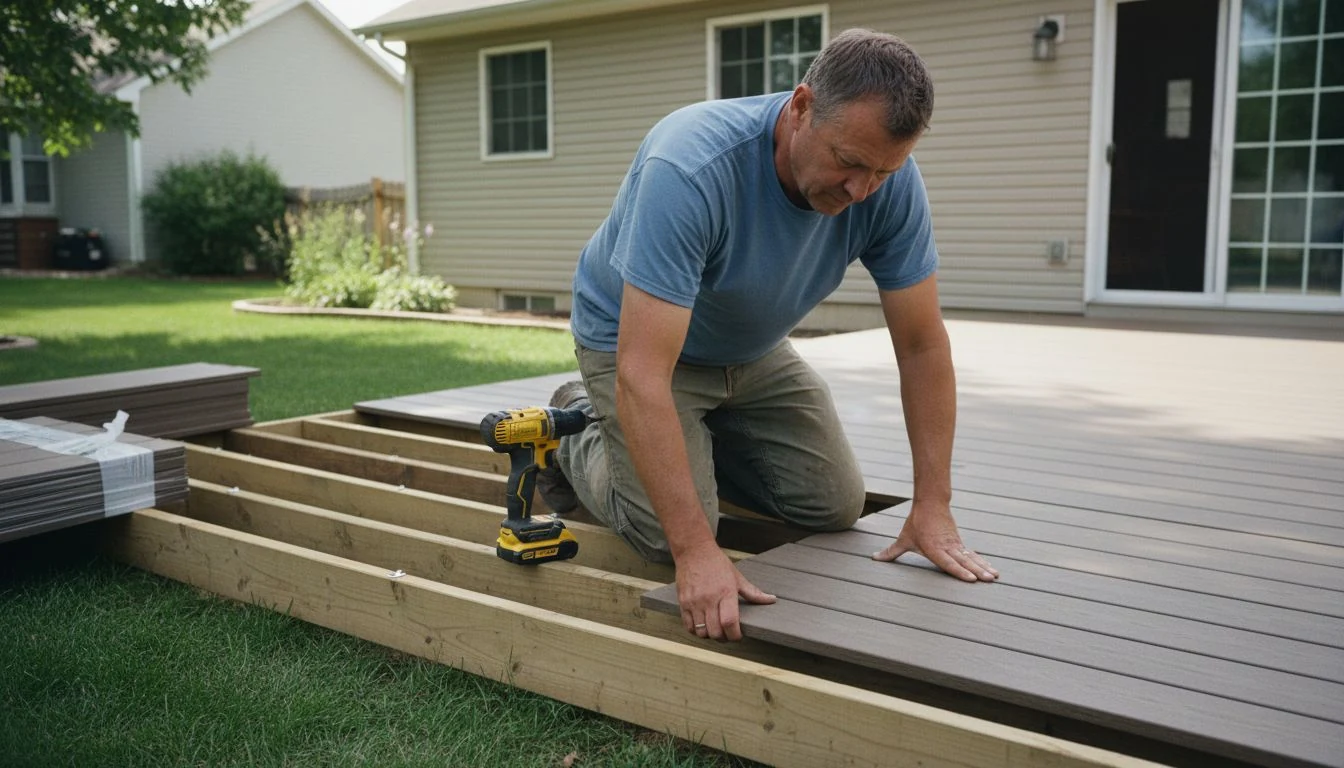
Year three, north corner of my deck, on my knees with a bucket and a stiff brush. The boards had a green film on them that a hose would not touch. I bought these because the box said no sanding, no staining, no sealing. Nobody printed the word “scrub” anywhere on it.
Low maintenance composite decking runs about $35 to $70 per square foot installed with a new frame under it in 2026, and the real upkeep is roughly two hours and a $25 jug of deck cleaner a year. That is a good trade against a weekend of staining. It is not zero. And the gap between a capped board and an uncapped one is the single decision that decides which of those two afternoons you get.
Jump to what you need:
- What it costs in 2026
- Capped or uncapped, the whole ballgame
- What you still do every year
- The mold thing nobody mentions
- The frame under it is still wood
- Heat, scratches, and the color you regret
- Composite, or restain what you have?
- The ten-year math
- FAQ
What does low maintenance composite decking cost in 2026?
Two numbers, because people quote them interchangeably and then argue about it.
If you are building new, frame and all, budget $35 to $70 per square foot installed. A 16 by 20 deck, so 320 square feet, lands between $11,000 and $22,000 depending almost entirely on which board line you pick and how far off the ground you are going.
If your frame is sound and you are only swapping the surface, it is far friendlier: $18 to $30 per square foot, because you are buying boards and a day of labor instead of footings, beams and joists. That was my situation. I replaced 320 square feet of tired cedar over an existing frame and the boards, hidden fasteners and fascia came to just under $4,800, with a two-day install on top.
| Board type | Boards only, per sq ft | Installed, per sq ft | What the extra buys you |
|---|---|---|---|
| Uncapped composite | $4 to $7 | $18 to $28 | The cheapest way in. Bare wood flour and plastic, no shell. |
| Capped on 3 sides | $6 to $9 | $24 to $38 | Shell on the top and edges. The bottom is left open. |
| Fully capped, 4 sides | $8 to $13 | $32 to $52 | Sealed all the way around. Better stain and fade warranty. |
| Capped PVC, no wood | $10 to $18 | $40 to $70 | No wood content at all, so nothing inside to feed mold. |
For the whole picture including framing, footings and railing, my full cost to build a deck breakdown puts wood and composite on the same per-square-foot scale.
Capped or uncapped is the whole ballgame
Every composite board is wood flour and recycled plastic pressed into a plank. The showroom leads with the color. Uncapped boards leave that mix bare on every face, while capped boards get a plastic shell extruded over the outside, and the shell is what resists stains, fading and mold. That shell is most of the difference between low maintenance composite decking and a board you end up scrubbing.
Uncapped is first-generation technology sold at a first-generation price. It fades. It stains from a spilled glass of red or a planter left in one spot. And it is the stuff I bought for my north corner, which is exactly why I was out there with a brush.
My take, and I will defend it: if the budget only reaches uncapped composite, buy a smaller capped deck instead. Build 12 by 16 in a capped board rather than 16 by 20 in an uncapped one. You will use the square footage you sit on anyway, and you will not be scrubbing in year three. Shrinking the footprint is the cheapest upgrade on the whole project.
Ask any quote which line the boards come from and whether the cap is on three sides or four. A three-sided cap leaves the underside bare, and the underside is the face that sits over damp ground in the shade.
What low maintenance composite decking still asks of you every year
The honest chore list, from someone who has now done it six times:
- Two real washes a year. Soapy water, a soft bristle brush, a garden hose. Spring, and again once the leaves come down. Call it ninety minutes.
- Sweep the gaps out. Leaves and pine needles pack in there and hold water against the board. Five minutes now saves the two-hour job later.
- Move the planters. Anything sitting flat on a board traps moisture under itself. Mine sit on plastic feet from the garden center now, $8 for a set of four.
- One or two spot treatments. Grill grease, berry stains, a rust ring from a fire bowl. Composite deck cleaner runs $20 to $35 a jug and one jug lasts me two seasons.
Against staining a wood deck, that is nothing. Staining is prep, wait for dry weather, two coats, and a lost weekend, every two or three years. I have written up the whole staining process and I stand by it as a good weekend, but I was ready to stop having it.
“Low maintenance” is a comparison, not a promise. Low compared to stain. Not low compared to a concrete patio, which asks nothing of you at all.
The mold thing nobody mentions at the showroom
This is where my green corner comes in, and it turns out it is not a me problem.
The USDA Forest Products Laboratory has been studying these boards for two decades. The industry’s original assumption was that mixing plastic and wood together would encapsulate the wood and stop both moisture and decay. Their published research on the durability of wood-plastic composite lumber reports that after more than a decade of outdoor exposure, issues surfaced from wood decay, susceptibility to mold, and polymer degradation. Manufacturers responded by adding fungicides and mildewcides to the formulations.
There is wood inside the board. Wood that gets damp and stays damp will grow things, whether it arrives as a plank or as a powder pressed into plastic. The cap keeps water away from that wood, which is why a four-sided cap or a PVC board is worth real money in a shady, damp yard in Ohio and close to nothing in full sun in Arizona.
The mold does not grow because you bought a bad board. It grows where water sits and does not leave. Fix the water and the board is fine.
Practically, that means airflow under the deck, gaps kept clear, and downspouts that do not dump onto the boards. My corner was shaded, badly drained, and had a rain chain emptying two feet from it. All three were free to fix and I fixed none of them for three years.
The frame underneath is still wood, and that is the real maintenance
Composite boards go on top of a frame of pressure-treated lumber. Joists, beams, ledger, posts. That frame is preservative-treated softwood, and it is the part of your deck that can actually hurt someone if it fails.
The EPA’s overview of wood preservative chemicals notes that alkaline copper quaternary, ACQ, is currently the most widely used preservative for residential applications, and that the older chromated arsenical treatment was voluntarily pulled from virtually all residential uses, including decks, at the end of 2003. Treated is not indestructible. It is wood that bugs and fungi find unappetizing, which is a different claim.
Once a year, get under there with a flashlight and a screwdriver. Push the tip into the joists near the ledger and near any post that touches soil. If it sinks in like styrofoam, you have found something worth a phone call. My deck repair cost guide walks through that screwdriver test and what each fix runs.
The cruel joke of composite is that the surface will outlive the frame. People buy a fifty-year board and bolt it to a frame with twenty years in it.
Heat, scratches, and the color you will regret
Things I wish someone had said out loud before I picked a color off a two-inch sample.
Dark boards get hot. Uncomfortably hot in direct afternoon sun, hotter than wood, because the plastic holds heat. If your deck faces west and anyone in your house walks around barefoot, go lighter. It is the regret I hear most often and the cheapest one to avoid, since color costs the same either way.
Composite scratches, and it will not sand out. That is the trade you make for never having to sand it. A dragged grill leg or a dog with long nails leaves a mark you live with. Capped boards hide it better because the shell is tougher. Felt pads under the furniture, and lift things instead of sliding them.
Pressure washing can wreck a board. I opened a fuzzy patch on mine with too narrow a tip held too close. Most warranties cap you near 1,500 PSI with a fan tip a foot away, and mine would not have covered what I did to that plank. When in doubt, use the brush.
Should you go composite, or restain the wood you already have?
If your frame is solid and your boards have five good years left in them, restain them and put the money somewhere else. Low maintenance composite decking is a full surface swap, so it only earns its price once the boards themselves are finished.
Go composite when the planks are cupping, splintering or going soft underfoot, or when the staining cycle has worn you down in a specific and stubborn way. Both are honest reasons. “It pays for itself” is not one of them, and the ten-year table below is why.
You can lay composite yourself over a good frame. Hidden fasteners clip into grooved board edges and go fast. Two real cautions: composite expands and contracts more than wood, so follow the manufacturer’s gapping chart to the sixteenth, and check the required joist spacing, since many composite lines want 12 inches on center where a wood deck was framed at 16. Discovering that after demo is an expensive afternoon. It is where a lot of budget DIY plans quietly die, and the same trap shows up in half the projects in my budget backyard makeover.
What low maintenance composite decking really costs over ten years
Sticker prices are easy to compare. I wanted the year-ten number, so I ran it for the same 320 square foot deck using what I spend on mine plus 2026 installed pricing.
| Deck surface | Installed 2026 | 10-yr upkeep cost | Weekends spent | Total at year 10 |
|---|---|---|---|---|
| Pressure-treated wood, stained | $7,000 | $1,200 | About 8 | $8,200 |
| Cedar, sealed | $9,600 | $1,400 | About 8 | $11,000 |
| Uncapped composite | $12,000 | $350 | About 3 | $12,350 |
| Capped composite | $14,700 | $250 | Under 2 | $14,950 |
Capped composite costs about $6,750 more than stained wood by year ten, and buys back roughly six weekends. That is over a thousand dollars a weekend. Anyone telling you low maintenance composite decking pays for itself inside a decade has not run the row.
The math flips later, around year fifteen to twenty, when the wood deck needs its boards replaced and the composite one does not. That is the real case for it. You are buying your Saturdays back and pushing the next big spend a decade further out. Both are worth paying for. Just buy them on purpose. If you want to see where a deck sits against every other project competing for the same money, my home improvement cost statistics put it in line with the rest of 2026.
What blows the composite budget
- Joist spacing you did not check. Composite lines that require 12 inches on center over a frame built at 16 mean sistering in extra joists. Add $800 to $2,000 on a mid-size deck, discovered after the old boards are already in the dumpster.
- Railing bought as an afterthought. Matching composite railing runs $60 to $110 per linear foot installed. On a 320 square foot deck that is easily $3,000, and it is quoted separately often enough that people miss it.
- Fascia, trim and stair treads. The pieces that make it look finished are priced per piece, not per square foot. Stairs alone can add $900. Ask for these as line items or your bid comparison is not comparing the same deck.
Grab my free Project Cost Estimator. Put in your square footage, your board tier and whether the frame stays, and you will walk into every quote already knowing your own fair range. It is the sheet that caught the railing sitting outside one of my three bids.
Frequently Asked Questions
Is composite decking really maintenance free?
No. The honest label on low maintenance composite decking is low, not none. Plan on two washes a year with soap, water and a soft brush, keeping the board gaps clear of leaves, and lifting anything that sits flat on the surface. That is around two hours and a $25 jug of cleaner a year, against a full weekend of staining every two or three years on wood. Capped boards need less than uncapped ones because the shell keeps water out of the wood inside.
Does composite decking get mold?
It can. There is wood flour inside the board, and USDA Forest Products Laboratory research documents mold and decay showing up in wood-plastic composites after a decade of outdoor exposure, which is why manufacturers now add mildewcides. Mold grows where water sits and does not drain, so shaded corners, packed gaps and downspouts emptying onto the deck are the usual culprits. Fully capped or PVC boards are the better buy in a damp, shady yard.
How long does low maintenance composite decking last?
Expect 25 to 30 years from a good capped board, with warranties often running 25 to 50 years on fade and stain. The catch is that the pressure-treated frame under it usually has 15 to 25 years in it, so the surface tends to outlive the structure. Check your joists with a screwdriver once a year, especially at the ledger and anywhere a post meets soil.
All prices here are 2026 estimates and vary by region, deck size, board line, height off the ground and installer. Tessa is a hands-on homeowner, not a licensed contractor; use these ranges to ask sharper questions and confirm figures with local pros and your manufacturer’s own installation and warranty documents.
Free DIY Project Cost Estimator
The spreadsheet I use to price out a project before I start, so a weekend job never blows the budget. Join the newsletter and I’ll send it over.
No spam, ever. Unsubscribe anytime. — Tessa
Keep reading — more on Exterior & Structural Costs

Gutter Cleaning Cost: What I Paid, and the Month It Stops Being Optional
Gutter cleaning cost in 2026 runs $120 to $425 for most houses. Real quote numbers, what…
Read article →
Foundation Repair Cost in 2026: The Crack That Matters and the One That Does Not
A man in a branded polo put a level against my basement wall, made a face…
Read article →
Roof Repair Cost in 2026: What It Costs by What Actually Broke
The stain showed up on the upstairs hallway ceiling the morning after a March storm, about…
Read article →
Garage Door Spring Replacement Cost in 2026 (and Why I Do Not DIY This One)
It sounded like a rifle going off in the garage at 6:40 on a Tuesday morning.…
Read article →