
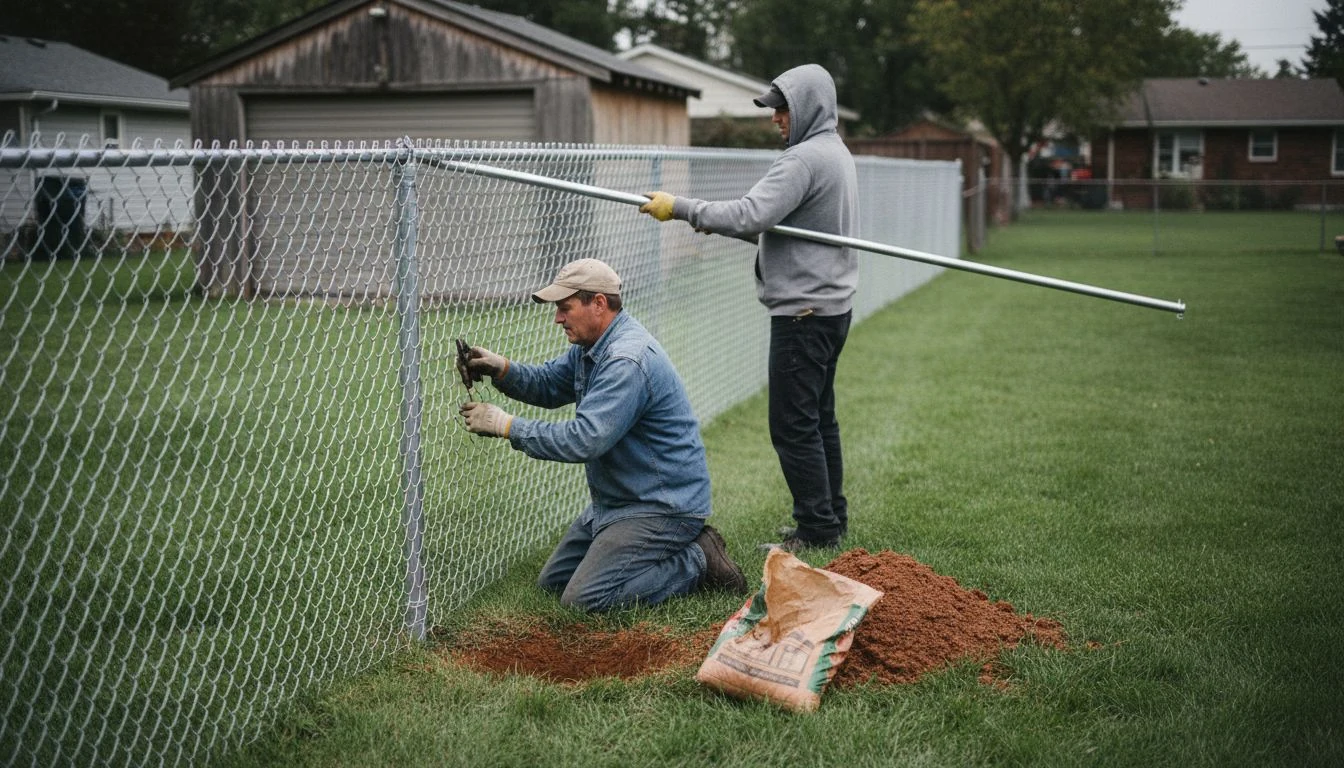
The first bid I got for the back corner of my lot was $4,900. The second was $2,650. Same 150 feet, same four-foot fence, same lumpy yard. I sat in my kitchen with both sheets side by side for an hour before I found the difference, and it was not the fence at all. It was two gates and a wire gauge I had never heard of.
The number you came for, up front. The chain link fence cost to install in 2026 runs about $12 to $28 per linear foot with a crew doing the work, which puts a typical 150-foot yard somewhere between $2,000 and $4,200. A short four-foot run around a dog area can land near $1,800. Six feet of nine-gauge with a drive gate can pass $5,000. But that per-foot figure hides what moves your bill: how tall the fence is, how many corners you have, and whether a vehicle needs to drive through it.
Jump to what you need:
- What chain link costs to install in 2026
- Cost per linear foot, by height and gauge
- Galvanized or vinyl coated
- The posts nobody counts
- The gate that blows up the quote
- Can you install it yourself?
- Permits, property lines, and the free call
- What 150 feet is made of
- FAQ
What does chain link fence cost to install in 2026?
Most homeowners pay $12 to $28 per linear foot installed. The national middle sits around $18 a foot for a standard four-foot galvanized residential fence, which is why so many quotes for an average yard land in that $2,400 to $3,000 band.
By yard size, before gates:
- 100 feet (a dog run or a side yard): $1,200 to $2,800
- 150 feet (a typical suburban backyard): $1,800 to $4,200
- 250 feet (a full perimeter on a quarter acre): $3,000 to $7,000
The split is the part that surprised me. On chain link, labor is roughly half the bill, sometimes more. Materials for my 150 feet came to a little under $2,000 with two gates, and the $2,650 bid meant the crew was charging me about $700 to dig, set, stretch, and hang it in a day and a half. That is fair money for that work. The $4,900 bid was not a scam either. It was priced with nine-gauge fabric and a ten-foot drive gate I had asked about in passing and then forgotten I asked about.
Chain link is still the cheapest real fence you can buy. If you want the whole comparison across wood, aluminum, and vinyl, my full fence installation cost breakdown by material puts every option on the same per-foot scale. Chain link almost always wins on price and almost always loses on looks. That trade is the entire decision.
Chain link fence cost to install per linear foot, by height and gauge
Two numbers drive the per-foot price, and only one of them is obvious. Height you already know. Gauge is the wire thickness, and the part that trips people up is this: a lower gauge number means thicker wire. Nine-gauge is beefier than eleven-and-a-half gauge, not thinner.
| Fence spec | Installed, per linear foot | What it is for |
|---|---|---|
| 4 ft, 11.5-gauge galvanized | $12 to $20 | The big-box residential standard. Pets, property line, kids. |
| 4 ft, 9-gauge galvanized | $15 to $24 | Same height, thicker wire. Big dogs that lean on things. |
| 5 ft, 11-gauge galvanized | $15 to $24 | The in-between height most people skip and then wish they had. |
| 6 ft, 11-gauge galvanized | $18 to $28 | Privacy-height perimeter, jumping dogs, pool codes. |
| 6 ft, 9-gauge galvanized | $22 to $34 | Commercial grade. Overkill for most backyards. |
| 6 ft, 9-gauge black vinyl coated | $25 to $40 | When you want it to disappear into the tree line. |
| 8 ft, 9-gauge galvanized | $30 to $48 | Sports courts, storage yards, serious containment. |
Going from four feet to six feet does not cost fifty percent more, even though you are buying fifty percent more fabric. It usually costs about thirty to forty percent more, because the digging and the post setting are nearly identical. If you are on the fence about height, so to speak, the upgrade is cheaper than it looks. Going from eleven-and-a-half gauge to nine-gauge adds roughly $3 to $6 a foot and buys you a fence that shrugs off a dog throwing its weight into it.
Galvanized or vinyl coated, and what you are really paying for
Galvanized is the silver stuff everyone pictures. Vinyl coated is the same steel core dipped in a polymer skin, almost always black, sometimes dark green. The coating adds about $4 to $10 per linear foot to your chain link fence cost to install, which on 150 feet is $600 to $1,500 for a color change.
I paid for the black coating on the section that faces my patio and left the rest galvanized, and I would make that call again. Black chain link recedes. Stand twenty feet back and your eye reads the trees behind it instead of the fence. Silver does the opposite. It catches light and announces itself.
The durability argument for vinyl coating is weaker than the sales pitch. A good galvanized fence lasts fifteen to twenty years, and a coated one maybe twenty to thirty, but only if the coating never gets nicked. Once you scrape through it with a mower deck or a shovel, water sits in that scratch and rusts the core from the inside. My honest read: buy the coating because you want the look, not because you are buying decades.
The posts nobody counts, and why they cost three times a line post
This is the part of the quote I did not understand until I priced the parts myself, and it is where quotes diverge.
A chain link fence has two kinds of posts. Line posts are the skinny ones every ten feet that just hold the fabric up. Terminal posts are the fat ones at every corner, every end, and both sides of every gate, and they are the ones that take the strain when the fabric gets stretched tight. A line post runs about $14 to $20. A terminal post runs $35 to $55, needs more concrete, and takes longer to set.
So a straight 150-foot run along a back property line might need thirteen line posts and two terminals. The same 150 feet wrapped around a yard with four corners and two gates needs nine terminals. Same footage, same fabric, several hundred dollars apart. Corner count is the quietest driver of chain link fence cost to install, and it never shows up as its own line. When two bids on the same yard are far apart, count the corners before you assume someone is gouging you.
My mistake, and I will own it: I described my yard to the first estimator over the phone as “about 150 feet, pretty square.” It was not square. It had a jog around the utility easement that added two corners, which he found when he walked it and repriced. Walk the line with the estimator. Every time.
The gate is the line item that blows up the quote
A four-foot walk gate is $150 to $400 installed. A ten-foot double drive gate is $600 to $1,500 installed. That is not a typo, and it is the single most underestimated number in this whole project.
Why so steep? A drive gate needs two oversized gate posts set deeper and in more concrete, because they carry a swinging load all day for twenty years. It needs heavier frame tubing so a ten-foot span does not sag. It needs a drop rod, a latch, and hinges rated for the weight. You are not buying a wider walk gate. You are buying a different object.
Price your gates first, before you fall in love with the per-foot number. Two gates can be fifteen percent of the total chain link fence cost to install. And if you only need to get a mower through, a five-foot single gate does that for a third of what a drive gate costs.
Can you install a chain link fence yourself?
Yes, more so than with most fence types, and you cut the chain link fence cost to install by roughly forty to fifty percent. On my 150 feet, doing it myself would have put materials near $2,000 against that $2,650 installed bid. That is a thin margin for a hard weekend, which is exactly why I hired it out and do not regret it.
But the work splits into pieces of very different difficulty, and you can buy back real money by taking only the easy half:
- Demo and haul-off. Pulling the old fence yourself saves $400 to $1,200 and requires no skill, only a truck and a bad afternoon. Easiest money on the list.
- Clearing the line. Cutting back brush and moving the woodpile so the crew is not billing you to landscape. Free to do, and estimators quietly pad for mess.
- Digging and setting posts. Doable, but every hole has to be plumb and at the right depth, and the concrete has to cure before anything else happens. Get one post wrong and the whole run tells on you.
- Stretching the fabric. This is the actual skill. It takes a come-along and a stretcher bar to pull chain link drum-tight, and a fence that is not tight sags and waves within a season. This is the step most DIY chain link fails at.
If you do hire out, get more than one written estimate and read the contract before anything gets dug. The FTC’s guidance on how to avoid a home improvement scam is blunt about the warning signs, and two of them show up constantly in fence work: a contractor who wants the whole amount up front or in cash, and one who asks you to pull the permits. It also makes the point I wish more people took seriously, which is not to default to the lowest bidder. When a fence bid comes in far under the others, something got left off the sheet. My guide to telling whether a contractor quote is fair walks through how to line two bids up when they do not list the same items, and what a general contractor costs is worth a look if the fence is one piece of a bigger yard project.
Permits, property lines, and the free call you have to make first
Most towns require a permit for a fence, and it is usually cheap, somewhere between $25 and $150. What matters more is what the permit process forces you to confirm: your setback from the property line, your maximum allowed height in a front yard versus a back yard, and which side of the fence has to face your neighbor.
Do not eyeball the property line. I know someone who set fourteen posts three feet inside a neighbor’s lot and paid to move every one of them. If your corner pins are missing, a survey is $400 to $900 and is cheaper than the alternative.
And before a single post hole gets dug, call 811. The national 811 before-you-dig service is free, run nationwide, and it explicitly lists installing fences as a project that needs a locate request. You call or file online a few business days ahead, and the utilities come mark their buried lines with paint and flags. Chain link post holes go two to three feet down, which is exactly the depth where gas and electric lines live. That call is free. Hitting a line is not.
What chain link fence cost to install covers: the 150-foot parts list
Every cost guide gives you a per-foot range and stops. What I wanted while I was comparing those two bids was the parts list underneath them. This is a real takeoff for 150 feet of four-foot galvanized eleven-and-a-half gauge with one walk gate and one drive gate, on a yard with four corners.
| Part | How many for 150 ft | Ballpark each | Line total |
|---|---|---|---|
| Line posts, 1-3/8 in. | 13 | $16 | $208 |
| Terminal and corner posts, 2-3/8 in. | 6 | $42 | $252 |
| Gate posts, 2-7/8 in. | 3 | $58 | $174 |
| Chain link fabric, 4 ft x 50 ft rolls | 3 | $105 | $315 |
| Top rail, 10.5 ft lengths | 15 | $17 | $255 |
| Tension bars, brace bands, rail ends, caps, tie wire | 1 lot | $175 | $175 |
| Concrete, 60 lb bags | 38 | $6.50 | $247 |
| Walk gate, 4 ft with hardware | 1 | $110 | $110 |
| Double drive gate, 10 ft with hardware | 1 | $385 | $385 |
| Materials subtotal | 150 linear ft | 2 gates included | $1,921 |
Read that table next to any bid you get. If a quote is $4,900 and the materials are $1,900, you are being asked for $3,000 in labor on a day and a half of work, and you have earned the right to ask why. Maybe the answer is good, like rocky ground or hauling the old fence. Maybe it is not.
What blows the chain link budget
- The drive gate you mentioned once. It gets scoped into the bid whether or not you decided on it, and it is $600 to $1,500 sitting quietly inside a per-foot number. Ask which gates are in the price and have them listed separately.
- Corners you did not count. Every corner is a terminal post at triple the price of a line post plus extra concrete. A yard with a jog around a shed or an easement can carry four more terminals than the estimator assumed from your phone description.
- Ground that fights back. Rock, tree roots, and old buried concrete turn a fast auger job into hand digging, and almost every fence contract has a clause letting them reprice for it. Walk the whole line and point at the ugly spots on purpose before anyone bids.
Grab my free Project Cost Estimator. Before an installer walks your property line, plug in your linear footage, height, corner count, and gates so you meet every bid already knowing your own fair range. It is the same one-page sheet that caught the drive gate one company had folded silently into a per-foot price.
If the fence is one piece of a bigger yard plan, it helps to see the number in context. My vinyl fence installation cost breakdown is the fair comparison when you want privacy instead of containment, a budget backyard makeover covers what to do with the space once it is enclosed, and the wider home improvement cost statistics show where fencing sits against everything else people spend on in 2026.
Frequently Asked Questions
How much does it cost to install 150 feet of chain link fence?
Roughly $1,800 to $4,200 installed in 2026, with most four-foot galvanized jobs landing near $2,400 to $3,000. Materials alone run close to $1,900 for that footage with two gates, so labor is about half of the chain link fence cost to install. A six-foot fence, nine-gauge wire, a drive gate, or a yard with many corners each push you toward the top of the range.
Is chain link cheaper than wood fence?
Yes, and it is not close. Chain link installs for about $12 to $28 per linear foot against $15 to $30 for basic wood, and the gap widens over time. Wood needs staining or sealing every few years and lasts ten to fifteen. Galvanized chain link needs almost nothing and lasts fifteen to twenty. You are trading appearance for both a lower sticker and a lower cost of ownership.
How deep do chain link fence posts need to go?
Plan on a third of the post length in the ground, which is about two feet for a four-foot fence and closer to three for a six-foot one, and always below your local frost line. Terminal and gate posts get wider holes and more concrete than line posts because they carry the tension and the swinging weight. Call 811 first, since those depths are where buried utility lines sit.
All prices here are 2026 estimates and vary by region, yard conditions, corner count, and installer. Tessa is a hands-on homeowner, not a licensed contractor; use these ranges to ask sharper questions and confirm figures with local pros. And whatever you do, call 811 before you dig.
Free DIY Project Cost Estimator
The spreadsheet I use to price out a project before I start, so a weekend job never blows the budget. Join the newsletter and I’ll send it over.
No spam, ever. Unsubscribe anytime. — Tessa
Keep reading — more on Exterior & Structural Costs

Gutter Cleaning Cost: What I Paid, and the Month It Stops Being Optional
Gutter cleaning cost in 2026 runs $120 to $425 for most houses. Real quote numbers, what…
Read article →
Foundation Repair Cost in 2026: The Crack That Matters and the One That Does Not
A man in a branded polo put a level against my basement wall, made a face…
Read article →
Roof Repair Cost in 2026: What It Costs by What Actually Broke
The stain showed up on the upstairs hallway ceiling the morning after a March storm, about…
Read article →
Garage Door Spring Replacement Cost in 2026 (and Why I Do Not DIY This One)
It sounded like a rifle going off in the garage at 6:40 on a Tuesday morning.…
Read article →