
The stain showed up on the upstairs hallway ceiling the morning after a March storm, about the size of a coffee saucer and the color of weak tea. Nothing was dripping. It just sat there being brown.
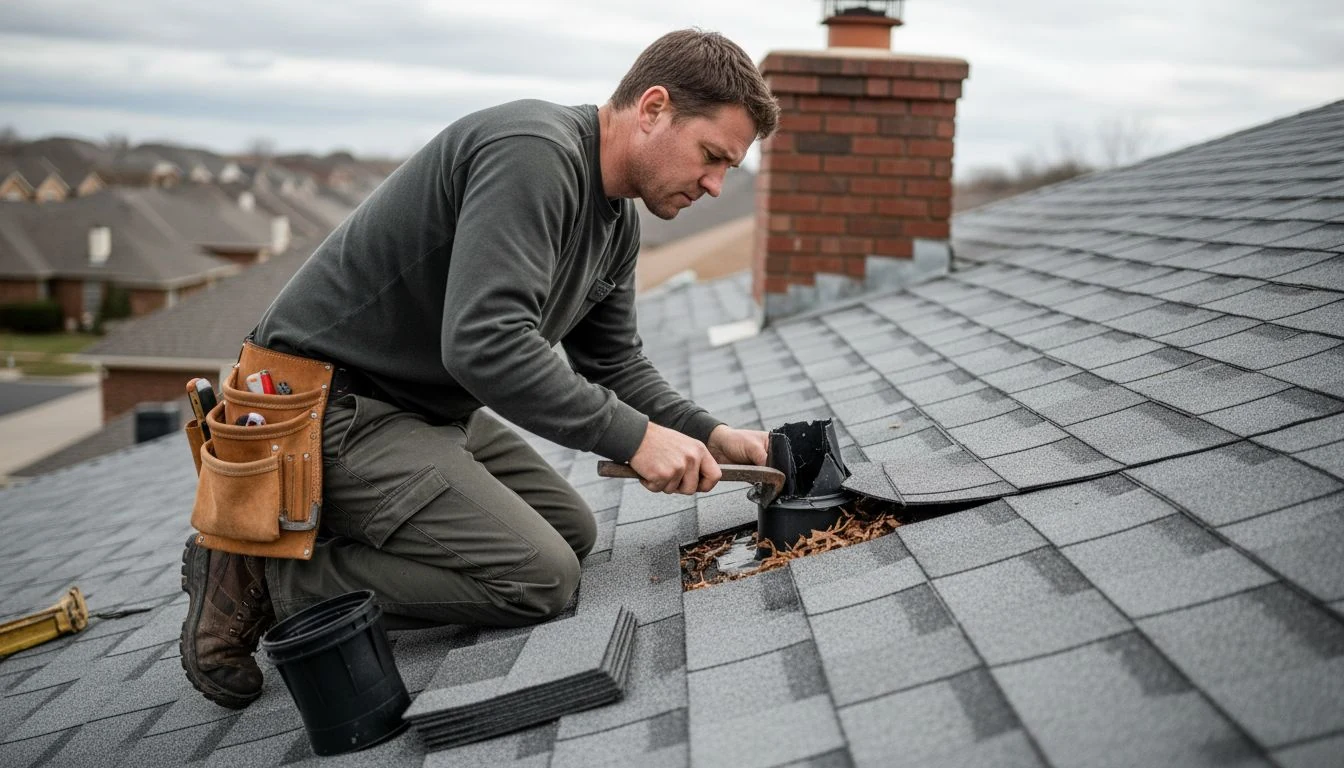
The first roofer I called stood in my driveway for four minutes, looked up, and said I needed the whole thing done. Fourteen thousand dollars, held until Friday. What broke was a cracked plastic vent boot the size of my hand, and the second company charged me $285 to replace it.
Roof repair cost in 2026 runs about $150 to $450 for a small single-point fix and $400 to $1,500 for most real repairs, and the number depends almost entirely on which component failed, not on how big your roof is. That is the part nobody tells you while they are quoting you a replacement.
Below is what each failure costs on its own, why the stain on your ceiling is almost never under the hole, the three-line version of the repair-or-replace question, and the mistake I made that turned a $285 job into a $700 one. I am not a licensed roofer. I am the homeowner who tried to caulk her way out of this and paid for it twice.
Jump to what you need:
- What it costs in 2026
- Start with what broke, not the roof
- Cost by the thing that failed
- Why the stain is not under the hole
- Repair or replace, in three lines
- The guy who knocks after the hailstorm
- What I fixed and what I stopped doing
- Cost by scenario, and a fair quote
- FAQ
What roof repair cost actually looks like in 2026
Most roof repairs are small. That is the whole secret. A roof is not one object, it is a field of shingles plus about six places where something pokes through it, and it is almost always one of those six places that fails first.
$150 to $450 covers a small fix: a handful of blown-off shingles, one pipe boot, a loose ridge cap.
$400 to $1,500 is where most honest repairs land once somebody has to find the source, open something up, and close it back correctly.
$1,500 and up usually means the water has been getting in for a while and the plywood underneath is soft, or the repair is structural.
There is also a floor you should know about before you call. Most roofing companies have a minimum charge of roughly $150 to $350 just to put a truck and two people on your street, so a $40 part does not produce a $40 invoice. That is not a scam. It is the reason it is worth bundling three small things into one visit instead of calling three times, which is exactly what I did not do.
These are 2026 estimates and they move hard with your region, your roof pitch and how many stories up the work is. A walkable ranch roof in Missouri and a steep third-story dormer in Seattle are two different invoices for identical shingles.
Start with what actually broke, not with the roof
Here is the reframe that saved me thousands, and it took a leak and a bad quote to learn it.
When you ask “how much does a roof cost,” every answer you get is a replacement answer, because that is the question the industry is built to answer. When you ask “what does it cost to replace a cracked vent boot,” you get a number under $400 and a much shorter conversation.
So before you call anybody, go stand in the yard with your phone and zoom in. You are looking for one of a very short list of things: shingles missing in a patch, a shingle field that looks bald or gravelly, the metal collar around a chimney or a wall, the rubber collar around a plumbing pipe, the line where two roof planes meet, or the cap along the peak.
That is basically the whole failure catalog for an asphalt roof. Name the part on the phone and you change what gets quoted. And if you cannot tell from the ground, a paid inspection at $100 to $400 from somebody who does not sell roofs is the cheapest money in this entire article.
Roof repair cost by the thing that failed
Each line below is a discrete repair, not a share of a bigger job. The right column is the part that catches people out, because a repair that is cheap in isolation gets expensive when it has been leaking quietly since last spring.
| What failed | Typical 2026 repair | How common | What makes it cost more |
|---|---|---|---|
| Pipe or vent boot cracked | $150 to $400 | Very common | Rot under it, tile or metal roof |
| Shingles blown off, small patch | $175 to $500 | Very common | Discontinued color, steep pitch |
| Step or chimney flashing re-done | $300 to $1,000 | Common | Masonry work, counterflashing cut in |
| Valley leak repaired | $400 to $1,200 | Common | Shingles woven, decking soft |
| Ridge cap or ridge vent | $250 to $800 | Common | Long ridge run, storm damage |
| Skylight reflashed or resealed | $300 to $900 | Occasional | Unit itself failed, not the flashing |
| Decking sheet replaced | $70 to $150 per sheet | Occasional | Every soft sheet found once opened |
| Fascia or soffit rot at the edge | $300 to $1,200 | Occasional | Gutter was overflowing for years |
| Ice dam damage at the eave | $400 to $1,200 | Cold climates | Attic insulation is the real cause |
| Emergency tarp after a storm | $200 to $700 | Storm season | Night call, second story, wind |
| Diagnostic leak hunt, source unknown | $150 to $500 | Common | Often credited if you approve work |
| Sagging or structural framing | $1,500 to $8,000 | Rare | Not a repair, this one is a project |
Read that table once more with the “what makes it cost more” column in mind. Almost every line that pushes roof repair cost upward is time, not materials. The boot is a $15 part. What you are paying for is somebody finding it, getting to it safely, and cutting shingles back far enough to lay the new collar under the course above instead of smearing sealant over the top.
The stain on your ceiling is almost never under the hole
This is the single most useful thing I know about roofs, and I learned it standing in my hallway pointing at the wrong spot.
Water gets in at the failure, lands on the underside of the plywood, and then runs downhill along a rafter until it hits something that stops it. It can travel eight or ten feet before it soaks through drywall and shows up as a stain. My boot was almost directly above the bathroom, one room over.
Which means two things for your money. First, nobody can price roof repair cost off the location of your stain without going up and looking. Second, when the invoice comes, expect the drywall to be its own line item and its own trade, because it is. Patching and repainting a ceiling stain runs roughly $150 to $600 depending on size, and it is the part everyone forgets to budget.
Grab my free Project Cost Estimator. Put in the component that failed, your metro and your roof pitch, and you walk into the second call already holding your own fair range. When there is a brown ring spreading on your ceiling and somebody is standing in your driveway quoting five figures, having a number in your hand before they arrive is the entire negotiation.
Repair or replace, in three lines
You do not need a philosophy for this. You need three questions.
Is the roof under about fifteen years old, is the damage confined to one area, and are the shingles elsewhere still flat and holding their granules? Three yeses means repair, and anybody selling you a replacement is selling, not diagnosing. If the field is curling and shedding grit into the gutters, or you are on your third repair in two years, or the decking is soft in more than one place, you have crossed over and you should be pricing the whole thing.
That is the entire decision. The full numbers for the other side of it live in my roof replacement cost breakdown, and it is a completely different budget with a completely different set of traps. If you are weighing it against the other big-ticket items competing for the same money, I keep the whole-house view in my home renovation cost guide.
The guy who knocks on your door after the hailstorm
Three days after that March storm I had two separate people at my door offering free roof inspections. Neither had a truck with a name on it.
This is its own industry, and it runs on something true: after hail or high wind there is real damage on a lot of roofs, and insurance does pay for a share of it. The problem is that the incentive is to find damage, and a person on your roof unsupervised with a hammer is in an excellent position to find some.
The Federal Trade Commission lists the tells plainly in its guide on how to avoid a home improvement scam: scammers knock on your door because they are “in the area,” say they have materials left over from a previous job, pressure you for an immediate decision, want everything paid up front or only in cash, and ask you to get the required building permits. That last one is the quiet giveaway. A licensed contractor pulls the permit in their own name because their license is what is on the line.
The FTC’s other line is the one I keep taped to the inside of my head: do not pay the full amount for the project up front, and never make the final payment until the work is done and you are satisfied with it. On a $400 repair that means you pay when it is finished. The same read applies to every trade, and I walk through how I score a written quote line by line in my guide to telling a fair contractor quote from a padded one.
What I fixed myself, and what I stopped doing
I have replaced faucets, patched drywall and painted my own cabinets. So of course my first move on the vent boot was a tube of roof sealant and a Saturday.
I got up there in sneakers, on a ladder that was maybe a foot shorter than it should have been, and I laid a fat ring of black sealant over the crack. It held for about eleven months. Then the stain came back at twice the size, and by then the plywood had gone punky and the ceiling needed patching and repainting on top of the actual repair. My $9 tube of caulk cost me somewhere around $700 all in, because sealant on top of a failed boot does not stop water. It just hides it while it keeps going.
That is the honest rule I landed on. Anything you can reach from the ground or from a ladder without stepping onto the roof surface is fair game: clearing the gutters, cutting back the branch that is dragging on the shingles, screwing a loose downspout back on. Once your feet are on the roof, the math changes.
OSHA is blunt about why. Its Fall Prevention Campaign states that falls are the leading cause of death in construction, and that in 2024 there were 389 fatal falls to a lower level out of 1,034 construction fatalities. Those are trained people wearing harnesses on a workday. I was a homeowner in sneakers on a damp March morning holding a caulk gun.
Gutters are the one adjacent job I do still handle myself, mostly because a gutter that overflows all winter is how fascia rot starts in the first place, and I priced that whole system out in my gutter installation cost guide.
2026 roof repair cost by scenario, and what a fair quote looks like
The first table prices components once somebody has diagnosed them. This one runs roof repair cost the other way round, from the thing you are staring at, which is the only information you have while the phone is ringing.
| What you are seeing | What it usually is | Fair range | Watch for |
|---|---|---|---|
| Brown ring on the ceiling, no drip | Slow leak at a penetration | $300 to $900 plus drywall | Quoted from the ground |
| Shingles in the yard after wind | Patch, matching the field | $175 to $500 | Told the color no longer exists |
| Water stain on the wall by the chimney | Flashing, not shingles | $300 to $1,000 | Sealant sold as a flashing repair |
| Drip that only appears in driving rain | Wind-driven, often a valley | $400 to $1,200 | Nobody hose-testing before quoting |
| Hail two nights ago, stranger at the door | Possibly nothing at all | Insurance claim, not cash | Free inspection, no company name |
| Icicles and a wet spot at the eave | Ice dam, an attic problem | $400 to $1,200 | Repeat repair with no insulation fix |
| Ceiling actively dripping right now | Tarp first, repair after | $200 to $700 to tarp | Being sold a full roof at midnight |
| Third leak in two years, granules in gutter | The roof is done, not broken | Price a replacement instead | Paying for a fourth repair |
What blows the roof repair budget
- Sealing over the problem instead of replacing the part. Caulk buys you a season and lets the decking rot underneath, so the second bill includes plywood and a ceiling. That is my $9 tube turning into roughly $700, and it is the most common self-inflicted wound on this list.
- Calling three times for three small things. Most companies charge a $150 to $350 minimum per visit, so the loose ridge cap, the cracked boot and the bent flashing should go on one work order. Walk the roof with them once and get everything listed.
- Approving a replacement during a leak. Nobody makes a good five-figure decision with a bucket in the hallway. Get it tarped or patched, then collect two written quotes on a dry week when you can actually read them.
Frequently Asked Questions
How much does roof repair cost on average?
Most 2026 repairs land between $400 and $1,500, with small single-point fixes like a cracked vent boot or a few blown-off shingles running $150 to $450. Flashing and valley work sits in the middle at $300 to $1,200. Expect a minimum service charge of roughly $150 to $350 on any visit, and add $150 to $600 if a stained ceiling needs patching and repainting.
Why is my roof leaking in one spot but the stain is somewhere else?
Water enters at the failure, lands on the underside of the decking and runs downhill along a rafter until something stops it, which can be eight or ten feet from where it got in. That is why a repair quoted from your driveway based on where the stain is means nothing. Anyone pricing the job should be up on the roof, in the attic, or both.
Is it cheaper to repair a roof or replace it?
Repair, until it is not. If the roof is under about fifteen years old, the damage is confined to one area, and the rest of the shingles are still flat and holding their granules, repair is the right call and costs a fraction of replacement. Once you are on your third repair in two years, or the decking is soft in more than one place, you are renting time on a roof that is finished.
Can I repair a roof leak myself?
You can reach a lot from a ladder without stepping onto the roof, and that part I do myself. The roof surface is a different matter: OSHA reports 389 fatal falls to a lower level in construction in 2024, and those are trained crews in harnesses. Beyond the risk, a sealant patch over a failed component usually just hides the leak while the plywood underneath rots, which is how a cheap fix turns into an expensive one.
Does homeowners insurance cover roof repair?
Generally it covers sudden damage from a covered event like wind or hail, and generally it does not cover wear, age or a leak you left running. Deductibles for wind and hail are often a percentage of the home’s insured value rather than a flat amount, so a $600 repair may sit entirely under your deductible. Read your own policy before you let anybody file a claim on your behalf.
If you want the wider picture on where a repair like this sits against everything else a house asks for in a year, I keep the running numbers in my home improvement cost statistics roundup.
All prices here are 2026 estimates and vary by region, labor rates, roof pitch, story height, material and how long a leak has been running before it was found. Tessa is a hands-on homeowner, not a licensed roofing contractor or an insurance adviser. Work performed on a roof surface carries a real fall risk and belongs to a trained, insured crew. Use these ranges to ask sharper questions and to compare two written quotes.
Free DIY Project Cost Estimator
The spreadsheet I use to price out a project before I start, so a weekend job never blows the budget. Join the newsletter and I’ll send it over.
No spam, ever. Unsubscribe anytime. — Tessa
Keep reading — more on Exterior & Structural Costs

Gutter Cleaning Cost: What I Paid, and the Month It Stops Being Optional
Gutter cleaning cost in 2026 runs $120 to $425 for most houses. Real quote numbers, what…
Read article →
Foundation Repair Cost in 2026: The Crack That Matters and the One That Does Not
A man in a branded polo put a level against my basement wall, made a face…
Read article →
Garage Door Spring Replacement Cost in 2026 (and Why I Do Not DIY This One)
It sounded like a rifle going off in the garage at 6:40 on a Tuesday morning.…
Read article →
Window Trim Replacement Cost in 2026 (Per Window, Inside and Out)
The pry bar went behind the casing on the second-floor bedroom window and the whole bottom…
Read article →