
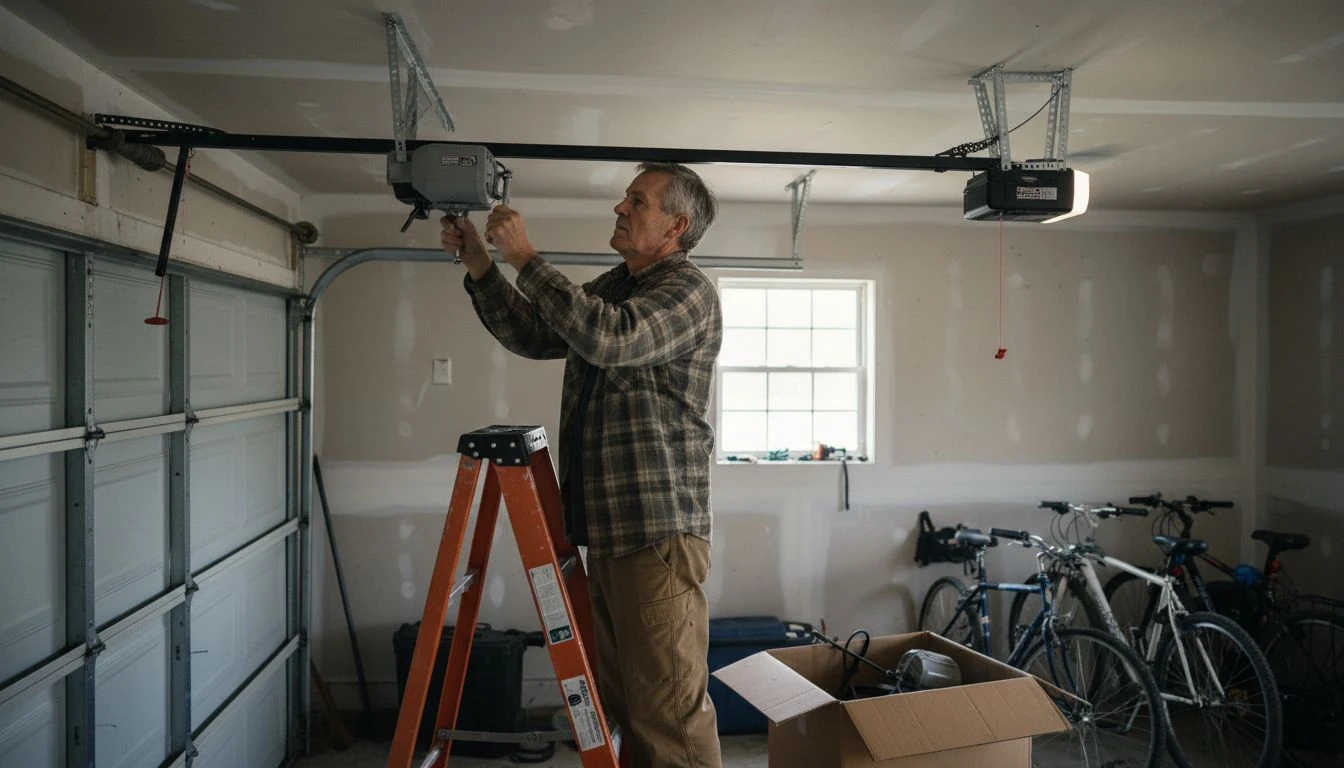
It was raining sideways on a Tuesday in March, and the garage door stopped about knee high with a sound like a blender full of gravel. My car was inside. I was late. I kept pressing the wall button like it owed me money. The motor just hummed and clicked.
I pulled the red emergency cord and lifted the door by hand. The opener was a 1998 chain drive, cover gone yellow.
The garage door opener installation cost in 2026, short version: swapping an old opener for a new chain drive usually runs about $350 to $650 installed. A belt drive is more like $450 to $850, and a wall-mount or fully loaded smart opener can land anywhere from $750 to $1,500. Labor alone, if you already bought the unit, tends to be $150 to $400. These are estimates, and they move with your region and your garage.
Below: what each type costs installed, the three quotes I got (one of them tried to sell me springs I didn’t need), the parts of the job I did myself, and the quote line I’d push back on.
Jump to what you need:
- Garage door opener installation cost in 2026
- Chain, belt, screw and wall-mount prices
- Smart opener installation
- My three opener quotes
- What adds to the labor
- What you can do yourself
- Opener installation cost by job
- Frequently Asked Questions
Garage door opener installation cost in 2026
First, a quick sort, because I mixed these up at the start. The opener is the motor unit on the ceiling, plus the rail, the trolley that rides along it, the wall button, the remotes and the two little safety sensors near the floor. It isn’t the door, and it isn’t the springs either. The springs do the heavy lifting.
That matters because an opener is the cheapest of the three to replace. If your door panels are cracked or the whole thing is falling apart, that’s a different project, and our guide to the cost to replace a garage door has those numbers. If the door is heavy and slams shut when you lift it by hand, you’re probably looking at springs first.
For a straight swap on a standard 7-foot-tall door, these are the numbers I got from the installers who came out and from two neighbors who’d done it in the last year:
- The opener itself: about $150 to $300 for a basic chain drive, $220 to $450 for belt, and $450 to $900 for a wall-mount unit.
- Installation labor: usually $150 to $400 for a replacement, which covers removing the old unit, hanging the new rail, setting the travel limits and force, and testing the safety reverse.
- Small add-ons that show up a lot: haul-away ($25 to $75), an extension kit for an 8-foot door ($40 to $100), a keypad outside ($40 to $90).
A brand new install, where there was never an opener before, costs more. The installer may need to add a ceiling outlet, reinforce the header above the door, or mount angle iron to hang the motor. Figure $600 to $1,200 for that kind of job before you even pick a fancy model.
Chain, belt, screw and wall-mount opener installation prices
The drive type is the biggest decision you’ll make, and it’s mostly about noise.
Chain drive is the old reliable. A metal chain pulls the trolley along the rail. It’s the cheapest, it handles heavy doors fine, and it’s loud. My old one rattled the light fixture in the laundry room, which sits right on the other side of the garage wall. Installed, most quotes land around $350 to $650.
Belt drive works the same way, but with a reinforced rubber belt instead of a chain. It’s much quieter. If anyone sleeps in a room above or next to the garage, this is the one people tend to pick. Installed: about $450 to $850.
Screw drive uses a long threaded rod. Fewer moving parts, decent for heavy doors, but they don’t love big temperature swings and they’re less common now. Installed, roughly $400 to $750.
Wall-mount openers (some installers call them jackshaft or side-mount) bolt to the wall beside the door and turn the torsion bar directly. No rail across the ceiling. They’re the quietest and they free up overhead space for storage or a high ceiling, but they need the right spring setup and enough side room. Installed: about $750 to $1,500.
On horsepower: a 1/2 HP motor (or the DC equivalent) is plenty for most single doors and lighter double doors. Heavy wood or insulated double doors usually get 3/4 HP. One installer told me a bigger motor is not a fix for a door that’s out of balance. It just hides the problem while it wears everything else out. That stuck with me.
Smart opener installation: is the extra worth it?
“Smart” mostly means the opener connects to your Wi-Fi and you can check and close the door from your phone. Most mid-range openers now include it. The bump over a basic unit is often only $50 to $150.
Where it gets expensive is the stuff stacked on top. Built-in cameras, in-garage delivery features, a battery backup, motion-sensing lights, a second keypad. Each one is small. Together, I watched them turn a $500 job into $1,150 on one of my quotes.
For me, the phone app was worth it, because I’m the person who drives two blocks and then wonders if I closed the door. The camera wasn’t. And if your Wi-Fi barely reaches the garage, budget for a cheap range extender, or the smart part won’t work anyway.
Battery backup is worth asking about. It lets the door open during a power outage. California has required it on new openers since 2019, so in some places it’s not optional, and the installer should already know that.
My three garage door opener quotes
Same garage, same week. Two-car attached garage, one 16-by-7 insulated steel door, the original 1998 chain opener, and an outlet on the ceiling that the previous owner had extended with an orange cord stapled to a joist. (I know.)
Quote 1: $1,150 for a smart belt drive “package.” The tech was friendly and fast. He hit the button twice, said my springs were “probably near the end,” and wrote up a smart belt opener with a camera, battery backup, two remotes, a keypad, and a spring replacement for another $420 on top. When I asked him to show me what was wrong with the springs, he said they were “original,” which isn’t a diagnosis. He never pulled the release cord to check the balance.
Quote 2: $385 labor only, if I bought the opener myself. The handyman was upfront about it. I’d pick up a belt drive from the hardware store for around $260, he’d install it, total about $645. Cheap. But he didn’t mention the safety sensors, didn’t mention the extension cord on the ceiling, and said haul-away was “whatever, I’ll leave it by the curb.” I asked about a warranty on his work. He laughed.
Quote 3: $780 all in. This was a small local garage door company a coworker used. The installer pulled the red cord, lifted the door halfway and let go. It stayed put. Springs fine, he said, door balanced, no reason to touch them. He quoted a belt drive with Wi-Fi and battery backup, two remotes, the wall button, new safety sensors, haul-away, and a one-year labor warranty. He also said, without me asking, that the orange cord had to go and I should have an electrician put in a real ceiling outlet, which he wouldn’t do himself.
I took Quote 3. The electrician was another $210 for the outlet, so my total came to $990. Not the cheapest number on the table, but the only one where someone tested the door before telling me what it needed.
Quote 1’s spring line still bugs me. I looked it up afterward, and our garage door spring replacement cost guide explains how to tell if springs need work. Mine didn’t. That would have been $420 for nothing.
What adds to opener installation labor
Two quotes for “a new opener” can be hundreds of dollars apart, and it’s usually because of these. Read every quote for them.
- No outlet near the motor. The opener needs a grounded outlet on the ceiling, close to where the motor hangs. Extension cords are a no. An electrician typically charges $150 to $400 to add one, more if the panel is far away.
- Tall doors. An 8-foot door needs a rail extension kit. A 10-foot door may need a different model entirely.
- First-time installs. No existing header bracket, no mounting hardware, sometimes a ceiling that needs blocking added. That’s extra time.
- An out-of-balance door. A good installer won’t hang a new opener on a door that fights it. If the springs or cables are bad, that work comes first, and it’s a separate line.
- High or unusual ceilings. Vaulted garage ceilings, bonus rooms above, or low headroom can push you toward a wall-mount unit.
- Permits. Most towns don’t require one for a straight opener swap, but some do for new electrical work. Ask who handles it.
The safety sensors aren’t an extra. Federal rules have required openers to reverse on contact since 1991, and the Consumer Product Safety Commission added external protection, like the electric eyes near the floor, in 1993. Their release on the garage door opener rules also tells owners to test the reversing feature every month. Any installer who skips the sensors, or tapes them together so they “stop beeping,” is someone I’d send home.
Watch for a quote that’s mostly upsells, too. Extra remotes, cameras, maintenance plans, “while we’re here” spring jobs. Some of that you may want. Ask for the opener-only price as its own line anyway, then decide on the rest.
What you can do yourself
I’m not a garage door tech, and I didn’t install the opener myself. But there was a surprising amount I could do before anyone came out, and it made the quotes easier to read.
The balance test was the big one. With the door fully closed, I pulled the red release cord so the door was disconnected from the opener. Then I lifted it by hand to about waist height and let go. A balanced door stays roughly where you leave it, or drifts slowly. If it slams down or shoots up, the springs need attention, and that’s a pro job. Springs are under enough tension to break bones. I don’t touch them, and I’d tell anyone else not to either.
Other things I did on one Saturday morning:
- Measured the door height and width with a tape and wrote them down, so I could compare quotes for the same rail length.
- Ran the reversal test on the old opener: a 2×4 laid flat on the floor in the door’s path. It hit the board and kept pushing. That alone told me the 1998 unit had to go, broken motor or not.
- Looked at the ceiling outlet and found the stapled extension cord. Took a photo for the installers.
- Unscrewed the old manual lock bar from the inside of the door, which can jam a new opener if someone flips it by accident.
- Checked how far my Wi-Fi reached by standing in the garage with my phone. One bar. I moved the router closer to the door between the kitchen and garage, and now it’s fine.
Can you install an opener yourself? Plenty of homeowners do. The boxed ones come with instructions and it’s usually a long afternoon, four to six hours for a first-timer, with a ladder and a second person. If your door is balanced, you already have a proper outlet, and you’re comfortable on a ladder holding a motor over your head, it’s a reasonable DIY job and saves the $150 to $400 in labor.
Where I’d stop and call someone: any work on springs, cables or the torsion bar, adding electrical outlets, and wall-mount units, which tie straight into the spring system. And if you do it yourself, the 2×4 reversal test isn’t optional. Run it when you finish and once a month after that.
Ask every opener installer these before you sign. Did you test the door’s balance with the opener disconnected, and what did you find. Is the opener price listed separately from add-ons. What drive type and horsepower are you quoting, and why that one for my door. Are new safety sensors included. Does my door need a rail extension. Is my outlet acceptable, or do I need an electrician. Is battery backup included or required where I live. Will you haul away the old unit. Will you run the reversal test in front of me before you leave. What is the warranty on the motor, and what is the warranty on your labor. Get every answer in writing.
Opener installation cost by job
I put this together from my three quotes, the electrician’s bill, and what two neighbors paid. Use it to read quotes, not as a price list.
| Opener job | Best for | Installed cost (2026 estimate) | What pushes it higher |
|---|---|---|---|
| Labor only, you supply the opener | You already bought the unit | $150 – $400 | First-time install, tall door |
| Chain drive swap | Detached garage, noise doesn’t matter | $350 – $650 | Heavy door, 3/4 HP motor |
| Belt drive swap | Bedroom or living space near the garage | $450 – $850 | Battery backup, extra remotes |
| Screw drive swap | Heavy doors in mild climates | $400 – $750 | Rail extension, haul-away |
| Smart belt with camera and add-ons | Phone control, package deliveries | $700 – $1,200 | Bundled extras you didn’t ask for |
| Wall-mount (side-mount) opener | High ceilings, overhead storage | $750 – $1,500 | Spring setup changes, side clearance |
| New install, no previous opener | Older garages that were always manual | $600 – $1,200 | New outlet, header reinforcement |
What blows the opener installation budget
- Paying for springs you didn’t need. Do the balance test yourself first. If the door stays put halfway, be suspicious of any spring line on an opener quote.
- Skipping the outlet. A cheap install on an extension cord is a fire risk and can void the motor warranty. Add the electrician’s cost to the cheap quote before you compare.
- Buying the opener before anyone measures. A tall door, a heavy wood door, or low headroom can make the unit you bought the wrong one, and returns are a pain.
Before you sign anything, the FTC’s guide on how to avoid a home improvement scam is worth ten minutes. The short version: get it in writing, and hold the final payment until the work is done. If you’re lining up a bigger list of projects around the house, our overview of home renovation costs shows where an opener fits next to the bigger jobs.
The installer came on a Thursday morning, three days after the electrician. Two and a half hours start to finish. Before he left, he laid a 2×4 flat on the floor, hit the button, and the door touched the board and went straight back up. Then he made me do it. Last week, I was standing in line at the grocery store when I remembered I might not have closed it. I opened the app. Closed. I put my phone back in my pocket and paid for the eggs.
Frequently Asked Questions
How much does it cost to install a garage door opener?
In 2026, replacing an existing opener usually costs about $350 to $650 for a chain drive and $450 to $850 for a belt drive, installed. Wall-mount and loaded smart openers can reach $750 to $1,500. Labor alone is often $150 to $400. These are estimates and vary by region and garage.
Is a belt drive worth the extra money over a chain drive?
If a bedroom, office or living room shares a wall or ceiling with the garage, usually yes. Belt drives are much quieter and the price difference is often $100 to $200. For a detached garage where noise doesn’t matter, a chain drive works fine and costs less.
Can I install a garage door opener myself?
Many homeowners do, if the door is balanced and there’s a proper grounded outlet on the ceiling. Expect four to six hours and a helper. Leave springs, cables, new electrical work and wall-mount units to a pro, and run the 2×4 reversal test when you finish and once a month after.
All prices here are 2026 estimates from my own written quotes, an electrician’s bill and what neighbors paid, and they vary by region, door size and weight, drive type and electrical work. Tessa is a hands-on homeowner, not a licensed garage door technician or electrician. Springs, cables, torsion hardware and new wiring should be handled by a qualified pro, and the opener’s safety reverse should be tested after any install or adjustment.
Free DIY Project Cost Estimator
The spreadsheet I use to price out a project before I start, so a weekend job never blows the budget. Join the newsletter and I’ll send it over.
No spam, ever. Unsubscribe anytime. — Tessa
Keep reading — more on Remodel & Renovation Costs
Whole House Humidifier Installation Cost (and Whether You Need One)
Last January the little hygrometer on my bookshelf read 21 percent. I’d bought it for $14…
Read article →
Gas Fireplace Installation Cost: Inserts, Built-Ins, and Venting
My sister Jen has a brick fireplace in her 1962 ranch that she has used exactly…
Read article →
Shower Remodel Cost: Refresh, Walk-In, and Full Tear-Out
My mom called me in August because the floor of her shower had started to flex.…
Read article →
Gas Line Installation Cost: For a Stove, Dryer, Fireplace, or Generator
For nine days last winter, a brand new gas range sat in the middle of our…
Read article →