
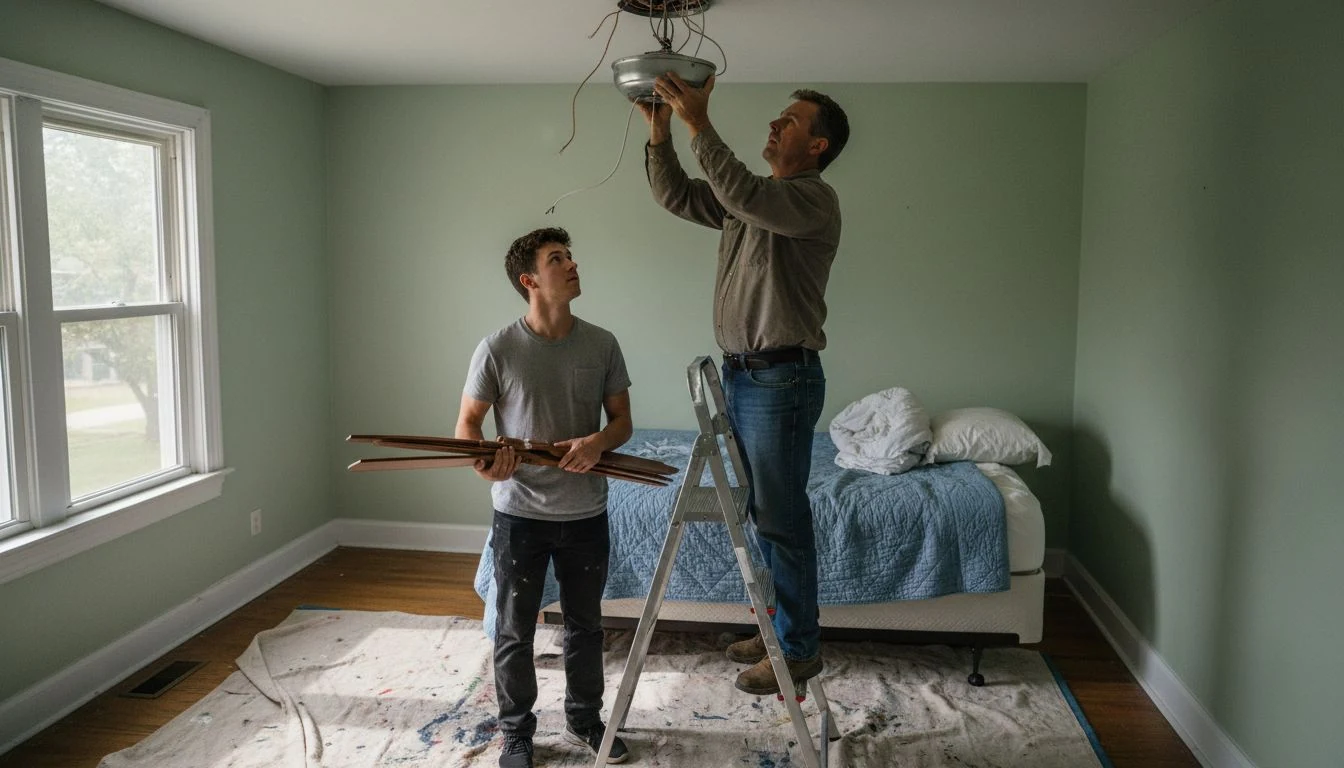
My back bedroom had one light: a frosted glass dome in the middle of the ceiling that turned the room orange and did nothing about the heat. Last August it hit 84 degrees in there at 10 p.m. I slept on the couch for two weeks and decided the dome had to go.
I got three quotes, and the ceiling fan installation cost came back at $185, $340 and $780 for what I thought was the same job. It wasn’t. Across the country, swapping an existing light for a fan usually runs about $150 to $400 in labor, and a brand-new spot with no wiring often lands between $400 and $1,000. The fan itself is extra, anywhere from $60 to $600.
I’m Tessa. I rent half of a duplex, I asked my landlord before touching anything, and I collect quotes the way some people collect mugs. Here’s what each electrician priced, the one box that decides most of the bill, and the part of this job I’d do myself.
Replacing a light vs. installing a fan where nothing exists
There are two very different jobs hiding under the words “install a ceiling fan,” and the gap between them is most of the price.
The easy one is a swap. You already have a ceiling light with a wall switch. The electrician takes the light down, checks the box, hangs the fan and connects the same wires. If the box is rated for a fan, that’s often one to two hours of work.
The expensive one is a new location. There’s no fixture in the ceiling, or the fixture is in the wrong spot. Now someone has to fish cable through the ceiling or the attic, cut in a new box, maybe add a wall switch, and patch the holes. That’s a half day or more.
My bedroom was the first kind. My friend Dani’s living room, where I tagged along for her quotes in September, was the second kind. Her lowest bid was more than four times my cheapest one.
My three ceiling fan quotes, line by line
All three came out on the same Saturday. Same room, same 8-foot ceiling, same 52-inch fan I’d already bought on sale for $139.
Quote one, $185, from a handyman. Take down the dome, hang my fan on the existing box, connect it, haul away the old fixture. When I asked what the box was rated for, he said “it’ll hold.” That answer cost him the job.
Quote two, $340, from a licensed electrician. Same swap, but she pulled the dome down while she was there, looked at the box, and found a round plastic light box held by two drywall screws. She priced in a fan-rated brace box that expands between the joists, plus a fan and light control so I could run them separately off the one switch.
Quote three, $780, from a bigger electrical company. Same brace box, plus a second switch run to the wall so the fan and light would each get their own, a new circuit check, and a “service call” line of $129 that showed up on nothing else.
I took quote two. The second switch would have been nice. It wasn’t worth $440.
The fan-rated box is the line item you can’t skip
A ceiling fan weighs more than most light fixtures, and it wobbles while it runs. A box made for a 6-pound dome light can work loose under a 20-pound fan that’s shaking a little for eight hours a night.
Fan-rated boxes are stamped or labeled for fan support, and the good retrofit kind is a brace bar that slides in through the hole and screws itself tight between two ceiling joists. The part costs about $20 to $45. With labor, adding one usually adds $75 to $200 to the bill.
If your existing box isn’t labeled for fans, that’s money well spent. Mine wasn’t. The electrician held up the old plastic box afterward and the screws pulled out with two fingers.
For the general wiring safety stuff (turn the breaker off, test before you touch), the Electrical Safety Foundation International has plain-language home guides that I’d read before even taking a light down.
What pushes a ceiling fan installation cost up
Once you know whether it’s a swap or a new location, these are the things that moved the numbers in every quote I’ve seen, mine and Dani’s.
Ceiling height. Standard 8 to 9-foot ceilings are the base price. Vaulted or 12-foot-plus ceilings need a taller ladder or scaffold, a downrod, sometimes an angled mount. Expect $75 to $250 more.
Switching. A single switch that runs both fan and light is the cheap setup. Separate wall controls mean running another wire, about $150 to $400. A remote or smart control kit is the cheaper workaround, around $30 to $80 for the part.
Access above. A house with an open attic over the room makes a new location much easier. A second-floor ceiling with a finished room above means cutting and patching drywall. Dani’s quote had $220 of drywall repair and paint in it.
The fan itself. Some electricians charge more to assemble a big fan with five blades, a light kit and a remote. Ask if assembly is included. One of Dani’s quotes wasn’t.
Your panel. If the electrician wants a new circuit and your panel is full, that’s a different conversation. I covered that whole mess in my electrical panel upgrade cost guide. For one fan on an existing lighting circuit, you almost never need it.
How much the fan itself costs
I’d call this the part where people overspend. A basic 42 to 52-inch fan from a big box store runs about $60 to $150. Mid-range fans with a DC motor, a quieter build and a remote are about $150 to $350. Designer fans can go well past $600.
Size it to the room. A small bedroom under about 100 square feet does fine with a 36 to 44-inch fan. My room is about 130 square feet and the 52-inch fan is plenty. Big living rooms want 52 to 60 inches or more.
Check the label. ENERGY STAR says its certified ceiling fans are up to 44% more efficient than conventional ones, mostly from better motors and blade designs. Mine isn’t certified. I bought it on sale before I looked, and I’d check next time.
One thing I wish someone had told me: buy the fan before the electrician comes, or at least have the model number. Two of my three quotes changed once they saw the actual box and its weight on the side.
Can you install a ceiling fan yourself?
If you own your home, the old fixture is already on a fan-rated box, and you’re comfortable turning off a breaker and testing wires, a straight swap is a reasonable weekend DIY. Most fans come with a mounting bracket and instructions written for exactly that. You’d save the $150 to $400 labor.
My rule is that I’d pay a pro if any of these apply: the box isn’t fan-rated, you need a new switch or new wiring, the ceiling is over 10 feet, or the house has old wiring with cloth insulation. Also if you rent. My lease says no electrical work, and my landlord would rather pay $340 once than worry about a fan landing on a tenant.
Here’s what I did do myself: I bought the fan, assembled the blades on the living room floor the night before (that saved about 30 minutes of billed time), cleared the room, and had the ladder and a drop cloth ready. Small stuff, but the electrician was out in an hour and fifteen minutes.
My ceiling fan mistake: the wobble
The fan went up in August. By October it had a wobble on high that made the light kit glass rattle. I assumed the install was bad and almost called the electrician back to complain.
It was the blades. One blade bracket screw I’d tightened the night before had worked loose, and the blades weren’t balanced. The fan came with a little balancing kit (a plastic clip and some stick-on weights) that I’d thrown in the junk drawer. Ten minutes on the ladder, clip on, weight on the light blade, and it runs smooth.
If yours wobbles, check every blade screw first, then use the balancing kit. Then check the box. A wobble that comes back after balancing can mean the mount is loose, and that’s when you call someone.
And yes, the bedroom is cooler now. On the same kind of 84-degree night, with the fan on medium, I sleep in my own bed. It doesn’t drop the temperature. It moves the air over you, and that’s enough. If you’re fighting summer heat without central air, my keep your house cool without AC guide has the cheaper fixes I tried first.
Ceiling fan installation cost by job type, 2026 estimates
These ranges come from my three quotes, Dani’s three quotes and the line items electricians broke out when we asked. They assume a standard home with an accessible ceiling.
| Job | Typical labor | Common extras | Time on site |
|---|---|---|---|
| Swap existing light, fan-rated box already there | $150 to $400 | Haul-away, assembly | 1 to 2 hours |
| Swap plus new fan-rated brace box | $250 to $550 | Brace kit $20 to $45 | 1.5 to 3 hours |
| Swap plus separate wall switch | $350 to $800 | New wire to the switch, wall patch | 3 to 5 hours |
| New location, attic access above | $400 to $900 | New box, cable, switch | Half day |
| New location, finished room above | $600 to $1,200 | Drywall repair and paint $150 to $400 | Half to full day |
| High or vaulted ceiling (add-on) | add $75 to $250 | Downrod, angled mount, tall ladder | Adds 30 to 90 minutes |
What blows the ceiling fan budget
- Assuming the old light box will hold a fan. If it’s not labeled for fan support, budget the brace box up front so it doesn’t show up as a surprise change order.
- Paying for wiring you could replace with a remote. A second wall switch is nice. A $40 remote kit does most of the same job without opening the wall.
- Forgetting the patch and paint. New locations under finished ceilings almost always need drywall work. Ask whether the quote includes it, or price it separately with my drywall repair cost guide.
Grab my free Project Cost Estimator. Put each electrician in a column and fill in labor, box, switch, ceiling height, drywall and haul-away. The blank boxes are where the surprise charges hide. I used the same sheet to show my landlord why the middle quote was the right one.
Frequently Asked Questions
How much does it cost to install a ceiling fan?
Most people pay about $150 to $400 in labor in 2026 to swap an existing light for a ceiling fan, and about $400 to $1,200 to put one where there was no fixture before. The fan is extra, usually $60 to $350. My three quotes for a simple bedroom swap were $185, $340 and $780.
Do I need an electrician to install a ceiling fan?
For a straight swap on a fan-rated box, many homeowners do it themselves where local rules allow. I’d hire a licensed electrician for new wiring, a new switch, a box that isn’t fan-rated, high ceilings or old wiring. Renters should check the lease first. Mine says no electrical work.
How do I know if my ceiling box can hold a fan?
Turn off the breaker, take the light down and look inside the box. A fan-rated box is marked for fan support, usually on a sticker or stamped into the metal. If there’s no marking, or it’s a thin plastic box held by a couple of screws, replace it with a fan-rated brace box before hanging the fan.
All prices are 2026 estimates from six quotes for two homes plus electricians’ itemized lines, and they vary by region, ceiling height, access, wiring and the fan you choose. Tessa is a hands-on renter and DIYer, not a licensed electrician. Electrical work should be done by a licensed professional where your local code or lease requires it.
Free DIY Project Cost Estimator
The spreadsheet I use to price out a project before I start, so a weekend job never blows the budget. Join the newsletter and I’ll send it over.
No spam, ever. Unsubscribe anytime. — Tessa
Keep reading — more on Remodel & Renovation Costs

Pest Control Cost in 2026: What Each Plan and Bug Really Costs
The ants showed up the second week of May, a neat little line from the window…
Read article →
Bathtub Replacement Cost: What My 3 Quotes Taught Me (2026)
Our upstairs tub had a crack running from the drain toward the front wall, about the…
Read article →
Chimney Cap Installation Cost (and Why a Missing One Costs More Later)
It started with a sound behind the living room wall. Scratching, then quiet, then scratching again,…
Read article →
Gutter Guard Installation Cost: Mesh, Screen, and Foam Compared
My mom has two big maple trees, and every October they drop what looks like the…
Read article →