
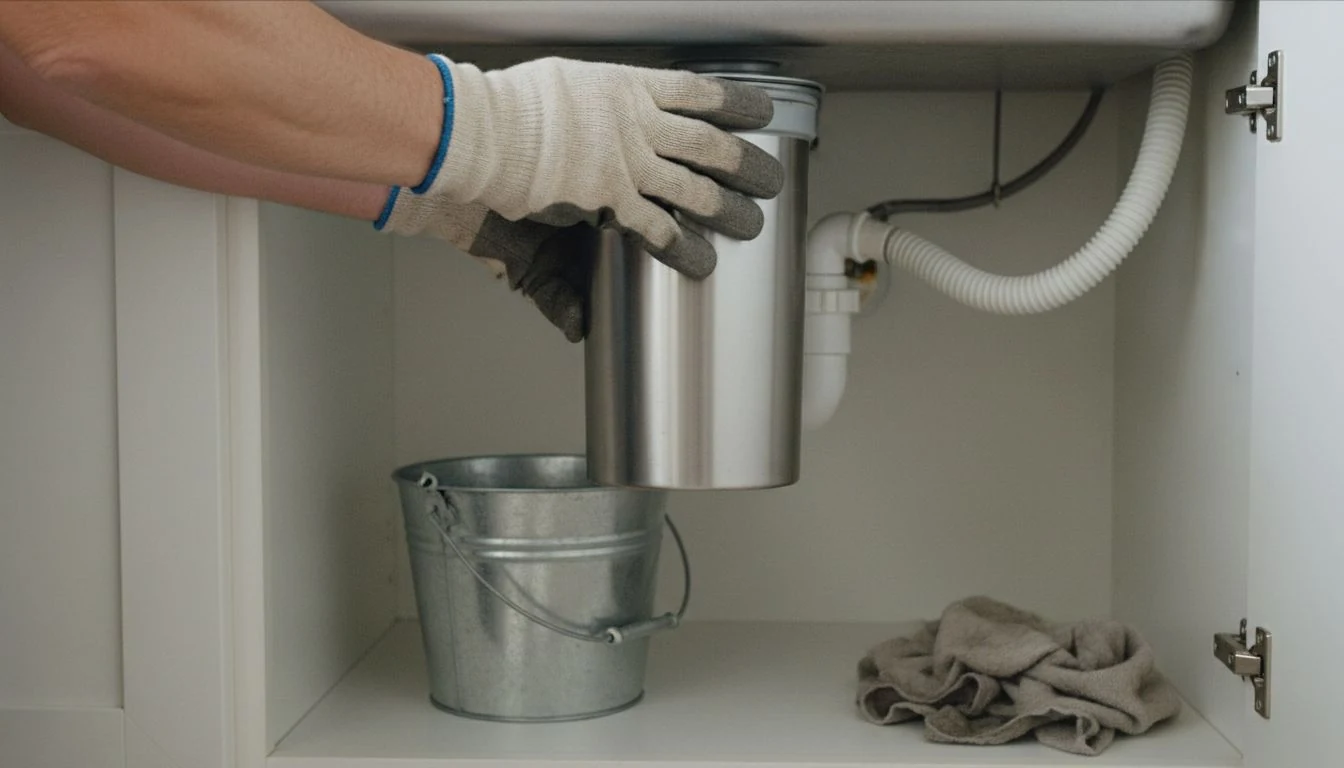
I found it with my sock. I stepped into the cabinet under the kitchen sink to grab a sponge, and the shelf gave a little under my heel. The disposal had been weeping from a seam near the motor housing for weeks, quietly, into particle board.
Water coming out of the body of the unit is not a repair. That was the thing I did not know at seven in the morning on a Tuesday, standing there with a wet sock.
Here is the short answer. A garbage disposal replacement runs about $185 to $450 installed in 2026, with the unit itself at $80 to $400 and a plumber’s labor at $100 to $250 for a straight swap. If there is already an outlet under your sink and you keep the same mounting hardware, this is a 60 to 90 minute job you can do yourself for the price of the unit and a $6 tube of plumber’s putty.
I have done this twice. The first took almost four hours, because I made the dishwasher mistake that I now think half of all first-timers make. The second took 50 minutes.
Jump to what you need:
- Garbage disposal replacement cost in 2026, line by line
- Repair or replace: how to tell which one you have
- How much horsepower you actually need
- Doing the garbage disposal replacement yourself, step by step
- When to just call someone
- If you are on a septic system, read this first
- Garbage disposal replacement by scenario
- Frequently Asked Questions
Garbage disposal replacement cost in 2026, line by line
Most quotes arrive as one number on a page, which hides how simple the arithmetic is. It is a box, an hour of somebody’s time, and occasionally a part nobody mentioned on the phone.
| Line item | Typical 2026 range | When you actually pay it |
|---|---|---|
| Unit, 1/3 to 1/2 horsepower | $80 – $160 | Apartments, one or two people, light use |
| Unit, 3/4 horsepower | $150 – $270 | The common family choice |
| Unit, 1 horsepower and up | $250 – $400 | Heavy cooking, large household |
| Plumber labor, straight swap | $100 – $250 | One to two hours on site |
| New sink flange and mounting assembly | $20 – $45 | Only if you change brands |
| Plumber’s putty, gaskets, drain tailpiece | $10 – $30 | Nearly always |
| Electrician adds an outlet under the sink | $150 – $350 | Only if yours is hardwired or missing |
| New wall switch or counter air switch | $90 – $250 | Only if there is no switch today |
| Haul away the old unit | $0 – $50 | Some shops fold it in, some do not |
Add it up and a hired job lands between $250 and $450 for most kitchens. Doing it yourself puts you at $110 to $300, the unit plus consumables. That roughly $150 gap is the honest value of the labor, and whether it is worth paying comes down to which scenario in the table below is yours. Skill has less to do with it than what is behind your cabinet door.
Repair or replace: how to tell which one you have
Before you spend anything, work out whether the unit is actually dead. I once watched a neighbor buy a new disposal for a jam that a hex wrench would have cleared in 90 seconds.
Run through this list in order:
- It hums but does not turn. That is a jam, not a failure. Cut the power, put the small hex wrench that came with the unit into the socket on the underside, and work it back and forth. Then press the red reset button. Free.
- It trips the reset button over and over even when empty. The motor is on its way out. Replace it.
- Water drips from the top, where the sink flange meets the basin. That is dried-out plumber’s putty. A repair, and a cheap one.
- Water comes out of the body itself, low on the canister. Replace it. The shell has corroded from the inside and there is nothing left to seal.
- It rattles violently. Something is in there, usually a bottle cap. Kill the power and look before you assume the worst.
- The sink drains slowly but the disposal spins fine. That problem is downstream in the trap or the branch line, and a new disposal will not touch it.
Age matters too. These units last 8 to 15 years, with 10 to 12 the realistic middle. Mine was 13 when it started weeping, so the leak was less a surprise than an overdue notice.
And if what is actually bothering you is a drip at the faucet rather than the disposal, that is a different and much cheaper afternoon. I have walked through fixing a dripping kitchen faucet and the general leaky faucet repair separately.
How much horsepower you actually need
The box on the shelf will not tell you this, so I will. Most households get oversold on horsepower and undersold on grind quality.
A 1/3 horsepower unit is false economy for anyone who cooks. It jams on celery, it struggles with anything fibrous, and you will be reaching for that hex wrench monthly. A 1/2 horsepower unit handles a couple who cook a few nights a week. A 3/4 horsepower unit is what I would pick for almost any family kitchen, and it is where the price-to-aggravation curve bottoms out. One horsepower and up earns its keep if you cook large volumes or feed a household of five, and wastes money otherwise.
Two things matter more than that number. First, whether the grind components are stainless, because galvanized parts are what corrode and produce the leak I described at the top. Second, physical fit. A bigger motor means a taller canister, and a 1 horsepower unit can crowd the trap in a shallow cabinet. Measure from the bottom of the sink to the top of the trap before you buy anything.
I am not naming models here. Ratings shift every year, and a cost guide that recommends a specific unit ages badly.
Doing the garbage disposal replacement yourself, step by step
This is an approachable job. It is also done lying on your back in a wet cabinet, which nobody mentions.
- Cut the power. Unplug it if it is plugged in. If it is hardwired, switch the breaker off and confirm with a tester. Do not trust the wall switch alone.
- Put a bucket and an old towel underneath. There is always water sitting in the trap, and it is never clean.
- Disconnect the dishwasher hose from the side of the disposal, if you have one, and the drain elbow at the back.
- Support the unit with one hand and twist the lower mounting ring to release it. It will drop. It weighs 10 to 20 pounds and it will land on your face if you are not ready. Ask me how I know.
- If you are keeping the same brand, leave the existing mounting assembly and sink flange in place. That is the whole reason a same-brand swap is fast.
- If you are changing brands, remove the old flange, scrape every trace of old putty off the sink, roll a fresh rope of plumber’s putty, seat the new flange, and tighten the new mounting assembly evenly.
- Knock out the dishwasher plug in the new unit before you hang it, for the reason in the paragraph under this list.
- Hang the new unit on the ring, twist to lock, then reconnect the drain elbow and the dishwasher hose. Use a new gasket at the elbow.
- Restore power, run cold water, and turn it on. Then watch every joint for a full minute with a dry paper towel underneath. A damp paper towel means you are not finished.
Now, step 7. New disposals ship with a solid plastic knockout plug sealing the dishwasher inlet, because plenty of installations have no dishwasher at all. Forget to punch it out with a screwdriver and a tap of a hammer, and the dishwasher has nowhere to drain. It will back up, and you will find out mid-cycle.
I forgot it. My dishwasher held four inches of grey water and I spent an hour with a turkey baster before I worked out what I had done. It takes fifteen seconds to do and it is the error I see first-timers make more than any other.
When to just call someone
I am firmly on the side of doing your own work where it is safe. But there are real lines here, and a cost guide that pretends otherwise is not being useful.
Call a professional if any of these are true:
- The unit is hardwired rather than plugged in. Opening that junction box is electrical work, and in many places it is licensed electrical work.
- There is no outlet and no switch under the sink today. Adding a circuit is not a plumbing job. If your panel is old enough that adding a circuit is a conversation in itself, the numbers are in my breakdown of upgrading an electrical panel.
- The drain has to be re-plumbed because the new unit sits at a different height and the trap no longer lines up.
- The cabinet floor is already water damaged. Deal with that first, or you are hanging new equipment over rot.
- You cannot hold 20 pounds overhead at an awkward angle. That is a real constraint and worth paying around, not a character flaw.
Before you accept any quote for this job, get these four answers. Is the unit plugged in or hardwired, and does the price include an electrician if it is hardwired? Is the disposal itself included, or are you supplying it? Does the price include a new mounting assembly, or only if you switch brands? And is hauling the old unit away part of the number? Four questions, and they account for nearly all of the spread between a $220 quote and a $600 one.
If the quotes you are getting feel far apart, that is normal and it is also worth interrogating. I keep a whole post on how to tell whether a contractor quote is fair, and this job is a good one to practice on, because the parts cost is public.
If you are on a septic system, read this first
This is the section I wish someone had put in front of me years ago, and it is why I did not simply replace like for like at the second house.
The EPA guidance on septic care is unusually direct. In its list of things to do at the sink, it tells homeowners to eliminate or limit use of a garbage disposal, because that cuts the fats, grease and solids reaching the tank, which is what clogs the drainfield. The full page is their guide to caring for your septic system.
That does not mean you cannot have one on septic. Plenty of people do. It means the disposal shortens the interval between pump-outs, which is a recurring cost you should price alongside the unit. Those numbers are in my guide to septic servicing costs, and once you see the pumping interval shift, the arithmetic on replacing the disposal at all looks different.
The alternative is not glamorous and it is nearly free. Scraps can go to a compost pile instead of down the drain, and the EPA has a plain-language page on composting at home. At the second house I skipped the disposal, capped the drain with a standard tailpiece for about $25, and put a lidded bin under the sink. Two years in, I have not missed it once.
Garbage disposal replacement by scenario
Everything above collapses into five situations. Find yours and you will know both the number and whether to pick up the phone.
| Your situation | What the job involves | DIY estimate | Hired estimate |
|---|---|---|---|
| Same brand, same size, existing outlet | Reuse the mount and flange, hang and connect | $95 – $180 | $200 – $330 |
| Different brand, existing outlet | New flange and mount, fresh putty, re-seat | $130 – $260 | $250 – $420 |
| Existing unit is hardwired | Disconnect and reconnect at the junction box | Not a DIY job | $260 – $500 |
| No outlet and no switch today | Electrician adds outlet and switch, then the swap | Not a DIY job | $330 – $800 |
| Removing the disposal entirely | Cap with a standard tailpiece and basket strainer | $25 – $60 | $150 – $300 |
What blows the budget on a garbage disposal replacement
- The dishwasher knockout plug. Forget it and the dishwasher backs up mid-cycle. If a plumber has to come back out for it, you have paid a second call-out fee over a 15 second step, and if the water reached the cabinet floor you now have a repair that costs more than the disposal did.
- Switching brands without checking the mount. Mounting assemblies are not universal. Changing brands means pulling the sink flange, scraping old putty off the basin, and re-seating everything, which turns a 50 minute swap into a two hour one and adds a $20 to $45 part nobody quoted.
- Discovering the old unit was hardwired. This is the one that genuinely doubles a bill. A plumber may not be licensed to touch it, so you are booking two trades for one appliance, and the outlet the electrician adds runs $150 to $350 on its own.
Frequently Asked Questions
How long does a garbage disposal replacement take?
A same-brand swap with an existing outlet takes a competent DIYer 60 to 90 minutes, and a plumber closer to 45. Changing brands adds an hour, because the sink flange has to come out and be re-sealed.
Do I need a permit to replace a garbage disposal?
For a like-for-like swap into existing plumbing and an existing outlet, generally no. If an electrician is adding a new circuit or outlet, that part usually does require a permit and an inspection. Rules vary by municipality, so a two minute call to your building department settles it.
Is it cheaper to repair a garbage disposal than replace it?
For a jam, a tripped reset, or putty failure at the flange, repair is far cheaper and often free. For a leaking canister, a motor that keeps tripping, or a unit past 12 years, replacement wins, because a service call alone can run $100 to $200 on a unit worth $150.
Can I replace a garbage disposal with a different horsepower?
Yes, with one caveat. A larger motor means a taller canister, and in a shallow cabinet it can crowd the trap and force you to re-plumb the drain. Measure the vertical space between the bottom of the sink and the top of the trap first.
If this is part of a bigger kitchen project rather than an emergency, the disposal is a small line inside a much larger number. I have broken down what a full kitchen remodel costs and what it runs to replace kitchen countertops, the job that most often forces a disposal swap whether you planned one or not. For how this sits against everything else a house asks for, there is my overview of home renovation costs.
All prices here are 2026 estimates and vary by region, local trade rates, the condition of your existing drain plumbing, and whether electrical work is involved. Tessa is a hands-on homeowner who has done this job and paid for it, not a licensed plumber or electrician. Nothing here is an inspection of your kitchen. Any work inside a junction box, any new circuit, and any suspected water damage to structure belong to licensed professionals. Use these ranges to ask sharper questions of whoever bids the work, not as a quote.
Free DIY Project Cost Estimator
The spreadsheet I use to price out a project before I start, so a weekend job never blows the budget. Join the newsletter and I’ll send it over.
No spam, ever. Unsubscribe anytime. — Tessa
Keep reading — more on Plumbing Costs
Water Softener Installation Cost: My $5,900 Quote vs. the $1,874 I Paid
The salesman set a clear glass of my tap water on the kitchen table, squeezed in…
Read article →
Septic Servicing Cost in 2026: What Pumping and Inspection Run Before the Ground Freezes
The man who sold us this house left exactly one useful thing behind: a napkin in…
Read article →
How Much Does a Water Heater Replacement Cost? (DIY vs. Hire)
Water heater replacement cost in 2026 runs $900 to $3,500 for a tank. Real prices by…
Read article →