
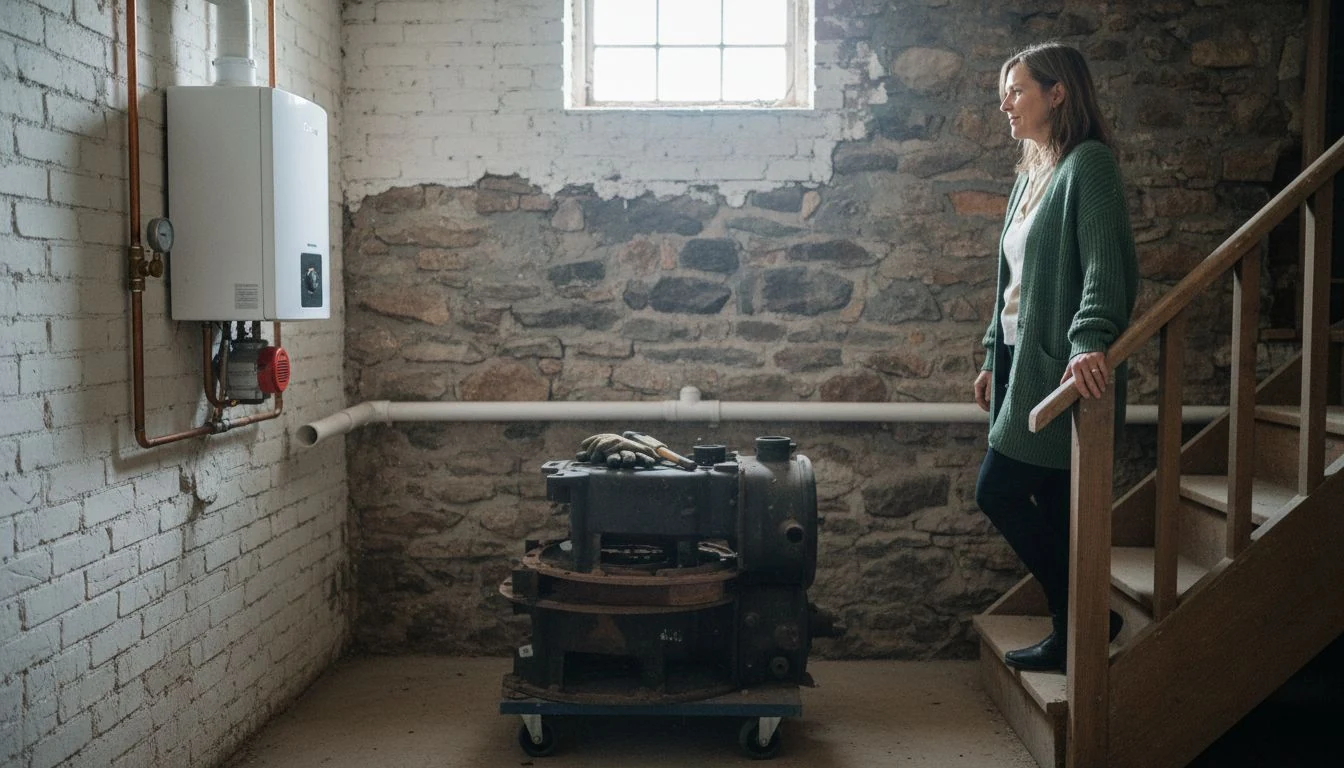
My friend Marisol called me on a Sunday in October with her coat on inside the house. The oil boiler in the basement of her 1926 duplex had quit for the third time in two winters, and the tech who came out said it was time. She had one quote on the fridge for $8,900 and no idea if that was normal. I’ve never owned a boiler (my house runs on a forced-air furnace), but I like a quote fight, so I spent the next two weeks helping her find out what a fair boiler replacement cost looks like.
Short version: in 2026, replacing a residential boiler usually runs about $5,000 to $9,000 installed for a standard gas boiler, $7,500 to $13,000 for a high-efficiency condensing gas boiler, and $6,500 to $11,000 for an oil boiler. A combi boiler, which also heats your tap water, lands around $6,500 to $12,000. Switching from oil to gas, relining a chimney, or pulling an old tank can add a few thousand on top.
Below is what I learned from Marisol’s three quotes, the lines that moved them $5,700 apart, the mistake I almost talked her into, and the table we built to compare everything.
Jump to what you need:
- Boiler replacement cost in 2026
- Gas, oil and combi boilers compared
- The combi boiler mistake I almost made
- The lines that move the total
- Repair or replace?
- How we compared three quotes
- Cost table by boiler type
- Frequently Asked Questions
What boiler replacement cost looks like in 2026
First, a quick untangling, because Marisol’s own insurance agent got this wrong. A boiler heats water and sends it through radiators or baseboard loops to heat the house. A water heater heats the water that comes out of your shower. Some people call a big tank water heater a “boiler,” and that’s a different job with a different price. If that’s what you have, our water heater replacement cost guide is the one you want.
For an actual heating boiler in a typical 1,500 to 2,500 square foot house, installed prices this year look roughly like this:
- Standard gas boiler (around 80 to 85 percent efficient), swapped like for like: about $5,000 to $9,000.
- Condensing gas boiler (90 percent or higher): about $7,500 to $13,000.
- Oil boiler, like for like: about $6,500 to $11,000.
- Steam boiler, the kind in a lot of pre-1940 houses: about $7,000 to $14,000.
- Electric boiler for a small house or an addition: about $4,000 to $8,000.
Marisol’s duplex is 2,100 square feet across two floors with cast iron radiators on a hot water loop. Her three quotes came in at $8,900, $11,200 and $14,600. Same house, same week, same radiators.
The equipment itself was only about a third to half of each bill. Labor on a boiler swap is heavier than people expect. The old cast iron unit in her basement weighed somewhere north of 500 pounds, and two guys had to break it apart to get it up the stairs.
Boiler replacement cost by type: gas, oil and combi compared
The type you choose decides most of the price, and it also decides what you’ll pay every winter after.
Standard gas or oil boiler
The $8,900 quote was a new oil boiler in the same spot, hooked to the same tank and the same chimney. It’s the simplest job. No new venting, no new fuel line. If your oil tank is in good shape and gas isn’t available on your street, like for like is a fair, honest option.
ENERGY STAR’s boiler guidance sets the bar for certified oil boilers at 87 percent AFUE or better, and certified gas boilers at 90 percent or better. AFUE is the share of fuel that turns into heat in your house instead of going up the flue. Her 1979 boiler was probably doing well under 70 on a good day.
Condensing gas boiler
Gas was already at her street, and the meter already fed her stove. The $11,200 quote switched her to a condensing gas boiler, wall-mounted, at around 95 percent AFUE. It pulls extra heat out of the exhaust, which cools it enough that the exhaust can’t safely go up an old masonry chimney. So it vents out the side wall through plastic pipe instead. I went down to her basement with a tape measure to check that the wall it would vent through wasn’t under her neighbor’s bedroom window. It wasn’t, by about six feet.
That price also included running a gas line from the meter to the basement, capping and removing the oil tank, and a condensate drain. Her oil bill had been about $2,600 last winter, so the fuel savings weren’t just a sales line.
Combi boiler
The $14,600 quote was a combi: one wall unit that heats the radiators and also makes hot water on demand, so no separate water heater. It’s compact and it’s efficient. It was also, as it turned out, the wrong fit for her house.
The combi boiler mistake I almost made
When I saw the combi quote, I told Marisol it was the obvious move. One box, no tank, done. That was me being wrong out loud.
Then she reminded me her water heater was four years old. And her upstairs tenant has two kids, which means two showers running at once most mornings. A combi heats water as it flows, and its hot water output is measured in gallons per minute. The installer’s own spec sheet showed it could keep up with about one and a half showers in January, when the incoming water is coldest. One shower plus the kitchen sink, fine. Two showers, somebody gets lukewarm.
So the combi meant paying an extra $3,400 to retire a working water heater and downgrade the tenant’s mornings. We crossed it off. I still think combis are great in a smaller house with one bathroom and an old water heater that’s due anyway. That just wasn’t her house.
The lines that move your boiler replacement price
Between $8,900 and $14,600 there was a lot of stuff, and some of it was missing from the cheap quote on purpose. These are the lines worth asking about by name.
Venting and the chimney
A standard boiler that vents into an old masonry chimney may need a stainless liner, about $1,500 to $4,000, because newer equipment runs cooler exhaust that can condense and eat the mortar. A condensing boiler skips the chimney and vents through PVC out a wall, usually $500 to $1,500. I made her ask all three companies about the liner by name. If you’re keeping the chimney, have it looked at first. Our chimney sweep cost guide covers what an inspection should include.
Oil tank removal or conversion
Going from oil to gas means the tank has to go. A basement tank removal ran $1,450 on her quote. A buried tank is a different animal, often $2,000 to $5,000 or more depending on your state’s testing rules. The gas line itself, if your meter is already there, was $900 on the middle quote.
I missed something else, too. The $8,900 oil quote didn’t say anything about the tank, and her tank was the original. When she asked, the tech said a new one would be about $2,800 “if it fails inspection.” That one line made the cheap quote less cheap.
Pumps, valves and the expansion tank
Circulator pumps run about $400 to $900 installed. An expansion tank is $250 to $600. Zone valves, if you have more than one heating zone, add $200 to $500 each. Two of her three quotes replaced the circulator. The cheapest one reused the old pump, which was 22 years old. I asked that tech why. He said it “sounded fine,” which is my least favorite answer in home repair.
Removal, permit and the asbestos question
Haul-away of an old cast iron boiler runs $300 to $1,200 depending on how many stairs are involved. Permits are typically $100 to $500. If your old boiler or its pipes are wrapped in white chalky insulation, get it tested before anyone touches it. Abatement on a basement boiler can add $1,000 to $3,000, and it’s not something you want broken apart in your basement without knowing.
Her pipes had been rewrapped in fiberglass at some point. Lucky.
Boiler replacement or repair: how to make the call
Boilers last a long time. Cast iron ones can go 25 to 35 years, sometimes more. That’s part of why replacement feels like such a shock. Most people have never done it.
The rule we used, and the same one I use for my own furnace: if a repair costs more than about a third of a new boiler and the unit is over 20 years old, start pricing replacement. If it’s younger and the repair is a pump, a valve or an igniter, fix it. A cracked heat exchanger or a cast iron section that’s leaking is usually the end.
The EPA’s carbon monoxide guidance recommends having a trained professional inspect, clean and tune your central heating system every year. Marisol’s boiler had gone four years without a service. Whether that killed it early, nobody can say for sure. It didn’t help. The visit itself works a lot like a furnace tune-up, so that guide gives you a sense of what a fair service call covers.
If you have forced air instead and you’re comparing systems, our furnace replacement cost guide shows how the two stack up. A boiler is usually more expensive to replace than a furnace of the same size. In exchange, radiators give an even, quiet heat that a lot of people won’t give up.
How we compared three boiler replacement quotes
We did what I do with every big quote: a one-page grid, every quote’s numbers line by line. It took an evening and a bottle of wine. The rows:
- Exact boiler model number and its AFUE rating.
- Whether the contractor did a heat loss calculation. One did. He measured her radiators, room by room, and sized the boiler smaller than the old one. Old boilers were often oversized by a lot.
- Venting: chimney liner, side-wall PVC, or “existing.”
- Fuel line and tank work, in dollars, not “as needed.”
- Circulator, expansion tank, zone valves: new or reused.
- Haul-away, permit and any asbestos testing.
- Labor warranty. Hers ranged from 1 year to 5.
- Who registers the parts warranty, and by when.
Once the cheap oil quote added the tank and a new circulator, it sat at about $12,200, and that was before anyone looked at the chimney. The gas condensing quote at $11,200 already had its venting, pump and tank removal in it. That’s how the “expensive” option turned out to be the cheaper one. Our guide on how to tell if a contractor quote is fair walks through more of this.
On the tax side, two quotes listed a federal credit. The IRS page on the Energy Efficient Home Improvement Credit says it covers property placed in service before December 31, 2025. For a 2026 install, don’t count on it. Call your gas utility instead. Hers had a $300 rebate for a qualifying high-efficiency boiler, and the contractor filed it.
Print this and ask every boiler installer the same questions. Did you do a heat loss calculation, and can I see it? What is the exact model number and AFUE? How will it vent, and does my chimney need a liner? Is the oil tank or gas line work included, with a price? Are you replacing the circulator, expansion tank and zone valves, or reusing them? Is haul-away and the permit included? Does anything need asbestos testing? How long is your labor warranty, and who registers the parts warranty? Get it all in writing and lay the quotes side by side.
Boiler replacement cost by boiler type
These are 2026 estimates I pulled from Marisol’s quotes, two readers’ invoices and a neighbor of hers who did the same swap last spring. Use them to spot a number that’s way off, not as a price anyone owes you.
| Boiler type | Typical 2026 installed price | Efficiency (AFUE) | Best fit |
|---|---|---|---|
| Standard gas boiler | $5,000 – $9,000 | 80% – 85% | Like-for-like swap, chimney in good shape |
| Condensing gas boiler | $7,500 – $13,000 | 90% – 96% | Long stay, gas on the street, wall to vent through |
| Combi gas boiler | $6,500 – $12,000 | 90% – 95% | One bathroom, water heater also due |
| Oil boiler | $6,500 – $11,000 | 84% – 87%+ | No gas service, tank in good condition |
| Steam boiler | $7,000 – $14,000 | 80% – 85% | Older house with steam radiators |
| Electric boiler | $4,000 – $8,000 | ~99% at the unit | Small house, addition, cheap electricity |
| Oil-to-gas conversion add-on | $2,000 – $5,000+ | – | Gas line plus tank removal |
What blows the boiler replacement budget
- Waiting for a January breakdown. No-heat calls in a cold snap leave no time for three quotes. If your boiler is past 20, start pricing in September.
- Ignoring the oil tank. A like-for-like oil quote that says nothing about a 40-year-old tank is a quote with a $2,800 hole in it.
- Buying a combi for a two-shower house. It looks cheaper on paper until someone’s shower goes cold and you end up adding a tank anyway.
If heat is one of several big projects on your list, our overview of home renovation costs shows how a boiler compares with a roof, windows and the rest.
Marisol’s new boiler went in on a Tuesday, two days before the first frost. I went over that Saturday to see it, mostly out of nosiness. It hangs on the basement wall, about the size of a kitchen cabinet, and the spot where the old one sat is now just a clean square of concrete. Her tenant says the upstairs radiators heat up faster than they used to. And the oil truck doesn’t come anymore.
Frequently Asked Questions
How much does it cost to replace a boiler in 2026?
Most homeowners pay about $5,000 to $9,000 for a standard gas boiler and $7,500 to $13,000 for a high-efficiency condensing gas boiler, installed. Oil boilers run about $6,500 to $11,000. Venting changes, tank removal, a gas line or a chimney liner can add more. These are estimates and vary by region and house size.
Is a combi boiler cheaper than a boiler plus a water heater?
Sometimes. A combi replaces both, so if your water heater is also near the end, it can save money and space. If your water heater is newer, or you often run two showers at once, a heat-only boiler with your existing tank is usually the better deal.
How long does a boiler last?
Cast iron boilers often last 25 to 35 years, and newer high-efficiency boilers about 15 to 25 years with yearly service. If yours is over 20 and needs a repair costing more than about a third of a new unit, get replacement quotes before you pay for the fix.
All prices here are 2026 estimates gathered from written quotes and real invoices, and they vary by region, house size, fuel type and venting. Tessa is a hands-on homeowner who helps friends read their contractor quotes, not a licensed heating contractor. Gas, oil, venting and electrical work on a boiler are jobs for a licensed pro.
Free DIY Project Cost Estimator
The spreadsheet I use to price out a project before I start, so a weekend job never blows the budget. Join the newsletter and I’ll send it over.
No spam, ever. Unsubscribe anytime. — Tessa
Keep reading — more on Remodel & Renovation Costs
HVAC System Replacement Cost: Furnace, AC, or Both at Once
The tech who told me my air conditioner was done also handed me a second price…
Read article →
Furnace Tune Up Cost: What a Fall Service Includes (and What to Skip)
Three companies left door hangers on my porch the same week in September. One said $79.…
Read article →
Furnace Blower Motor Replacement Cost in 2026: PSC vs ECM
My dad called on a Sunday in January and opened with “the furnace is running but…
Read article →
Sump Pump Replacement Cost in 2026 (and Signs Yours Is About to Fail)
The alarm went off at 2:40 in the morning during the second night of a March…
Read article →