
Last January I shoveled our driveway four times in six days. It’s 40 feet long, slopes toward the street, and the bottom third turns into a sheet of ice every time the plow leaves a ridge across it. On day six, at 5:40 a.m., with my back already sore, I opened a spreadsheet and started pricing the dream. The heated driveway cost turned out to be very different depending on how much of the driveway you heat, and that one choice moved my numbers by more than $10,000.
We were already getting quotes to replace the cracked concrete, so it was the right time to ask. Below is what each system costs to install, what it costs to run per storm, the cheap roll-out option, and the electrical panel question nobody mentioned until the third contractor did.
Quick answer: in 2026, an electric heated driveway installed in a new concrete pour runs about $12 to $25 per square foot for the heating system, so roughly $7,000 to $14,000 for a 24 by 24 foot two-car driveway. Hydronic systems cost more, often $12,000 to $25,000 or more with the boiler. Heating just two tire tracks can bring an electric job down to $2,000 to $4,500.
What a heated driveway cost looks like in 2026
The heating part of the quote sits on top of the driveway itself. If you’re replacing the slab anyway, you pay for demo and new concrete no matter what, and I broke those numbers down in my cost to replace a driveway guide. What follows is only the extra.
My middle quote, for heating tire tracks on our 40-foot driveway, came in at $3,850. The line items:
- Electric heating cable laid in two 2-foot-wide strips, 160 square feet total: $2,240
- Snow and temperature sensor with a controller: $610
- Electrician: new dedicated 240-volt circuit and wiring to the controller: $850
- Permit: $150
The full-driveway quote from the same company was $11,400 for the heating alone. Same cable, same sensor, three and a half times the square footage, plus a much bigger electrical job.
Electric vs hydronic heated driveways
There are two ways to warm a slab, and they’re priced very differently.
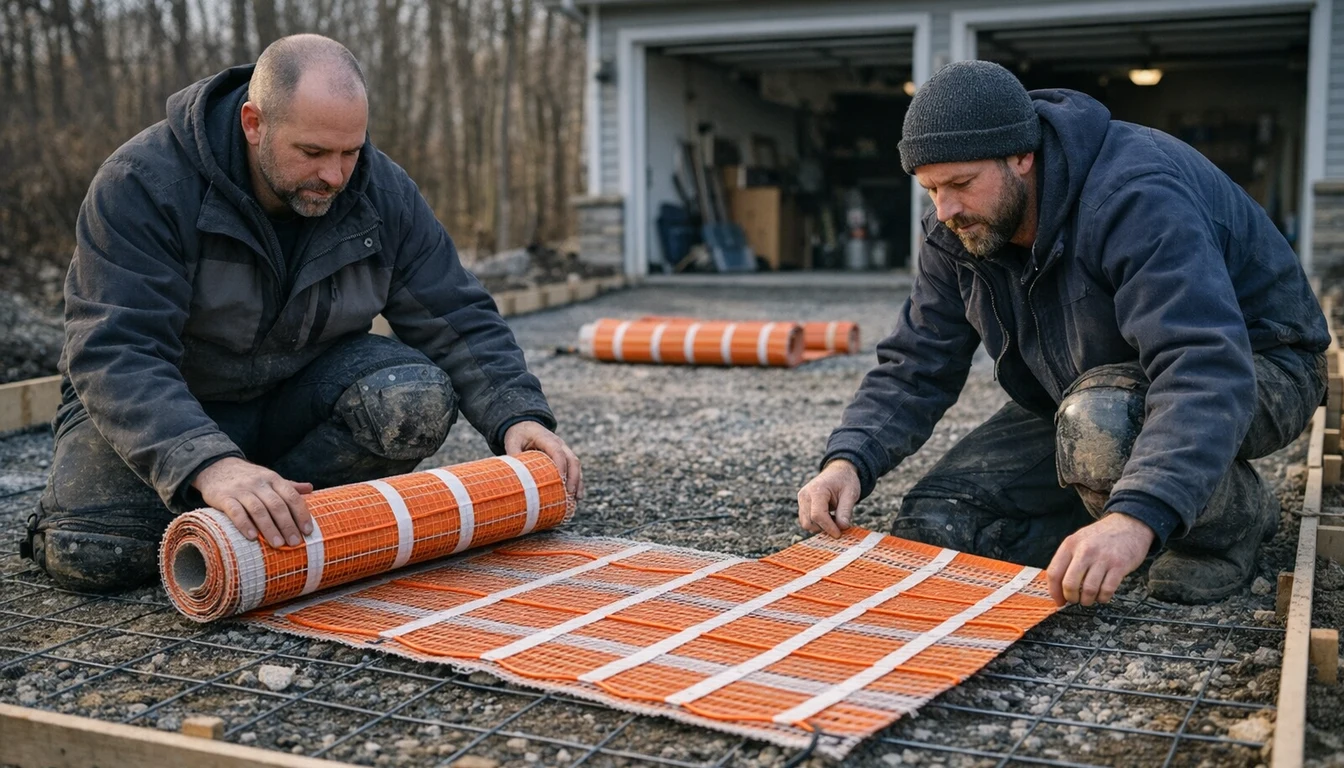
Electric. Heating cables or pre-spaced mats get laid on the base or tied to the rebar, and the concrete or asphalt goes over them. No moving parts, nothing to maintain except the controller. It’s the cheaper install, and the one all three of my contractors recommended for a residential driveway our size.
Hydronic. PEX tubing carries a heated water and glycol mix through the slab, warmed by a boiler. You need the boiler, a pump, a manifold and somewhere to put them, often the garage. The boiler alone was quoted at $4,500 to $7,500 installed. It can cost less to run if you heat with natural gas and your gas is cheap. But the upfront number is much higher, and I’d only look at it for a very large or very long driveway.
My pick: electric, unless you have a huge area and a reason you already need a boiler.
Heating a new driveway vs retrofitting an old one
The cheapest time to add heat is when the driveway is being poured anyway. The cable goes down before the concrete, and you’re only paying for the heating materials and a few extra labor hours.
If your driveway is in good shape, retrofitting is possible, but it isn’t cheap. One contractor described saw-cutting grooves into the existing concrete, laying cable in the grooves and filling them with a sealant. His estimate was $20 to $35 per square foot, and he warned that it shows. Pavers are the other route: they can be lifted, heat put underneath, and relaid. Asphalt needs a specific cable rated for the heat of hot asphalt when it’s put down.
For most people, I’d say this: if your driveway has 10 good years left, don’t tear it out just to add heat. Wait until it needs replacing, and price heating then.
Tire tracks only vs the full driveway
This was the decision that mattered most for us. Heating two strips where the tires roll covers maybe a third of the surface and gets you a clear path out. You still have snow in the middle and along the edges, but the car moves.
- Full two-car driveway, 24 by 24 feet: 576 square feet to heat
- Two tire tracks, 2 feet wide by 40 feet long: 160 square feet
- Tracks plus a walking path to the door: about 220 square feet
Fewer square feet means a cheaper install, a smaller electrical circuit and a lower bill every storm. The downside is looks, and that you’ll still shovel the edges if you get a big one. For a sloped driveway where the problem is getting the car up and down, tracks get you most of the benefit for about a third of the price.
What it costs to run per storm (my estimate math)
Every brochure I read said “low operating cost.” None of them gave a number, so I did the math myself. This is an estimate, and your numbers will be different.
The U.S. Energy Information Administration’s explainer on measuring electricity uses a simple example: a 40-watt bulb running for five hours uses 0.2 kilowatt-hours. Same math for a driveway, only much bigger. Watts times hours, divided by 1,000, gives you kWh. Multiply by your rate.
For the rate, I used the EIA’s average residential electricity price table, which listed a U.S. average of 18.16 cents per kWh for August 2026. That figure is preliminary, and winter rates in your area may be higher or lower. Check your own bill.
For the power draw, I used what my contractors quoted: roughly 40 watts per square foot while the system is on. That’s an assumption from their spec sheets, not a rule.
- Tire tracks: 160 sq ft times 40 watts is 6,400 watts. Six hours of melting is about 38 kWh, or about $7 per storm at 18.16 cents.
- Full driveway: 576 sq ft times 40 watts is 23,040 watts. Six hours is about 138 kWh, or about $25 per storm.
- A long, wet 12-hour storm doubles those numbers.
A snow sensor matters here. Without one, people turn the system on “just in case” and leave it running. With one, it only heats when it’s both cold and wet. My guess for our winter, with 15 to 20 real snow events, was $100 to $200 a season for tracks. Full coverage would have been $400 to $700.
Roll-out heated mats: the cheap alternative
Before you spend thousands, look at plug-in mats. They’re rubber mats with heating elements inside, and you lay them on top of the driveway or steps for the winter and roll them up in spring.
Walkway and stair mats ran about $80 to $300 each when I shopped this fall. Tire-track size mats, long enough for a car, were $1,200 to $2,500 a pair. Most of them plug into a regular outdoor outlet, though the big ones may need their own circuit. Plug them into a GFCI-protected outlet and follow the maker’s instructions on extension cords. I wouldn’t use an indoor cord for this, ever.
We ended up with one stair mat for the front steps, $140, and it’s the best winter purchase I’ve made in this house. My mother-in-law uses those steps.
Will your electrical panel handle a heated driveway?
The third contractor asked a question the first two didn’t: how big is your panel? An electric driveway draws a lot of power while it’s running. The full-driveway system above pulls about 23,000 watts. At 240 volts, that’s close to 100 amps, before your furnace, water heater and dryer.
Our house has a 100-amp panel. Tire tracks needed one dedicated circuit, which fit. The full driveway would have meant a panel upgrade, and that alone was quoted at $2,200. If you’re in the same spot, I priced it all out in my upgrading electrical panel cost post. Get a licensed electrician to do the load calculation before you sign for the heating. I’m not an electrician, and this is not a guess you want to make.
Heated driveway cost breakdown, 2026 estimates
These ranges come from my three quotes and the system prices I looked up this fall. They cover the heating only, not the concrete.
| Option | Install cost | Est. cost per 6-hour storm | Panel upgrade likely? |
|---|---|---|---|
| Electric, tire tracks (about 160 sq ft), new pour | $2,000 to $4,500 | About $7 | Rarely |
| Electric, full two-car (about 576 sq ft), new pour | $7,000 to $14,000 | About $25 | Often, on a 100-amp panel |
| Electric, saw-cut retrofit | $20 to $35 per sq ft | Same as new pour | Depends on size |
| Hydronic, full two-car with boiler | $12,000 to $25,000+ | Depends on gas price | Rarely |
| Snow sensor and controller | $300 to $800 | Cuts run time | No |
| Roll-out stair or walkway mat | $80 to $300 each | Under $1 | No |
| Roll-out tire-track mats | $1,200 to $2,500 a pair | About $2 to $4 | Sometimes a new circuit |
What blows the heated driveway budget
- Heating the whole driveway when tracks would do. Square footage drives the install, the circuit size and every storm’s bill, so start with tracks and a path.
- Skipping the load calculation. A full electric system can need around 100 amps, and finding out after the pour means a surprise panel upgrade.
- No snow sensor. Running the system by hand “just in case” can double what you spend each winter.
Grab my free Project Cost Estimator. It has a tab where you plug in your square footage, your electric rate and how many storms you get, and it spits out a rough cost per winter. That’s how I talked myself into tracks instead of the full $11,400 job.
Frequently Asked Questions
Is a heated driveway worth it?
It depends on your snowfall, your slope and who’s doing the shoveling. For a steep driveway, an older homeowner or someone who leaves early for work, tire tracks in a new pour can be worth it. For a flat driveway in a place with a few storms a year, a good shovel and a stair mat are a better deal.
Can you add heat to an existing driveway?
Yes, but it costs more. Concrete can be saw-cut for cable, and pavers can be lifted and relaid over heat. Most contractors I talked to said to wait until the driveway needs replacing and add it then.
How much electricity does a heated driveway use?
My estimate, using about 40 watts per square foot, was 38 kWh for tire tracks and 138 kWh for a full two-car driveway over a 6-hour storm. Multiply by your own rate from your bill. A snow sensor keeps it from running when it doesn’t need to.
Prices and running costs are 2026 estimates from my own quotes and math, and they vary by region, electricity rate, snowfall and system size. Have a licensed electrician check your panel before any electric heating install. Tessa is a hands-on homeowner and DIYer, not a licensed electrician or contractor. For the rest of the cold-weather list, see my winterize your house checklist.
Free DIY Project Cost Estimator
The spreadsheet I use to price out a project before I start, so a weekend job never blows the budget. Join the newsletter and I’ll send it over.
No spam, ever. Unsubscribe anytime. — Tessa
Keep reading — more on Exterior & Structural Costs

Gutter Cleaning Cost: What I Paid, and the Month It Stops Being Optional
Gutter cleaning cost in 2026 runs $120 to $425 for most houses. Real quote numbers, what…
Read article →
Foundation Repair Cost in 2026: The Crack That Matters and the One That Does Not
A man in a branded polo put a level against my basement wall, made a face…
Read article →
Roof Repair Cost in 2026: What It Costs by What Actually Broke
The stain showed up on the upstairs hallway ceiling the morning after a March storm, about…
Read article →
Garage Door Spring Replacement Cost in 2026 (and Why I Do Not DIY This One)
It sounded like a rifle going off in the garage at 6:40 on a Tuesday morning.…
Read article →