
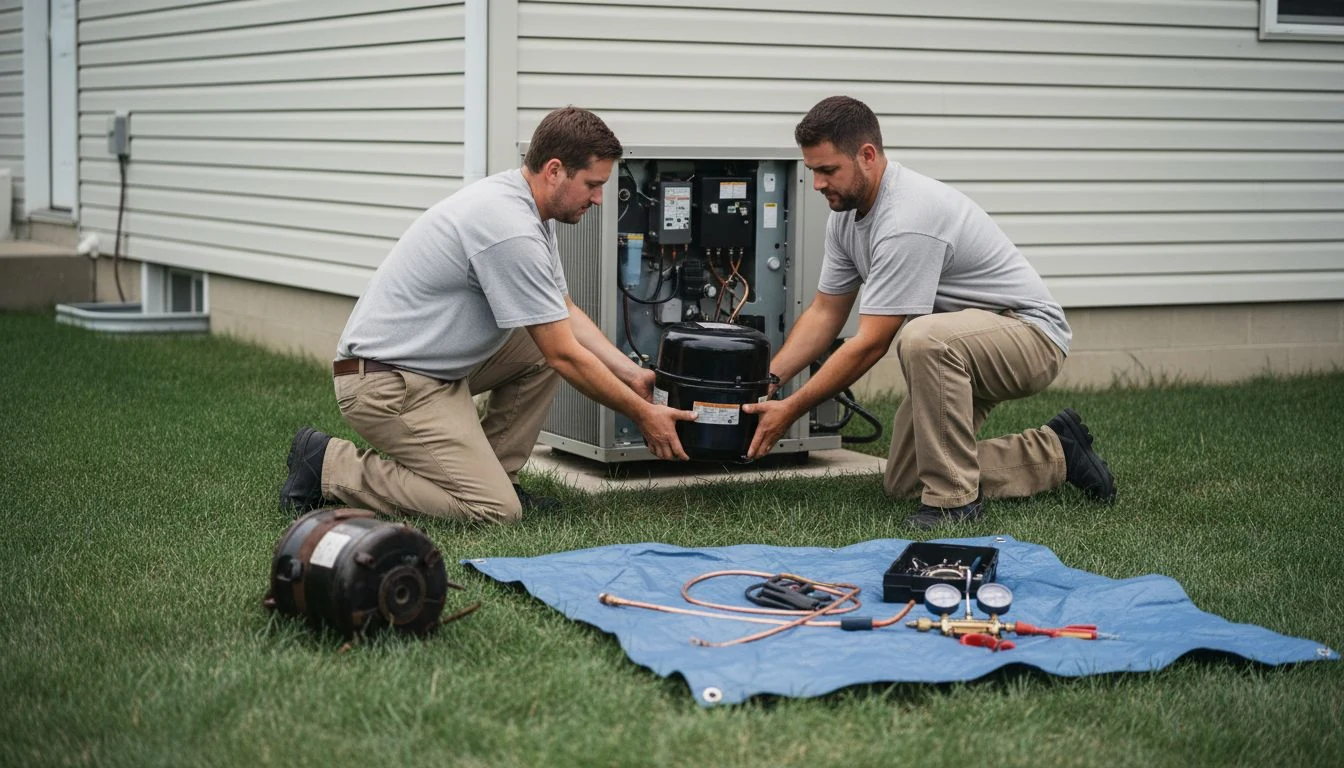
Last August the same company that sold me a $389 capacitor on a Sunday came back for the follow-up visit, put gauges on my 2011 outdoor unit, and told me the compressor was drawing locked rotor amps. Then came the sentence I had been braced for since the first visit: “At this age, honestly, I’d put that money toward a new system.”
He was not wrong. He also was not right yet, because he had not given me the number.
AC compressor replacement cost in 2026 runs $1,300 to $2,900 installed on a standard residential system, and climbs past $3,800 on a variable-speed unit or anything over four tons. The compressor itself is only $400 to $1,200 of that. Everything else is labor, refrigerant, and a cleanup step most first quotes leave off entirely.
This is the repair where “just replace the whole thing” is sometimes honest advice and sometimes a $9,000 shortcut past a $1,600 fix. Here is how to tell which one you are hearing.
Jump to what you need:
- What it costs in 2026
- Where the money actually goes
- Why your compressor type changes the price
- The warranty trap
- Burnout and the cleanup nobody quotes
- R-410A, R-22, and the 2025 change
- When replacing the unit wins
- What belongs on the quote
- FAQ
What does AC compressor replacement cost in 2026?
The compressor is the pump at the heart of the outdoor unit. When it dies you are not buying a part. You are buying a part, several hours of skilled labor, a recovery and recharge of refrigerant, and a new filter drier, all of which have to happen on the same visit.
$1,300 to $2,900 installed covers most two to four ton residential systems with a standard scroll compressor, out of warranty, done on a weekday.
$2,400 to $3,800 or more is where variable-speed and inverter-driven systems land, because the compressor is a different animal and often has to come from the manufacturer.
$700 to $1,800 out of pocket even when the part is free. That number surprises people, and it gets its own section below.
| System | Compressor part only | Typical installed 2026 | Why |
|---|---|---|---|
| 2 ton, single-stage scroll | $400 to $700 | $1,300 to $2,000 | Smallest charge, shortest labor day |
| 3 ton, single-stage scroll | $500 to $900 | $1,500 to $2,400 | The most common house, the most available part |
| 4 to 5 ton, single-stage | $700 to $1,200 | $1,900 to $2,900 | Heavier unit, more refrigerant, often two techs |
| Two-stage | $900 to $1,600 | $2,200 to $3,200 | Fewer aftermarket options |
| Variable-speed or inverter | $1,000 to $2,500 | $2,400 to $3,800+ | Brand-specific part, sometimes a matched driver board too |
| R-22 system, any size | Same part cost | Add $400 to $1,500 | The refrigerant, not the compressor |
If somebody hands you one number with no breakdown on a repair this size, that is the moment to slow down. The same rule applies here that applies to every bid on your house, and I wrote out the whole checklist in is your contractor quote fair.
The part, the labor, and the refrigerant
Three buckets. Only one of them is the compressor, and it is usually the smallest.
- The part: $400 to $1,200. A standard scroll compressor for a common three ton system is a stocked item. An inverter compressor for a five year old high-efficiency unit may be a special order with a lead time, and lead time in August is its own kind of cost.
- The labor: $600 to $1,400. Figure four to eight hours. The tech recovers the refrigerant into a tank, unbrazes the old compressor, sets and brazes in the new one under a nitrogen purge, pulls a deep vacuum to get moisture out, then recharges by weight. Skip the vacuum and the new compressor dies early, which is why the cheapest quote is not automatically the good one.
- The refrigerant: $300 to $1,200. A two to four ton system holds roughly six to twelve pounds. R-410A has been running $50 to $120 a pound installed, and R-22 sits anywhere from $100 to $250 a pound when a shop can even source it.
- The filter drier: $60 to $180. Not optional. Any shop that opens a sealed system and does not replace the drier is setting up the next failure.
The labor line looks enormous next to a $500 part until you know that federal law is standing behind part of it. Under EPA’s Section 608 rules, venting refrigerant is prohibited and the person handling it has to hold a technician certification. Recovery equipment, a certified tech and a documented charge are part of the job, and they cost what they cost.
Why compressor type moves the AC compressor replacement cost by thousands
Two houses on the same street, same three tons of cooling, same failure, and a $1,400 difference in the quote. The variable that explains most of it is what kind of compressor is sitting in the cabinet.
Single-stage scroll. On or off, full blast, nothing in between. It is the workhorse in most homes equipped before roughly 2015, parts are widely available, and a competent independent shop can often source one the same day. Cheapest to replace by a wide margin.
Two-stage. Runs at partial capacity most of the time and steps up when the house needs it. Quieter, more comfortable, and a smaller pool of replacement parts, so expect a few hundred more and possibly a day of waiting.
Variable-speed or inverter-driven. The premium tier, and the one where the repair bill starts to rival a new outdoor unit. The compressor talks to a control board, the board is often matched to that exact model, and when the compressor fails the shop has to determine whether the board took the hit too. When somebody quotes you $3,800 for a compressor, this is almost always why.
Reciprocating. Older piston design, still out there in systems from the nineties and early two-thousands. The part is usually cheap. The problem is that a system old enough to have one is almost certainly on R-22, and the refrigerant is what ends the conversation.
Do not guess which one you have. It is printed on the data plate on the side of the outdoor unit, next to the tonnage and the refrigerant type, and reading it before you call changes the tone of the entire phone conversation.
The warranty trap: the part is free and the bill is still $1,400
Almost every residential system sold in the last fifteen years carries a five or ten year manufacturer parts warranty, and the compressor is the headline item on it. Homeowners hear “your compressor is under warranty” and mentally file the repair under free.
It is not free. Here is what that warranty does and does not do.
- It covers the compressor itself. The manufacturer ships a replacement to the contractor. That is $400 to $1,200 off your bill, which is real money.
- It does not cover labor. Six hundred to fourteen hundred dollars of it, all yours. Some contractors sell a separate labor warranty at install time. If you did not buy one, you do not have one.
- It does not cover refrigerant. The three hundred to twelve hundred dollars of R-410A that has to go back in is on you.
- It does not cover the drier, the contactor, or anything else they touch on the way in.
- It may already be void. This is the one that stings. Most manufacturers require the system to be registered within sixty to ninety days of installation, and if nobody registered it the ten year warranty quietly drops to the base term, usually five years. If you bought the house, ask anyway. Registration follows the equipment more often than people assume.
Call the manufacturer’s consumer line yourself with the model and serial number off the data plate before you approve anything. Ten minutes on hold tells you if this is a $2,200 repair or a $1,000 one, and no contractor is obligated to make that call for you. It is the same lesson the capacitor taught me, at four times the stakes, and I laid that story out in the AC capacitor replacement cost guide.
Burnout: the cleanup line nobody puts on the first quote
Compressors fail two ways, and the difference is worth about a thousand dollars to you.
A mechanical failure means the pump seized or a valve gave out. Ugly, expensive, contained. Swap the compressor, change the drier, recharge, done.
A burnout means the motor windings cooked and the insulation broke down inside a sealed system full of oil and refrigerant. That produces acid, and the acid is now everywhere the refrigerant goes: the line set, the evaporator coil upstairs, the metering device. Drop a new compressor into that system without cleaning it and you will be doing this again in a year or two, out of warranty the second time, because manufacturers deny claims on repeat failures traced to a system that was never cleaned.
Proper cleanup adds real line items.
- Acid test and system flush: $200 to $600.
- A suction line drier in addition to the liquid line drier: $80 to $250.
- Line set replacement when contamination is severe: $600 to $1,800, more if the line runs through finished walls.
- A follow-up acid test a few weeks later, which good shops include and mediocre ones skip.
Ask one question when the quote comes in: was this a burnout, and if it was, what cleanup is in this price? A shop that ran the acid test answers in about four seconds. A shop that did not will get vague, and vague is your answer.
R-410A, R-22, and what changed in 2025
Refrigerant is the quiet variable that decides whether repairing your system makes any sense, and the ground moved recently.
If your system runs R-22, which covers most equipment installed before about 2010, production and import stopped in 2020. What is left is reclaimed stock at reclaimed prices. A compressor replacement that needs eight pounds of R-22 can carry $800 to $2,000 in refrigerant alone. On a fifteen year old system that math almost never favors the repair.
If your system runs R-410A, you are in the normal zone today, and it helps to know where the industry is heading. Under EPA’s technology transitions program, residential air conditioners and heat pumps are limited to refrigerants with a global warming potential under 700 beginning January 1, 2025, which pushed new equipment onto R-454B and R-32. R-410A did not become illegal and your system did not become a paperweight. Servicing it is still completely normal. What it does mean is that R-410A is now a legacy refrigerant with a long slow price curve ahead of it, and that is fair to weigh when you are choosing between a $2,200 repair and a new system.
What it does not mean is that you have to replace a working system this year. If a contractor tells you R-410A is banned and your unit has to go, they are selling, not informing.
When replacing the unit beats the AC compressor replacement cost
The honest version of the conversation my tech tried to have with me. There is a rule of thumb shops use, and it holds up: multiply the repair estimate by the age of the system in years. If the result clears about 5,000, replacement is the better buy.
My 2011 unit at thirteen years old with a $2,100 compressor quote came out at 27,300. Not close. The rule said replace, and this time the rule was right.
| System age | Repair quote | Age times cost | The call |
|---|---|---|---|
| 4 years | $1,800 | 7,200 | Repair. Check the warranty first, the part is probably covered |
| 7 years | $1,600 | 11,200 | Repair. You buy six to eight more years for a third of the price |
| 10 years | $2,200 | 22,000 | Get both quotes. The efficiency gain may close the gap |
| 13 years | $2,100 | 27,300 | Replace. This is where I landed |
| 15+ years on R-22 | $2,800 | 42,000 | Replace, and do not let anyone talk you into a rebuild |
Two more things to weigh before you sign either way.
Condenser only or the whole system? Replacing just the outdoor unit runs about $2,600 to $5,200 installed and is tempting when the indoor equipment is fine. It only works if the new outdoor unit is a rated match for your existing indoor coil, and on an older R-410A system that match is getting harder to find as new equipment moves to the low-GWP refrigerants. A mismatched pair loses efficiency and can void the new warranty. Full system replacement is the $5,000 to $12,000 conversation.
What is the rest of the unit doing? A compressor that failed on a system with a rusted-out coil and a fan motor on its last legs is not one repair. It is the first of three. That is the version of the pitch that is actually honest, and it is the one my tech should have led with. For how the individual repairs stack up against each other, I keep the running list in the AC repair cost guide.
While you are deciding you still have to live in the house. The stopgaps that work are in how to keep a house cool without AC, and a week of them buys you time to get a second quote instead of signing under heat stress.
What belongs on an AC compressor replacement quote
Get two written quotes on this repair. Always. At this dollar amount the spread between shops is routinely $800, and a written quote is the only thing that lets you see why.
Each one should show you, on separate lines:
- The compressor by brand, model, and whether it is OEM or aftermarket
- Whether the part is being claimed under the manufacturer warranty, and what that subtracts
- Labor hours and the rate, or the flat rate line
- Refrigerant type, pounds, and price per pound
- The filter drier, plus a suction line drier if this was a burnout
- Whether an acid test was performed and what it showed
- The labor warranty on this repair, in months, in writing
- What happens to the price if the coil turns out to be contaminated once they open it
That last line is the one people forget, and it is where change orders live. If you want the wider view of how a repair like this sits next to everything else a house asks for in a year, the numbers are in my home improvement cost statistics roundup.
AC compressor replacement cost by the situation you are in
Same failed part, six very different bills. This is the table I built for myself while I was deciding.
| Your situation | Realistic 2026 total | What is driving it | Worth doing |
|---|---|---|---|
| Out of warranty, clean failure, 3 ton scroll | $1,500 to $2,400 | Part plus a full labor day plus recharge | Yes if the system is under about ten |
| Part under manufacturer warranty | $700 to $1,800 | Labor and refrigerant are never covered | Yes, and call the manufacturer yourself first |
| Burnout with contamination | $2,200 to $4,200 | Flush, extra drier, sometimes the line set | Only on a newer system, otherwise replace |
| Variable-speed or inverter system | $2,400 to $3,800+ | Brand-specific compressor, possibly a control board | Compare against a new outdoor unit before approving |
| R-22 system, 15 years or older | $2,400 to $4,000 | Reclaimed refrigerant at reclaimed prices | No. Put it toward the replacement |
| New outdoor unit instead of the repair | $2,600 to $5,200 | Must be a rated match to your indoor coil | Ask for the match documentation in writing |
What blows the compressor bill
- Approving the repair before anyone checks the warranty. The part is the single largest line on the quote and a registered ten year warranty erases it. I watched a neighbor pay $2,150 for a compressor the manufacturer would have shipped free, because the visit happened on a Friday and nobody wanted to wait for Monday’s phone call.
- Skipping the acid test after a burnout. Six hundred dollars of cleanup you decline today becomes the entire repair again in eighteen months, and the second one is covered by nothing, because the manufacturer will point at the contamination.
- Replacing only the outdoor unit without a rated match. A mismatched condenser and coil loses the efficiency you just paid for and can void the new equipment warranty, which turns a $3,800 shortcut into the most expensive version of the job.
Grab my free Project Cost Estimator. Put in the repair, your metro, and the age of your system, and you walk into the second quote already holding your own fair range. On a repair this size that one sheet of paper is worth more than anything else I can hand you.
When the tech says to put the money toward a new system, ask which system: condenser and coil, or furnace too. Here is what replacing the whole HVAC system runs in 2026.
Frequently Asked Questions
How much does it cost to replace an AC compressor?
Budget $1,300 to $2,900 installed in 2026 for a standard two to four ton residential system that is out of warranty, and $2,400 to $3,800 or more for a variable-speed or inverter system. The compressor itself is only $400 to $1,200. The rest is four to eight hours of labor, a refrigerant recovery and recharge, and a new filter drier.
Is it worth replacing a compressor, or should I buy a new AC?
Multiply the repair estimate by the age of the system in years. Under about 5,000 the repair usually wins, over it the replacement usually does. A four year old system with a covered part is an easy repair. A fifteen year old R-22 system with a $2,800 quote is an easy replacement, since a new outdoor unit runs $2,600 to $5,200 and a full system is $5,000 to $12,000.
My compressor is under warranty, so why am I being charged $1,400?
Manufacturer parts warranties cover the compressor and nothing else. Labor, refrigerant, the filter drier and any contamination cleanup are all billed to you, and that combination is commonly $700 to $1,800. Check registration too: many warranties require the system to be registered within sixty to ninety days of installation, and an unregistered system usually drops to the shorter base term.
How long does an AC compressor last?
Ten to fifteen years is typical, and the system usually reaches the end of its own life around the same time. Compressors die early for reasons worth knowing, because they are fixable: a low charge from an unrepaired leak, a failed capacitor that leaves the motor straining on every start, a filthy condenser coil, or an oversized system that short cycles all summer. If you are replacing a compressor on a system under eight years old, insist somebody find the cause before they charge it back up.
All prices here are 2026 estimates and vary by region, system size, refrigerant type, part availability and the condition of the rest of your equipment. Tessa is a hands-on homeowner, not a licensed HVAC technician; refrigerant work is legally restricted to certified technicians. Use these ranges to ask sharper questions and to compare two written quotes.
Free DIY Project Cost Estimator
The spreadsheet I use to price out a project before I start, so a weekend job never blows the budget. Join the newsletter and I’ll send it over.
No spam, ever. Unsubscribe anytime. — Tessa
Keep reading — more on HVAC & Hiring a Contractor
Furnace Replacement Cost in 2026: My Three Quotes and the Signs It Was Time
Last April the furnace in our basement started to howl. The little motor that pulls exhaust…
Read article →
Chimney Inspection Cost: What I Paid Before Lighting the First Fire
The first cold night in my fixer-upper, I had a stack of firewood on the porch,…
Read article →
Heat Pump Maintenance: What It Costs and Why It Beats the Repair
The tech pulled the top grille off my outdoor unit, tipped it toward me, and let…
Read article →
Interior House Painting Service: How to Hire One Without Getting Burned
The first interior house painting service to quote this house described the entire job in five…
Read article →